Great Shakespeareans offers a systematic account of those figures who have had the greatest influence on the interpretation, understanding and cultural reception of Shakespeare, both nationally and internationally.
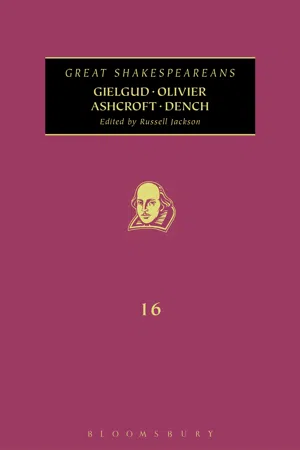
In this volume, leading scholars assess the contribution of John Gielgud, Laurence Olivier, Peggy Ashcroft and Judi Dench to the afterlife and reception of Shakespeare and his plays. Each substantial contribution assesses the double impact of Shakespeare on the figure covered and of the figure on the understanding, interpretation and appreciation of Shakespeare, provide a sketch of their subject's intellectual and professional biography and an account of the wider cultural context, including comparison with other figures or works within the same field.
- 248 pages
- English
- ePUB (mobile friendly)
- Available on iOS & Android
eBook - ePub
About this book
Information
Chapter 1
John Gielgud
Sir John Gielgud, actor and director, was born in 1904. On his mother’s side he was connected with a remarkable theatrical family: Kate Gielgud was the daughter of Kate Terry Lewis, the eldest sister of Ellen Terry. Their sister Marion and their brother Fred and his wife Julia Neilson Terry were influential figures in John’s childhood. His aunt Mabel Terry-Lewis was also a successful actress, and played Lady Bracknell when her nephew appeared for the first time as Jack Worthing in The Importance of Being Earnest at the Lyric, Hammersmith in 1930. It was through the family connection that Gielgud had received his first full-time engagement, with a company led by his cousin Phyllis Neilson-Terry. There was a theatrical inheritance on his father’s side, too, although it was less immediately apparent than that of the Terry clan. His father Frank’s grandmother was a famous Lithuanian actress, Aniela Aszpergorowa, and his grandfather was Adam Gielgud, the exiled younger brother of a Polish count.
Two full-length biographies, by Jonathan Croall and Sheridan Morley, appeared almost immediately after Gielgud’s death in 2000, superseding that by Ronald Hayman, published in 1971.1 As well as continuing the narrative into his eighth and ninth decades, these works include details of Gielgud’s private life and opinions necessarily omitted in Hayman’s and other earlier accounts. However, in many respects Gielgud was his own best chronicler; unlike his not always cordial rival Laurence Olivier, Gielgud was an articulate and gifted speaker and writer. Early Stages (1939; revised in 1948, 1974 and 1987) was followed by An Actor and his Time (1979), Distinguished Company (1972), and Backward Glances (1989), which includes Distinguished Company together with additional essays. In these and through the posthumous publication of his letters (2004), he reflected with wit and skill on his experiences of mentors and colleagues and expressed with remarkable frankness his misgivings about his strengths and limitations. In Stage Directions (1963) and the collection first published in 1991 with the unduly (but perhaps characteristically) hesitant title Shakespeare – Hit or Miss? (reissued in 1997 as Acting Shakespeare) Gielgud discussed his work on particular plays and roles.2
His long and intimate experience of the theatre, together with considerable talent as a writer, produced an unrivalled personal account of eight decades of the English stage – with forays abroad and into film and television. Membership of a distinguished theatrical dynasty seems to have equipped him with the charm and perception of his great-aunt Ellen Terry, as well as the family’s notorious and at times useful ability to produce real tears on stage: ‘The Terrys all had mellifluous voices which could break very easily and a great gift for tears – a gift I seem to have inherited.’3 Edith Evans once advised him that if he cried less on stage, the audience might cry more. ‘Oh yes,’ he replied, ‘I have always cried very easily, my Terry tears you know; I cry for trumpets, I cry for Queens, oh dear, perhaps I should never have said that.’4 (As well as being one of the many faux pas for which he was famous, this involved an inadvertent reference to his homosexuality, an open secret within the profession but necessarily a closed secret outside it until late in his life.) The Terry lineage also afforded him an entrée into the social and theatrical life of the early twentieth century that provided a stock of anecdotes and perceptions, without preventing him from being aware of the dangers of reverence for tradition or custom in the theatre. Enthusiasm for new ideas and experiences brought him into contact with many of the influential directors of the century, including Edward Gordon Craig, Harley Granville-Barker, Harcourt Williams, Michel Saint-Denis, Theodore Komisarjevsky, Tyrone Guthrie and Peter Brook.
Gielgud’s distinctive voice and his virtuoso delivery of Shakespeare’s text were a constantly recurring theme in the critical reception of his performances. Alec Guinness described ‘the superb tenor voice, like a silver trumpet muffled in silk’ as he heard it giving directions in the 1930s.5 With age the tenor shaded into a baritone but retained enough of the penetrating higher register to allow the actor to play on an unusually expressive tonal range. Gielgud could use long vowels for emphasis and, if necessary, to convey passion, was able to negotiate rapidly through clusters of consonants but maintaining a legato that carried through and across verse lines without sacrificing the rhythms of the pentameter on the one hand while avoiding obtrusive marking of line endings on the other. Al Alvarez, in a New Statesman article, identified the ‘faint tremolo on the stressed word, a quiver that is not so much excess of feeling as an unvarying trick of speech’, and the concomitant problem that ‘the deeper, the more mature the emotion, the less Gielgud seems to be with it’.6 The actor was aware of the temptations of mannerism, of ‘singing’ too much, and was frank about them in interviews and memoirs. Asked in 1959 about the current standard of verse-speaking, he told Laurence Kitchin that ‘actors of each decade sort of smell the feeling of modernity and have a modern comment on the traditional way of speaking which makes it new’.
Progress should be towards a more and more faithful expression of the text. When I was young I enjoyed colouring the words. I tried to deliver them in an emotional and colourful way. Now I try to shut in the phrases, so to speak, in rat-traps. I try not to sing (smiling at his chronic mannerism), not to elongate the a-o syllables and vowels. As in a musical phrase, you should try to do no more than exactly what the text demands.7 [Emphasis in original]
Peter Brook was respected as a ‘very honest and very fearless’ director: ‘he can tell me when I’m putting on my face or my voice or my sort of mannered things, which are affected or untrue, in a kind and frank way which doesn’t upset me…I don’t really mind being told when I’m terrible because I know it only too well myself.’8 Michael Kustow, in his biography of the director, suggests that Brook’s direction of Gielgud as Angelo in the 1949 Stratford production of Measure for Measure (famous for the long pause that preceded Isabella’s decision to plead for her husband’s life) ‘stiffened him against the actor’s natural desire to be liked by the audience’.9 The Times noted that Gielgud had laboured ‘against his temperamental grain’ and that having suggested a strong man of affairs, ‘unsmiling, precise, and overweeningly confident of his own powers, he deliberately [let] something vicious in Angelo’s nature be his undoing’.10 In the final scene, Trewin thought, Gielgud had ‘rarely spoken with more power’, and he later recalled him as a ‘fanatic with a twist in his brain and frost in his voice’.11
Angelo was one of the roles in which, with the support and discipline of a director of Brook’s skill and insight, Gielgud could explore the full potential of a vocal technique too easily characterized as ‘merely’ musical. Paul Scofield, in a tribute shortly after Gielgud’s death, recalled the ‘remarkable driving tension and perfectly co-ordinated pace’ of his performances, and the speaking that ‘if faster than thought, lost nothing of nuance or shade of meaning…a sparkling continuity of ideas and images; it was superb musicianship in complete control of tempo and melody.’12 One of the least tactful critics of Gielgud’s acting was Kenneth Tynan, whose first book, He That Plays the King, included an account of Gielgud’s 1944 Hamlet that began ‘Body and soul always seem to be at odds in this actor’s work’, and complained that while the voice was ‘all soul, injured and struggling’, the body was ‘curiously ineffectual’. Gielgud was not an ‘intemperately exciting actor’, and was ‘too wire-drawn, too thin-spun and fugitive, essentially unanchored to earth’.
The voice, too, tends to fly too high, and resorts too often to a resonant alto headnote, which, though it certainly expresses demoniacal possession, will not do for all the variety of rage, terror and love.13
In 1959, reviewing Gielgud’s recital The Ages of Man in New York, Tynan insisted ‘I have always felt that Sir John Gielgud is the finest actor on earth from the neck up, and…I am in no mood to revise that opinion’.14 For all his bumptiousness – Gielgud considered him ‘a brilliant but rather odious young fellow’ – Tynan was touching on an aspect of Gielgud’s work that was always a matter of concern to the actor, who was anxious about his lack of physical ease and expressiveness and wary of attitudinizing.15
Inevitably, the comparisons with Olivier on which Tynan was eloquent had their origins in the early 1930s, and had been a prominent feature of the 1935 production of Romeo and Juliet, directed by Gielgud, in which the actors ‘shared’ Romeo and Mercutio. (They did not alternate performances; Olivier played the part for the first stretch of the run, then changed roles with Gielgud.) Late in his career Gielgud’s pre-eminence as a speaker of verse (and of prose, for that matter) was held up as an example to others; in Michael Billington’s review of Julius Caesar at the National Theatre in 1977, in which Gielgud played the title role, his failure to convince as a potential tyrant suggested that the conspiracy was ‘a gratuitous attempt to kill off the best verse-speaker on the English stage’.16
Throughout his career Gielgud’s natural home seemed to be within the ‘classical’ repertoire of the Old Vic and Stratford-upon-Avon – not subsidized by the state until the 1960s – and the kind of conservative ‘quality’ commercial theatre associated with H. M. Tennent. (See Introduction, p. 4.) Hugh (‘Binkie’) Beaumont, the managing director of the agency, supported him with roles and directing work for some years, but kept him and many other artists on a tight financial rein.17 His business partner and lover, John Perry had been Gielgud’s lover in the early 1930s, but the three remained on good (indeed, intimate) terms, and it was not until relatively late in his career that Gielgud discovered that through neglect on the part of his own accountant and parsimony on the part of Beaumont he was gravely under-provided to meet his living expenses and an accumulated tax bill. This prompted him to accept lucrative but sometimes trivial film work, and even doing what he referred to as his ‘butler’ act in commercials for Paul Masson wines. (Like Olivier’s similar money-spinners, by contract these would be seen only in the United States.)
From the beginning Gielgud was much more than a ‘classical’ or West End actor or director. He had always been open to work that in its day was innovative, such as the early London productions of Chekhov, Michel Saint-Denis’ production of an English version of André Obey’s Noah (1935) and Christopher Fry’s The Lady’s Not for Burning (1949). In 1964 he appeared in Edward Albee’s baffling Tiny Alice in New York, and later directed the same playwright’s All Over, and in 1968 played the title role in Peter Brook’s production of Seneca’s Oedipus (in a version by Ted Hughes) for the National Theatre at the Old Vic. In the 1970s he made important forays into the work of new playwrights, notably David Storey’s Home (1970) and Harold Pinter’s No Man’s Land (1975). In Edward Bond’s Bingo (1974) he played Shakespeare, here a playwright who had moved beyond articulacy, a Warwickshire landowner who by profiting from enclosures had become a representative of the exploiting classes. In this version of Shakespeare’s last days his ending was indeed despair, and the bleakness and silences of Bond’s dialogue played off against the fact that the role was being taken by a supremely gifted performer of sophisticated dramatic language. ‘Bond has chosen’, wrote John Spurling in the New Statesman, ‘to call his own pain by Shakespeare’s name…to draw attention to it.’ Gielgud was ‘left to stare into space and to suffer almost in silence the general misery of mankind, partially illustrated by a couple of Stratford sub-plots, a dispiriting domestic situation and a speech about bear-baiting.’18
Gielgud’s knighthood was announced in the Coronation ...
Table of contents
- Series
- Title
- Contents
- Series Editors’ Preface Peter Holland and Adrian Poole
- Notes on Contributors
- Note on References to Shakespeare
- Introduction Russell Jackson
- Chapter 1 John Gielgud Russell Jackson
- Chapter 2 Laurence Olivier Abigail Rokison
- Chapter 3 Peggy Ashcroft Carol Chillington Rutter
- Chapter 4 Judi Dench Kathryn Prince
- Notes
- Select Bibliography
- Index
- Copyright
Trusted by 375,005 students
Access to over 1.5 million titles for a fair monthly price.
Study more efficiently using our study tools.
Frequently asked questions
Yes, you can cancel anytime from the Subscription tab in your account settings on the Perlego website. Your subscription will stay active until the end of your current billing period. Learn how to cancel your subscription
No, books cannot be downloaded as external files, such as PDFs, for use outside of Perlego. However, you can download books within the Perlego app for offline reading on mobile or tablet. Learn how to download books offline
Perlego offers two plans: Essential and Complete
- Essential is ideal for learners and professionals who enjoy exploring a wide range of subjects. Access the Essential Library with 800,000+ trusted titles and best-sellers across business, personal growth, and the humanities. Includes unlimited reading time and Standard Read Aloud voice.
- Complete: Perfect for advanced learners and researchers needing full, unrestricted access. Unlock 1.5M+ books across hundreds of subjects, including academic and specialized titles. The Complete Plan also includes advanced features like Premium Read Aloud and Research Assistant.
We are an online textbook subscription service, where you can get access to an entire online library for less than the price of a single book per month. With over 1.5 million books across 990+ topics, we’ve got you covered! Learn about our mission
Look out for the read-aloud symbol on your next book to see if you can listen to it. The read-aloud tool reads text aloud for you, highlighting the text as it is being read. You can pause it, speed it up and slow it down. Learn more about Read Aloud
Yes! You can use the Perlego app on both iOS and Android devices to read anytime, anywhere — even offline. Perfect for commutes or when you’re on the go.
Please note we cannot support devices running on iOS 13 and Android 7 or earlier. Learn more about using the app
Please note we cannot support devices running on iOS 13 and Android 7 or earlier. Learn more about using the app
Yes, you can access Gielgud, Olivier, Ashcroft, Dench by Russell Jackson in PDF and/or ePUB format, as well as other popular books in Literature & Literary Criticism History & Theory. We have over 1.5 million books available in our catalogue for you to explore.