Over the last decade task-based approaches to language learning and teaching (TBLT) have become a global focus of increased levels of research. Governments around the world have turned to TBLT as a potential solution for curricula that lack authentic and meaningful engagement with language learning and are failing to motivate students as a result. This book focuses on Asia, where this shift has been particularly in evidence. TBLT has often been implemented in top-down approaches to curriculum development, which presents a huge range of challenges at the cultural as well as the pedagogic level.
Contemporary Task Based Language Teaching in Asia looks at the drivers, stakeholders and obstacles across the region. Some countries have adapted TBLT to deal with the local constraints, others have found it hard to apply and many are still in the process of investigating its implementation in their specific contexts. This collection is important to all involved in language development, from curriculum reform to materials development. It assists from programme evaluation to the setting of assessment standards. The chapters cover all aspects of language education across Asia, from primary to tertiary, private and public education, as well as innovations at local, regional and national levels.
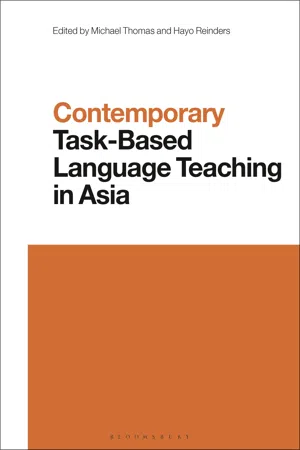
eBook - ePub
Contemporary Task-Based Language Teaching in Asia
- 368 pages
- English
- ePUB (mobile friendly)
- Available on iOS & Android
eBook - ePub
Contemporary Task-Based Language Teaching in Asia
About this book
Information
1
Introduction
Over the last decade task-based approaches to language learning and teaching (TBLT) have become the focus of increased amounts of research, leading Carless to argue that it has become a ‘well-established field of study’ (Carless, 2012, p. 353) in its own right. Governments around the world looking to implement new language teaching policies have turned to TBLT as a potential solution to curricula that are perceived to lack an authentic and meaningful engagement with language learning and that fail to motivate and engage contemporary learners as a result (Ho & Wong, 2004). In the context of globalization, language education policy is no longer a peripheral issue. It has become a matter of strategic national importance as countries attempt to develop their educational infrastructure to produce graduates for the knowledge economy who can effectively communicate and collaborate in the digital age. These socio-economic factors have added more significance and urgency to discussions about what constitutes the most effective approach or combination of approaches for today’s language learners (Nunan, 2003). Children leaving school and students graduating from universities need to have a range of employability skills, including intercultural communication, fluency in at least one, if not two or three foreign languages, and digital literacy to promote the mobility and flexibility to enable them to integrate seamlessly into the global economy. Debates about TBLT are therefore part of a much wider debate about the reform of formal education that still owes much in some parts of the world to an industrial model than to one fit for the twenty-first century. Research on TBLT is not marginal to the arts and humanities but central to debates about how important communicative language learning is to individual development in terms of promoting intercultural understanding and tolerance (Bax, 2003; Richards, 2005). As a holistic approach which stresses that language learning is much more than merely learning grammatical structures and vocabulary, TBLT has been advocated as a ‘whole-person’ developmental approach based on authentic tasks and problem-solving that learners are likely to be involved with and encounter in the real world (Carless, 2003, 2007).
This shift has been particularly evident in the emerging Asian economies where TBLT has steadily been seen as a potential solution to outdated forms of language education that no longer produce confident graduates with effective English language communication skills who are capable of analysis and critical thinking (Littlewood, 2007). Learners are increasingly growing up in a world in which information is placed instantly at their fingertips via a tablet or smartphone and they can network with friends and acquaintances, creating, sharing, publishing and disseminating knowledge in their first or second language in the blink of an eye. Sitting in a classroom listening to an instructor trying to explain a grammar point in abstract terms or ploughing through a commercially available textbook that was not written with their culture in mind might be termed education but not qualify as an engaging learning experience for these students.
Nevertheless, transitioning to more learner-centred forms of teaching and learning takes a significant effort on a range of levels above and beyond the sphere of influence of individual language instructors and while numerous small- and larger-scale initiatives involving TBLT have been attempted, few however have succeeded. As a consequence, over the last few years there has been a growing interest in the lessons to be learned from research on the implementation of task-based language teaching in specific foreign language contexts, with Japan and China being notable foci in the Asian context (Shehadeh & Coombe, 2012).
The current collection continues this trend and is the first book-length volume that specifically includes chapters focusing only on Asian countries, thus adding to the body of work that acts as a counterbalance to the dominance of Anglo-American research in the field. The twenty-one chapters presented here include previously unpublished research studies and practitioner perspectives on eleven South-East Asian contexts: Cambodia, China, Hong Kong, Indonesia, Japan, Korea, Malaysia, Singapore, Taiwan, Thailand and Vietnam. While China and Japan have generated significant previous interest in this respect, perspectives are also included on contexts in Asia which have been less central and more peripheral to existing debates. These shed new light on a range of factors, from implementation strategies to teacher training initiatives, from research approaches to ethical considerations. In being under-represented in the literature, the book calls for more research on these and other countries to capture the diversity evident in the Asian context.
Reflecting the developing body of work on TBLT in Asia, the book is divided into six main parts that have preoccupied policymakers, teacher trainers, researchers, practitioners and learners over the last two to three decades, each introduced by leading academics with extensive experience of teaching, learning and curriculum design in Asia: the cultural and pedagogical context (Part One, introduced by William Littlewood); the role of the learner in TBLT implementation (Part Two, introduced by Phil Benson); teachers’ perspectives (Part Three, introduced by Jack C. Richards); technology-mediated task-based learning (Part Four, introduced by Glenn Stockwell); materials and curriculum design (Part Five, introduced by Nigel Harwood); and assessment and evaluation (Part Six, introduced by Ali Shehadeh). The six introductions preface each part and discuss the synergies between the chapters, locating them in the context of research in their respective fields. The collection is therefore positioned in a way that attempts to aid stakeholders involved in language development, from curriculum reform to materials development, and from programme evaluation to the establishment of assessment standards. The chapters in the book cover a rich variety of language education institutions across Asia, from schools to tertiary level, from private to public education, as well as innovations at local, regional and national levels.
Arising from the work of Prabhu in India in the late 1970s, TBLT has historical affinities with Asian learners, however it is no longer necessarily regarded as a new innovation. To some extent it continues to be regarded as something of a puzzle or enigma, promising opportunities but often bringing profound challenges to all concerned, and perpetuating a number of rather fundamental ambiguities, from what constitutes a ‘task’ (Ellis, 2003; Samuda & Bygate, 2008), to how best to balance grammar input with an emphasis on eliciting oral communication. Indeed, previous research in this context has identified a range of potential challenges to the integration of task-based approaches, including those identified with learners, instructors and institutions, as well as the wider macro and strategic context that is decided by educational policy makers (Lee, 2005). Arising from this research and these perspectives, there are a number of positive and challenging conclusions. Central among these is the idea that intended educational reforms are often adapted to fit traditional ways of teaching and learning, thus nullifying the innovation (Adamson & Tong, 2008). Important aspects of TBLT may therefore by lost in the process of implementation (Spillane, Reiser & Reimer, 2002).
Rather than adopting a doctrinaire view that attempts to enforce TBLT as one coherent approach that can be imposed on others regardless of local traditions, more research is needed on effective localization strategies. This would be concerned with how it can be adapted to fit local needs in a more flexible way, inviting acceptance and investment from teachers at the ‘chalk face’, who are often more concerned with the practicalities of survival rather than the rewards of educational innovation found in the West (Tang, 2004). Accordingly, Littlewood (2007, p. 248) has argued:
There is now widespread acceptance that no single method or set of procedures will fit all teachers and learners in all contexts. Teachers can draw on the ideas and experiences of others but cannot simply adopt them as ready-made recipes: they need to trust their own voice and develop a pedagogy suited to their own specific situations.
Finally, and perhaps most significantly, Asian countries are often aligned with a focus on high-stakes summative assessments in language education and TBLT needs to convince administrators, instructors, learners and their parents (the latter sometimes overlooked, but even more essential in an Asian context), that it can provide the kind of learning that produces language gains and an accurate assessment of proficiency and skills rather than unfocused discussion. This is an area requiring more research (see Part Six, this volume) and as many of the studies outlined throughout the collection indicate, high-stakes testing is a deeply rooted phenomenon. Transitioning to the more subjective and process-oriented focus evident in task-based approaches and striking an appropriate balance between formative and summative assessments which lead teachers to accept the pedagogical change required by TBLT, remains a priority and a challenge (Carless, 2011; Tong, 2011).
Within a wider educational context, TBLT has of course significant antecedents and is drawn from a tradition of constructivist approaches where tasks and project-based learning were developed to provide learners with authentic learning environments and more holistic ways of learning that avoid memorization and other forms of rote-based instruction (Littlewood, 2004). It seems unnecessary if not unrealistic to argue that TBLT should completely replace what has gone before in terms of language teaching approaches such as Presentation-Practice-Production (PPP). In its place, there has been a broad movement in some Asian contexts toward more communicative forms of language learning, leading to the integration of some features of TBLT alongside traditional foci such as grammatical input in a pre-task phase. This has led to weaker forms of TBLT such as task-supported language teaching (TSLT). In stimulating modes of TBLT that focus on different skills such as reading and writing, rather than exclusively on oral communication, it is important to stress the need to develop hybrid and localized forms of communicative language teaching drawing on a range of traditions in a non-doctrinaire approach that is open to local adaptation.
Above all, as many of the chapters in the volume argue, it is important to interrogate and reassess essentialist assumptions that dominate the debate about TBLT in Asia. Essentialist approaches make overwhelmingly negative assumptions about the impossibility of using tasks in large classes with lower level learners who all seemingly display the same characteristics and stifle all attempts at meaningful collaboration. Such a perspective needs challenging in order to reflect the diversity and complexity of learners and teachers in these countries and to move the field forward.
In the Foreword to this collection, David Nunan argues that it is important to rise above the ‘small picture’, to consider the larger questions which shape why language policy is the way it is and to ask: Is it the purpose of education to ‘preserve or transform’? Task-based learning does not derive from the field of language learning but from reforms in the wider field of education as has been indicated above. It concerns the very purpose of learning. At a time when language learning and the humanities in general are even more under threat in various systems of higher education around the world, now more than ever there is a need to argue for the strategic importance of language learning as central to effective and mutually beneficial globalization. Language learning is central to enhancing cross-cultural understanding, tolerance and promoting interaction with people from different cultures, providing learners with key skills needed for their personal and social development throughout their lives. The collective picture of task-based approaches that emerges from these chapters is that the revisioning and reform of education is not just a major challenge in Asia but throughout the world, where older industrial models of instructivism still prevail in formal educational contexts. What is needed is a strategy that is attentive to the local and the global in a way that is not overly prescriptive, but includes more focus on the importance of the learner and learner creativity (Watkins, 2005).
While TBLT has offered the opportunity to explore authentic language learning environments, then, it also presents a range of challenges on the cultural, pedagogical and institutional level. Some Asian countries have adapted TBLT to deal with local constraints, while others have rejected TBLT and many are still in the process of investigating its implementation in local contexts (Nunan, 1999). By looking at the drivers, stakeholders, obstacles and affordances across the Asian region, it will be possible to gain deeper insights into the ways in which change processes and implementation can occur, as well as the potential range of localized forms TBLT may assume. This book makes an attempt to initiate and contribute to these macro debates, calling for more socioculturally informed designs involving qualitative research of learner and teacher perspectives (Carless, 2004). The book will be of particular interest to those involved in implementing change in the area of language education and to researchers in TBLT seeking a highly nuanced understanding of the cultural, pedagogical and institutional factors influencing its integration and development in the Asian context.
References
Adamson, B., & Tong, S. Y. A. (2008). Leadership and collaboration in implementing curriculum change in Hong Kong secondary schools. Asia Pacific Education Review, 9(2), 180–189.
Bax, S. (2003). The end of CLT: A context approach to language teaching. ELT Journal, 57(3), 278–287.
Carless, D. (2003). Factors in the implementation of task-based teaching in primary schools. System, 31(4), 485–500.
Carless, D. (2004). Issues in teachers’ re-interpretation of a task-based innovation in primary schools. TESOL Quarterly, 38(4), 639–662.
Carless, D. (2007). The suitability of task-based approaches for secondary schools: Perspectives from Hong Kong. System, 35(4), 595–608.
Carless, D. (2011). From testing to productive student learning: Implementing formative assessment in Confucian-heritage settings. New York: Routledge.
Carless, D. (2012). TBLT in EFL settings: Looking back and moving forward. In A. Shehadeh & C. Coombe (Eds), Task-based language teaching in foreign language contexts: Research and implementation (pp. 345–358). Amsterdam: John Benjamins.
Ellis, R (2003). Task-based learning and teaching. Oxford: Oxford University Press.
Ho, W. K., & Wong, R. Y. L. (Eds) (2004). English language teaching in East Asia today. Singapore: Eastern Universities Press.
Lee, S.-M. (2005). The pros and cons of task-based instruction in elementary English classes. English Teaching, 60(2), 185–205.
Littlewood, W. (2004). The task-based approach: Some questions and suggestions. ELT Journal, 58(4), 319–326.
Littlewood, W. (2007). Communicative and task-based language teaching in East Asian classrooms. Language Teaching, 40(3), 243–249.
Nunan, D. (1999). Second language teaching and learning. Boston, MA: Heinle & Heinle.
Nunan, D. (2003). The impact of English as a global language on educational policies and practices in the Asia-Pacific Region. TESOL Quarterly, 37(4), 589–613.
Richards, J. C. (2005). Communicative language teaching today. Singapore: RELC
Samuda, V., & Bygate, M. (2008). Tasks in second language learning. Basingstoke: Palgrave Macmillan.
Shehadeh, A., & Coombe, C. (2012) (Eds.). Task-based language teaching in foreign language contexts: Research and implementation. Amsterdam: John Benjamins.
Spillane, J. P., Reiser, B. R., & Reimer, T. (2002). Policy implementation and cognition: Reframing and refocusing implementation research. Review of Educational Resea...
Table of contents
- Cover
- Series
- Title Page
- Copyright
- Contents
- List of Figures
- List of Tables
- List of Abbreviations
- Foreword
- Notes on Contributors
- 1 Introduction
- PART ONE The South-East Asian context
- PART TWO Focusing on the learner
- PART THREE Teachers’ perspectives
- PART FOUR Tasks and technology
- PART FIVE Materials and curriculum design
- PART SIX Assessment and evaluation
- Epilogue
- Index
Trusted by 375,005 students
Access to over 1.5 million titles for a fair monthly price.
Study more efficiently using our study tools.
Frequently asked questions
Yes, you can cancel anytime from the Subscription tab in your account settings on the Perlego website. Your subscription will stay active until the end of your current billing period. Learn how to cancel your subscription
No, books cannot be downloaded as external files, such as PDFs, for use outside of Perlego. However, you can download books within the Perlego app for offline reading on mobile or tablet. Learn how to download books offline
Perlego offers two plans: Essential and Complete
- Essential is ideal for learners and professionals who enjoy exploring a wide range of subjects. Access the Essential Library with 800,000+ trusted titles and best-sellers across business, personal growth, and the humanities. Includes unlimited reading time and Standard Read Aloud voice.
- Complete: Perfect for advanced learners and researchers needing full, unrestricted access. Unlock 1.5M+ books across hundreds of subjects, including academic and specialized titles. The Complete Plan also includes advanced features like Premium Read Aloud and Research Assistant.
We are an online textbook subscription service, where you can get access to an entire online library for less than the price of a single book per month. With over 1.5 million books across 990+ topics, we’ve got you covered! Learn about our mission
Look out for the read-aloud symbol on your next book to see if you can listen to it. The read-aloud tool reads text aloud for you, highlighting the text as it is being read. You can pause it, speed it up and slow it down. Learn more about Read Aloud
Yes! You can use the Perlego app on both iOS and Android devices to read anytime, anywhere — even offline. Perfect for commutes or when you’re on the go.
Please note we cannot support devices running on iOS 13 and Android 7 or earlier. Learn more about using the app
Please note we cannot support devices running on iOS 13 and Android 7 or earlier. Learn more about using the app
Yes, you can access Contemporary Task-Based Language Teaching in Asia by Michael Thomas, Hayo Reinders, Michael Thomas,Hayo Reinders in PDF and/or ePUB format, as well as other popular books in Languages & Linguistics & Linguistics. We have over 1.5 million books available in our catalogue for you to explore.