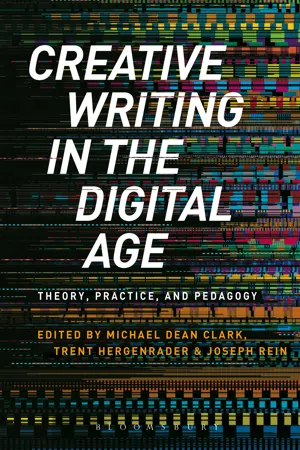
eBook - ePub
Creative Writing in the Digital Age
Theory, Practice, and Pedagogy
- 208 pages
- English
- ePUB (mobile friendly)
- Available on iOS & Android
eBook - ePub
Creative Writing in the Digital Age
Theory, Practice, and Pedagogy
About this book
Creative Writing in the Digital Age explores the vast array of opportunities that technology provides the Creative Writing teacher, ranging from effective online workshop models to methods that blur the boundaries of genre. From social media tools such as Twitter and Facebook to more advanced software like Inform 7, the book investigates the benefits and potential challenges these technologies present instructors in the classroom. Written with the everyday instructor in mind, the book includes practical classroom lessons that can be easily adapted to creative writing courses regardless of the instructor's technical expertise.
Information
1
Introduction
Michael Dean Clark, Trent Hergenrader, and Joseph Rein
Creative writing scholarship has experienced slow but steady growth and diversification since the turn of the millennium. Earlier, most articles pertaining to creative writing focused almost exclusively on craft-based issues. Fortunately, however, the past two decades have produced more scholars willing and eager to address the long-overdue work of examining pedagogical practice and theorizing the creative writing classroom. Of course, craft concerns will always be central to the discipline; however, this recent wave of scholarship asks more fundamental questions that analyze the purpose and effectiveness of creative writing pedagogical models. Where there were once only a handful of books—among them, Joseph M. Moxley’s Creative Writing in America, Hans Ostrom and Wendy Bishop’s Colors of a Different Horse, D. G. Myers’s The Elephants Teach—instructors now have a wide variety of texts that focus exclusively on creative writing both as a discipline and as classroom practice. Where essays on creative writing pedagogy used to appear only in broader English journals, they can now be read in New Writing, a journal focused exclusively on the issue of creative writing theory and practice. Creative writing studies have advanced because of the work done by scholars such as Heather Beck, Paul Dawson, Diane Donnelly, Katherine Haake, Graeme Harper, Jeri Kroll, Tim Mayers, Kelly Ritter, Carl Vandermeulen, and Stephanie Vanderslice. Among others, they have expanded the possibilities of teaching in the field by presenting new and exciting avenues for the future.
And yet, despite this surge in creative writing scholarship, very few works deal with the profound impact digital technology has on our discipline. Simply put, creative writing remains more doggedly reliant on, and rooted in, print culture than almost any other discipline. The genres with which creative writers primarily engage—poetry, fiction, creative nonfiction, and in some programs, drama—are often viewed and studied as disparate from those “digital” genres: multimodal presentations, fan fiction, social media posts, digital narratives, wikis, and blogs, just to name a few. This happens despite the fact that all these genres contain similar craft concerns creative writing instructors already discuss in their classrooms.
Creative writing has been hesitant to join other writing disciplines, such as rhetoric and composition and professional writing, that have recognized the importance of digital influences and have theorized how these technologies impact their writing classrooms. Perhaps this is because creative writing instructors feel the digital tools themselves are intricate, hard to master, and ever changing. And, of course, this is true. But rather than conceiving them as an obstacle, creative writers ought to view digital tools as providing an opportunity for students to broaden their creative skill set. Creative writing has been—and always should be—about exploration and play, two linchpins of creative work in the digital realm. Regardless of the composing tools students use, the fundamental tenets of creative expression, be it precise language, narrative, or self-reflection, will always remain.
Creative Writing in the Digital Age seeks to redress this situation, challenge this hesitancy, and mark a starting point for a new line of discussion in creative writing pedagogy. This collection seeks to enter the ongoing conversations surrounding digital creative writing from a variety of avenues, addressing both theoretical concerns and practical applications. Our contributors include both prominent scholars in creative writing studies as well as groundbreaking scholars working in digital literature. These contributors present myriad approaches intended to inspire both the novice and the expert, to encourage the use of both simple tools and innovative technologies. Creative writing instructors, not only in the United States but also in Great Britain and Australia, are already experimenting with digital tools in fascinating ways; as a discipline, we simply haven’t talked enough about it. More than anything, we hope this collection gets people talking.
The collection is divided into two sections. The first, “Digital influences on creative writing studies,” contextualizes the impact of the digital age on our discipline. Graeme Harper’s opening essay “Creative writing in the age of synapses” focuses on the ways in which the discipline might be reenvisioned as a “synaptic” digital response system in tune with life in a digital world. Adam Koehler’s “Screening subjects: Workshop pedagogy, media ecologies, and (new) student subjectivities” discusses the need to reconstitute the writing workshop in light of both the digital humanities and posthuman theory, leading to a better understanding of twenty-first-century students/writers. In “Concentration, form, and ways of (digitally) seeing,” Anna Leahy and Douglas Dechow balance using various facets of technological platforms in the classroom while still focusing on craft principles central to poetry writing. Next, Trent Hergenrader’s “Game spaces: Videogames as story-generating systems for creative writers” argues that instructors can use students’ knowledge of videogame narratives to reconfigure the classroom and push student writing in new directions. In a similar vein, Michael Dean Clark posits in “The marketable creative: Using technology and broader notions of skill in the fiction course” that ideas from sources as diverse as engineering, business, and network theory can be used to broaden student writing and skill. To conclude the section, Joe Amato and Kass Fleisher, in “Two creative writers look askance at digital composition (crayon on paper),” inquire about disciplinary ownership of multimodal writing and how we might tackle the question of aesthetics in new media forms.
The second section, “Using digital tools as creative practice,” explores practical classroom applications for digital instruction. Joseph Rein’s essay “Lost in digital translation: Navigating the online creative writing classroom” explores best practices for teaching creative writing online, a quickly growing trend in creative writing programs at both the undergraduate and the graduate levels. Janelle Adsit takes on the issue of creative writing, identity, and technology in “Giving an account of oneself: Teaching identity construction and authorship in creative nonfiction and social media,” showing how students can expand their concept of characterization through exploring their already-existing online personas. In “Reconsidering the online writing workshop with #25wordstory,” Abigail Scheg discusses social media microblogs as a focused workshop environment that can dissolve the walls between the classroom and the wider literary community. In the first of three speculative pieces, “Writing with machines: Data and process in Taroko Gorge,” James J. Brown Jr. argues that working with executable computer code is actually quite similar to writing within the constraints of formalist poetics and demonstrates how such limitations focus student attention on language. Aaron A. Reed draws on similar experiences in “Telling stories with maps and rules: Using the interactive fiction language ‘Inform 7’ in a creative writing workshop.” In the essay, he posits that the procedural rules required by a programming language require students think more deeply about setting and characterization. In “Acting out: Netprov in the classroom,” Rob Wittig and Mark C. Marino bring performance into the classroom with Netprov (or Networked Improvisational Narrative) that blurs the line between audience and participants during the generation of unpredictable, interactive narratives. Christina Clancy discusses the ways digital storytelling platforms have challenged and improved the personal narratives of her creative nonfiction students in “The Text Is Where It’s At: Digital Storytelling Assignments That Teach Lessons in Creative Writing.” And finally, Amy Letter’s “Creative writing for new media” gives an honest and accessible account of the successes and challenges of using new media in the creative writing classroom.
The book also has a companion website, available through Bloomsbury’s homepage. On the site, each author has provided additional lesson plans, ideas, and assignments to augment the ideas discussed in the essay. We also urge readers to check out our social media sites, where instructors can share their successes and struggles with digital approaches. We hope, above all, that this collection becomes the starting point of a lively and consistent conversation within the discipline about embracing and engaging the powerful opportunities technology provides.
Finally, we wish to acknowledge that the digital world opens opportunities not only for our creative writing classrooms but also for collaborations both campus-wide and beyond. The digital humanities continues to grow at universities both in the United States and abroad; creative writing can, and should, play a central role in its evolution. Scholars and students working in fields from computer science to graphic design continue to build projects around compelling content; who else are better to give these projects the artistic resonance and deft use of language they need than creative writers? We suggest contacting colleagues in on campus to inquire about working on interdisciplinary projects, guest lecturing in each other’s classes, or co-teaching a course. Creative writers may never master writing code and programmers may never master literary forms, but both sides have much to gain from active collaboration. Far from diminishing the discipline, such collaborations will bolster creative writing as a discipline, while continuing its vital work in the modern university.
SECTION ONE
Digital influences
on creative writing
studies
on creative writing
studies
2
Creative writing in the age of synapses
Graeme Harper
Making the change
The world changed, many people noticed, but not many reacted. Further focusing on such a comment will certainly appear accusatory, and yet I will. Alongside changes in ways of reading, the writing and distribution of works of creative writing changed. Many people noticed, but only a very small percentage of those teaching creative writing reacted to these changes. Because of that, much in the teaching of creative writing continues to address a predigital world rather than the environment in which we now live, learn, and teach. Fortunately, some of us have noticed this has happened and are beginning to do something about it.
The specific phenomenon we need to target today clearly owes its origins to digitalism. It has arisen out of digitalism to be our contemporary modus operandi, the ethos of our era, our guide, and in many ways, our gift. We can refer to this phenomenon as “synapticism.”
Synaptic technologies are those contemporary technologies that support reciprocal human experiences, not material manifestations, of our human presence in the world. That is, they are technologies of action and experience, not primarily technologies associated with materialism. Depending on the specific device, these contemporary technologies were born when the sometimes immediate and sometimes gradual changeover from analog to digital technologies generated opportunities for more direct, accessible, domesticated, and reciprocal human connections (or what can be called “interconnection”).
Certainly, such synaptic technologies can produce material results; that is, they can be used to produce artifacts (in the case of creative writing, such artifacts as novels, poems, scripts). But these technologies are not, in essence, about materiality. Rather, they are about the human experiences they initiate, support, and empower. They empower these in interconnected ways. So, for example, texting on a cell phone does not primarily produce words on a small screen. True, this material element is obvious and undeniably relevant. But it is secondary to the cell phone’s support for an experience of reciprocal human connectedness, often combining this with a sense of immediacy and almost always involving a personal and interactive conversation between persons.
The developed world in the twenty-first century is one of technological interfaces with human experiences. Synaptic technologies, or what might thus be also called experience technologies, produce and support opportunities for human interaction and interconnection, well beyond the local or regional geography of direct physical contact, at a pace of experience and level of convenience never before accomplished. Indeed, include here the technologies of the cell phone and the internet; in fact, include all those contemporary digital technologies that offer experiential opportunities. They each might also initiate and/or support material results, but that is not the primary consequence.
As the name suggests, synapticism involves a network of reciprocal connections or junctions, and synaptic technologies are those that allow such connections to operate. Synapses are openings or bridges. They are nodes in a network. These networks are not based in linearity. By being structured in a nonlinear fashion, networks of this kind support and both literally and metaphorically encourage nonlinear thinking and acting.
Digitalism, as we most often consider it today, is associated specifically with the arrival and rapid spread of digital media technologies toward the latter part of the twentieth century. This contemporary instance is not the only instance of the digital in human history. The digital has a wider definition and the digital technologies we associate with our contemporary world are distinct to our era. That said, digitalism generally means the bringing together of discrete interrelated entities rather than a continuous connected linear flow in one direction. It involves joining together to create interconnected experiences and the opportunity for nonlinearity. So, for example, digital sound technologies produce less distortion because an increase in capacity can be addressed by adding more data units at points in a sequence, whereas analog sound technologies rely on maintaining a continuous linear flow, and thus the likelihood of distortion rises with increases in the size of material to be stored.
Nonlinearity means an opportunity to combine more or interconnect greater, and to do so successfully. That these additions might not be in a single line of connectivity is exactly what the definitions of nonlinearity and interconnection suggest. But there are other things here as well.
In creative writing pedagogy, imagine a set of activities, encouragements, and alignments that were not fixed on an end result—that is, actions that relate to the learning of ways, modes, understandings, and relationships; in essence a creative writing pedagogy that is about the interconnectedness of human action. Whereas linear creative writing pedagogics predominantly rely on notions of material completion, achievement defined by reaching a material end point, nonlinear pedagogics can produce a wider variety of results in the area of creative writing understanding and knowledge. In this way, nonlinearity makes more of the aspects that all of us involved in creative writing have always recognized. Nonlinearity does not necessarily reduce the goal-directed, or teleological, nature of much of our human action. Humans often act with goals in mind, even if those goals can occasionally be short term, badly conceived, or in the rea...
Table of contents
- Cover
- Title
- 1 Introduction
- SECTION ONE Digital influences on creative writing studies
- SECTION TWO Using digital tools as creative practice
- Author biographies
- Index
- Copyright
Trusted by 375,005 students
Access to over 1.5 million titles for a fair monthly price.
Study more efficiently using our study tools.
Frequently asked questions
Yes, you can cancel anytime from the Subscription tab in your account settings on the Perlego website. Your subscription will stay active until the end of your current billing period. Learn how to cancel your subscription
No, books cannot be downloaded as external files, such as PDFs, for use outside of Perlego. However, you can download books within the Perlego app for offline reading on mobile or tablet. Learn how to download books offline
Perlego offers two plans: Essential and Complete
- Essential is ideal for learners and professionals who enjoy exploring a wide range of subjects. Access the Essential Library with 800,000+ trusted titles and best-sellers across business, personal growth, and the humanities. Includes unlimited reading time and Standard Read Aloud voice.
- Complete: Perfect for advanced learners and researchers needing full, unrestricted access. Unlock 1.5M+ books across hundreds of subjects, including academic and specialized titles. The Complete Plan also includes advanced features like Premium Read Aloud and Research Assistant.
We are an online textbook subscription service, where you can get access to an entire online library for less than the price of a single book per month. With over 1.5 million books across 990+ topics, we’ve got you covered! Learn about our mission
Look out for the read-aloud symbol on your next book to see if you can listen to it. The read-aloud tool reads text aloud for you, highlighting the text as it is being read. You can pause it, speed it up and slow it down. Learn more about Read Aloud
Yes! You can use the Perlego app on both iOS and Android devices to read anytime, anywhere — even offline. Perfect for commutes or when you’re on the go.
Please note we cannot support devices running on iOS 13 and Android 7 or earlier. Learn more about using the app
Please note we cannot support devices running on iOS 13 and Android 7 or earlier. Learn more about using the app
Yes, you can access Creative Writing in the Digital Age by Michael Dean Clark, Michael Dean Clark,Trent Hergenrader,Joseph Rein, Michael Dean Clark, Trent Hergenrader, Joseph Rein in PDF and/or ePUB format, as well as other popular books in Languages & Linguistics & Creative Writing. We have over 1.5 million books available in our catalogue for you to explore.