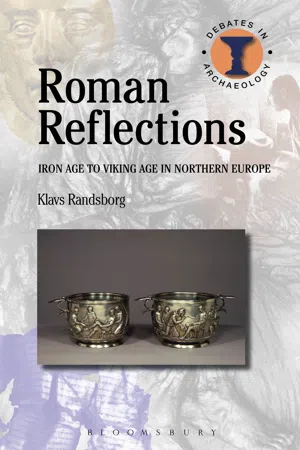
Roman Reflections uses a series of detailed and deeply researched case studies to explore how Roman society connected with and influenced Northern Europe during the Iron and Viking Ages. In an original way, the book brings late prehistoric Denmark – best known for its so-called 'bog bodies' – into a world dominated by textual histories, principally that of Tacitus.
The studies include a new examination of the bog-bodies of the late first millennium BC, a classical archaeological puzzle: men, women and children murdered yet respected in death and adorned with items of fine clothing. A second essay challenges traditionally held ideas about the Cimbri by exploring the textual and archaeological evidence, including the startling and famous European artefact, the Gundestrup silver cauldron. The other studies comprise an archaeologically founded modernist discussion of the ethnography of Tacitus' Germania, in particular considering the character of ancient Germanic Bronze and Iron Age societies; a linguistic exploration of the Latin inheritance in northern European names and places, much of which seems to have been invented by the Romans; and an analysis of the origins of the Danes.
Throughout, traditional sources and history are presented in conjunction with new archaeological observations and interpretations. In an accessible way, Roman Reflections assesses Denmark's part on a larger stage, showing how foundations were laid for its zenith in Viking times.
- 208 pages
- English
- ePUB (mobile friendly)
- Available on iOS & Android
eBook - ePub
About this book
Information
1
Hostages and Bog Bodies
New Interpretations
Adeo ut efficacius obligentur animi civitatum quibus inter obsides puellae quoque nobiles imperantur.
Tacitus’ Germania, Book 8
Introduction
The bog bodies of the Early Iron Age in northern Europe, in particular the centuries BC, constitute one of the most fascinating classes of archaeological finds of the era and region. Very particular conditions of preservation in oxygen-starved wet environments have secured stunning data (van der Sanden 1996; Lund 2002; Asingh & Lynnerup 2007; etc.) (Fig. 1.1 and 1.2; Table 1.1). Human parts and even entire human bodies in the flesh are also known from bogs in other prehistoric periods, but the cited chronological and geographical concentration in the Early Iron Age of Denmark and northwestern Europe calls for one particular set of explanation, or rather several.
In an age and a region otherwise dominated by cremations, the bog bodies are evidence of a very different norm of burial. In Denmark, for instance, the bog bodies constitute the only uncremated human beings in the entire first millennium BC. Most of the bodies – men, women and even children – are naked and were obviously killed, often by hanging, although other methods of killing are also recorded. There have been occasional claims that the dead body carries evidence that suggests the use of unnecessary violence or ‘overkill’, more than would have been needed to kill the person, but this seems uncertain. Male and female bog bodies occur in about equal numbers in Denmark while males dominate the material found elsewhere, such as in northern Germany, and also in Ireland, England, and the Netherlands (van der Sanden 1996, 189f. with map). A number of the bog bodies from England and elsewhere belong to the Neolithic period and Bronze Age.

Figure 1.1 The Tollund Man, found in a bog in Central Jylland/Jutland, c. 300 BC
Photo: National Museum/Silkeborg Museum

Figure 1.2 Sum diagram for carbon-14 dates of bog bodies, clothing and plaits of human hair found in bogs
Some of the best finds have more than one date. Some of the older dates are probably less reliable. The most recent high-quality carbon-14 dates are the most reliable; these are all marked with an asterisk.
After Ebbesen 2008 (plaits); Mannering et al. 2009 (bog bodies and clothing); cf. Ravn 2010


Interpretations
Based on various observations drawn from the Germania by Publius Cornelius Tacitus (c. AD 56–117), tradition would have it that the bog bodies were criminals who had been killed (Much 1937). The ‘punishment of criminals’ theory was partly modified after the First World War by the suggestion that the culprits were sacrificed to the god whose rules they had violated. In the latter half of the twentieth century a ‘pure’ sacrificial hypothesis gained ground, based on the many particular, even luxurious, finds in the prehistory of Denmark that came from bogs and seemed to be votive ...
Table of contents
- Cover
- Series Page
- Title Page
- Contents
- List of Figures
- List of Tables
- Preface
- Acknowledgements
- 1 Hostages and Bog Bodies: New Interpretations
- 2 The Cimbri: Death · Resurrection · Death
- 3 Nations and Alliances: The Ethnography of Tacitus’ Germania
- 4 Romans in the North: Deconstruction of Names and Identities
- 5 Origins of the Danes: From Tacitus to King Harald
- 6 Epilogue: The First Millennium AD in Denmark: Words and Things
- Index
- Copyright
Trusted by 375,005 students
Access to over 1.5 million titles for a fair monthly price.
Study more efficiently using our study tools.
Frequently asked questions
Yes, you can cancel anytime from the Subscription tab in your account settings on the Perlego website. Your subscription will stay active until the end of your current billing period. Learn how to cancel your subscription
No, books cannot be downloaded as external files, such as PDFs, for use outside of Perlego. However, you can download books within the Perlego app for offline reading on mobile or tablet. Learn how to download books offline
Perlego offers two plans: Essential and Complete
- Essential is ideal for learners and professionals who enjoy exploring a wide range of subjects. Access the Essential Library with 800,000+ trusted titles and best-sellers across business, personal growth, and the humanities. Includes unlimited reading time and Standard Read Aloud voice.
- Complete: Perfect for advanced learners and researchers needing full, unrestricted access. Unlock 1.5M+ books across hundreds of subjects, including academic and specialized titles. The Complete Plan also includes advanced features like Premium Read Aloud and Research Assistant.
We are an online textbook subscription service, where you can get access to an entire online library for less than the price of a single book per month. With over 1.5 million books across 990+ topics, we’ve got you covered! Learn about our mission
Look out for the read-aloud symbol on your next book to see if you can listen to it. The read-aloud tool reads text aloud for you, highlighting the text as it is being read. You can pause it, speed it up and slow it down. Learn more about Read Aloud
Yes! You can use the Perlego app on both iOS and Android devices to read anytime, anywhere — even offline. Perfect for commutes or when you’re on the go.
Please note we cannot support devices running on iOS 13 and Android 7 or earlier. Learn more about using the app
Please note we cannot support devices running on iOS 13 and Android 7 or earlier. Learn more about using the app
Yes, you can access Roman Reflections by Klavs Randsborg in PDF and/or ePUB format, as well as other popular books in History & European History. We have over 1.5 million books available in our catalogue for you to explore.