- 312 pages
- English
- ePUB (mobile friendly)
- Available on iOS & Android
eBook - ePub
About this book
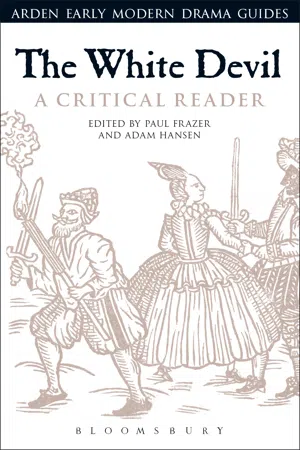
The White Devil is one of the most violent and most fascinating plays in English theatrical history. It is also a notoriously challenging work; this volume offers a practical, accessible and thought-provoking guide to the play, surveying its major themes and critical reception. It also provides a detailed and up-to-date history of the play's performance, beginning with its first staging in 1611 staging and ending with the RSC's 2014 revival. Moving through to four new critical essays, it opens up cutting-edge perspectives on the work, and finishes with a practical guide to pedagogical approaches and resources. Detailing web-based and production-related resources, and including an annotated bibliography of critical works, the guide will equip teachers and facilitate students' understanding of this complex play.
Information
1
The Critical Backstory
In 1651, Samuel Sheppard declared that after reading Webster’s The White Devil, people would no longer bother with the classical tragedies of Euripides and Sophocles.1 In 1856, Charles Kingsley opined that Vittoria Corombona was exactly the sort of criminal young woman that London magistrates had to deal with every week. In 1989, Dympna Callaghan suggested that Webster’s play showed that the entire genre of tragedy was inherently flawed. As these few examples imply, the critical backstory of The White Devil is both a dramatic and eccentric one. The play has been subject to a range of critical paradigms and frameworks in the centuries since the first printing of 1612; at different times commentators have valued aesthetic smoothness, moral aptness, conceptual coherence, realism of representation, rounded characters, thematic unity, moral vision, chaotic alienation and ironic distance. Webster’s work is likely to be accorded a higher valuation under some of these criteria than others, but it is striking how often The White Devil transgresses these canons or resists explanation by them. The play is so very frequently ‘wrong’, when judged according to a shifting array of aesthetic and moral standards, and critical appreciation of it often takes on the character of apology, explanation or justification. Just as the stage history of Webster’s plays is marked by productions which declare themselves as ‘revivals’, their critical history involves a series of conscious ‘recuperations’ or ‘revaluations’. This does not account for the entire history, but it is frequent enough to feature as a significant factor in any account of that history. Judgements on The White Devil, whether positive or negative, are often arranged around an implicit (or explicit) ‘but’. Therefore, what follows is not a comprehensive history of what has been said about the play but rather an account of some of the tragedy’s most critical ‘problematic’ focal points. I have directed attention towards the disagreements and complications which form such a part of the play’s critical history. This should both provide a more accurate account of how the play has been regarded than a simple account of description and exegesis, and help to avoid (as much as possible) a narrative of how people in the past gradually came to understand the play better as they became more like us. It should also provide the reader with some sense of what has been going on in the generations before they turned up, orienting them in the turmoil whose aftershocks continue to shape the landscape of thought and practice around this play.
Perhaps the first piece of literary criticism we should take into account is by Webster himself, in a bad tempered and defensive epistle to the reader attached to the play’s initial printing in 1612. The play’s performance at the old-fashioned and open air Red Bull had been a flop for which the author clearly felt justification was necessary, or for which blame should be apportioned. He begins with this declaration:
In publishing this tragedy, I do but challenge myself that liberty, which other men have taken before me; not that I affect praise by it, for, nos hæc novimus esse nihil [we know that these things are nothing] only since it was acted in so dull a time of winter, presented in so open and black a theatre, that it wanted (that which is the only grace and setting-out of a tragedy) a full and understanding auditory.2
Webster also staves off several expected criticisms, including the suggestion that he has broken poetic conventions and that his writing practice is overly laborious:
To those who report I was a long time in finishing this tragedy, I confess I do not write with a goose-quill winged with two feathers; and if they will need make it my fault, I must answer them with that of Euripides to Alcestides, a tragic writer: Alcestides objecting that Euripides had only, in three days composed three verses, whereas himself had written three hundred: Thou tellest truth (quoth he), but here’s the difference, thine shall only be read for three days, whereas mine shall continue for three ages.3
Whether or not we accept the goose quill (or its absence) as a valid standard of canonicity, we can recognize Webster’s preface as an attempt to control the criteria by which his work has been judged. As Zachary Lesser and Douglas Brooks have demonstrated, this authorial passage before the main text was part of an attempt within in the early modern book trade to create a category of ‘literary playbooks’.4 These volumes frame their contents in terms of aesthetic value and the appreciation of a discriminating readership, defining themselves apart from – and in some cases in direct opposition to – the theatrical popularity which was cited proudly on other title pages. Webster’s epistle makes an effort to involve the reader in a narrative of cultured judgement, retrospectively relocating his play from the Red Bull theatre to the more exclusive Blackfriars or even to the imagined library of the book buyer. In presenting a standard by which to evaluate his play, Webster tacitly gives the reader a standard to live up to. His classical references offer them a literary game to play if they will accept the legitimacy of his work.
Despite the paucity of formal literary criticism in the seventeenth century, Webster’s epistle appears to have succeeded in at least one case. In 1651, Samuel Sheppard included a commendatory poem on The White Devil in his Epigrams Theological, Philosophical and Romantic:
We will no more admire Euripides,
Nor praise the tragic strains of Sophocles;
For why? Thou in this tragedy hast framed
All real worth that can in them be named.
How lively are thy persons fitted, and
How pretty are thy lines! Thy verses stand
Like unto precious jewels set in gold
And grace thy fluent prose. I once was told
By one well skilled in Arts he thought thy play
Was only worthy fame to bear away
From all before it. Brachiano’s ill –
Murdering his Duchess hath by thy rare skill
Made him renowned, Flamineo such another –
The Devil’s darling, murderer of his brother.
His part – most strange! – given him to act by thee
Doth gain him credit and not calumny.
Vittoria Corombona, that famed whore,
Desperate Lodovico weltering in his gore,
Subtle Fransisco – all of them shall be
Gazed at as comets by posterity.
And thou meantime with never-withering bays
Shall crowned be by all that read thy lays.5
Sheppard’s references to classical tragedians praise Webster by accepting his self-description as their equal, in the preface to The White Devil. Indeed Sheppard goes one step further, using the familiar metaphor of the ‘never-withering bays’ to imagine art as a transhistorical competition, in which Webster has surpassed his exemplars. The rather bland hearsay opinion of ‘one well skilled in Arts’ chimes with the epistle’s stress on individual judgement by properly qualified readers, rather than appealing to popularity or the general voice. Sheppard also introduces a couple of themes which were significant in the play’s ensuing critical reception: the unusual construction of Webster’s dramaturgy, and the sexual culpability (or otherwise) of Vittoria. In the rest of this chapter, I will use these themes to organize my discussion of The White Devil’s critical backstory and also add another from Webster’s own epistle: his perennial comparison with Shakespeare.
The problem of Vittoria’s guilt
Over the centuries Vittoria’s character and, in particular, her culpability, have provided a problem around which commentary and criticism have gathered. It is not simply that she is a powerful central figure who commits morally wrong acts – though this has, in itself, been enough to provoke anxious and elaborate commentaries – but also that the play seems to ascribe fluctuating characteristics to her. In some scenes, Vittoria appears both devious and calculating and yet, in others, she speaks with apparent sincerity and integrity. Arguments about Vittoria’s character are, thus, often concerned with questions of moral blame and justification, as well as with the theatre’s ability to represent the world in accurate and realistic ways.
Sheppard’s poem dismisses the titular character of the tragedy, referring misogynistically to ‘Vittoria Corombona, that famed whore’; it reflects the later critical tendency to reduce the role’s complexity to her sexual transgressions. We should perhaps read ‘famed’ not solely as a reference to her public shaming within the play or the notoriety of the historical Vittoria Corombona, but also as a natural complement to ‘whore’. Early modern concerns around women’s sexualities and their proper place in the social order come together in assumptions about the unchastity of women who are ‘public’ in some sense. To be spoken of too much, on whatever basis, is to attract suspicion (hence the paradox of women famous for their private virtues), and Sheppard’s phrase performs the easy slip between meanings: Vittoria is not only ‘famed’ for being a ‘whore’, she is also a ‘whore’ because of her ‘fame’.
No sustained discussions of the play have survived between the mid-seventeenth and early nineteenth centuries. However, when it then reappears in critical commentary, Vittoria’s conduct and character are once again a significant factor. William Hazlitt gives a remarkable and impressionistic description in Lectures Chiefly on the Dramatic Literature of the Age of Elizabeth (1820):
the insulted and persecuted Vittoria darts killing scorn and pernicious beauty at her enemies. This White Devil (as she is called) is made as fair as the leprosy, dazzling as the lightning. She is dressed like a bride in her wrongs and her revenge.6
Hazlitt seems to admit her guilt while also feeling that the audience should (or does) side with her. Violence and disease are made beautiful, and even justified by the greater evil of those around her: she is ‘persecuted’ and magnificent.
By the time Hazlitt described this ‘killing scorn and pernicious beauty’, Charles Lamb had already, in 1808, introduced a phrase into criticism of The White Devil which would serve as touchstone and stimulus for subsequent commentators:
This White Devil of Italy sets off a bad cause so speciously, and pleads with such an innocence-resembling boldness, that we seem to see that matchless beauty of her face which inspires such gay confidence into her, and are ready to expect, when she has done her pleadings, that her very judges and her accusers, the grave ambassadors who sit as spectators, and all the court, will rise and make proffer to defend her in spite of the utmost conviction of her guilt.7
That ‘innocence-resembling boldness’ clearly distinguishes between the guilt that the audience is aware of (because they witnessed her crimes) and the character’s demeanour within the trial scene. Though Lamb seems to intend a tribute to Webster’s characterization here, his emphasis on the admiration provoked in the onstage audience (the judges and ambassadors) towards the guilty women (Vittoria and Zanche) seems to have unsettled some other critics, as we shall see below. Lamb’s description taps into the concerns around the possibility of male knowledge of women’s motives, and the necessity of justice being performed publicly. In suggesting that the off-stage audience, or even the reader, might find themselves equally taken in by this ‘matchless beauty’ and skilful pleading, Lamb implies there was something in the play which troubled the operations of moral and theatrical judgement – all without implying that Vittoria was innocent in any sense.
The Reverend Alexander Dyce is similarly enthusiastic in his praise of Webster’s character-drawing when he discusses Vittoria in his 1859 edition of Webster’s Works:
What genius was required to conceive, what skills to embody, so forcible, so various, and so consistent a character as Vittoria! We shall not easily find, in the whole range of our ancient drama, a more effective scene than that in which she is arraigned for the murder of her husband.8
Having praised the skill with which the dramatist held together the variety of the central figure with such consistency, Dyce goes on to differ from Lamb’s assessment. Where Lamb thought her ‘boldness’ resembled innocence, Dyce suggests that Webster has written the character to demonstrate the ‘forced and practised presence of mind’ typical of a ‘hardened offender’.9 He insists that there is a difference between the ‘simple confidence’ which ‘the innocent manifest under the imputation of a great crime’ and the way V...
Table of contents
- Arden Early Modern Drama Guides
- Title
- Contents
- Series Introduction
- Acknowledgements
- Notes on Contributors
- Timeline
- Introduction Paul Frazer and Adam Hansen
- 1 The Critical Backstory Jem Bloomfield
- 2 The White Devil in Performance Eva Griffith
- 3 The White Devil: The State of the Art Brett D. Hirsch
- 4 New Directions: Ritual Dissonance in The White Devil David Coleman
- 5 New Directions: Unbridled Selfhood in The White Devil – Webster’s use of Calvin and Montaigne Paul Frazer
- 6 New Directions: Boy Prince and Venetian Courtesan – Political Critique in The White Devil Christina Luckyj
- 7 New Directions: The Look of Love? – Pornography and The White Devil’s ‘terrible vision’ Adam Hansen
- 8 Pedagogy and Resources: The Devil is in the Details James Hirsh
- Notes
- Select Bibliography
- Index
- Copyright
Trusted by 375,005 students
Access to over 1.5 million titles for a fair monthly price.
Study more efficiently using our study tools.
Frequently asked questions
Yes, you can cancel anytime from the Subscription tab in your account settings on the Perlego website. Your subscription will stay active until the end of your current billing period. Learn how to cancel your subscription
No, books cannot be downloaded as external files, such as PDFs, for use outside of Perlego. However, you can download books within the Perlego app for offline reading on mobile or tablet. Learn how to download books offline
Perlego offers two plans: Essential and Complete
- Essential is ideal for learners and professionals who enjoy exploring a wide range of subjects. Access the Essential Library with 800,000+ trusted titles and best-sellers across business, personal growth, and the humanities. Includes unlimited reading time and Standard Read Aloud voice.
- Complete: Perfect for advanced learners and researchers needing full, unrestricted access. Unlock 1.5M+ books across hundreds of subjects, including academic and specialized titles. The Complete Plan also includes advanced features like Premium Read Aloud and Research Assistant.
We are an online textbook subscription service, where you can get access to an entire online library for less than the price of a single book per month. With over 1.5 million books across 990+ topics, we’ve got you covered! Learn about our mission
Look out for the read-aloud symbol on your next book to see if you can listen to it. The read-aloud tool reads text aloud for you, highlighting the text as it is being read. You can pause it, speed it up and slow it down. Learn more about Read Aloud
Yes! You can use the Perlego app on both iOS and Android devices to read anytime, anywhere — even offline. Perfect for commutes or when you’re on the go.
Please note we cannot support devices running on iOS 13 and Android 7 or earlier. Learn more about using the app
Please note we cannot support devices running on iOS 13 and Android 7 or earlier. Learn more about using the app
Yes, you can access The White Devil: A Critical Reader by in PDF and/or ePUB format, as well as other popular books in Literature & Drama. We have over 1.5 million books available in our catalogue for you to explore.