- 320 pages
- English
- ePUB (mobile friendly)
- Available on iOS & Android
eBook - ePub
About this book
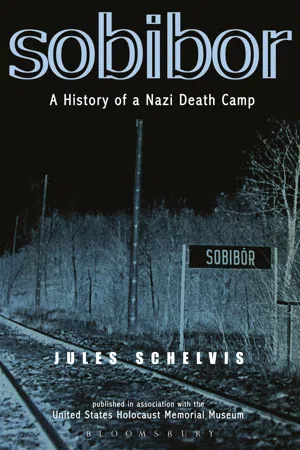
Auschwitz. Treblinka. The very names of these Nazi camps evoke unspeakable cruelty. Sobibör is less well known, and this book discloses the horrors perpetrated there.Established in German-occupied Poland, the camp at Sobibör began its dreadful killing operation in May 1942. By October 1943, approximately 167,000 people had been murdered there. Sobibör is not well documented and, were it not for an extraordinary revolt on 14 October 1943, we would know little about it. On that day, prisoners staged a remarkable uprising in which 300 men and women escaped. The author identifies only forty-seven who survived the war.Sent in June 1943 to Sobibör, where his wife and family were murdered, Jules Schelvis has written the first book-length, fully documented account of the camp. He details the creation of the killing centre, its personnel, the use of railways, selections, forced labour, gas chambers, escape attempts and the historic uprising.In documenting this part of Holocaust history, this compelling and well-researched account advances our knowledge and understanding of the Nazi attempt to annihilate the European Jews.Published in association with the United States Holocaust Memorial Museum.
Trusted by 375,005 students
Access to over 1.5 million titles for a fair monthly price.
Study more efficiently using our study tools.
Information
–1–
Introduction
Sobibór, in the eastern part of Poland, was one of the three extermination camps in the General Government which, together with Bełżec and Treblinka, formed part of Operation Reinhardt,1 launched by Himmler and headed by Odilo Globocnik.2 Approximately 170,000 Jews from Germany, France, the Netherlands, Austria, Poland, Slovakia, the Soviet Union and Czech territory were sent there to be gassed by carbon monoxide. The camp was operational from the end of April 1942 until 14 October 1943, when an uprising broke out, which now holds a unique place in the history of Jewish persecution during the Second World War. Earlier that year, in the summer of 1943, a group of Arbeitshäftlinge3 (Jewish workers) from Poland had banded together, forming an underground group led by Leon Felhendler, a Polish Jew.4 The group consisted of fewer than ten men, who over the preceding months had been selected5 from various transports to work at the camp. They plotted their escape in total secrecy, keeping their plans even from the other Arbeitshäftlinge. Earlier escape attempts by other prisoners, including five men from the Waldkommando6 (forest detachment) who actually managed to get away, had met with varying degrees of success. However, for Felhendler and his allies it remained but a dream. A lack of insight, knowledge and skill hampered their chances of succeeding with such a complicated operation. Preparing and executing an escape in every minor detail required a lot of specialist knowledge, and they simply failed to come up with a sound plan.
On 22 September 1943, the arrival of 2,000 Russian Jews from Minsk, including a number of Jewish prisoners of war, gave rise to new hope. As it happened, carpenters were required at that time to build barracks in an as yet unfinished part of the camp. One of the volunteers was Alexander Petsjerski, not a carpenter but a Red Army lieutenant whose officer training had been geared not just to teaching soldiers how to fight, but also to how to overcome extremely challenging circumstances. He was swiftly asked, within days of his arrival, to join Felhendler’s group, and it took him only three weeks to prepare and execute an uprising in every detail. This uprising carries great significance not only in terms of the 300 men and women who managed to break out of the camp, of whom forty-seven ultimately survived the war, but also for the generations that followed. Without the uprising, there would have been no survivors, no one to testify to what happened at Sobibór. No court proceedings could have been started against the SS staff and Ukrainian guards, and the crimes that were carried out in the strictest secrecy would never have been exposed.
The urge to delve deeper into the truth about what happened to my wife and family, who were murdered in Sobibór, is what compelled me to start writing about it. I also wanted to try to understand what led to all of this. The first steps in that direction took me to Hagen in the Ruhr area of Germany, where in 1982 a Sobibór trial had started, lasting until 1985. Initially I sat in on the proceedings as a regular visitor, in an almost empty courtroom. At times, I would be joined by school pupils from the local area on an educational visit. In that courtroom, during the months of questioning, Sobibór first began to take shape. Very few documents relating to Sobibór and the other death camps had actually survived. After the uprising, Globocnik wrote to Himmler that ‘the evidence should be destroyed as quickly as possible, now that all else has been destroyed,’7 and virtually all of the incriminating documents were burnt soon after.
The many statements and testimonies given during the trial do not include any from the Arbeitshäftlinge in Lager 3, the part of the camp where the gas chambers and mass graves were situated in a separate enclosure, surrounded by its own barbed wire fence. The SS prevented any form of contact between the Jews who worked in that part of the camp and the other camp prisoners; even the way in which the killing was carried out was kept strictly secret from all others. For any descriptions of the actual extermination procedure in Sobibór one has to rely solely on the SS men who were there; not a single Jew from Lager 3 managed to survive. Faced with the prospect of punishment, these SS henchmen tried to play down the role they played, doing so in order to protect their comrades. Yet there did turn out to be one Arbeitshäftling, Rudolf Reder, who was able to describe his experiences of the gas chambers. He had escaped from extermination camp Bełżec, where circumstances were very similar to those in Sobibór.
Still using their Nazi jargon, those who had once been in power, showing no signs of emotion and giving only the barest of facts, submitted their statements about what had happened at Sobibór. Later, however, one of them, while serving life imprisonment, decided to be less economical with the truth than he had previously been, admitting that: ‘I have kept my silence up till now out of a false sense of loyalty, so as not to implicate my comrades, but I want to come clean about the whole truth from this moment on, to avoid being apportioned all the blame.’8
The first Sobibór trial was held as early as 1950, following the arrest of SS man Erich Bauer in Berlin after a tip-off by two of the camp’s ex-prisoners.9 Around the same time, Johann Klier and Hubert Gomerski were apprehended in Frankfurt am Main. The latter, following his arrest, signed a statement in which he wrote: ‘I can only declare that a place by the name of Sobibór is unknown to me.’10 Bauer and Gomerski were sentenced to life imprisonment, while Klier was found not guilty. The trials received hardly any publicity. The third trial took place in Hagen in 1965.11 The verdicts, pronounced on 20 December 1966 and underpinned by voluminous case records of more than 400 pages, varied from not guilty to life imprisonment. Then, at the end of 1971, Gomerski started an appeal procedure, which had to be concluded early due to his bad health. Finally, at the end of 1982 yet another Wiederaufnahmeverfahren (retrial) started in Hagen, this time initiated by SS sergeant Frenzel, who had been sentenced to life imprisonment in 1966. By this time, the Schwurgericht (court) had come into the possession of additional statements made by witnesses from the former Eastern bloc countries. In due course, the court agreed to let me act as one of the public prosecutors in the trial,12 in which capacity I was able to collect information, and was the first foreigner and non-jurist to deliver, on 22 August 1985, an address to the jury in a German court of law, in which I demanded life imprisonment for the accused. On 4 October 1985 Frenzel’s life sentence was reimposed. The verdict and its motivations have been recorded in a voluminous work of more than 700 pages.
The SS staff quotations that have been included in my book13 have been taken from statements and interrogations which they themselves endorsed with their signatures. Still there are those who stubbornly refuse to acknowledge – now also on the Internet – the existence of the extermination camps. They will find the incontestable evidence to the contrary in this book. No one could possibly still believe, once the last survivor has passed away, that the extermination camps were only a figment of Jewish imagination.
Shortly after the liberation of Poland in 1944, a number of survivors gave statements about what happened in the camp, and the criminals who operated there. Still so traumatized by the torture they had endured, they referred to some of their torturers by name in relation to specific crimes which, years later, they felt less sure about. Some knew only first names. These testimonies should be regarded as contemporary documents rather than legal indictments where each and every comma and full stop or period must be in the right place. Despite their inaccuracies, they are of great value because they were given fresh from memory rather than being influenced by later writings or statements by others. The actual events mattered more, at the time, than naming specific individual SS men. As some of the details were inconsistent, however, the defending counsels used these testimonies to assert their clients’ innocence. The perpetrators, in turn, believed for a long time that their crimes would remain undiscovered and that they would never be held to account.14
The intriguing question is why, in the spring and summer of 1943, the transports from Western Europe headed for Sobibór rather than Auschwitz/Birkenau, which was in fact closer. From Danuta Czech’s Kalendarium of Auschwitz/Birkenau it can be deduced that Birkenau had sufficient ‘capacity’ all through the period to ‘receive’ these transports, with the exception of March, when more than 21,300 people were gassed in that camp, while still others were selected for work. Perhaps the answer may be found in J. Wulf’s15 chapter on Globocnik, who visited Auschwitz during that summer of 1943 and exchanged a few thoughts by the fireside one evening with commandant Höss. Globocnik was very interested in the Auschwitz crematoriums and mentioned he was not getting enough Jewish transports. It was his personal aim to hold pride of place with his Vernichtungen (annihilations), and as he put it to Höss: ‘Everything was done much more quickly at his camp.’
In occupied Holland the name Sobibór was first mentioned on 26 March 1943, at a meeting of the Central Commission of the Jewish Council: ‘The latest news from Germany is not unfavourable. Some recent transports have apparently not been sent to Auschwitz, but to Sobibór. Also, according to Mr aus der Fünten16 elderly people from the Netherlands are now being sent to Theresienstadt as well. However, the general situation with respect to employment remains as yet unclear.’17 In all other respects, the name Sobibór remained largely unknown for the duration of the entire war. Even in Poland only a few insiders knew of its existence. Early in June 1942, shortly after the camp became operational, members of the Polish-Jewish underground group Dror managed to establish the camp’s name. On 8 June, two couriers from Warsaw first heard the name Sobibór at the station of the small town of Miaczyn, and reported to the leader of their group: ‘From dawn until dusk cartloads of people and their possessions were arriving there. As evening fell, the Jews were herded into special wagons. They were not allowed to take their luggage. [. . .] The train departed to an unknown destination. Rumours have it that the Germans have built an extermination camp like Bełżec.’18 The few postcards received in Germany and Holland were never recognized as signs of life from Sobibór, as they always had to be postmarked as though sent from Włodawa.
I myself was deported to Sobibór on 1 June 1943, along with 3,005 other people including my wife Rachel and her family. No one in the transport knew what to expect. Together with eighty others I was able to leave the camp within a few hours, as it turned out that the SS required eighty new workers in Dorohucza, a small labour camp for digging peat. After almost two years of being sent from one labour camp to the next in Poland and Germany, I was finally liberated on 8 April 1945 by the French army, in Vaihingen an der Enz near Stuttgart and, while still recovering from typhus in the local hospital, started to write about everything that had happened to me during those years. On 30 June 1945 I registered as a repatriate with the authorities in Amsterd...
Table of contents
- Cover
- Half-Title
- 1 Introduction
- 2 Prelude to the ‘Final Solution’
- 3 Construction and Staffing
- 4 The Trains
- 5 Arrival and Selection
- 6 The Arbeitshäftlinge
- 7 The Gas Chambers
- 8 Dorohucza and Lublin
- 9 Escape Attempts
- 10 The Revolt
- 11 After the Revolt
- 12 Transports, Deportees and Death Counts
- 13 Sobibór Survivors
- 14 The Perpetrators
- Index
Frequently asked questions
Yes, you can cancel anytime from the Subscription tab in your account settings on the Perlego website. Your subscription will stay active until the end of your current billing period. Learn how to cancel your subscription
No, books cannot be downloaded as external files, such as PDFs, for use outside of Perlego. However, you can download books within the Perlego app for offline reading on mobile or tablet. Learn how to download books offline
We are an online textbook subscription service, where you can get access to an entire online library for less than the price of a single book per month. With over 1.5 million books across 990+ topics, we’ve got you covered! Learn about our mission
Look out for the read-aloud symbol on your next book to see if you can listen to it. The read-aloud tool reads text aloud for you, highlighting the text as it is being read. You can pause it, speed it up and slow it down. Learn more about Read Aloud
Yes! You can use the Perlego app on both iOS and Android devices to read anytime, anywhere — even offline. Perfect for commutes or when you’re on the go.
Please note we cannot support devices running on iOS 13 and Android 7 or earlier. Learn more about using the app
Please note we cannot support devices running on iOS 13 and Android 7 or earlier. Learn more about using the app
Yes, you can access Sobibor by Jules Schelvis, Karin Dixon in PDF and/or ePUB format, as well as other popular books in History & 20th Century History. We have over 1.5 million books available in our catalogue for you to explore.