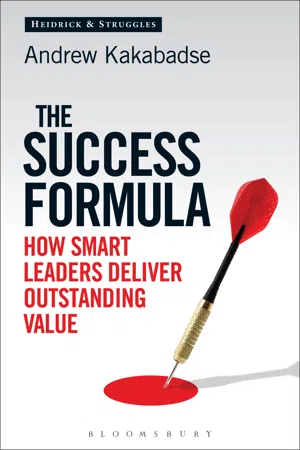
What do successful organizations and smart leaders have in common? They deliver outstanding value to their stakeholders.
Interviews with over 80 leading organizations in private, public and third sectors from all over the world have led Andrew Kakabadse to a fascinating insight: organizations where stakeholder engagement was highest were not those led by charismatic and visionary leaders, but by a culture of delivering outstanding value.
Through his research, he found two different approaches at work. In strategy-led organizations, senior management has a clear notion of how value can be created and enacts a strategy to achieve it with the support of key managers and board members. Value-delivery-led organizations approach value creation differently. In these organizations, the leadership gathers evidence from internal and external stakeholders to determine the value the organization is delivering today and can deliver in the future. A strategy is then put in place to support those findings – and is deliberately exposed to challenges from stakeholders to create engagement.
The Success Formula demonstrates how value-delivery-led organizations are outperforming their strategy-led counterparts and how the world's best organizations deliver value to their stakeholders, with examples drawn from Anglo American, Deutsche Bank, Citibank, Jaguar/Landrover, Microsoft, BMW and Alfa Bank. This authoritative guide shows leaders how to improve the way they gather meaningful evidence to create a value-delivery culture that maximizes the benefits for their organizations and stakeholders.
- 208 pages
- English
- ePUB (mobile friendly)
- Available on iOS & Android
eBook - ePub
About this book
Information
Chapter 1
Understanding value
What is your definition of success?
I have asked this question of executives throughout the world. Among them was Georges Dabaghi, general manager of Vubiquity in the Middle East and for the CIS countries, and formerly with SeaChange, Lucent Technologies, and AT&T. Vubiquity is the world’s largest provider of multiplatform video services and Georges has been involved in telecommunications in the Middle East and Africa for nearly twenty years. His answer was characteristically thoughtful and explored some of the issues others raised when the question was posed:
I’m tempted to say that success is about meeting goals you set earlier, but I think there is more to it, a feeling of creating value somehow, that you created something. I would measure success on more than one dimension.
There is financial success, which you cannot ignore, whether it is revenue growth, profitability, or the number of employees you have. And then you have the non-quantifiable elements of success: employees’ happiness, your own happiness, how others look at you and whether you bring value to their businesses and the community they belong to.
Even though it’s a very small example, we created our own company in the UAE [United Arab Emirates] so that all our financial transactions pass through UAE banks, all our food and drinks and hotels and conference booking, and travel is passing through local entities, which is adding more to GDP, bringing more value and making the economy here a little bit more prosperous. I see that as success. Success is also measured by how much you give—to the industry, to other operators, to people doing menial jobs and so on.
Georges Dabaghi’s answer to the question of what constitutes success raises many of the issues we will explore in the pages that follow. Success is a potent and often troubling cocktail of the short-term and the long-term, money and conscience, the company and the world, and the individual and the organization.
So, what is success? To distill it down, success is the creation of value—economic and social benefits and outcomes that serve a purpose for the people they are intended to help, in accordance with a set of values that the organization subscribes to.
Organizational success generally comes from having a clear plan or strategy to deliver on a mission. But a strategy is not a success until it delivers its intended value.
“I think the most important role for the CEO is to, first, develop a great leadership team and to develop with that leadership team a clear strategy,” Renè Obermann, CEO of Deutsche Telekom, told me.
“This involves analyzing the business and its perspectives; understanding the market and changes in the market; understanding technologies and the key drivers for the business; and then developing a strategy. Thereafter, the CEO and leadership team provide strategic clarity to the organization and constantly work on the alignment and execution of that strategy. All of this in order to generate value to all stakeholders.”
Successful organizations create value. Organizations, of course, come in many shapes and sizes, flavors and colors. This book is predominantly concerned with companies, but the same points apply to all organizations. The definition of success will vary from organization to organization, but the need to create value in support of a mission is universal.
A variety of values
In the case of a company, this might be shareholder value. Asked what success looks like, Sally Tennant, CEO of Kleinwort Benson Bank, replied: “Creating shareholder value, having a larger client base where you’ve delivered and your clients are satisfied. You measure that partly by being one of the places where people want to come and work. And have a top quality team so that you could fall under a bus and the place wouldn’t collapse. I don’t think it’s success if it’s down to an individual.”1
In the 1990s, the focus of organizations worldwide shifted to generating shareholder value. Suddenly this was seen as the most relevant measure of a company and leader’s success. Its allure has since paled, but it is clearly a vital ingredient in any consideration of what constitutes corporate success.
Pure financial value also has its place. Chris Gibson-Smith, chairman of the London Stock Exchange and formerly the chief geologist at BP, recounted to me how he helped “turn a cash negative, one and a half billion, into the largest single source of cash revenue in the BP group worldwide.” Turning losses into profits, creating financial value where it didn’t previously exist, can be immensely exciting and satisfying. This is the corporate equivalent of alchemy, the marvelous transition of losses into profits.
Clearly, companies need to make money to survive and provide value more generally. But that is not the be-all and end-all of most organizations—or should not be. As Henry Ford observed, “A business that makes nothing but money is a poor kind of business.” In my interviews, it was interesting how little emphasis there was on financial performance. It is necessary but not sufficient, the organizational equivalent of breathing.
These are enduring themes—as old as business itself. Money, price, and profit are simply indicators of value. They are by-products of value creation. So, too, is quality. As the great management thinker Peter Drucker observed: “Quality in a product or service is not what the supplier puts in. It is what the customer gets out and is willing to pay for. A product is not quality because it is hard to make and costs a lot of money, as manufacturers typically believe. This is incompetence. Customers pay only for what is of use to them and gives them value. Nothing else constitutes quality.”2
In other words, value is in the eye of the beholder. Value is something that is created in the mind of another person. It may have a price tag or it may be something less tangible. Value might be seen in terms of social value. Increasingly, the companies I encounter throughout the world have a clear notion of contributing to society more generally. They want to help make the world a better place, while still making a profit.
Value is often also seen in terms of the stakeholders involved: the individuals, groups, or organizations with a direct interest in the activities of a corporation. These include shareholders, customers, suppliers, employees, investors, and members of the community in the location where the company operates.
Stakeholder value thinking has been central to research at Harvard University and many American corporations. In particular, the work of Michael Jensen has been influential.3 In recent years, thousands of initiatives have been launched and billions of dollars have been spent in the quest for improving stakeholder engagement to generate value. Yet, the results are mixed.
Our notions of value are continually evolving. Leading the current intellectual charge is the familiar form of Michael Porter of Harvard Business School. The originator of the Five Forces framework now talks of “creating shared value.” The debate about what constitutes value is gathering pace as the next set of challenges facing companies become clearer. “[Companies] remain trapped in an outdated approach to value creation that has emerged over the past few decades. They continue to view value creation narrowly, optimizing short-term financial performance in a bubble while missing the most important customer needs and ignoring the broader influences that determine their longer-term success,” lament Porter and Mark Kramer in their 2011 Harvard Business Review article “Creating shared value.”4
Calling on companies to take the lead in bringing business and society back together, Porter and Kramer argue that “the solution lies in the principle of shared value, which involves creating economic value in a way that also creates value for society by addressing its needs and challenges. Businesses must reconnect company success with social progress. Shared value is not social responsibility, philanthropy, or even sustainability, but a new way to achieve economic success. It is not on the margin of what companies do but at the center. We believe that it can give rise to the next major transformation of business thinking.”
Delivery failure
Value in its many manifestations is at the center of corporate life. Different types of organizations will seek to create different sorts of value, but all organizations must create value to legitimize their existence. Value is truly the currency of success.
So far, so good. But while it is easy to agree that delivering value is the essential ingredient of success, time and time again it has become evident that value is not being delivered. In the success formula of many organizations, the numbers simply don’t add up. Value is left on the factory floor or the boardroom table.
Consider the very basic notion of financial value. If corporate profitability alone is taken as the key measure of value, the reality is disappointing.
This is brutally exposed in Richard D’Aveni’s 2012 book Strategic Capitalism. “America’s long run profitability was highest during the 1950s and 1960s,” reports D’Aveni. “Trouble started in the early 1970s but the U.S. rebounded until returns peaked somewhere around 1980 in both the services and manufacturing sectors. Since then we have seen a continuous, long run decline in corporate profitability (return on assets), even during periods of economic growth. The decline has been about 3 percentage points in profitability for both sectors from their peaks of 9 percent in manufacturing and 5 percent in services around 1980. (It is worth noting here that service industries have not been the saviors anticipated. They haven’t filled the employment gulf created by the downsizing of the manufacturing sector. Nor have services generated the same level of return on assets that manufacturing did over the last 50 years.).”5
By this measure, US companies have, on average, been less successful over time. Increased global competition accounts for some of the decline, but there are other factors at work—including value destruction as a result of misguided management. In particular, one pernicious trend is at work: the tendency to manage companies for the short term in order to boost the share price, to the detriment of the company’s long-term position.
Value is being unsuccessfully delivered in other areas. We will come to a variety of examples of this later. First, to better understand how companies have failed to deliver value, which defines success, let us look at value propositions. They are the starting point of value. Modern management theory dictates that all organizations should have a clear and compelling value proposition. In simple terms, a value proposition is a positioning statement that explains what benefits (value) the organization provides for whom and how it does it uniquely well. The value proposition is derived from the competitive advantage enjoyed by the organization.
In his highly influential work prior to his championing of shared value, Michael Porter argued that there are three generic strategies that companies can pursue based on their market positioning and competitive advantages. They are either low cost, or differentiation, or focus. In this view, a company chooses between one of two competitive advantages—either it competes via lower costs than its competitors or it competes by differentiating itself along dimensions valued by customers to command a higher price. A company also chooses one of two types of scope—either focus, offering its products and services to selected segments of the market, or industry-wide, offering its products and services to many segments. Which generic strategy a company adopts reflects these choices.
As useful as Porter’s model still is, an organization’s strategy should follow from its value proposition rather than vice versa. This often does not happen.
Failure to define the value proposition properly is one of the most common problems in organizations. But there is another, potentially even more insidious, danger. Too many senior management teams—led by ambitious CEOs—create a strategy to support a flawed value proposition, or for reasons that have little to do with value creation. Business history is replete with examples of CEOs who went on an acquisition spree—buying companies not because they were adding value but because they were empire building. Value propositions can be left behind in a headlong rush to pursue imaginary or elusive alternative sources of value.
Interestingly, too, the very same traits or behaviors that made leaders successful earlier in their career can derail them. Indeed, what has been...
Table of contents
- Cover-Page
- Half-Title
- Title
- Contents
- About the author
- Acknowledgments
- List of figures
- Foreword
- Preface
- Introduction
- 1 Understanding value
- 2 Diversity of thinking
- 3 Discipline 1—Evidence
- 4 Discipline 2—Mission
- 5 Discipline 3—Alignment
- 6 Discipline 4—Engagement
- 7 Discipline 5—Leadership
- 8 Discipline 6—Governance
- 9 Discipline 7—Wisdom
- 10 Key questions
- Notes
- Index
- Copyright
Trusted by 375,005 students
Access to over 1.5 million titles for a fair monthly price.
Study more efficiently using our study tools.
Frequently asked questions
Yes, you can cancel anytime from the Subscription tab in your account settings on the Perlego website. Your subscription will stay active until the end of your current billing period. Learn how to cancel your subscription
No, books cannot be downloaded as external files, such as PDFs, for use outside of Perlego. However, you can download books within the Perlego app for offline reading on mobile or tablet. Learn how to download books offline
Perlego offers two plans: Essential and Complete
- Essential is ideal for learners and professionals who enjoy exploring a wide range of subjects. Access the Essential Library with 800,000+ trusted titles and best-sellers across business, personal growth, and the humanities. Includes unlimited reading time and Standard Read Aloud voice.
- Complete: Perfect for advanced learners and researchers needing full, unrestricted access. Unlock 1.5M+ books across hundreds of subjects, including academic and specialized titles. The Complete Plan also includes advanced features like Premium Read Aloud and Research Assistant.
We are an online textbook subscription service, where you can get access to an entire online library for less than the price of a single book per month. With over 1.5 million books across 990+ topics, we’ve got you covered! Learn about our mission
Look out for the read-aloud symbol on your next book to see if you can listen to it. The read-aloud tool reads text aloud for you, highlighting the text as it is being read. You can pause it, speed it up and slow it down. Learn more about Read Aloud
Yes! You can use the Perlego app on both iOS and Android devices to read anytime, anywhere — even offline. Perfect for commutes or when you’re on the go.
Please note we cannot support devices running on iOS 13 and Android 7 or earlier. Learn more about using the app
Please note we cannot support devices running on iOS 13 and Android 7 or earlier. Learn more about using the app
Yes, you can access The Success Formula by Andrew Kakabadse in PDF and/or ePUB format, as well as other popular books in Business & Business Development. We have over 1.5 million books available in our catalogue for you to explore.