Business Process Outsourcing (BPO)-the sourcing of business services through external third parties-is a global phenomenon, which generated nearly $300 billion worldwide in 2012. BPO is highly IT-enabled, and on a growth trajectory that impacts across functions of major, medium and small enterprises, including procurement, human resources, accounting and finance, sales, marketing, legal, asset management and key administrative processes.
Despite this size and spread, BPO services and the ability of clients to manage their providers, are still evolving and have a mixed record. In the course of their research, the authors have found only 20% of outsourcing arrangements are world-class performers. A further 25% are 'good', 40% are 'OK' and 15% are 'poor'.
This book pinpoints and describes in detail the effective practices that characterize the top global BPO performers, including Microsoft, BP, EMC and TalkTalk. The authors provide case illustrations and examples throughout of how world-class practices were generated and evolved, and how they can be applied to real life settings and problem areas.
- 256 pages
- English
- ePUB (mobile friendly)
- Available on iOS & Android
eBook - ePub
Nine Keys to World-Class Business Process Outsourcing
About this book
Information
Chapter 1
Introducing the nine keys to world-class BPO1
What’s inside: This chapter reviews the BPO report card, points to foundational practices that lead to good performance and introduces the nine key practices that lead to world-class BPO performance.
1.1. Introduction
Organizations source many of their business processes through external service providers, a practice known as BPO. Growing from about a $150 billion global market in 2000 to $304 billion by 2013,2 BPO growth shows no sign of slowing down. But despite its long history and escalation, BPO performance has a mixed report card. Some clients achieve superior results from BPO, while other clients experience grave disappointments. What accounts for such disparities in performance?
Our research sought to find the key practices that distinguish world-class BPO performance. We wanted to understand how some BPO relationships achieve more than just minor cost savings and meet SLAs. We wanted to know how some BPO clients extract additional sources of value from their BPO relationships. World-class performers deliver much greater business value to clients. Providers in our study helped clients implement shared services on a global scale, enabled rapid growth, delivered products faster and increased the clients’ bottom lines by, for example, capturing more discounts and by reducing errors. Based on the results of five surveys and on interviews with client and provider executives leading 32 BPO relationships (see Appendix A for details about the research method), we identified nine key practices that contribute to world-class BPO performance. We organized the nine practices along a journey to world-class performance. Three practices launch BPO relationships in the right direction, three practices keep the BPO relationship on target and three practices explore new frontiers (see Table 1.1).
Table 1.1 The nine keys for world-class BPO performance
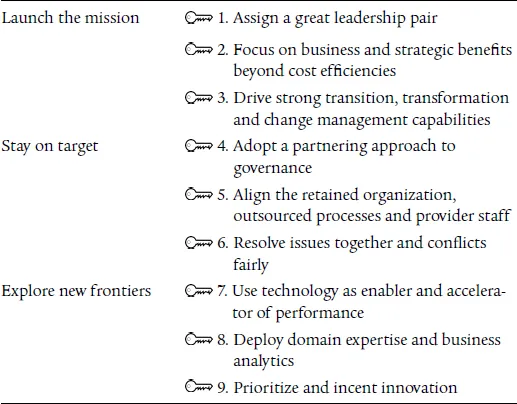
Key practices around establishing a relationship should happen first. These practices include assigning strong leaders, seeking business value beyond cost and managing the transition. Practices to keep relationships on target include governing end-to-end performance as partners, deeply involving the provider’s staff and solving inevitable service issues together. Once relationships are stable and delivering the anticipated business and strategic benefits, world-class performers unleash the power of technologies, analytics and innovations to deliver new value.
We think practitioners would benefit by adopting the practices in the order suggested in Table 1.1. Reality, of course, is messier. In our research, no best-in-class performers enacted the nine practices in precisely this sequence. Some BPO clients initially assigned lousy leaders, contracted too rigidly for cost efficiencies at the sacrifice of business benefits and failed to align their retained organizations with outsourced processes and provider staff. The consequences were poor to marginally acceptable performance. To rescue these BPO relationships, the partners in our study who enacted even some of the nine key practices dramatically improved performance. The very top BPO performers – those in the upper 20 per cent of performance – adopted seven or more of these practices. Our most powerful message is that it is never too late to improve BPO performance.
1.2. The BPO report card
There are many surveys that assess BPO performance, including our own academic review3 and the BPO survey conducted by Everest (see Appendix B for details on the survey).4 The academic review assessed three levels of performance: positive (56%), no change (33%) and negative (11%). The Everest survey assessed three levels: best-in-class (20%), potential best-in-class (20%) and typical (60%). Although the performance levels and rates vary depending on which survey is consulted, all of the evidence suggests that BPO performance varies widely across companies and industries. Our in-depth case studies conducted over the last 12 years find that BPO performance is best differentiated by four levels of performance: poor, doing okay, good and world-class (see Figure 1.1). We estimate that approximately 15 per cent of BPO relationships have poor performance, 40 per cent are doing okay, 25 per cent are good and 20 per cent are world-class performers.
Poor BPO performance is characterized, from the client’s perspective, by lack of cost savings (or worse – cost escalation after outsourcing), poor service performance and low client satisfaction. Poor BPO performance can result from failure to execute foundational processes, including a flawed business case, a tough-minded procurement process more suitable for the purchase of products rather than BPO services, lack of in-house client retained capabilities to integrate the provider successfully in the organization, poor knowledge transfer or poor provider staffing. Sometimes poor performance is only temporary (such as during a rocky transition), while sometimes poor performance lasts until the relationship terminates.
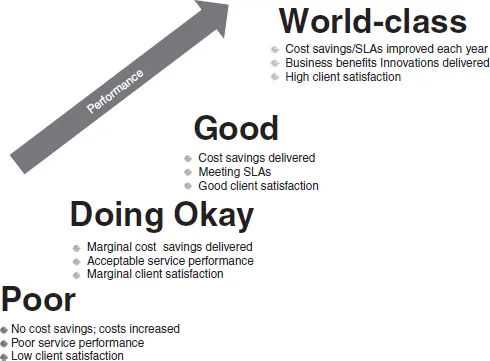
Figure 1.1 Levels of BPO performance
Doing okay performance is characterized, from the client’s perspective, by some cost savings and acceptable service performance, and mixed client satisfaction. The relationship struggles with some service lapses while other services are performing fine.
Good performance is characterized by cost savings delivered, by service levels that are ‘green’ (i.e. meeting contractual SLAs) and by good client satisfaction. These relationships are humming along, and partners are usually keen to ask ‘What’s next?’ What’s next is, potentially, world-class performance.
World-class performance is characterized by continual improvements in productivity (cost) and/or quality (service) for baseline services. Beyond baseline, the partners focus on continually improving the client’s key performance indicators (KPIs), not just improving SLAs. World-class relationships are also characterized by the high client satisfaction, continual rounds of innovation delivered and business benefits delivered.
BPO performance is not stationary – it can get better or worse over time (see Figure 1.2). During the life of a BPO relationship, one common pattern we found is that performance was often temporarily poor during the transition (1 to 3 months), and then proceeded to doing okay or good performance as the relationship stabilized. The quote from one client is representative of the trajectory of BPO performance and of the importance of communicating realistic expectations, ‘Communication is absolutely key. Tell the organisation what’s going to happen. Be realistic and tell the organisation, particularly the senior management of the organisation, that things will get worse before they get better. But give them a date. Tell them how long that pain is going to last. And of course, having told them, deliver to that timescale’. – BPO client
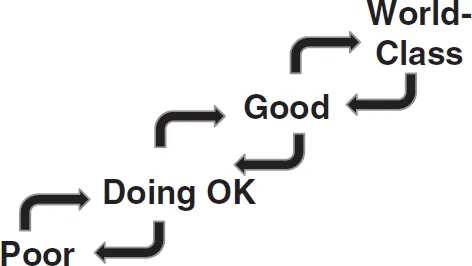
Figure 1.2 BPO performance can get better or worse over time
This book aims to help practitioners improve BPO performance by adopting the key practices that lead to world-class performance. Much like long-term, happy marriages, both partners have to stay engaged, enthusiastic and willing to execute the practices that deliver continually excellent results.
Although the four levels of performance – poor, doing okay, good and world-class – are described from the client’s perspective, data show that client performance is highly coupled with provider performance. In our prior outsourcing research, we investigated the relationship between client-reported performance and provider-reported performance in 85 client–provider matched pairs. Among the 85 reported relationships, 60 per cent had positive outcomes from both the client and provider perspectives – this is compelling evidence for the win–win (see Figure 1.3). There was also a strong connection between provider’s failing to earn their target profit margin on a deal and the client’s reporting of poor outcomes. In many poor-performing deals from a client’s perspective, the deals were bad for the provider as well. Specifically, in 18 per cent of the relationships, when the provider failed to earn their target margins, 14 per cent of clients reported poor outsourcing performance and only 4 per cent reported good outcomes. In contrast, providers met their target margins in 82 per cent of the deals, and only 19 clients (22%) reported poor outsourcing performance. This data is actually quite powerful because it shows that it is in the best interest of both parties to ensure a mutually beneficial relationship. The win–win relationship is not a nice-to-have, but a must-have.
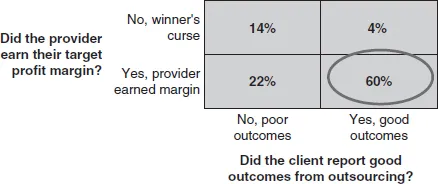
Figure 1.3 Client and provider outcomes: The evidence for the win–win (Source: Adapted from Kern et al. 2002)5
1.3. Sourcing practices that lead to good performance
One [foundational practice] is to baseline your performance, otherwise when the BPO starts working, people only notice what’s getting worse than before not necessarily when it is getting better. Also the business tends to have a very pink vision of how their life was in the past. So having a few baseline surveys is quite useful when it comes to showing if we are making progress or not making progress with facts rather than perceptions. – Global Procurement Manager
The majority of client firms, about 65 per cent of them, achieve BPO performance in the doing okay/good performance range. These clients often pursue outsourcing to reduce costs, to focus in-house staff on more strategic activities and to access provider skills. They expect the provider to deliver good services as defined, measured and reported on in SLAs. The fundamental practices to achieve cost savings, solid delivery on SLAs and good client satisfaction ratings are thoroughly covered in another book, Outsourcing: All You Ne...
Table of contents
- Cover
- Half-Title
- 1 Introducing the nine keys to world-class BPO
- 2 Key 1: Assign a great leadership pair
- 3 Key 2: Focus on business and strategic benefits beyond cost efficiencies
- 4 Key 3: Drive strong transition, transformation and change management capabilities
- 5 Key 4: Adopt a partnering approach to governance
- 6 Key 5: Align the retained organization, outsourced processes and provider staff
- 7 Key 6: Resolve issues together and conflicts fairly
- 8 Key 7: Use technology as enabler and accelerator of performance
- 9 Key 8: Deploy domain expertise and business analytics
- 10 Key 9: Prioritize and incent innovation
- 11 Microsoft case study: Engaging a BPO provider to help create OneFinance
- 12 BP case study: Reclaiming world-class performance
- 13 EMC case study: Journey to world-class performance
- 14 TalkTalk case study: Transforming a vendor into a partner
- Appendix A: Research base and method
- Appendix B: Assessing leadership pair effectiveness
- Index
- Copyright
Trusted by 375,005 students
Access to over 1.5 million titles for a fair monthly price.
Study more efficiently using our study tools.
Frequently asked questions
Yes, you can cancel anytime from the Subscription tab in your account settings on the Perlego website. Your subscription will stay active until the end of your current billing period. Learn how to cancel your subscription
No, books cannot be downloaded as external files, such as PDFs, for use outside of Perlego. However, you can download books within the Perlego app for offline reading on mobile or tablet. Learn how to download books offline
Perlego offers two plans: Essential and Complete
- Essential is ideal for learners and professionals who enjoy exploring a wide range of subjects. Access the Essential Library with 800,000+ trusted titles and best-sellers across business, personal growth, and the humanities. Includes unlimited reading time and Standard Read Aloud voice.
- Complete: Perfect for advanced learners and researchers needing full, unrestricted access. Unlock 1.5M+ books across hundreds of subjects, including academic and specialized titles. The Complete Plan also includes advanced features like Premium Read Aloud and Research Assistant.
We are an online textbook subscription service, where you can get access to an entire online library for less than the price of a single book per month. With over 1.5 million books across 990+ topics, we’ve got you covered! Learn about our mission
Look out for the read-aloud symbol on your next book to see if you can listen to it. The read-aloud tool reads text aloud for you, highlighting the text as it is being read. You can pause it, speed it up and slow it down. Learn more about Read Aloud
Yes! You can use the Perlego app on both iOS and Android devices to read anytime, anywhere — even offline. Perfect for commutes or when you’re on the go.
Please note we cannot support devices running on iOS 13 and Android 7 or earlier. Learn more about using the app
Please note we cannot support devices running on iOS 13 and Android 7 or earlier. Learn more about using the app
Yes, you can access Nine Keys to World-Class Business Process Outsourcing by Mary Lacity,Leslie Willcocks in PDF and/or ePUB format, as well as other popular books in Business & Business General. We have over 1.5 million books available in our catalogue for you to explore.