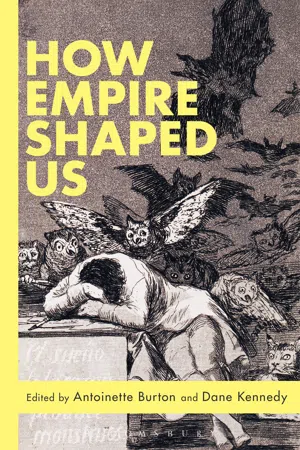
Few historical subjects have generated such intense and sustained interest in recent decades as Britain's imperial past. What accounts for this preoccupation? Why has it gained such purchase on the historical imagination? How has it endured even as its subject slips further into the past?
In seeking to answer these questions, the proposed volume brings together some of the leading figures in the field, historians of different generations, different nationalities, different methodological and theoretical perspectives and different ideological persuasions. Each addresses the relationship between their personal development as historians of empire and the larger forces and events that helped to shape their careers. The result is a book that investigates the connections between the past and the present, the private and the public, the professional practices of historians and the political environments within which they take shape. This intellectual genealogy of the recent historiography of empire will be of great value to anyone studying or researching in the field of imperial history.
- 272 pages
- English
- ePUB (mobile friendly)
- Available on iOS & Android
eBook - ePub
How Empire Shaped Us
About this book
Information
1
From Empire to India and Back:
A Career in History
Thomas R. Metcalf
b. 1934
The first course I ever taught, as a graduate student at Cambridge University, was ‘The Expansion of Europe’. My task as a tutor during the academic year 1956/7 was to prepare undergraduates for their year-end tripos exams. The last full course I taught was the ‘British Empire’, as a seminar for graduate students and as a lecture course for undergraduates, during the spring semester of 2007 at the University of California, Berkeley – exactly fifty years later. The intervening fifty years encompassed a professional career in which, as the historiography flowed first in one direction and then in another, and then back again, the British Empire, and above all the Raj in India, defined my enduring scholarly engagement. An account of this career, as one individual threaded his way through it, may help illuminate the larger shifts and turns of imperial history in the latter half of the twentieth century. At its core are my two years at Cambridge University, where I studied with Ronald Robinson and experienced first hand the tumult of the 1956 Suez Crisis. These were followed over the subsequent decade by a struggle to secure regular university employment in the new environment of the 1960s as the US began to engage with the ‘Third World’ and scholars disparaged Britain’s imperial past.
Empire
As a youth growing up in a small city in upstate New York, with a father who was an engineer, and a mother who, despite having a college degree, was a homemaker, I was in no obvious way drawn to the study of history. My schooling, even in high school, was bland and uninspiring. History was taught only tangentially under the label ‘civics’, and even then, for fear of McCarthyism, anything that might be controversial was adroitly skirted. I have no recollection of India’s independence in 1947. What did engage me, from at least the age of ten, was collecting postage stamps. I still have, on a shelf above my desk, the albums that contain my collection. At its heart are the stamps of the British Empire. I was drawn to them I imagine in part because of my parallel youthful fascination with geography. There were just so many British colonies scattered all around the globe, and the stamps were often decorated with colourful local scenes. At the same time, during those years I closely followed the battles of the Second World War, and watched from a distance as my father, dodging German bombs, worked on the development of Britain’s radar network and then in the Pacific on the deployment of the atomic bomb. Poring over a map was for me as a youth never only an academic exercise. In high school I joined local chapters of the World Federalists and the United Nations Association. By the early 1950s I was fully aware of America’s growing world predominance, and I supported such actions as the Korean War. Yet I was anxious that this power be contained within a larger world order. ‘We’ would not issue stamps from numerous colonies!
From high school I went on to Amherst College in 1951. Here I first encountered history taught as a serious academic subject, and was soon drawn to it. I wrote a senior honours thesis on ‘The Development of Liberalism in the Thought of William Ewart Gladstone, 1831–1868’. Why did I care about liberalism? Perhaps as an enthusiastic liberal myself – I had stood in the crowd at the railway station when Harry Truman came to my town on his ‘whistle-stop’ tour in 1948 and a few years later I supported the doomed candidacy of Adlai Stevenson – I wanted to see where the ideas of liberalism had come from, and how and why they had flourished. For this purpose it made sense to me on completion of my Amherst degree to pursue British history in Britain itself. I enroled at Cambridge University with the aim of pursuing a second BA (as was the case for overseas students in those days when separate Master’s programs did not exist). By a serendipitous chance – a wartime friend of my father’s was a graduate – I joined St Johns College, and was assigned Dr Ronald Robinson as my supervisor. Two years before, in collaboration with John Gallagher next door at Trinity, he had published a path-breaking article on the ‘Imperialism of Free Trade’; and he was then engaged in the writing of what would become Africa and the Victorians (1961).
When I appeared at Robinson’s door, I had already begun to wonder why empire had made no appearance in my senior thesis. I had included such topics as Peelite free trade and church disestablishment, but the historiography that I had unquestioningly accepted spoke of the mid-Victorian era as a time of ‘anti-imperialism’, especially among liberals such as Gladstone. Yet I could plainly see that the empire was expanding during the 1840s and 1850s in India and South Africa, that British overseas trade was growing dramatically as the country made itself into the ‘workshop of the world’, and that Britain, from the 1850 Don Pacifico affair to the two Opium Wars, was unhesitatingly asserting its power around the globe. None of these events could plausibly be explained under any theory of mid-Victorian ‘anti-imperialism’.
Hence, I quickly fell under Robinson’s spell. With his encouragement I decided to compress the usual two-year course into one year, and to devote the second year to research. Unfortunately, when I came up for the Expansion of Europe tripos examination at the end of my first year, I found myself confronted with questions that my studies with Robinson had left me unprepared to answer. What was I to make of a question such as, ‘To what do you attribute Portuguese success in Brazil?’ (I still have the exam paper.) I was not surprised when I did not receive a ‘first class honours’ degree from Cambridge.
But it did not matter, for I now had a year in which to devise a doctoral project. Robinson was himself a historian of Africa. So I assumed that, as his student, I should work on Africa as well. To my surprise, he replied, ‘I am doing Africa. You do India.’ I protested that I knew nothing about India and had no topic in mind. (My initial thoughts had been directed either to Sierra Leone or the Chinese treaty ports.) He then gave me a research topic: the 1857 revolt. Again, I protested that I knew nothing about it. But that did not alter his opinion. So, as my research year began, every morning I bicycled to the Cambridge University Library, and set about methodically going through its voluminous holdings, reading everything on the mid-Victorian empire to see what I might come up with for a topic. I knew I would focus on the ties between liberalism and empire, but there existed almost nothing in print to guide me. (Eric Stokes’s magisterial The English Utilitarians and India only appeared three years later, in 1959.)
My ideas took shape gradually during that autumn of 1956. In weekly letters to my parents I sought to describe the process. Initially, in early October I wrote simply that I would ‘of course be having regular meetings with my supervisor Dr. Robinson to discuss my reading and try to get a project in motion’. Naively, I continued, ‘The main problem in doing a thesis is that of defining the topic; once you know what you are trying to do, actually doing it is relatively easy.’ A month later, with the Suez crisis raging outside, I was closing in on a topic. I had decided to study, as I wrote on November 11, ‘the conflict between the mid-Victorian ideology – of free trade and liberalism and the moral superiority of England and of Christianity – and the practical results of their experience in ruling India’. The Mutiny, I continued, was the ‘key point’ that forced Britain to realize that its policy and attitude to India must be changed, ‘because India could not be made into a copy of 19th century England’. Here, in a nutshell, was the argument of my dissertation, and subsequently of The Aftermath of Revolt: India 1857–1870, published in 1964.
To undertake the necessary archival research, I soon discovered, was no ‘easy’ matter. During the 1950s, the India Office records were still housed in the old India and Foreign Office Building off Whitehall, constructed in the 1860s, with a looming statue of Clive at the end of King Charles Street. While it was exciting to ‘hob nob’ with diplomats, as I wrote in mid-December when I first ventured in, ‘There are so many documents in the India Office I do not know where to start.’ Overwhelmed, after a week I abandoned the enterprise ‘until I know what I am trying to do’. In the end sustained archival research had to await my return to Britain, and then on to India, some three years later.
Much else besides my work with Robinson shaped my engagement with the empire during my years at Cambridge. Many of my friends were, at least initially and perhaps not wholly by chance, fellow ‘colonials’, from Australia, New Zealand, even Mauritius. My roommate one year was from Malaya, just then gaining its independence. Man Mohan Singh, later prime minister of India, was also a classmate at St Johns. What were they all doing at Cambridge, I often asked myself? From them I gained some sense of what the empire meant, as it shaped the lives of its former colonial subjects. Though keen on taking advantage of an English education – my Malayan roommate subsequently became a prosperous lawyer in Singapore – they were not, as I saw it, what Homi Babha later would call ‘mimic men’, seeking unsuccessfully to become English.
Then too, above all, there was the Suez crisis. As a naive American liberal, I was unprepared for the storm that burst over Britain in the fall of 1956. I could not fathom how Anthony Eden could join a conspiracy to invade Egypt, nor could most of my Cambridge friends. I participated in a number of anti-war protests, and several heated discussions. Only later, when I visited friends’ families in the countryside over the winter holidays, did I come to realize how much the empire meant to Britons across wide sections of the public. Indeed, people I met left me in no doubt about their bitter feelings of betrayal when President Eisenhower forced the British to call off the invasion. Some of their animosity was even directed at me as an American – the only time this ever happened. The trauma of Suez seemed also to validate my own commitment to the study of imperialism. My work, as I wrote in a letter at the height of the crisis, ‘does throw light on the present situation’. After Suez I came to realize that the study of empire was a project worth undertaking, and further that imperialism would not simply disappear without a trace. Did I take up the study of the British Empire so that I could better understand the growing world power of the United States? I cannot say. But, clearly, as an American of the mid-twentieth century I could not escape complicity in it.
From Empire to India
Upon my return from England, I enroled at Harvard to complete my PhD. Using only published library sources, and building upon the work I had done at Cambridge, I finished the dissertation in two years. I then secured a position as instructor at the University of Wisconsin in Madison, where I was hired to teach both British and Indian history. This dual position suited me, but by 1960 the academic world was beginning to shift beneath my feet. Above all, with the collapse of the empire, imperial history fast went out of favour. In Britain, the subject became prey to nostalgia, regret and general indifference among scholars. E. P. Thompson, for instance, took up the study of the English working classes rather than that of the Raj of his childhood, while Eric Hobsbawm sought ‘primitive rebels’ in Europe not in the empire. In the United States, propelled by the Cold War, and then by the enthusiasms of the Kennedy era, scholars turned first to study of the nation’s antagonists, the Soviet Union and ‘Red China’, and then to the newly freed states of South Asia and Africa. America now required knowledge of the so-called ‘Third World’; the lens of empire no longer sufficed. Hence scholars sought, by studying such topics as rural social change and political mobilization, to make sense of the histories of former colonial societies from within and from below. In the United States this new style of research, which informed work in the social sciences more generally, came to be known as ‘area studies’. Much of this, of course, under the label ‘development studies’, advanced American interests in encouraging capitalist economies and political stability. Still, from the early 1960s, the government began an extensive programme of supporting language and area studies by creating research centres and fellowship programmes. Ancillary organizations, partly foundation funded, such as the American Institute of Indian Studies, grew up alongside these government programmes, so that over the last fifty years almost all American scholars of countries such as India have secured research support during their careers.
My position at Wisconsin was among the earliest casualties of this new scholarly turn. In 1960 Wisconsin’s newly hired African historian, Philip D. Curtin, though himself schooled in imperial history, established a graduate training programme called Comparative Tropical History. This programme sought to co...
Table of contents
- Cover
- Title Page
- Contents
- Notes on Contributors
- Introduction: The Autobiographical Pulse in British Imperial History
- 1 From Empire to India and Back: A Career in History
- 2 Seven Pivots Towards Empire
- 3 Empire From Above and From Below
- 4 Empire and Class: The Making of a History Boy
- 5 Inside/Outside: A Non-native Caribbeanist’s Journey
- 6 With and Against the Grain
- 7 In and Out of Empire: Old Labels and New Histories
- 8 An Education in Empire
- 9 A Child of Decolonization
- 10 From South Asian Studies to Global History: Searching for Asian Perspectives
- 11 Crooked Lines and Zigzags: From the Neocolonial to the Colonial
- 12 Some Intimacies of Anglo-American Empire
- 13 Homes and Native Lands: Settler Colonialism, National Frames and the Remaking of History
- 14 Empire Made Me
- 15 Paths to the Past
- 16 Conversations with Caroline
- 17 Dis-oriented in a Post-imperial World
- Index
- Copyright
Trusted by 375,005 students
Access to over 1.5 million titles for a fair monthly price.
Study more efficiently using our study tools.
Frequently asked questions
Yes, you can cancel anytime from the Subscription tab in your account settings on the Perlego website. Your subscription will stay active until the end of your current billing period. Learn how to cancel your subscription
No, books cannot be downloaded as external files, such as PDFs, for use outside of Perlego. However, you can download books within the Perlego app for offline reading on mobile or tablet. Learn how to download books offline
Perlego offers two plans: Essential and Complete
- Essential is ideal for learners and professionals who enjoy exploring a wide range of subjects. Access the Essential Library with 800,000+ trusted titles and best-sellers across business, personal growth, and the humanities. Includes unlimited reading time and Standard Read Aloud voice.
- Complete: Perfect for advanced learners and researchers needing full, unrestricted access. Unlock 1.5M+ books across hundreds of subjects, including academic and specialized titles. The Complete Plan also includes advanced features like Premium Read Aloud and Research Assistant.
We are an online textbook subscription service, where you can get access to an entire online library for less than the price of a single book per month. With over 1.5 million books across 990+ topics, we’ve got you covered! Learn about our mission
Look out for the read-aloud symbol on your next book to see if you can listen to it. The read-aloud tool reads text aloud for you, highlighting the text as it is being read. You can pause it, speed it up and slow it down. Learn more about Read Aloud
Yes! You can use the Perlego app on both iOS and Android devices to read anytime, anywhere — even offline. Perfect for commutes or when you’re on the go.
Please note we cannot support devices running on iOS 13 and Android 7 or earlier. Learn more about using the app
Please note we cannot support devices running on iOS 13 and Android 7 or earlier. Learn more about using the app
Yes, you can access How Empire Shaped Us by Antoinette Burton, Dane Kennedy, Antoinette Burton,Dane Kennedy in PDF and/or ePUB format, as well as other popular books in History & 19th Century History. We have over 1.5 million books available in our catalogue for you to explore.