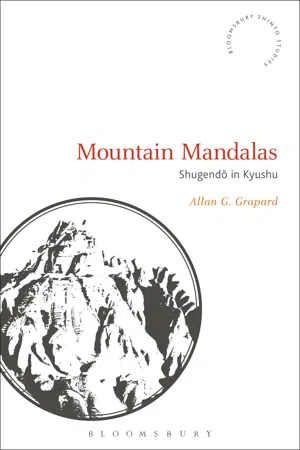
In Mountain Mandalas Allan G. Grapard provides a thought-provoking history of one aspect of the Japanese Shugendo tradition in Kyushu, by focusing on three cultic systems: Mount Hiko, Usa-Hachiman, and the Kunisaki Peninsula. Grapard draws from a rich range of theorists from the disciplines of geography, history, anthropology, sociology, and humanistic geography and situates the historical terrain of his research within a much larger context.
This book includes detailed analyses of the geography of sacred sites, translations from many original texts, and discussions on rituals and social practices. Grapard studies Mount Hiko and the Kunisaki Peninsula, which was very influential in Japanese cultural and religious history throughout the ages. We are introduced to important information on archaic social structures and their religious traditions; the development of the cult to the deity Hachiman; a history of the interactions between Buddhism and local cults in Japan; a history of the Shugendo tradition of mountain religious ascetics, and much more.
Mountain Mandalas sheds light on important aspects of Japan's religion and culture, and will be of interest to all scholars of Shinto and Japanese religion. Extensive translations of source material can be found on the book's webpage.
- 320 pages
- English
- ePUB (mobile friendly)
- Available on iOS & Android
eBook - ePub
About this book
Information
The term Shugendō may be translated as “Way to Supernatural Powers” and refers to an institutional and ritual system that was elaborated over a period of several centuries on the basis of various cults in the mountains of Japan. On the ritual level Shugendō evolved as a vehicle to realize Buddhahood by means of austerities and ascetic practices that were executed in mountains, and through the performance of rituals that were drawn, for the most part, from Esoteric Buddhism. These practices were sometimes related to Daoism as well, and Shugendō practitioners also created and maintained diverse cults dedicated to a multitude of native (Japanese) and foreign (Indian, Chinese, and Korean) entities. On the institutional level these mountain cults were managed by what is often referred to as (Shinto) shrines and (Buddhist) temples, but it is imperative to point out that these shrines and temples were associated for most of their history and formed vast cultic centers contemporary Japanese scholars call “shrine-temple complexes” (jisha or, less commonly, shaji). Popularly known as yamabushi, Shugendō practitioners were ubiquitous in Japanese society for nearly one thousand years; they almost completely vanished from the landscape in 1872, when the Japanese government issued a decree that abolished Shugendō and forced its members to abandon their institutions and return to lay life. This decree was enforced until 1882 when the government allowed yamabushi to reorganize (along its rules), but the profound damage done by the 1868 events was irreversible. The post-war constitution of 1945 guaranteed freedom of religion, and some Shugendō groups reconstituted themselves as best they could, and are quite active. Before they were submitted to the political and social erasures characteristic of Japan’s modern reconfiguration of cultural discourses and reorganization of social, economic, and physical spaces, however, these yamabushi had produced a striking culture. Based on pan-Asian ritual practices issued from Indian cults as well as Chinese Daoist practices, Korean mountain cults, and indigenous, local cults, this culture was also the result of combinations with the high theological and ritual traditions of Esoteric Buddhisms. In their Shingon (tōmitsu) and Tendai (taimitsu) forms, Japanese Esoteric Buddhisms long dominated Japanese ritual practices and soteriology, within institutional contexts that were often related to the imperial court’s outlook on power and legitimacy. Due to these multifarious combinations and to very diverse local conditions, the yamabushi produced social and cultic systems that are distinct from (but sometimes related to) other mountain cults in Asia and this sets them apart in ways that must be reflected in the means devised to study them. Shugendō institutions were sponsored or controlled successively by emperors, courtiers, warlords, and commoners, and their adherents had an apparently unlimited ability to assimilate, retain, create, or transform a variety of practices ranging from sophisticated “technologies of the self” to the most peculiar therapeutic devices and to self-torturing mortifications, including dances as well as contests of physical and spiritual strength. Constituted through the combinations of elements of several Asian cultures and through interactions between diverse social groups as it was, Shugendō formed a cornerstone of Japanese culture: it produced or refined elements of the philosophy and practice of space which characterize that culture, and it was instrumental in the formation of the concept of Japan as a territorial entity suffused with a sublimed character. It was, therefore, far more than a “folk religion,” the status to which it has been relegated by some Japanese scholars as well as by most Western scholars. Sustained academic attention to the world of Shugendō should contribute to a more provocative history of the relations between the physical and cultural landscapes of Japan, and may also lead to a reconsideration of the categories customarily used in the analysis of that country’s social, cultic, and political history. As a consequence of the features outlined above, and whenever possible, the term “religion” will be abandoned in this study and will be replaced with the term “cultic and cultural systems.”
Japanese scholars almost invariably state that nature worship (shizen sūhai) and mountain creeds (sangaku shinkō) represent some of the oldest traceable components of their country’s spiritual character. Basing himself on the fact that about 74 per cent of the Japanese archipelago’s landmass consists of mountains, Murayama Shūichi, for example, suggests that Japan’s history is really the history of its mountains. He adds that the yamabushi’s attire and institutional affiliations linked them to major Buddhist temples, but that the mountains where they practiced and to which they dedicated cults as though they were living sacred entities, were actually pre-Buddhist sites of worship, a worship he says never dwindled. Murayama goes on to list the sites of mountain shrines recorded in official documents of the tenth century, thereby giving the impression that Shugendō came to be practiced in mountains that had long been regarded as sacred, and that it evolved as a Shinto-Buddhist combinatory cultic and cultural system in which one can also identify traces of “primitive magic,” Yin-Yang views and practices (onmyōdō), and mystical and therapeutic practices of various origins. Furthermore, Murayama points out that the study of Shugendō belongs to the domain of the ethnographer (because the yamabushi had a long history of complex interactions with commoners), but that it is also, though only collaterally, the domain of historians of religions and politics (because Shugendō was necessary to the aristocratic and military ruling classes, which used it for their own political and personal purposes.) This stance toward Shugendō is shared by leading authorities on the topic such as Miyake Hitoshi, Wakamori Tarō, Gorai Shigeru, and many others. Indeed, it is appropriate to reiterate here their view, according to which the world of the yamabushi has left deep traces not only on many mountains, but also on literature, the performing and visual arts, and concepts of legitimacy. All Japanese scholars agree on these points, and their research, which must be deemed of outstanding quality, is germane to some arguments this study will propose.
A significant aspect of Shugendō is missing from the majority of studies published heretofore, however, and it can be characterized in two words: spatial knowledge. That is, even though Shugendō occupied the majority of Japan’s mountainous areas, and even though its practitioners stressed spatial aspects in their soteriology as well as in their cosmography and rituals, virtually no scholar has attempted to reconstruct the spatial dimensions of a meticulously elaborated world. Surprisingly, human geography and cartography are absent from the majority of studies of Shugendō that have been written in or out of Japan. A possible explanation is that Japanese scholars have taken mountain sites of cult for granted; indeed, their understanding that cultic and cultural systems are primarily grounded in specific sites is shared by most scholars of history, if not by the Japanese population at large. When this notion is not critically analysed, however, and when it is coupled with the equally shared premise that sacred mountains are extremely ancient and self-evident phenomena, students of Shugendō are prevented from problematizing space and from explaining how and why sites of cult became the object of elaborate cults of sites, or the object of so many conflicts.
In contradistinction to the position outlined above and espoused by the majority of interpreters of Shugendō, it may be argued that the generally accepted but unexamined claim that mountains were sacred to begin with is ideologically biased, in that it privileges supposedly native conceptions while positing an ontological argument to the effect that sacredness was “always already there.” This claim has no plausibility as an explanation for the phenomena investigated in the following study, for it appears to be the grandchild of early-modern nativist views and of modern totalizing trends informed by nationalistic ideology. Alternative attempts to define the sacred character of Japanese mountains by describing exotic practices or linking them to concepts of the otherworlds have equally failed, in that they lack comprehensiveness or historical depth. In a similar vein, the classical or paradigmatic view of sacred space held in the past by many Western historians of religions has tended to obfuscate the concept, in overloading it with metaphysical properties while emptying it of its historical and locale-specific features, and this academic trend may have been instrumental in preventing a detailed analysis of the ways in which some Japanese constructed, interpreted, and contested both the space of their existence and those apparently special cases of sites to which the term “sacred” has been affixed uncritically. The following study attempts to remedy this presumed inadequacy by positing “space,” and the yamabushi’s understanding and construction of it, as one of its central problems. In undertaking to illuminate both the temporal and spatial components of Shugendō’s world, it borrows from both history and geography, looking for elements of a geohistorical synthesis that might yield more distinctive features of that world’s spatial and social character, and it must therefore be limited to a given region. To resist any totalizing wish, Shugendō will not be treated here as a single phenomenon thought to have remained the same throughout Japan’s history and space, but as a set of specific modalities of the relations of a given population to its geographical and historical conditions. The region proposed for consideration is located in the northeastern part of Kyushu Island and consists of three major sites of cult discussed below in relation to each other: the Usa Hachiman Shrine-temple complex, Mount Hiko, and the Kunisaki Peninsula.
Five reasons for this choice may be offered here. First, Mount Hiko’s summits and those of the Kunisaki Peninsula are separated by only fifty kilometers and share profound ties with the original Hachiman site of cult that is nested between them in Usa. Geographical proximity notwithstanding, the inhabitants of these three neighboring regions elaborated remarkably different habits of thought and practice over time and, as we will see, the experience of space the yamabushi constructed in each case was related—only in part but specifically—to their perception and interpretation of the geographical and morphological features of their surroundings, and to the nature of their rituals. Second, the regions under consideration are ideally suited for the study of the historical appropriation, assimilation, and transformation of non-Buddhist cults by Buddhist systems of thought and practice: the Hachiman cult is Japan’s foremost and oldest combinatory cult, and neither Mount Hiko’s nor the Kunisaki Peninsula’s cults were ever independent from it prior to 1868—when the great divide between Shinto and Buddhism was institutionalized. It may sound strange to mention in the same breath Shugendō and the Hachiman cult. However, they were tightly associated in Kyushu, in their origins as well as during their long history: all historical sources at our disposal mention them together, and this association needs elucidation. Third, in the late sixteenth century Mount Hiko was home to Akyūbō Sokuden, a yamabushi whose works became the backbone of Shugendō’s unified doctrine and ritual procedures during the early modern period (1615–1868). Fourth, the post-Meiji fate of these three closely related sites of cult was strikingly different, and the reasons for this difference need elucidation and have some bearing on the nature of this study. Finally, the Hachiman cult was an oracular and territorial cult sponsored by the imperial lineage, by courtiers of the Nara (710–84) and Heian (794–1185) periods, as well as by warlords of the Kamakura (1185–1333) and Muromachi (1333–1570) periods. This cult’s spatial and other properties will in some significant ways assist in outlining the parameters of concepts of territoriality that were operative during much of Japanese history, in the sense that they sustained the production of a number of ideological propositions, ritual practices, political decisions and acts, and confl...
Table of contents
- Cover
- Dedication
- Series Page
- Title Page
- Contents
- Illustrations
- Preface
- Organization of the Book
- Acknowledgements
- Note on Translation and Text
- 1 Shugendō and the Production of Social Space
- 2 Geotyped and Chronotyped Social Spaces
- 3 Festivities and Processions: Spatialities of Power
- 4 Shattered Bodies, Statues, and the Entreaties of Truncated Memory
- Afterword: From Spatialities to Dislocation
- Japanese Glossary
- Notes
- Bibliography
- Index
- Copyright
Trusted by 375,005 students
Access to over 1.5 million titles for a fair monthly price.
Study more efficiently using our study tools.
Frequently asked questions
Yes, you can cancel anytime from the Subscription tab in your account settings on the Perlego website. Your subscription will stay active until the end of your current billing period. Learn how to cancel your subscription
No, books cannot be downloaded as external files, such as PDFs, for use outside of Perlego. However, you can download books within the Perlego app for offline reading on mobile or tablet. Learn how to download books offline
Perlego offers two plans: Essential and Complete
- Essential is ideal for learners and professionals who enjoy exploring a wide range of subjects. Access the Essential Library with 800,000+ trusted titles and best-sellers across business, personal growth, and the humanities. Includes unlimited reading time and Standard Read Aloud voice.
- Complete: Perfect for advanced learners and researchers needing full, unrestricted access. Unlock 1.5M+ books across hundreds of subjects, including academic and specialized titles. The Complete Plan also includes advanced features like Premium Read Aloud and Research Assistant.
We are an online textbook subscription service, where you can get access to an entire online library for less than the price of a single book per month. With over 1.5 million books across 990+ topics, we’ve got you covered! Learn about our mission
Look out for the read-aloud symbol on your next book to see if you can listen to it. The read-aloud tool reads text aloud for you, highlighting the text as it is being read. You can pause it, speed it up and slow it down. Learn more about Read Aloud
Yes! You can use the Perlego app on both iOS and Android devices to read anytime, anywhere — even offline. Perfect for commutes or when you’re on the go.
Please note we cannot support devices running on iOS 13 and Android 7 or earlier. Learn more about using the app
Please note we cannot support devices running on iOS 13 and Android 7 or earlier. Learn more about using the app
Yes, you can access Mountain Mandalas by Allan G. Grapard in PDF and/or ePUB format, as well as other popular books in Theology & Religion & Asian Religions. We have over 1.5 million books available in our catalogue for you to explore.