Bringing together an impressive cast of well-respected scholars in the field of modern Russian studies, Russian History through the Senses investigates life in Russia from 1700 to the present day via the senses. It examines past experiences of taste, touch, smell, sight and sound to capture a vivid impression of what it was to have lived in the Russian world, so uniquely placed as it is between East and West, during the last three hundred years.
The book discusses the significance of sensory history in relation to modern Russia and covers a range of exciting case studies, rich with primary source material, that provide a stimulating way of understanding modern Russia at a visceral level.
Russian History through the Senses is a novel text that is of great value to scholars and students interested in modern Russian studies.
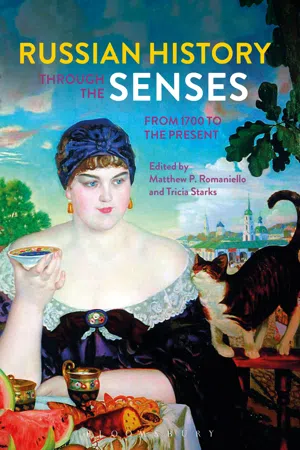
eBook - ePub
Russian History through the Senses
From 1700 to the Present
- 320 pages
- English
- ePUB (mobile friendly)
- Available on iOS & Android
eBook - ePub
Russian History through the Senses
From 1700 to the Present
About this book
Information
CHAPTER ONE
Introduction: The sensory in Russian and Soviet history
Many people interested in the past like historical fiction better than works of scholarship. Of course, fiction writers have the unfair advantage of being able to invent romantic plotlines and probe the intimate thoughts of their characters, but they also manage to give texture to their stories by evoking the primal, almost instinctual ways in which we experience the world around us. What emotions are triggered in us by a religious service, a football game, a battlefield, a favorite movie? What memories stir at the sound of an old pop song, the smell of a freshly mowed lawn, the heat of a summer day, or the sting of an insect bite?
Any depiction of our lives would be incomplete without these fleeting, elusive feelings and perceptions, yet accounting for them confronts the historian with great challenges. My mother spent her childhood during the Second World War in a German city subject to frequent air raids, and that memory left her, and probably many of her generation, with a visceral dislike for the wail of early-warning sirens. Her uncle fought on the Western Front in the First World War and later said that when you approached the frontlines, what struck you from afar was not only the sound but the stench (of sewage, corpses, explosives, and much besides), and one wonders: how did this experience affect him after he returned to civilian life? In both cases—the sound of sirens and the smell of the trenches—a sense impression affected how people experienced and remembered history. Experiences like these are everywhere in history, from the sound of medieval church bells to the coal smoke of Victorian London or the sultry heat of a Southern cotton field. Such things are formative for entire generations, peoples, and social classes, but how do we fit them into the historical record?
In recent decades, historians have increasingly sought solutions to this conundrum. For instance, the French historian Alain Corbin, a pioneer in this field, wrote about why the French upper classes around 1800 developed a distaste for the heavy, musky perfumes that they had traditionally favored. One of the reasons, he found, was that after the upheavals of the French Revolution, these smells had started to remind them uncomfortably of the odor of the poor. As Corbin’s study shows, what was thought to smell good or bad could change from one era to the next, and people’s sense perceptions evolved in tandem with the larger forces of history.1
The senses thus provide an avenue for understanding how people interpret, at a holistic and non-rational level, situations that are difficult or unfamiliar. This brings us to Russia. As the chapters in this volume show, Russian history abounds with cases where people have encountered realities that they found utterly alien. Some of these experiences of alterity, such as deafness or war, occur in all societies, but others are more specific to Russia. The reason is that so many of the people who created our historical sources either came to Russia from abroad, or tried to transform how Russia worked, or felt alienated from the way Russians lived in the present or the past, and in each case, the encounter with Russia affected the senses. Europeans found the Russian winters astonishingly cold. Educated Russians in the nineteenth century constructed their national identity by studying the exotic customs of the common people, including their foods. In the twentieth century, ideas about both the utopian communist future and, once the Soviet Union was gone, the totalitarian past, were associated with a particular smell, taste, feel, look, and sound. Russian history has created experiences that seemed unfamiliar, even bewildering to many people, or at least, to many of those who produced our historical sources. The senses provide an entry point into those perceptions.
In the pages that follow, we will begin with a brief overview of the chapters in this volume. To provide a context, we will then consider the scholarly literatures to which they contribute, and finally, how they are linked together by three larger themes: collective identities, experiments in social engineering, and war.
Overview
The chapters in this collection are divided into four broad categories that reflect the radical discontinuities in Russian history.
In the imperial period of the eighteenth and nineteenth centuries, Russians encountered Europe and faced two new challenges. First, how to define Russia’s identity: what made Russia a distinctive nation, and how did that distinctiveness “feel”? Matthew P. Romaniello and Alison K. Smith engage this question by examining weather and food: how did Europeans who froze in the Russian winter interpret that sensation in light of their own theories about climate and the human body, and how did upper-class Russians use the taste of fermented foods to construct a sense of what made something “taste” either Russian or European? Second, like all European and Western societies, Russia faced the challenge that modernity posed to older ways of imagining class, gender, and the place of one’s own nation in the larger world. One aspect of this, discussed by Abby Schrader, was consumerism. Shopping traditionally took place in musty, unheated, dimly lit bazaars. Then a competitor arose in the form of elegant arcades, forerunners of today’s shopping malls, which transformed the sensory experience of shopping and scrambled the rules governing how the sexes interacted in public places. Tricia Starks examines another sensory experience of modernity, the smoke of cigarettes, and how tobacco—where it came from, how it was blended and marketed, how it smelled—affected Russians’ ideas about foreign countries, colonialism, and the class structure of their own society.
The First World War plunged Russia into a crisis that destroyed the monarchy, leading to the Bolshevik Revolution and a calamitous civil war that ended only with the establishment of Soviet rule. Aaron B. Retish’s chapter uses a traditional alcoholic drink of the Udmurt people to examine how officials and the educated public dealt with peasants and ethnic minorities throughout the period of war and revolution. Laurie S. Stoff adopts an entirely different perspective: she focuses on middle- and upper-class Russian and European women who volunteered to serve as nurses in the Russian army, and their traumatic encounter with the sights, sounds, and smells of men wounded in battle.
The final two sections of the book are devoted to the Soviet era. The first examines how the senses helped build the new Soviet order, and reveals the mixed results of the regime’s attempts to mold a New Soviet Person with specific sensory perceptions. Anton Masterovoy shows how the Soviet state responded to persistent food shortages by engineering new foodstuffs and then trying, without much success, to re-educate people’s taste buds accordingly. Steven G. Jug looks at what soldiers during the Second World War saw, smelled, touched, heard, and tasted, and how their experience contradicted the image of the war in the regime’s propaganda. Claire Shaw explores the complicated position of the deaf in a Soviet system that wanted to integrate them into mainstream society but was ambivalent about sign language as a legitimate form of communication.
The last section of the book is about the senses and the shaping of Russian memories of the Soviet period. Tim Harte analyzes two movies by the filmmaker Aleksei German, Sr. that capture the oppressiveness of the Stalin era through disturbing evocations of its sights and smells. Adrienne Harris, finally, takes us back to the Second World War through the figure of Zoia Kosmodemianskaia, a young partisan tortured and hanged by the Germans, who for decades persisted in the Russian collective memory through iconic photographs of her mutilated body and the written record of the last words that she spoke.
Historiographical contexts
The chapters in this volume are original pieces of research by the individual authors, but they also form a part of larger intellectual traditions. Let me point out five of these to help provide a framework for understanding the chapters.
One is the work of Walter Benjamin (1892–1940), a German social theorist of the interwar period. Benjamin drew inspiration from Karl Marx’s idea of “commodity fetishism.” What Marx meant by this is that the actual value of a commodity (that is, a product) comes from the labor of the worker who created it, but capitalism ignores this and instead transforms it into an object of trade by inventing a non-existent commercial value for it, much as a pagan religion might attribute imaginary powers to a wooden fetish or idol. Benjamin took Marx’s idea and extended it to the way in which capitalism encourages us to invest consumer goods with our deepest, most unrealizable hopes and dreams. He was writing about nineteenth-century Paris and also had in mind the 1920s and 1930s, but commerce in our own time is no different. Buy our brand of lipstick, the ad whispers to us, and you will look like the photoshopped model on the magazine cover; take your children to our burger joint, and you too will be happy like the smiling family in the TV commercial. Benjamin’s point is that capitalism uses consumer goods to encourage utopian fantasies that, by definition, are impossible to fulfill.2 The fact that Harley-Davidson went to the trouble of trying (unsuccessfully) to trademark the special vroom of its motorcycles3 tells us that our senses, because they are immune to reason, offer especially easy access to our imagination. The same that holds true for advertisers today also applies to historians studying the past, as we see in the chapters by Abby Schrader and Tricia Starks on shopping and cigarette smoke: much can be learned about people by exploring the nexus between their senses and consumerism.
A second source of inspiration for the authors in this book is Benjamin’s contemporary, the German-British sociologist Norbert Elias (1897–1990). Elias’s book The Civilizing Process was first published in 1939, but reached a broad audience only after it was reissued in 1969. It contends that from the Middle Ages to the eighteenth century, as different classes competed for social dominance, refined manners and sensibilities—say, not relieving oneself in public, or eating with forks and napkins, or disgust at certain odors—became a sign of high status. At first, people had to be taught these things, but then they completely internalized them. Our modern attitudes in such matters are therefore not “natural,” but neither are they arbitrary; rather, they result from the way our social system has developed.4 Following Elias’s insight, scholars have argued that assertions of dominance often have a sensory component. For instance, people in the past have tried to prove their own group’s superiority by claiming that other groups (Africans, Jews, East Europeans, the poor) smelled bad.5 Likewise, rulers have used visuality to demonstrate their power by arranging people and things in straight rows: soldiers on parade, neat rows of trees in palace gardens, geometrically aligned avenues in a planned city.6 The senses can thus be used to demonstrate power. This theme runs through a number of chapters in this volume, including those by Smith, Schrader, Starks, and Retish on the ways in which food, drink, smoking, and shopping helped to establish relations of power.
A third source of ideas is the French philosopher Michel Foucault (1926–84). Foucault’s most important idea, for our present purposes, is that the advance of science and technology and of the institutions that support them should not be seen primarily as a triumph of knowledge over ignorance but as a form of power. Foucault makes this argument, for example, in his history of psychiatric hospitals,7 but one can name many other instances as well. The Nazi doctors who sent disabled people to the gas chambers on eugenic grounds are a grotesque extreme, but in truth, all modern states give immense power to experts—for instance, government child-welfare officials can take away your children if they have (serious) objections to your parenting style. Scholars have taken up Foucault’s ideas and asked about the ways in which the cultural authority and legal power of supposed experts have been used to promote a coercive social agenda—and ways in which average people have refused to comply with it.8 These questions are central to several chapters: Masterovoy’s and Retish’s on the state’s attempts to control what Russians ate and drank, Jug’s on its propaganda effort to mold people’s perceptions of the Second World War, and Shaw’s on its quest to shape how the deaf communicated.
A fourth area of scholarship that lies behind these chapters concerns the development of national identities. We conventionally distinguish between two basic types of nationalism. Romantic nationalism holds that we are one nation if we share a common way of thinking and feeling derived from a folk culture (language, customs, religion, and the like) that we have inherited from our ancestors. According to statist or civic nationalism, on the other hand, what makes us one nation is that we owe allegiance to the same government and have a shared vision of the social system that we want to create. There is no consensus about the moment in time when the English, Germans, Russians, and other European peoples first developed a sense of national identity, but it is in the eighteenth century that i...
Table of contents
- Title
- Contents
- List of maps
- List of illustrations
- Notes on contributors
- Acknowledgments
- 1 Introduction: The sensory in Russian and Soviet history Alexander M. Martin
- PART ONE Imperial Russia
- 2 Humoral bodies in cold climates Matthew P. Romaniello
- 3 Fermentation, taste, and identity Alison K. Smith
- 4 Market pleasures and prostitution in St. Petersburg Abby Schrader
- PART TWO Revolutionary Russia
- 5 The taste, smell, and semiotics of cigarettes Tricia Starks
- 6 The sounds, odors, and textures of Russian wartime nursing Laurie S. Stoff
- 7 The taste of kumyshka and the debate over Udmurt culture Aaron B. Retish
- PART THREE Soviet Russia
- 8 Engineering tastes: Food and the senses Anton Masterovoy
- 9 Deafness and the politics of hearing Claire Shaw
- 10 Sensing danger: The Red Army during the Second World War Steven G. Jug
- PART FOUR Reconstructing Russia
- 11 The sensory experience of martyrdom and Soviet collective memory Adrienne Harris
- 12 Stalinism’s sights and smells in the films of Aleksei German, Sr. Tim Harte
- Selected bibliography
- Index
- Copyright
Trusted by 375,005 students
Access to over 1.5 million titles for a fair monthly price.
Study more efficiently using our study tools.
Frequently asked questions
Yes, you can cancel anytime from the Subscription tab in your account settings on the Perlego website. Your subscription will stay active until the end of your current billing period. Learn how to cancel your subscription
No, books cannot be downloaded as external files, such as PDFs, for use outside of Perlego. However, you can download books within the Perlego app for offline reading on mobile or tablet. Learn how to download books offline
Perlego offers two plans: Essential and Complete
- Essential is ideal for learners and professionals who enjoy exploring a wide range of subjects. Access the Essential Library with 800,000+ trusted titles and best-sellers across business, personal growth, and the humanities. Includes unlimited reading time and Standard Read Aloud voice.
- Complete: Perfect for advanced learners and researchers needing full, unrestricted access. Unlock 1.5M+ books across hundreds of subjects, including academic and specialized titles. The Complete Plan also includes advanced features like Premium Read Aloud and Research Assistant.
We are an online textbook subscription service, where you can get access to an entire online library for less than the price of a single book per month. With over 1.5 million books across 990+ topics, we’ve got you covered! Learn about our mission
Look out for the read-aloud symbol on your next book to see if you can listen to it. The read-aloud tool reads text aloud for you, highlighting the text as it is being read. You can pause it, speed it up and slow it down. Learn more about Read Aloud
Yes! You can use the Perlego app on both iOS and Android devices to read anytime, anywhere — even offline. Perfect for commutes or when you’re on the go.
Please note we cannot support devices running on iOS 13 and Android 7 or earlier. Learn more about using the app
Please note we cannot support devices running on iOS 13 and Android 7 or earlier. Learn more about using the app
Yes, you can access Russian History through the Senses by Matthew P. Romaniello, Tricia Starks, Matthew P. Romaniello,Tricia Starks in PDF and/or ePUB format, as well as other popular books in History & Modern History. We have over 1.5 million books available in our catalogue for you to explore.