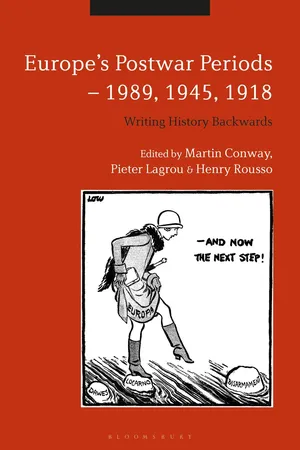
This book brings together world-renowned scholars from all over Europe to analyse how successive Europes have been constructed in the wake of the key conflicts of the period: the Cold War and the two World Wars. By regressively tracing Europe's path back to these pivotal moments as part of a unique methodology, Europe's Postwar Periods - 1989, 1945, 1918 reveals the defining characteristics of these postwar periods and integrates the changes that followed 1989 into a more substantial historical perspective.
The author team address the crucial themes in recent European history on a chapter-by-chapter basis that gives comprehensive coverage to the whole of the European region for topics such as borders, states, empires, democracy, justice, markets and futures.
The volume highlights the fact that Europe was made less by wars than is commonly thought, and more by the nature of the settlements – international, national, political, economic and social – that followed the two World Wars and the Cold War. It is an important, innovative text for all students and scholars of 20th-century European history.
eBook - ePub
Europe's Postwar Periods - 1989, 1945, 1918
Writing History Backwards
- 248 pages
- English
- ePUB (mobile friendly)
- Available on iOS & Android
eBook - ePub
Europe's Postwar Periods - 1989, 1945, 1918
Writing History Backwards
About this book
Information
1
Demobilizations
John Horne
It would be hard to deny that 1989 was a turning point in European history. It changed the balance of power on the continent. It dissolved the ideological conflict that had split Europe for nearly half a century and had divided each half of the continent internally, communism not being confined to the east or anti-communism to the west. It consigned communism as one contending economic model to history and promoted the other, a neo-liberal form of capitalism, to a position of hegemony. The year 1989 was also perhaps the last time that a European event – the fall of the Berlin Wall – was pivotal to the world. As communism collapsed and the Cold War ended, the importance of Europe, sustained since 1948 by its place at the heart of that conflict, dwindled. Europe became what it has remained – a significant region but only one of several in a world that has been redefined by the rise of China, a turbulent Middle East, the surge of militant Islam and an embattled United States trying to secure its own values and interests.
Yet, in this book, we argue that 1989 was more than a turning point. We contend that it began a postwar period of some duration, and that although this is now over, it helped create our contemporary history – the continuous present in which we live. We further propose that this being the case, the last of Europe’s twentieth-century postwar periods ought to provide a powerful lens through which to look at the two previous ones, after 1945 and 1918, not only by way of comparisons that chart the distance travelled by the continent since the Great War but also in terms of the processes involved.1 So what exactly was the period of change triggered by 1989? Does it provide new understandings of what went before, especially in the earlier postwar periods? These questions lie at the core of the book and, as explained in the Introduction, justify the regressive method we use.
Postwar periods and the process of demobilization
In addressing these issues, we assume that wars help shape postwar periods. But we also assume in turn that postwar periods play a key role in how wars are settled and how their effects are absorbed. Arguably, postwar periods are as important as the wars they resolve (or fail to resolve) precisely because they shape their legacy. In our case, this means that the postwar periods after the Cold War and the two world wars helped redefine twentieth-century European history. They had historical cogency.
Of course, other processes also changed the continent, interacting with the postwar periods while maintaining their own cogency. The economy is a case in point. The Cold War and the two world wars most clearly shaped politics, ideologies and collective experiences, while economic and social changes followed a different path and time-scale. It could be argued that the Second Industrial Revolution, which centred on a cluster of technical inventions in the 1880s (cheap steel, electricity, the internal combustion engine, etc.), drove ‘Fordist’ mass production and the related mass consumption that shaped European societies down to the 1980s.2 A prolonged economic crisis from the 1970s signalled the shift to a third transformation based on information technology and electronics that reconfigured the international division of labour and, in the form of neo-liberal economics, influenced European integration.
Wars and postwar periods certainly affected these economic processes. In the west, they contributed to the welfare state with its redistribution of wealth, while in the east, the First World War and the Russian Revolution generated the communist command version of the Second Industrial Revolution. That version moulded the destinies of Soviet states during the Cold War but failed to make the transition to the Third Industrial Revolution. Yet the period from the 1880s to the 1980s had its own economic and social logic that represents a different time frame from those of the wars.
Europe had other wars, notably the Spanish Civil War. This foreshadowed the Second World War and was affected by it, as the victorious Nationalists gravitated to the Axis powers from 1939 but ended up after Axis defeat on the Allied side in the Cold War. Yet the Civil War was also part of a specifically Spanish trajectory that led from the final loss of the new world colonies in 1898 to war and dictatorship in the long mid-century and to liberal democracy from the late 1970s – well ahead of 1989.3
Caveats are important for the credibility of any thesis. Nothing explains everything. Far more important, however, is the explanatory power of what is proposed, which brings us to the subject of this chapter – demobilization. The Cold War and the two world wars were indeed global but they afflicted Europe more completely and with greater intensity than anywhere else on the planet. The zone from the Atlantic to the Urals and from Turkey to the Arctic constituted the principal killing ground of both world wars. It witnessed genocides in each of them – the attempted destruction of the Ottoman Armenians and Europe’s Jews respectively. It also provided the laboratory for weapons of mass destruction that have haunted the world ever since (the exception being the atom bomb, developed in the United States and dropped on Japan). Once the USSR acquired nuclear capability in 1949, the spectre of mutual annihilation froze the dizzying escalation of warfare since 1914. In little more than thirty years, this had gone from infantry charges that Napoleon would have recognized to the obliteration of entire cities – along with the distinction between soldiers and civilians. ‘Mutually assured destruction’ (or MAD as it was known) kept the Cold War cold at its European and East Asian epicentres, which were the likely triggers of all-out war. The Korean War of 1950–53 and the Cuban Missile Crisis in 1962 were the exceptions that proved the rule since by hinting at the zero sum logic of a nuclear showdown, they avoided the ultimate military escalation.4
Because Europe was uniquely defined by war in the twentieth century, it experienced to the full the mobilization such wars required. First and foremost, this meant military and economic mobilization. Beginning with the French Revolution, Europe had invented the ‘nation (or empire) in arms’, which turned on the idea that all adult males owed the state short-term military service as the corollary of their status as citizens or subjects. Prussia in the mid-nineteenth century enhanced the practice by retaining conscripts as reservists into middle age. This meant that in wartime, the state could call up much of the adult male population into the armed forces, resulting by 1914 in armies of a size unknown a century earlier.5 Great Britain, as a naval power, ignored conscription until the need for a continental-sized army in the First World War forced it to improvise ‘national service’, which it reintroduced for the Second World War and kept until the early 1960s. The United States followed a similar path.
However, it became apparent in the First World War that the industrialization of firepower (i.e. the application of the Second Industrial Revolution to armaments), in conjunction with a war of attrition, meant that the total resources of the economy were now vital to waging war. They included ‘manpower’ – the word dates from 1915.6 Depriving the enemy of those same resources (including by starving and bombing its civilian manpower) was a strategy in its own right. Harnessing the economy to war thus produced a double mobilization, economic as well as military.
Ending war meant making peace. This entailed reversing the military and economic mobilizations. Unless men and women resumed civilian life and until the economy returned to normal production (from housing to consumer goods), peace could not be achieved. More than a moment, a year or even a ‘turning-point’, it was a process – demobilization. Yet demobilization in this material sense was also shaped by the hard politics of the war’s outcome. It depended on whether a state was victor or vanquished, occupier or occupied and whether the defeated accepted their lot.7 Military and economic demobilization was thus linked to a diplomatic settlement without which the war effort could not be wound down. For soldiers to go home and workers to resume normal production, war by definition had to be in the past tense.
However, Europe’s twentieth-century wars were more than military and economic affairs. Many states felt that not only the balance of power but also sheer survival were at stake. Already in 1914, each camp saw its enemy as less than human. Germans rejected Western ‘civilization’ in favour of German ‘culture’, while the British and French dismissed the latter as a fig leaf for autocratic militarism.8 The result was a mobilization of political and cultural values – and a sense of profound enmity – that gave meaning to the conflict. What was true of the First World War was truer still of its successor, whose ideological agenda originated in the antagonisms caused by political mobilization and breakdown during the Great War. This resulted in communism, fascism and fuller-blooded versions of liberal democracy than before. Combined with unprecedented death and suffering (and the accompanying language of ‘sacrifice’), politics was transformed. Henceforth, it was hard to forge political legitimacy without invoking the demos (popular will), albeit in conflicting variants.
Yet, the ‘dizzying escalation’ of warfare from 1914 to 1945 meant that war itself as an arbi...
Table of contents
- Cover
- Half Title
- Title Page
- Contents
- Preface
- Contributors
- Introduction
- 1 Demobilizations
- 2 Borders
- 3 Justice
- 4 Futures
- 5 States
- 6 Democracies
- 7 Empires
- 8 Markets
- 9 Pasts
- Conclusion
- Bibliography
- Index
- Copyright Page
Trusted by 375,005 students
Access to over 1.5 million titles for a fair monthly price.
Study more efficiently using our study tools.
Frequently asked questions
Yes, you can cancel anytime from the Subscription tab in your account settings on the Perlego website. Your subscription will stay active until the end of your current billing period. Learn how to cancel your subscription
No, books cannot be downloaded as external files, such as PDFs, for use outside of Perlego. However, you can download books within the Perlego app for offline reading on mobile or tablet. Learn how to download books offline
Perlego offers two plans: Essential and Complete
- Essential is ideal for learners and professionals who enjoy exploring a wide range of subjects. Access the Essential Library with 800,000+ trusted titles and best-sellers across business, personal growth, and the humanities. Includes unlimited reading time and Standard Read Aloud voice.
- Complete: Perfect for advanced learners and researchers needing full, unrestricted access. Unlock 1.5M+ books across hundreds of subjects, including academic and specialized titles. The Complete Plan also includes advanced features like Premium Read Aloud and Research Assistant.
We are an online textbook subscription service, where you can get access to an entire online library for less than the price of a single book per month. With over 1.5 million books across 990+ topics, we’ve got you covered! Learn about our mission
Look out for the read-aloud symbol on your next book to see if you can listen to it. The read-aloud tool reads text aloud for you, highlighting the text as it is being read. You can pause it, speed it up and slow it down. Learn more about Read Aloud
Yes! You can use the Perlego app on both iOS and Android devices to read anytime, anywhere — even offline. Perfect for commutes or when you’re on the go.
Please note we cannot support devices running on iOS 13 and Android 7 or earlier. Learn more about using the app
Please note we cannot support devices running on iOS 13 and Android 7 or earlier. Learn more about using the app
Yes, you can access Europe's Postwar Periods - 1989, 1945, 1918 by Martin Conway, Pieter Lagrou, Henry Rousso, Martin Conway,Pieter Lagrou,Henry Rousso in PDF and/or ePUB format, as well as other popular books in History & 20th Century History. We have over 1.5 million books available in our catalogue for you to explore.