eBook - ePub
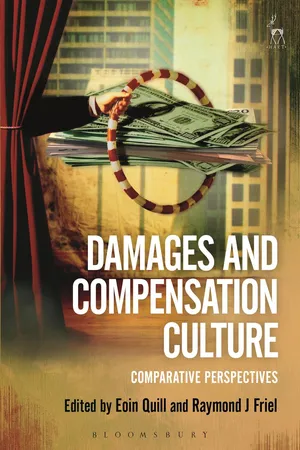
Damages and Compensation Culture
Comparative Perspectives
- 360 pages
- English
- ePUB (mobile friendly)
- Available on iOS & Android
eBook - ePub
Damages and Compensation Culture
Comparative Perspectives
About this book
The focus of the essays in this book is on the relationship between compensation culture, social values and tort damages for personal injuries. A central concern of the public and political perception of personal injuries claims is the high cost of tort claims to society, reflected in insurance premiums, often accompanied by an assumption that tort law and practice is flawed and improperly raising such costs. The aims of this collection are to first clarify the relationship between tort damages for personal injuries and the social values that the law seeks to reflect and to balance, then to critically assess tort reforms, including both proposals for reform and actual implemented reforms, in light of how they advance or hinder those values. Reforms of substantive and procedural law in respect of personal injury damages are analysed, with perspectives from England and Wales, Canada, Australia, Ireland and continental Europe. The essays offer valuable insights to anyone interested in the reform of tort law or the tort process in respect of personal injuries.
Information
Part I
General Features of the Relationship between Damages and Compensation Culture
1
‘The Whiplash Capital of the World’: Genealogy of a Compensation Myth
One of the most persistent refrains in the current debate about the so-called compensation culture1 is that the UK has become ‘the whiplash capital of Europe’—or even, on some accounts, ‘the world’. This chapter explores the origins of the claim subjects it to critical analysis and provides some wider reflections on the rhetoric employed. But it begins by placing the claim in the context of the wider debate and the UK’s ongoing civil justice reforms.
Context: The Road to Whiplash Reform
Whiplash Becomes an Issue
In retrospect, it is remarkable how recent a phenomenon the problematisation of whiplash has been, notwithstanding the recognition of its prevalence for quite some time. In 2002, when the Association of British Insurers (ABI) responded to an Insurance Europe questionnaire on ‘minor cervical trauma claims’,2 it reported that these made up 76% of all motor bodily injury claims in the UK,3 but the focus of the measures it described as having been taken by insurers was on injury avoidance (more efficient head-rest systems) and the prevention of long-term complications,4 rather than on problems associated with routine, low-value claims, which have been the main focus of the current debate. In 2003 and 2004, the market intelligence firm Datamonitor reported that whiplash was the most common type of motor personal injury claim, with between 80 and 90 % of all motor personal injury claims being for whiplash-related injuries, mostly for relatively low amounts of compensation.5 But this information was presented purely descriptively, without any indication that whiplash as such was a problem. More strikingly still, in 2005, when the ABI presented a set of proposals for reforms to improve the compensation system, there was no mention of whiplash at all.6 And even Lord Justice Jackson’s Final Report into the costs of civil litigation, published in December 2009, contains just a single reference to whiplash and that only in evidence presented to the judge7 and not in his own analysis of issues of concern.
It was only around this time that insurers came to problematise whiplash claims as a category. In 2008, the ABI published a dedicated report on the issues raised: Tackling Whiplash: Prevention, Care, Compensation.8 The report highlighted that the number of whiplash claims was rising even though the Government’s road casualty statistics suggested that British roads were getting safer.9 This was followed by further news releases by the ABI,10 reinforced by media interventions by its officers. Under the headline, ‘[t]he UK’s pain in the neck culture must end’, James Dalton, the ABI’s then Head of Motor and Liability, was quoted as saying: ‘[i]f whiplash was an Olympic sport, the UK would be gold medallists’.11 In a BBC interview, the ABI’s Rob Cummings referred to ‘a whiplash epidemic’ gripping the UK.12
The ABI’s membership took up the same refrain—most notably in a significant ‘Whiplash Report’ published by AXA Insurance in July 2013,13 which explicitly sought to identify ‘lessons from overseas’ with a view to reforming UK law on the basis of best practice from elsewhere in Europe.14 In a report by Aviva the following year, whiplash—and specifically claims for minor, short-term whiplash injury—was identified as the main reason why the UK’s system for dealing with motor bodily injury claims needed reform.15 The Aviva report summarised the outcomes of research the insurer had commissioned which again highlighted the prevalence of whiplash and soft tissue injury claims as the main driver of increases in the number of road traffic accident (RTA) personal injury pay-outs.16
Shaping the Political Debate
These interventions decisively shaped the political debate. In October 2010, the House of Commons Transport Committee launched an investigation into the cost of motor insurance in the light of reported rises in average premiums in the preceding year (estimated to be 29.9% by the Automobile Association, AA) at a time when the number of road accident casualties was decreasing.17 In its written evidence to the Committee,18 the ABI highlighted whiplash claims as a significant factor in the cost rises, claiming that 20% of motor premiums was paid out against such claims every year19 and urging the adoption of measures to address the problem by improving driver awareness of the risk and practical precautions such as adjusting car head restraints properly and keeping a safe distance.20 This constituted only one of a set of seven proposals advanced with a view to the better controlling of motor insurance costs: others included the implementation of the recommendations of the Jackson Report on civil litigation costs, measures to reduce the incidence of uninsured driving, and facilitating greater data sharing between the insurance industry and the public sector in order to tackle fraud.21 It was only in oral evidence provided by ABI Director Nick Starling that the ABI suggested that the problems of whiplash and fraud were interrelated, Starling saying: ‘[w]hiplash … is a soft tissue injury. There is no physiological evidence, as I understand it, that you’ve got that injury. I think people are put in temptation’s way to a large extent and people are encouraging them to make these claims’.22 Others giving evidence to the Committee linked whiplash and fraud more explicitly, especially in connection with so-called ‘cash for crash’ scams.23 The Committee itself noted these concerns without expressly endorsing them24 but perhaps had them in mind when stating that the wider access to justice that was a welcome consequence of the introduction of conditional fee agreements (CFAs) ‘should not provide an opportunity for people to make fraudulent claims for compensation for non-existent or pre-existing aches and pains’.25
After the Committee’s report was published on 11 March 2011, a number of discrete threads of development became intertwined. In September 2011, the Government published its Response to the Report,26 without a single reference to whiplash or soft tissue injuries or problems created by claims for such injuries. Instead, the Government’s main focus was on the implementation of the Jackson proposals to reform CFAs and other measures to reduce the cost of civil litigation generally,27 though it also endorsed the Committee’s recommendations about the tackling of fraud through joint initiatives with the insurance sector.28
Proposals for Targeted Whiplash Reform
Parliament’s attention was drawn back to whiplash claims by a ten minute rule Bill introduced by Jack Straw MP in September 2011.29 Introducing the Bill, Straw described whiplash as ‘not so much an injury, more a profitable invention of the human imagination—undiagnosable except by third-rate doctors in the pay of the claims management companies or personal injury lawyers’.30 Clause 2 of the Bill, entitled ‘Whiplash’, accordingly sought to introduce two limitations on the ability to recover damages for whiplash injuries: first, a requirement for ‘independent, objective evidence’ of the injury, and not merely the claimant’s ‘subjective description of symptoms’; second, a rebuttable presumption that no whiplash injury has been suffered in the absence of musculoskeletal indications or if the relative speed of the collision giving rise to the accident was 15 miles per hour or less. In full, the clause read:
(1)This section applies to any personal injury claim for whiplash.
(2)The onus shall be on the claimant to satisfy the court that there is independent, objective evidence that the claimant has suffered harm, and of the extent of that harm.
(3)No damages shall be recoverable if the only evidence is the subjective description of symptoms by, or behalf of [sic], the claimant.
(4)There shall be a rebuttable presumption that no harm or injury to the claimant has been suffered where either or both of the following conditions applies—
(a)the collision giving rise to the accident took place at a relative speed of 15 miles per hour or less;
(b)there are no musculoskeletal signs of any injury, including fracture and dislocation.
(5)In this section ‘whiplash’ means a neck injury caused by a sudden movement of the head forwards, backwards or sideways.
Other proposals in the Bill to clean up the ‘extensive and grubby industry’31 that had grown up around whiplash claims were the abolition of referral fees and the cutting in half (from £1,200 to £600) of the fixed fee that lawyers were entitled to recover as costs for their work on low-value road traffic claims.
The Bill did not receive a second reading and failed to complete its passage through Parliament before the end of the session, consequently making no further progress.32 However, even before Straw had formally introduced the Bill, the Government had indicated its support for his proposal to abolish referral fees,33 as previously recommended in the Jackson Report.34 A set of provisions on referral fees was accordingly introduced to the Legal Aid, Sentencing and Punishment of Offenders (LASPO) Bill that was brought to the House of Lords from the Commons in November 2011.35 It fell to the House of Commons Transport Committee to pick up Straw’s proposals relating specifically to whiplash. In a follow-up to its report on The Cost of Motor Insurance,36 it indicated its support for an ‘objective evidence’ requirement should the Jackson reforms prove ineffective in reducing the number of whiplash claims:
[I]n relation to whiplash, we are not convinced that a diagnosis unsupported by any further evidence of injury or personal inconvenience arising from the injury should be sufficient for a claim to be settled. In our view, the bar to receiving compensation in whiplash cases should be raised … We note the Government’s argument that its legal reforms should reduce the money in the system and encourage insurers to defend claims more vigorously. If the number of whiplash claims does not fall significantly once these changes are implemented there would in our view be a strong case to consider primary legislation to require objective evidence of a whiplash injury, or of the injury having a significant effect on the claimant’s life, before compensation was paid.37
Though the LASPO Act did not receive Royal Assent until 1 May 2012, and though its reforms to the CFA regime and referral fees did not come into effect until 1 April 2013,38 the Government continued to press on with measures to address the problem of whiplash claims without waiting to evaluate the impact of the LASPO reforms. After a summit with insurance industry, consumer and business groups i...
Table of contents
- Cover
- Title Page
- Preface
- Contents
- List of Contributors
- Introduction
- Part I: General Features of the Relationship between Damages and Compensation Culture
- Part II: Damages Reform in Various Jurisdictions
- Part III: The Process for Delivery of Damages
- Part IV: Compensation and Personal Responsibility
- Index
- Copyright Page
Trusted by 375,005 students
Access to over 1.5 million titles for a fair monthly price.
Study more efficiently using our study tools.
Frequently asked questions
Yes, you can cancel anytime from the Subscription tab in your account settings on the Perlego website. Your subscription will stay active until the end of your current billing period. Learn how to cancel your subscription
No, books cannot be downloaded as external files, such as PDFs, for use outside of Perlego. However, you can download books within the Perlego app for offline reading on mobile or tablet. Learn how to download books offline
Perlego offers two plans: Essential and Complete
- Essential is ideal for learners and professionals who enjoy exploring a wide range of subjects. Access the Essential Library with 800,000+ trusted titles and best-sellers across business, personal growth, and the humanities. Includes unlimited reading time and Standard Read Aloud voice.
- Complete: Perfect for advanced learners and researchers needing full, unrestricted access. Unlock 1.5M+ books across hundreds of subjects, including academic and specialized titles. The Complete Plan also includes advanced features like Premium Read Aloud and Research Assistant.
We are an online textbook subscription service, where you can get access to an entire online library for less than the price of a single book per month. With over 1.5 million books across 990+ topics, we’ve got you covered! Learn about our mission
Look out for the read-aloud symbol on your next book to see if you can listen to it. The read-aloud tool reads text aloud for you, highlighting the text as it is being read. You can pause it, speed it up and slow it down. Learn more about Read Aloud
Yes! You can use the Perlego app on both iOS and Android devices to read anytime, anywhere — even offline. Perfect for commutes or when you’re on the go.
Please note we cannot support devices running on iOS 13 and Android 7 or earlier. Learn more about using the app
Please note we cannot support devices running on iOS 13 and Android 7 or earlier. Learn more about using the app
Yes, you can access Damages and Compensation Culture by Eoin Quill, Raymond J Friel, Eoin Quill,Raymond J Friel in PDF and/or ePUB format, as well as other popular books in Jura & Schadenersatzrecht. We have over 1.5 million books available in our catalogue for you to explore.