- 272 pages
- English
- ePUB (mobile friendly)
- Available on iOS & Android
eBook - ePub
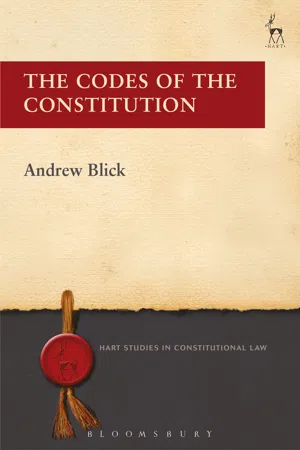
The Codes of the Constitution
About this book
This book describes an astounding feat of constitutional writing and publication. For a number of decades, officials working across different branches of the United Kingdom (UK) constitution have been engaged in a series of separate projects. Taken in their totality, they amount to a vast enterprise. Yet, until now, no-one has fully recognised or critically analysed what has taken place. There has been a proliferation in the UK of publicly available codes, normally lacking a basis in statute, providing official accounts of a variety of different features of UK constitutional rules and principles. They cover institutions ranging from the Cabinet to the Civil Service to the judiciary, and relationships between entities such as central government and the devolved executives; and between the UK executive and the Westminster Parliament. Among them are prominent texts such as the Ministerial Code, the Cabinet Manual, the Guide to Judicial Conduct and the devolution Memorandum of Understanding – as well as more obscure documents that nonetheless contain important stipulations regarding the operation of the system. Similar developments have taken place in countries including Australia, Canada and New Zealand. The author explores the history of this phenomenon in the UK, how it functions today here and elsewhere in the Commonwealth, and its implications for the UK constitution.
Information
Part One
The Codification Phenomenon
1
Historic Origins of Codification
THE CODIFICATION PHENOMENON is historical in nature. It began to come about in the form described in this book from the First World War onwards, arising from a combination of different tendencies, each of which had its own time phase and pattern of development. To consider the historic gestation of the present codification environment, then, is a means of understanding the nature of this process in the contemporary UK. But what are these prerequisites to and drivers of codification we should assess? When did they appear? And how might we detect their impact both in earlier and in more recent times? An effective means of answering these questions is both to assess the tendencies underlying codification and to consider a variety of relevant texts themselves. The latter part of this task can also serve to demonstrate the value of these documents beyond their being manifestations of a particular official literary genre, and as sources providing insight into constitutional perceptions at given points in history.
Fundamental to any project for the writing down of rules is the ability to write. Literacy has existed in UK—or to be precise, English—governmental institutions at least since the early seventh century and the time of the law code of King Ethelbert of Kent. This text represents the first known use—by a considerable margin—of the English language in written form. Indeed it seems likely that more than the ability to write being a precondition for the production of this document, the desire to create the code spurred Ethelbert to bring about the creation of the written English language. After Ethelbert, subsequent Anglo-Saxon rulers continued to produce legal texts.1 By the post-Conquest era, Latin was the language employed, however.
Describing principles and practices in writing is one feature of codification as defined in this book. Another, developing later, has been that increasingly they are made publicly available. While literacy may have existed among medieval royal officials and the clergy, more widely it was a rare skill. Furthermore the technology for mass dissemination of the written word was not as developed as it would later become. The printing press, for instance, did not appear in Europe until the fifteenth century; while the Internet and World Wide Web were inventions of the late twentieth.2 Nonetheless, it was possible for scribes to produce multiple copies of documents for distribution to key locations such as cathedrals, as happened with the text now known as Magna Carta; and they could be read aloud to an illiterate public.
At the time that Magna Carta was first agreed, in 1215, Parliament did not exist.3 Neither, therefore, did Acts of Parliament, let alone secondary legislation deriving its authority from parent Acts or codes issued under the authority of Acts. The differentiations made in this book between the legal status of different documents could not fully apply until the set of categories employed today became more clearly discernible. Only with this means of distinguishing texts could we conceive of official statements of rules that did not have direct legal force, lacking enforcement specifically through an Act of Parliament (though some of the codes considered, such as the Civil Service Code, are now issued under statutory authority). Codification should be understand historically in the context of a legal system that has become more sophisticated, within which different categories of instrument or text are possible and can be deployed to suit particular circumstances. However, whether the differentiation that the UK executive today hopes to maintain between texts that are and are not legally enforceable is sustainable remains to be seen, an issue considered more fully in Chapter 4.
I.PRECURSORS TO CODIFICATION
Despite the qualifications set out above, we should avoid imagining that codification as understood today is wholly new. The idea of writing down values, rules and practices is an ancient one. An example of an attempt to codify principles can be found in books of chivalry from medieval Europe. Though they might not be official in the sense that they were issued by a governmental body, they engage with the functions of what could be perceived as public offices. The most famous such text is A Knight’s Own Book of Chivalry,4 attributed to Geoffroi de Charney, a French knight who lived from about 1306 to 1356. He participated in the conflict now known as the ‘Hundred Years War’ (1337–1453), and was the earliest person recorded as in possession of the ‘Shroud of Turin’. While his name is attached to the text, how directly involved he was in writing it is not certain—much in the way that in the contemporary era the Prime Minister or the Cabinet may sign off a document that is in practice largely the work of officials. A further similarity with the present codification trend is that the de Charney book reads as an attempt to bring together in a single, written document already existing understandings.
The de Charney book deals with a range of issues, including ethical conduct, general principles of governance, and the characteristics of different groups, such as the knighthood, priesthood and monastic orders. It considers matters such as the types of advice that worthy men should give to others (paragraph 34), and how they should be recruited into particular groups (paragraphs 36–40). The book holds, for instance, that it is possible to join the monastic order at an age
so young that one has no knowledge of sin nor of the world; those who enter at such an age are brought up in the order and should accept it more willingly; they should, therefore, conduct themselves better and adhere more closely to the rules of the religious order. (paragraph 38)
On the other hand, there are those who have spent time in the outside world and then
want to enter a religious order, lightly and without being truly devout. Then it is very hard for them to keep to and follow the right paths and the precepts and rules to which religious [sic] are required to adhere, and they are very reluctant to do so.(paragraph 38)
These matters—the relationship between recruitment, propriety and the world beyond the institution concerned—remain important subjects in various texts today, such as those that regulate the Civil Service. These later documents might aspire to bring about the highest standards of conduct, and they can in the process become celebrated—as did the de Charney work. Yet how effective they are in practice is a different subject. The extent to which those to whom codes are supposed to apply actually adhere to them is another perennial concern.
Knights are still with us, though the title is honorific and does not denote the specific social role it once did. Some of the precursors to codification offer more direct continuity to the present. The Privy Council was formalised in the fifteenth century out of the inner group of advisers around the monarch. It remains a working body in the twenty-first century. Moreover, membership of the Council in itself has a practical use. All members of the Cabinet are required to take the Oath of a Privy Counsellor (the spelling used in The Cabinet Manual and other official present-day texts) to bind them to secrecy. A text of the Oath dating from 1570 (the source uses the spelling ‘councillor’ rather than ‘counsellor’) has survived. It stresses, among other stipulations, the importance of loyalty to Elizabeth, the then monarch, and that ‘You shall keep secret all matters committed and revealed to you as her Majesty’s councillor or that shall be treated of secretly in council.’ A further commitment was mirrored consciously in later codes applying to civil servants. The oath taker is bound to ‘give true, plain and faithful counsel at all times, with respect either of the cause of the person, laying apart all favour, meed, affection, and partiality’. This service is to be provided to the Queen, as well as to ‘her heirs and lawful successors’.5
For comparative purposes, the current version of The Oath of a Privy Counsellor reads as follows:
You do swear by Almighty God to be a true and faithful Servant unto The Queen’s Majesty as one of Her Majesty’s Privy Council. You will not know or understand of any manner of thing to be attempted, done or spoken against Her Majesty’s Person, Honour, Crown or Dignity Royal, but you will lett and withstand the same to the uttermost of your power, and either cause it to be revealed to Her Majesty Herself, or to such of Her Privy Council as shall advertise Her Majesty of the same. You will in all things to be moved, treated and debated in Council, faithfully and truly declare your Mind and Opinion, according to your Heart and Conscience; and will keep secret all matters committed and revealed unto you, or that shall be treated of secretly in Council. And if any of the said Treaties or Counsels shall touch any of the Counsellors you will not reveal it unto him but will keep the same until such time as, by the consent of Her Majesty or of the Council, Publication shall be made thereof. You will to your uttermost bear Faith and Allegiance to the Queen’s Majesty; and will assist and defend all civil and temporal Jurisdictions, Pre-eminences, and Authorities, granted to Her Majesty and annexed to the Crown by Acts of Parliament, or otherwise, against all Foreign Princes, Persons, Prelates, States, or Potentates. And generally in all things you will do as a faithful and true Servant ought to do to Her Majesty.
SO HELP YOU GOD
The linkages between the historic Privy Council and the current Cabinet extend beyond the use of an Oath. Part of the function of the Privy Council was as an executive decision-taking body, and it was in this sense a precursor to the Cabinet, an entity that developed from the late seventeenth century onwards and that is frequently described as a sub-committee of the Privy Council. Paragraph 1.14 of The Cabinet Manual,6 for instance, states that ‘Cabinet is the executive committee of the Privy Council’. Efforts to codify the practices and principles of Cabinet have their precursors in attempts to do the same for the Council. In 1553, Edward VI issued A Method for the Proceedings in the Councils, part of which he wrote out himself.7 It listed the members of the Council, and then set out a series of subject-specific committees, and who would serve on them. A document issued in the same year sought to ensure that the Council functioned more effectively. It required members to seek permission before leaving court for more than two days (paragraph 9); it set a quorum of four (paragraph 10), with special procedural requirements to follow if there were fewer than six in attendance (paragraph 11). Paragraph 12 required that ‘if there rise such matter of weight as it shall please the King’s Majesty himself to be at the debating of, then warning shall be given, whereby the more may be at the debating of it’. A need to provide due notice to ensure meaningful discussion remains a concern for Cabinet and its committees. And recognising a reality that no doubt persists in Cabinet today, since the conduct of government relies on fallible human beings, the 1553 articles sought to deal with the limited attention span of Council members. They required:
In matters that be long, tedious, and busy there may be appointed or chosen two or three, more or less as the case shall seem to require, to prepare, set forth, and make plain the things being less cumbrous and diffuse may the easilier be dispatcht. (paragraph 15)8
Though it has now been supplanted in importance by its supposed executive committee, the Cabinet, the Privy Council remains a subject of codification today. The Cabinet Manual describes how the Privy Council—convened under the ancient monarchical authority known as the Royal Prerogative—‘advises’ the head of state on the deployment of ‘prerogative powers’ and ‘certain functions assigned’ to the head of state and the Privy Council by Acts of Parliament. According to the Manual the Council is the means of achieving ‘interdepartmental agreement’ on those official activities that ‘for historical reasons’ are the responsibility of ministers not in their departmental roles but as Privy Counsellors (paragraph 1.10). The Manual goes on to outline the powers of the Privy Council. They include the ability to produce secondary and even primary legislation; to issue orders proroguing Parliament (paragraph 1.16); to oversee regulators and ‘Chartered bodies’ (paragraph 1.17); and to consent to ‘Proclamations for new coinage’ and some bank holidays (paragraph 1.18), all on a quorum of three (paragraph 1.15). The monarch is present, and ministers attend, for whom a summons to Privy Council takes priority over any other commitments (paragraph 1.16). So-called ‘Privy Council terms’ are a means by which government can communicate in confidence with senior members of the Opposition who are themselves Privy Counsellors (paragraph 1.12). The Council also has standing committees, among which the Judicial Committee of the Privy Council is the final court of appeal for some Commonwealth states, and for all Crown Dependencies and Overseas Territories (paragraph 1.14). One-off committees of Privy Counsellors may form to investigate specific issues (paragraph 1.19). Codification, then, has deep roots, in the types of functions it performs, and even the institutions involved.
II.THE CIVIL SERVICE AND CODIFICATION
To understand why codification in its current form came about, it is important to recognise structural tendencies within governmental institutions. Support staff can be important to this process. A political leader wishing to produce a written statement of rules is likely delegate the work. Indeed, without the existence of such assistants to execute it, codification would be less likely to occur. Officials may not always welcome the task. However, from their point of view, it can have benefits. They have some opportunity, within practical limits, to shape the document in ways that may suit them. An important purpose of many texts is the regulation of the same support personnel that help draft them. The end product may perform a clarifying function with respect to roles, relationships and procedures that makes their job more straightforward and protects them from possible criticism. Potentially, a text setting out principles and arrangements can strengthen the place of officials within a governmental system by giving a firmer definition of their positions, perhaps expanding their remits in the process. For these reasons, staff within public institutions may be not only important participants within the codification process, but also a source of encouragement for it. As well as taking part in the drafting and updating of documents, officials are often central to the practical use made of them. Through applying codes, staff can maintain the relevance of these texts. The particular way in which they deploy them is also important, helping to determine the precise impact they have. Public officials, then, are crucial to codification.
A historic development in the UK constitution, the emergence of a politically impartial, career Civil Service, that gained pace from the mid-nineteenth century onwards, was a key development.9 It meant the emergence of a body of employees who—whatever the possible shortcomings in terms of policy expertise—possessed strong literary skills, enabling them to produce codes, and perhaps even disposing them to do so. They remained in their posts even when ministers moved or governments fell, meaning that they could become the keepers of texts, maintaining and updating them as required. The developing Civil Service became a more clearly defined institution, with increasingly complex bureaucratic structures and procedures. That such trends might lead on to the production of a growing volume of written guidance on good practice should not be difficult to comprehend.
Confirming the importance of war to constitutional change in general and codification in particular, an important event for the developing structure of the Civil Service was the appearance of what became the Cabinet Office. It be...
Table of contents
- Cover
- Dedication
- Title Page
- Acknowledgements
- Contents
- Introduction
- Part One: The Codification Phenomenon
- Part Two: The Content of Codes
- Index
- Copyright Page
Trusted by 375,005 students
Access to over 1.5 million titles for a fair monthly price.
Study more efficiently using our study tools.
Frequently asked questions
Yes, you can cancel anytime from the Subscription tab in your account settings on the Perlego website. Your subscription will stay active until the end of your current billing period. Learn how to cancel your subscription
No, books cannot be downloaded as external files, such as PDFs, for use outside of Perlego. However, you can download books within the Perlego app for offline reading on mobile or tablet. Learn how to download books offline
Perlego offers two plans: Essential and Complete
- Essential is ideal for learners and professionals who enjoy exploring a wide range of subjects. Access the Essential Library with 800,000+ trusted titles and best-sellers across business, personal growth, and the humanities. Includes unlimited reading time and Standard Read Aloud voice.
- Complete: Perfect for advanced learners and researchers needing full, unrestricted access. Unlock 1.5M+ books across hundreds of subjects, including academic and specialized titles. The Complete Plan also includes advanced features like Premium Read Aloud and Research Assistant.
We are an online textbook subscription service, where you can get access to an entire online library for less than the price of a single book per month. With over 1.5 million books across 990+ topics, we’ve got you covered! Learn about our mission
Look out for the read-aloud symbol on your next book to see if you can listen to it. The read-aloud tool reads text aloud for you, highlighting the text as it is being read. You can pause it, speed it up and slow it down. Learn more about Read Aloud
Yes! You can use the Perlego app on both iOS and Android devices to read anytime, anywhere — even offline. Perfect for commutes or when you’re on the go.
Please note we cannot support devices running on iOS 13 and Android 7 or earlier. Learn more about using the app
Please note we cannot support devices running on iOS 13 and Android 7 or earlier. Learn more about using the app
Yes, you can access The Codes of the Constitution by Andrew Blick in PDF and/or ePUB format, as well as other popular books in Law & Public Law. We have over 1.5 million books available in our catalogue for you to explore.