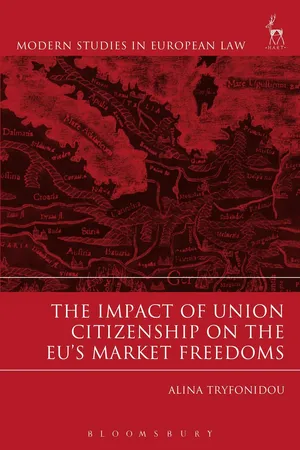
The book's aim is to consider the impact that the introduction and development of the status of Union citizenship has had on the interpretation of the EU's market freedoms. Starting by providing, in its introductory part (part one), a comprehensive and up-to-date analysis of the status of Union citizenship and its development from 1998 onwards, the book proceeds in part two to provide an in-depth examination of the relationship between this status and the Union's market freedoms. The central argument of the book is that, as a result of the move towards the creation of a meaningful status of Union citizenship, the market freedoms have been reconceptualised as fundamental, Union citizenship, rights and their interpretation has adapted accordingly.
Part three of the book analyses the result of this process of transforming the market freedoms into sources of fundamental, Union citizenship, rights and considers where it is likely to lead in the future. It demonstrates that, despite the fact that this development appears to be the next natural step in the process of constructing a meaningful notion of Union citizenship, it brings with it a number of issues that the EU will have to consider and carefully address. In particular, the method which the Court seems, up until now, to have employed to facilitate the metamorphosis of the market freedoms into citizenship rights, has led to criticisms on the grounds of legitimacy and coherence and will, undoubtedly, lead to further problems in the future. Hence part three of the book also identifies the difficulties that may emerge as a result of this process and suggests ways in which they may be overcome.
- 288 pages
- English
- ePUB (mobile friendly)
- Available on iOS & Android
eBook - ePub
The Impact of Union Citizenship on the EU's Market Freedoms
About this book
Information
Part I
Introductory Chapters
1
Introduction
THIS BOOK IS a study of the impact that the status of Union citizenship has had on the market freedoms. In particular, the book seeks to consider what has been, and what may have been, the impact of this status on the interpretation of these provisions to date and to consider whether the way that these provisions are now interpreted (as a result of this) can be supported under a literal and/or teleological approach to their interpretation. Moreover, the book considers the broader implications of this: once it is accepted that the market freedoms should, indeed, be interpreted in the light of Union citizenship, what further issues have to be addressed?
I. SETTING THE BACKGROUND
Once upon a time, six European countries decided to pool their coal and steel resources in an attempt to build a European Coal and Steel Community (ECSC). Although it was clear that loftier aspirations for this project were entertained from the very beginning,1 none of the drafters of the Treaty which gave birth to this Community could dare imagine that this new form of economic cooperation among a handful of western European nations would be the first, modest, seed, in what would become four decades later, the huge EU construct which would come as far as to have its own citizenry.
However, let us take things from the very beginning.
With the coming to an end of the Second Word War in the mid-1940s, Europe was faced with the challenge of having to be rebuilt from its ashes, the ensuing Cold War, re-establishing international relations but also, and perhaps more importantly, ensuring that the mistakes that were perpetrated in the past, would not be repeated in the future. This latter challenge was what led to the realisation that, in order to make a future conflict in the Continent ‘not merely unthinkable, but materially impossible’,2 the areas of the economy essential for the building and running of military machines would have to be joined and put together under the control and administration of a supranational authority. It was, hence, decided that the coal and steel resources of Germany and France should be pulled together, and if they wished, other western European countries would be welcome to participate in this Franco-German venture. Italy and the Benelux countries thereby decided to join, and this led to the signature of the ECSC Treaty in 1951, and its coming into force in the subsequent year.3
The main aim of the ECSC Treaty was to organise the free movement of coal and steel between the participating Member States and to ensure free access to the sources of production. The achievement of these aims would, mainly, be implemented and overseen by the High Authority, a supranational institution that was established for this purpose, and the latter would be assisted by a handful of other institutions that bore elements of both supranationalism and intergovernmentalism. As explained by Craig and de Búrca, the establishment of the ECSC ‘was the first significant step towards European integration going beyond intergovernmentalism, and establishing a supranational authority whose independent institutions had the power to bind its constituent Member States’.4
Although this form of cooperation proved successful, it was clear that the ECSC was merely a first step in the process of European integration and, thus, it was the beginning rather than the culmination of this process. Accordingly, even before this Community was formed, plans for further integration had been made, namely the 1950 Pleven plan, which proposed the creation of a European Defence Community with a European army, and soon after, there were proposals for a European Political Community. Needless to say, both proposals were rejected as, at the time, it was obviously too much to ask of the Member States to cede their sovereignty in these sensitive fields to supranational institutions.5
Despite the fact that this was a major setback for the integration process, it clearly did not signal the end of it. Therefore, in 1955, the foreign ministers of the six ECSC Member States met in Messina in Sicily and agreed to move European integration further in the direction of economic integration—an area which was less contentious and sensitive from the point of view of Member State sovereignty. They, consequently, agreed to establish two additional Communities, the European Atomic Energy Community (Euratom) and the European Economic Community (EEC), the respective Treaties of which were signed in 1957 and came into force in 1958.
As its name suggests, Euratom was established in order to coordinate the Member States’ actions in the field of nuclear energy. The EEC, on the other hand, had a much broader remit. Its main objective was to establish an internal market6 where goods, (economically active) Member State nationals, services and capital, would be free to move between Member States and, hence, any obstacle to their movement would be prohibited.7 Building the internal market was, therefore, the EEC’s core policy. Yet, even at this early stage, it was clear that the establishment of the internal market was ‘viewed as an instrument to enhance social welfare through a variety of objectives (that have expanded over time) and not as an end in itself’.8 In other words, despite the fact that the Communities would initially focus their efforts on the building of an internal market, this would not be their ultimate goal. Rather, as is clear from the Schuman Declaration, the pursuit of European (economic) integration was aiming at lasting peace in Europe and at safeguarding the well-being of Europeans.9
In order to achieve the economic aims of the Communities, it was considered necessary to include within the EEC Treaty a number of additional policies, such as a common agricultural policy, a social policy, and a common transport policy.10 The Communities were given the power to intervene in these fields in varied ways, such as by adopting a common organisation of the market, by (merely) coordinating the actions of the Member States, by promulgating legislative measures to (partly or wholly) harmonise the relevant sectors, or by resorting to negative harmonisation.
This latter method—negative harmonisation—has been the main tool used by the EEC and, later, its successors (the EC and the EU), in the process of executing the internal market policy. The emphasis placed on the use of this method for the removal of obstacles to the free movement of products and factors of production has led to a mainly decentralised system of governance, whereby the power to make legislation for the purpose of regulating economic activity continues to rest with the Member States, whilst the EU institutions (in cooperation with the national ones) police national measures to ensure that they do not create any obstacles to free movement.11
The main tools used for pursuing negative harmonisation in the area of the internal market have been—what I shall henceforth collectively call—‘the market freedoms’, which prohibit Member States from applying national measures that (unjustifiably) restrict the freedom of products, services, capital and economic actors to move between Member States. These provisions were, originally, found in the EEC Treaty, from 1993 until 2009 in the EC Treaty, and from 2009 onwards in the TFEU. As Kingreen has characteristically put it, the market freedoms ‘are the public law “trampoline” that gives all participants in the EU economy the opportunity to leap over the normative “turnpikes” between the national markets.’12
There are a number of different ‘market freedoms’, each devoted to a different aspect of the ‘production process’. Articles 34 and 35 TFEU prohibit the imposition of quantitative restrictions and measures having equivalent effect on, respectively, imports and exports of goods. Article 45 TFEU requires that the free movement of workers is secured within the Union, it prohibits any discriminatory (on the ground of nationality)—and as made clear by the Court13—non-discriminatory obstacles to the free movement of workers, and it provides a non-exhaustive list of rights to which migrant workers are entitled. Article 49 TFEU governs the right of establishment and prohibits any obstacles to the exercise of this freedom by (natural or legal) persons in the territory of another Member State. Like Article 45 TFEU, it makes explicit reference to ‘rights’ to which persons who fall within its scope are entitled. The freedom to provide services is protected by Article 56 TFEU, which prohibits any restrictions on the freedom to provide or receive (as clarified by the Court and the EU legislature) services from one Member State to another. Finally, Article 63 TFEU, governing the free movement of capital, is the only provision that has not remained the same since the birth of the EEC Treaty. This has always been considered as ‘the Cinderella freedom’,14 since it started life as a mere obligation imposed on the Member States to progressively abolish restrictions on the movement of capital during the transitional period, ‘only to the extent necessary to ensure the proper functioning of the common market’.15 The Article currently provides that all restrictions on payments, and on the movement of capital, between Member States and between Member States and third countries, are prohibited.
Negative harmonisation on its own would, however, never suffice in building an internal market. This is due to the fact that in certain instances, national measures that do impede free movement are, nonetheless, necessary for protecting other (equally valued) non-economic interests, such as public health, consumer protection, and public security, and, as such, there is a good reason for these actions to continue or for the measures to stay in force and for the Member States to continue applying them even in situations involving a cross-border element.16 The drafters of the EEC Treaty were well aware of this and the latter, from its inception, included an exhaustive list of derogations from the market freedoms. These have survived the subsequent amendments to this Treaty and are, now, found, in its current successor, the TFEU.17 This has also been recognised by the Court of Justice in its case-law, where the so-called ‘mandatory requirements’ or ‘objective justifications’ have been developed,18 which comprise, in essence, an additional non-exhaustive list of derogations.19 However, recognising that if an internal market is to be built, it is not possible to allow the existence of such (justified) obstacles in the long run, the EEC was given competence to make legislation having as its aim to ensure that obstacles to free movement are removed whilst non-economic interests which are deemed worthy of protection are secured, albeit that they are secured by a harmonising piece of EEC (and later EC, and now, EU) legislation.20
The original internal market harmonising provision was—what is now—Article 115 TFEU, which requires unanimity in the Council and which gives competence to the Union to ‘issue directives for the approximation of such laws, regulations or administrative provisions of the Member States as directly affect the establishment or functioning of the internal market’. Moreover, the more broadly-worded Article 352 TFEU (under the current numbering), has often been used (especia...
Table of contents
- Cover
- Title Page
- Acknowledgements
- Table of Contents
- List of Abbreviations
- Table of Cases (numerical)
- Table of Secondary Legislation
- Part I: Introductory Chapters
- Part II: The Impact of Union Citizenship on the EU’s Market Freedoms
- Part III: The Future
- Bibliography
- Index
- Copyright Page
Trusted by 375,005 students
Access to over 1.5 million titles for a fair monthly price.
Study more efficiently using our study tools.
Frequently asked questions
Yes, you can cancel anytime from the Subscription tab in your account settings on the Perlego website. Your subscription will stay active until the end of your current billing period. Learn how to cancel your subscription
No, books cannot be downloaded as external files, such as PDFs, for use outside of Perlego. However, you can download books within the Perlego app for offline reading on mobile or tablet. Learn how to download books offline
We are an online textbook subscription service, where you can get access to an entire online library for less than the price of a single book per month. With over 1.5 million books across 990+ topics, we’ve got you covered! Learn about our mission
Look out for the read-aloud symbol on your next book to see if you can listen to it. The read-aloud tool reads text aloud for you, highlighting the text as it is being read. You can pause it, speed it up and slow it down. Learn more about Read Aloud
Yes! You can use the Perlego app on both iOS and Android devices to read anytime, anywhere — even offline. Perfect for commutes or when you’re on the go.
Please note we cannot support devices running on iOS 13 and Android 7 or earlier. Learn more about using the app
Please note we cannot support devices running on iOS 13 and Android 7 or earlier. Learn more about using the app
Yes, you can access The Impact of Union Citizenship on the EU's Market Freedoms by Alina Tryfonidou in PDF and/or ePUB format, as well as other popular books in Law & International Law. We have over 1.5 million books available in our catalogue for you to explore.