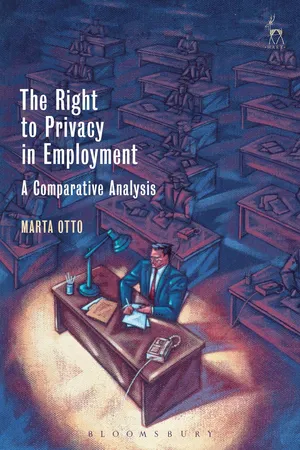
At the beginning of the twenty-first century the term 'privacy' gained new prominence around the world, but in the legal arena it is still a concept in 'disarray'. Enclosing it within legal frameworks seems to be a particularly difficult task in the employment context, where encroachments upon privacy are not only potentially more frequent, but also, and most importantly, qualitatively different from those taking place in other areas of modern society. This book suggests that these problems can only be addressed by the development of a holistic approach to its protection, an approach that addresses the issue of not only contemporary regulation but also the conceptualization, adjudication, and common (public) perception of employees' privacy.
The book draws on a comprehensive analysis of the conceptual as well as regulatory convergences and divergences between European, American and Canadian models of privacy protection, to reconsider the conceptual and normative foundations of the contemporary paradigm of employees' privacy and to elucidate the pillars of a holistic approach to the protection of right to privacy in employment.
- 256 pages
- English
- ePUB (mobile friendly)
- Available on iOS & Android
eBook - ePub
About this book
Information
1
Employee Privacy: United States Law
I.INTRODUCTION
THE AMERICAN LEGAL framework for privacy protection is impressive, both in terms of its volume and heterogeneity. As Westin observes, ‘the U.S. approach to privacy remains [an] eclectic blend of constitutional interpretation, pin-pointed and sector-specific legislation, common law judicial interpretation, labour-management bargaining and voluntary organizational policies’.1 While many of these laws play significant roles with respect to privacy issues in employment, it is far beyond the scope of this book to study in-depth each of the elements of the American legislative arena. Therefore, having in mind the specific analytical goals of the study, this part of the book will be limited to a general overview of the ‘federal specific instruments’, tort law and arbitral jurisprudence.
In order to comprehend the American exceptionalism in the area of employees’ privacy rights, but also to capture the gravity of the initial choices and certain path dependency in the American legal system, I commence with a rudimentary examination of the historical trajectory of the extant American privacy framework. In the subsequent sections, I will take a closer look at the jurisprudence, and the discourse on privacy rights in employment that has surfaced in the privacy legal landscape in the United States and which, since the early decisions rendered in the 1980s, have crystallized into what is now often referred to as ‘the American model’.2 The conceptual and normative parameters of this ‘American model’, will be presented in the last section of this Chapter.
II.THE ORIGINS OF THE AMERICAN FRAMEWORK OF PRIVACY PROTECTION
The undeniable defining moment for privacy protection in the United States came with Samuel D Warren and Louis T Brandeis’ seminal article from 1890, ‘The Right to Privacy’.3 Almost 75 years before the US Supreme Court explicitly recognized privacy as a constitutional right, having observed that ‘the intensity and complexity of life, attendant upon advancing civilization subjected the man to mental pain and distress, far greater than could be inflicted by mere bodily injury’, they called for common law recognition of a distinct legal right to privacy (‘the right to be let alone’).4 By nimbly revolving around the fundamental concept of property, Warren and Brandeis attempted to enhance the common law protection of the physical person and corporeal property by instilling within it a much broader concept, that of inviolate personality. The article opened up the discourse relating to privacy protection and proved a catalyst for the substantial development of the law in that area.5
In 1960, William Prosser, a leading tort expert, having studied the privacy case law generated by the Warren and Brandeis article, argued that ‘the law of privacy comprises four different interests, which otherwise have almost nothing in common except that each represents an interference with the plaintiff’s “right to be let alone”’. Accordingly, he distilled privacy invasions into four different types of infringement:
1.intrusion upon the plaintiff’s seclusion or solitude, or into his private affairs;
2.public disclosure of embarrassing private facts about the plaintiff;
3.publicity which places the plaintiff in a false light in the public eye;
4.appropriation, for the defendant’s advantage, of the plaintiff’s name or likeness.6
This classification, in the intervening years, proved extraordinarily persuasive for courts and state legislatures.7
Five years after, in 1965, in Griswold v Connecticut, the Supreme Court eventually found that the Constitution holds an implicit right to privacy which is guaranteed to American citizens through the First, Fourth, Fifth, and Ninth Amendments, covering freedom of speech, religion, association; freedom from unreasonable searches and seizures; right to due process; and non-enumerated rights, respectively. The Court’s analysis, commonly referred to as the ‘penumbra theory’, rested upon the assumption that ‘specific guarantees in the Bill of Rights have penumbras, formed by emanations from those guarantees that help give them life and substance. Various guarantees create zones of privacy’.8
Meanwhile, as case law developed in this area and new technological advances came to light elevating the level of public concern about the possible abuses of wiretapping powers, federal legislation sprang up providing for fragmentary privacy protection inter alia with regard to the interception of wire and oral communication (Wiretap Act)9 or the use of information regarding credit worthiness or credit standing.10
In 1973, the Secretary’s Advisory Committee on Automated Personal Data Systems released a comprehensive report, ‘Records, Computers, and the Rights of Citizens’, which advocated the introduction of legislation establishing a code of fair information practices for all automated personal data systems, essentially centered on: (1) the general prohibition of secret personal data record-keeping systems; (2) a public notification requirement concerning the existence of automated personal data system; (3) the prohibition of non-consensual disclosure of personal data; (4) individuals’ right to obtain information concerning the data pertaining to them and their usage, and to correct or amend such data; (5) the accountability of the organization for establishing proper organizational and technical safeguards against the misuse of data systems.11 Interestingly, as some commentators have noted, the Code played a significant role in formulating information privacy standards, not only in the United States,12 but also on an international level.13 Initially, the code of fair information practices was fully implemented by Bill 3418 (‘Information Bill of Rights’), a draft of an omnibus law for both private and public sector, which also introduced the Privacy Protection Commission, a supervisory authority, with a wide range of powers (including the authority to hold hearings regarding violations; to enter premises where data is held; to compel the production of documents; and to order organizations to cease unauthorized information practices).14 Ultimately, however, as Purtova explains, ‘under pressure from both public and private sector organizations, this legislative initiative ended with the passage of a weakened legislation’, which focused on regulation of the public sector and abandoned the idea of establishing a distinct supervisory agency (Privacy Act 1974).15
In the mid 1980s, it became increasingly apparent that further amendments to the current framework were needed in order to adjust the federal privacy protection standards to the increasing technologization of life. The enactment of the Electronic Communication Privacy Act 1986 (ECPA)16 extended the restrictions on wiretapping introduced by the Wiretap Act to electronic communications and added new provisions that prohibited accessing stored electronic communications (Stored Communications Act).17
The ‘final’ modification of the federal framework, took place in the aftermath of 11 September 2001, along with the passage of the hugely controversial USA PATRIOT Act,18 which directed privacy policy towards more security-centric goals and considerably broadened governmental surveillance prerogatives.19
To summarize, the evolution of privacy law in the USA proves its malleability amid changing social and political contexts. The social context has been a major force behind transferring the ‘out of law’ concept into an implicit constitutional right that opened up the law’s vision for the various interests that are at stake in the ‘privacy’ domain, and that prompted the legislature to give some of these interests distinctive legal coloration. The political context, on the other hand, has considerably affected the scope of legislative measures by preventing the introduction of comprehensive privacy norms in the private sector.20
III.THE CO...
Table of contents
- Cover
- Dedication
- Title Page
- Contents
- Table of Cases
- Table of Legislation
- Introduction
- 1. Employee Privacy: United States Law
- 2. The Right to Privacy: In Search of the European Model of Protection
- 3. Employee Privacy in Canada
- 4. The Right to Privacy in Employment: An Enquiry into the Conceptual and Normative Foundations of the Contemporary Paradigm of Employees’ Privacy
- Bibliography
- Index
- Copyright Page
Trusted by 375,005 students
Access to over 1.5 million titles for a fair monthly price.
Study more efficiently using our study tools.
Frequently asked questions
Yes, you can cancel anytime from the Subscription tab in your account settings on the Perlego website. Your subscription will stay active until the end of your current billing period. Learn how to cancel your subscription
No, books cannot be downloaded as external files, such as PDFs, for use outside of Perlego. However, you can download books within the Perlego app for offline reading on mobile or tablet. Learn how to download books offline
Perlego offers two plans: Essential and Complete
- Essential is ideal for learners and professionals who enjoy exploring a wide range of subjects. Access the Essential Library with 800,000+ trusted titles and best-sellers across business, personal growth, and the humanities. Includes unlimited reading time and Standard Read Aloud voice.
- Complete: Perfect for advanced learners and researchers needing full, unrestricted access. Unlock 1.5M+ books across hundreds of subjects, including academic and specialized titles. The Complete Plan also includes advanced features like Premium Read Aloud and Research Assistant.
We are an online textbook subscription service, where you can get access to an entire online library for less than the price of a single book per month. With over 1.5 million books across 990+ topics, we’ve got you covered! Learn about our mission
Look out for the read-aloud symbol on your next book to see if you can listen to it. The read-aloud tool reads text aloud for you, highlighting the text as it is being read. You can pause it, speed it up and slow it down. Learn more about Read Aloud
Yes! You can use the Perlego app on both iOS and Android devices to read anytime, anywhere — even offline. Perfect for commutes or when you’re on the go.
Please note we cannot support devices running on iOS 13 and Android 7 or earlier. Learn more about using the app
Please note we cannot support devices running on iOS 13 and Android 7 or earlier. Learn more about using the app
Yes, you can access The Right to Privacy in Employment by Marta Otto in PDF and/or ePUB format, as well as other popular books in Law & Civil Rights in Law. We have over 1.5 million books available in our catalogue for you to explore.