The European Society of International Law (ESIL) is known for its particularly dynamic character. After 10 years of existence it has proved that it is one of the most cutting-edge scholarly associations in the field of public international law. At its 10th Anniversary Conference in September 2014, which was held in Vienna, participants assembled in order to discuss 'International law and…', the proceedings of which are published here. Going beyond the usual related disciplines of political science, international relations, economics and history, this conference ventured into less well-trodden paths, exploring the links between international law and cinema, philosophy, sports, the arts and other areas of human endeavour.
As the proceedings show, it is clear that international law has long been influenced by other fields of law and other disciplines. They also explore whether the boundaries of international law have been crossed and, if so, in what ways.
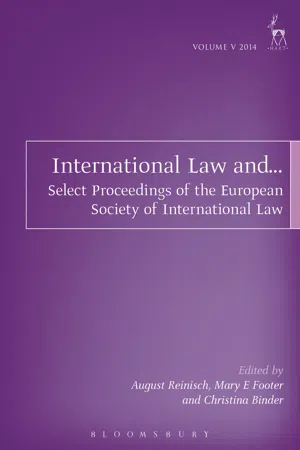
eBook - ePub
International Law and...
Select Proceedings of the European Society of International Law, Vol 5, 2014
- 560 pages
- English
- ePUB (mobile friendly)
- Available on iOS & Android
eBook - ePub
International Law and...
Select Proceedings of the European Society of International Law, Vol 5, 2014
About this book
Information
PART I
INTERNATIONAL LAW AND HUMAN RIGHTS ADJUDICATION
1
Judicial Engagement in International Human Rights Comparativism
I. INTRODUCTION
FRAGMENTATION IN INTERNATIONAL law and jurisprudence has become a significant concern of academic discourse over the past decade.1 It thus does not come as a surprise that the notion of judicial dialogue is attracting increasing attention as a potential means for enhancing coherence.2 At the same time, the role of judges in the context of ‘government networks’ attracts academic interest.3 The dialogue among international judges has become a subject of empirical research which considers different motivations for and channels of this interaction.4 Less attention has been paid so far to the extent to which the notion of dialogue has become manifest in international human rights jurisprudence and the normative basis on which it is grounded. Human rights law is particularly interesting for this debate because of its multiplicity of international and regional instruments. Arguably, the variety of judicial bodies entrusted with the interpretation of these instruments might foster fragmentation and jeopardise universal human rights protection. Therefore the question arises of whether and to what extent this risk can be overcome by the respective bodies’ mutual engagement with each other’s jurisprudence.
In an effort to answer this question, the following contribution takes the Human Rights Committee as an example and considers whether and to what extent the Committee is part of an international judicial dialogue. Based on an analysis of the Committee’s views in the individual communication procedure, it describes the relevant partners and the Committee’s jurisprudential practice of referring to international jurisprudence. It analyses the Committee’s methodology and endeavours to identify the normative foundations of its international human rights comparativism. In order to recognise the Committee’s impact on international human rights protection more generally, the contribution advocates a more inclusive approach to judicial interchange which goes beyond the customary notion of judicial dialogue.5 It identifies modes of interaction which go beyond the formal confines of a dialogue. To capture them the author introduces the notion of judicial engagement, and distinguishes between different degrees of engagement depending on their respective rationales.
II. THE OBJECT OF ENGAGEMENT
Before considering whether and to what extent the Human Rights Committee takes part in an international judicial dialogue, the question arises whether the Committee is capable of taking part in a ‘judicial’ dialogue in the first place. Its denomination as a committee, not a court, may point at a different direction. However, under the International Covenant on Civil and Political Rights (ICCPR) the Committee is entrusted with the competence of interpreting the ICCPR by its States parties.6 Those who have ratified or acceded to the Optional Protocol recognise the Committee’s competence to consider individual communications.7 The ‘views’ which the Committee adopts at the end of this process reflect and conclude the Committee’s examination of each individual communication. They are based on its interpretation of the Covenant as a legally binding instrument and result from the legal analysis of individual cases thereunder. For this reason the Committee in its General Comment No 33 on ‘The Obligations of States Parties under the Optional Protocol to the International Covenant on Civil and Political Rights’ explained its task as follows:
While the function of the Human Rights Committee in considering individual communications is not, as such, that of a judicial body, the views issued by the Committee under the Optional Protocol exhibit some important characteristics of a judicial decision. They are arrived at in a judicial spirit, including the impartiality and independence of Committee members, the considered interpretation of the language of the Covenant, and the determinative character of the decisions.8
To put it concisely, it is not the nature of the institution, but the task, the nature of the decision-making process, and the procedural safeguards which render the individual communication procedure quasi-judicial.9 Hence, to the extent that the Committee engages in this type of norm-interpretation, it is a potential partner for a judicial interchange with other jurisdictions.
III. THE PARTNERS OF ENGAGEMENT
The Committee’s norm-interpretative role and quasi-judicial nature is commonly recognised by international courts. The International Court of Justice (ICJ), for example, described the Committee in the Diallo case (Republic of Guinea v Democratic Republic of the Congo) as an ‘independent body that was established specifically to supervise the application of that treaty [the ICCPR]’.10 The Court interpreted Article 13 ICCPR as requiring that the expulsion of an alien lawfully in the territory of a State party must comply with domestic law. In support of its interpretation it pointed out that it was ‘fully corroborated by the jurisprudence of the Human Rights Committee established by the Covenant to ensure compliance with that instrument by the States parties’.11 The ICJ even went so far to describe the Committee’s findings in response to individual communications and General Comments as ‘interpretative case law’.12
Though the Court did not consider itself bound by the Committee’s interpretation, it acknowledged that, given the Committee’s mandate and independence, the Court ‘should ascribe great weight to the interpretation adopted by this independent body’.13 It explained that the object of its consideration of this case law was ‘to achieve the necessary clarity and the essential consistency of international law, as well as legal security’.14
The ICJ took a similar approach in its Advisory Opinion on the Legal Consequences of the Construction of a Wall in the Occupied Palestinian Territory.15 When confronted with the question of whether the ICCPR applies extraterritorially, it recognised that States parties are bound by it when exercising jurisdiction outside their national territory. The Court explicitly pointed out that its interpretation was consistent with the Human Rights Committee’s previous practice.16
Both cases demonstrate that the ICJ’s engagement with the Human Rights Committee’s interpretation is based on a recognition of the Committee’s quasi-judicial task and composition. By referring to its interpretation the ICJ recognises the Committee as an appropriate partner for judicial interchange and aims at a coherent interpretation of the ICCPR as a treaty which is shared by both jurisdictions.
The ICJ is not the only international court which considers the Committee’s human rights jurisprudence. While the European Court of Human Rights ECtHR is entrusted with the interpretation of the European Convention on Human Rights (ECHR), the regional counterpart to the ICCPR, it also keeps an eye on the Human Rights Committee’s interpretation of the Covenant.17 The Court’s overview of relevant case law of foreign jurisdictions and international bodies and the section on relevant international law and practice as part of the Court’s judgments include Human Rights Committee’s cases.18 The references indicate that the Court at some point in its analysis takes note of relevant Committee cases. At times the Court examines whether and to what extent its jurisprudence is in line with the Committee’s cases. A recent example is SAS v France, where the Court held that the ban on full-face veils in public places was not in violation of the European Convention. Before arriving at this conclusion, the Grand Chamber distinguished the facts at issue in this case from the Committee’s views in Hudoyberganova v Uzbekistan. In the latter case the Human Rights Committee had found a student’s exclusion from university for wearing a headscarf to be in violation of the freedom of religion.19 In the ECtHR’s overview of the relevant international law and practice, it explicitly pointed out that the Human Rights Committee ‘has not yet ruled on the question of a blanket ban on the wearing of the full-face veil in public places’.20 As the case before it could be distinguished from earlier Committee cases the Court continued with its own legal analysis.
Citations of Committee views can also be found in the merits section of ECtHR judgments.21 At times, the Court seeks information from the Committee with respect to the broader context or the evaluation of the particular situation in a State party.22 In other instances the Court considers the Committee’s practice in respect to procedural issues.23 For example, when the Court determined the legal force of its interim measures in Mamatkulov and Askarov v Turkey, it pointed inter alia to the Committee’s similar practice as part of the broader international legal context.24
In a few cases the Court has referred to the Committee in its interpretation of substantive rights.25 The purpose is usually to confirm its own interpretation. Occasionally the Committee’s views are cited to underscore that the Court’s interpretation of a right protected under the European Convention is in accordance with that of the Committee’s interpretation of the ICCPR, provided that the respective provisions are ‘substantially similar in wording’.26 In Babar Ahmad et al v the UK the ECtHR explicitly derived ‘interpretative assistance’ from the Human Rights Committee’s interpretation of the prohibition on torture and ill-treatment.27 It had to deal with the question of whether non-refoulement applied only to torture or also to other forms of ill-treatment. In the context of its legal analysis of Article 3 ECHR, the Court pointed out that Article 7 ICCPR according to the Committee’s General Comment No 20 prevents refoulement, both when there is a real risk of torture and when there is a real risk of other forms of ill-treatment. The Court decided to share this interpretation in its legal analysis of Article 3 ECHR.
Another example is the ECtHR judgment in Svinarenko and Slyadnev v Russia of July 2014 which concerned degrading treatment during criminal trials. Here, again, the Grand Chamber referred to and agreed with the interpretation by the Human Rights Committee. Only a few months before the Chamber rendered its ...
Table of contents
- Cover
- Title Page
- Foreword
- Contents
- Introduction
- PART I: INTERNATIONAL LAW AND HUMAN RIGHTS ADJUDICATION
- PART II: INTERNATIONAL LAW AND NATIONAL LAW
- PART III: INTERNATIONAL LAW AND TRADE AND INVESTMENT
- PART IV: INTERNATIONAL LAW AND INTERNATIONAL RELATIONS
- PART V: INTERNATIONAL LAW AND NEW TECHNOLOGIES
- PART VI: INTERNATIONAL LAW AND THE SOCIAL AND HUMAN SCIENCES
- PART VII: INTERNATIONAL LAW AND SPORT
- PART VIII: INTERNATIONAL LAW AND THE ARTS AND HUMANITIES
- PART IX: INTERNATIONAL LAW AND THE AESTHETIC
- EPILOGUE
- Copyright Page
Trusted by 375,005 students
Access to over 1.5 million titles for a fair monthly price.
Study more efficiently using our study tools.
Frequently asked questions
Yes, you can cancel anytime from the Subscription tab in your account settings on the Perlego website. Your subscription will stay active until the end of your current billing period. Learn how to cancel your subscription
No, books cannot be downloaded as external files, such as PDFs, for use outside of Perlego. However, you can download books within the Perlego app for offline reading on mobile or tablet. Learn how to download books offline
Perlego offers two plans: Essential and Complete
- Essential is ideal for learners and professionals who enjoy exploring a wide range of subjects. Access the Essential Library with 800,000+ trusted titles and best-sellers across business, personal growth, and the humanities. Includes unlimited reading time and Standard Read Aloud voice.
- Complete: Perfect for advanced learners and researchers needing full, unrestricted access. Unlock 1.5M+ books across hundreds of subjects, including academic and specialized titles. The Complete Plan also includes advanced features like Premium Read Aloud and Research Assistant.
We are an online textbook subscription service, where you can get access to an entire online library for less than the price of a single book per month. With over 1.5 million books across 990+ topics, we’ve got you covered! Learn about our mission
Look out for the read-aloud symbol on your next book to see if you can listen to it. The read-aloud tool reads text aloud for you, highlighting the text as it is being read. You can pause it, speed it up and slow it down. Learn more about Read Aloud
Yes! You can use the Perlego app on both iOS and Android devices to read anytime, anywhere — even offline. Perfect for commutes or when you’re on the go.
Please note we cannot support devices running on iOS 13 and Android 7 or earlier. Learn more about using the app
Please note we cannot support devices running on iOS 13 and Android 7 or earlier. Learn more about using the app
Yes, you can access International Law and... by August Reinisch, Mary E Footer, Christina Binder, August Reinisch,Mary E Footer,Christina Binder in PDF and/or ePUB format, as well as other popular books in Law & International Law. We have over 1.5 million books available in our catalogue for you to explore.