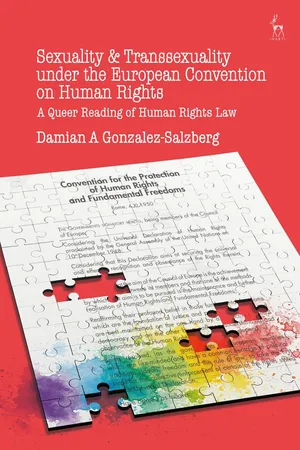
eBook - ePub
Sexuality and Transsexuality Under the European Convention on Human Rights
A Queer Reading of Human Rights Law
- 248 pages
- English
- ePUB (mobile friendly)
- Available on iOS & Android
eBook - ePub
Sexuality and Transsexuality Under the European Convention on Human Rights
A Queer Reading of Human Rights Law
About this book
This book undertakes a critical analysis of international human rights law through the lens of queer theory. It pursues two main aims: first, to make use of queer theory to illustrate that the field of human rights law is underpinned by several assumptions that determine a conception of the subject that is gendered and sexual in specific ways. This gives rise to multiple legal and social consequences, some of which challenge the very idea of universality of human rights. Second, the book proposes that human rights law can actually benefit from a better understanding of queer critiques, since queer insights can help it to overcome heteronormative beliefs currently held. In order to achieve these main aims, the book focuses on the case law of the European Court of Human Rights, the leading legal authority in the field of international human rights law. The use of queer theory as the theoretical approach for these tasks serves to deconstruct several aspects of the Court's jurisprudence dealing with gender, sexuality, and kinship, to later suggest potential paths to reconstruct such features in a queer(er) and more universal manner.
Information
1
An Introduction to Queer(ing) Human Rights Law
Human rights can be defined as the rights held by all individuals, anywhere they are, for the mere fact of being human.1 These rights are characterised by their particular aspiration to universality, which is apparent in three different levels: every right, for every person, and everywhere. As affirmed by Amartya Sen, it is certainly a deeply attractive idea that every person anywhere in the world, irrespective of citizenship or territorial legislation, has a number of fundamental rights, which others should respect.2 This global aspiration allows human rights to act as a common language for victims of injustice to communicate their suffering in universally understandable terms. In fact, human rights have been used in contemporary struggles against oppression, cruelty and violence and can be seen as invaluable tools for improving people’s lives.3 Moreover, existing legal procedures for the redress of human rights violations offer a path for victims to seek a decision that can put an end to the violation and establish certain forms of reparation for their suffering.
Human rights have been proclaimed the only political-moral idea that has received universal acceptance,4 and have been declared the greatest legal invention of our civilisation.5 It can even be affirmed that human rights have become the ideology of our century.6 They have acquired a central position in the fields of politics and law, as the notion of human rights appears to be present in every discussion on international themes.7 The language of human rights has been accepted by policy-makers and governments, by NGOs and academics, by the media and wide sectors of the general population, and it is seen by many as providing a framework for a progressive transformation of international relations and international law.8
That being said, human rights are certainly not a perfect invention. This book undertakes a critical analysis of the notion of human rights from a theoretical perspective grounded in queer theory. The purpose of this work is to illustrate that the field of human rights law is underpinned by several assumptions that determine a certain conception of the subject of human rights. In particular, the individual entitled to these universal rights has been conceived as gendered and sexual in specific ways, giving rise to multiple legal and social consequences, some of which betray the very idea of universality of human rights.
To clarify, this is not a doctrinal legal study of the human rights of LGBT individuals,9 by which I mean lesbians, gays, bisexuals and trans people.10 Many pages have already been written on that topic.11 This book is aimed at critically engaging with the construction of sexual and gender identities within human rights law and queer theory is the theoretical lens chosen to perform this task. Within the legal field, the use of queer theory as a theoretical tool for research remains largely unexplored,12 but its use in closely related areas, such as political science, international relations and criminology, reveals an increasing academic interest in queer theory.13 As to the use of queer theory to inform the interconnected study of sexual and gender identities in international human rights law, this is missing in the literature. In this specific area it is only possible to find shorter, more limited interventions.14 Therefore, this book comes to fill an existing gap in the literature. One of the primary aims of this work is to demonstrate that human rights law can make use of insights from queer theory in order to further approach its ideal of universality.
I.The Method and the Methodology of the Book
I purposely distinguish between the method and the methodology of this book. While I give the term ‘methodology’ a strong theoretical connotation, by ‘method’ I refer to how the research has actually been conducted.15 Hence, the methodology used in this work is queer theory. This is the approach that guides the interpretation of the analysis performed.16 As a result, a very important number of the secondary sources drawn upon in this work are the writings of queer theorists. As to the method, I have read, analysed and engaged with the jurisprudence of the European Court of Human Rights (‘the Court’) on sexuality and transsexuality. The main primary sources of this research project are the judgments of that Court. In addition to this, another essential part of the secondary sources used in this project consists of the work produced by legal scholars concerning the rulings of the Court. An important clarification is needed, in that while I have read and examined every published ruling issued by this Court on matters of sexuality and transsexuality up to the end of the year 2017, not every judgment will appear in the book’s discussion. The purpose of this work is not to analyse all the decisions adopted, but to use a selection of those decisions to illustrate how the Court has constructed the notions of sex, gender and sexuality through its case law.
The methodology adopted has several implications for the method. The analysis of the cases does not consist of a traditional doctrinal reading of legal sources, or even a general critical interpretation of them. This book performs a reading of the case law inspired by queer theory, and deconstruction is queer’s technique par excellence.17 I use the term deconstruction to mean a critical reading of texts that is specifically aimed at highlighting certain meanings that, while present in the text, do not appear as the obvious focus of attention.18 This is of extreme importance for legal sources, since what becomes law is the text as read, rather than the text as written.19 As affirmed by Jack Balkin, there are at least three very appealing reasons for making use of a deconstructive reading of legal texts:
First, deconstruction provides a method for critiquing existing legal doctrines; in particular, a deconstructive reading can show how arguments offered to support a particular rule undermine themselves, and instead, support an opposite rule. Second, deconstructive techniques can show how doctrinal arguments are informed by and disguise ideological thinking … Third, deconstructive techniques offer both a new kind of interpretive strategy and a critique of conventional interpretations of legal texts.20
I aim to demonstrate that a deconstructive reading of the Court’s case law can shed new light on the meaning and scope of human rights law. This theoretically grounded method will allow me to engage with the following question: How has the European Court of Human Rights constructed the gendered and sexual subject of human rights?
II.The European Court of Human Rights
As I mentioned above, the method of the book consists of a specific type of critical analysis (one inspired by queer theory) of the case law of the European Court of Human Rights. The use of this Court in order to study the field of human rights can be justified for several reasons. The European Court of Human Rights is the longest standing monitoring body regarding the international protection of human rights, as its work started in February 1959, and it had delivered more than 20,000 judgments by the end of 2017.21 In fact, many authors consider the Court as the world leading authority in human rights law, since its judgments are a source of reference not only for the domestic judicial bodies of the states of the Council of Europe, but also for many states worldwide and for other international courts.22 This system of international protection of human rights has also been characterised as the most effective one in existence.23 In addition to this, the Court is the human rights monitoring body that has decided the largest number of cases concerning sexual and gender identities.
Having stated the main reasons for selecting the jurisprudence of this Court as the object of study, I will briefly explain how this Court works.24 The Court was conceived by the Convention for the Protection of Human Rights and Fundamental Freedoms (hereinafter, ‘European Convention on Human Rights’ or ‘Convention’), adopted in 1950.25 This is an international treaty aimed at the protection of human rights within the states of the Council of Europe. This Convention was actually the first international treaty by which states acquired an international obligation to secure to every person within their jurisdiction a number of rights and freedoms.26 As affirmed by Ed Bates:
[B]y becoming a party to the Convention, a member State was assenting to the principle that matters that had hitherto been solely within their domestic jurisdiction were now subject to international law and a level of international control and censure by international bodies.27
This Convention established a Court (and back then, also a Commission),28 with jurisdiction to decide whether the conduct of States Parties to the treaty amounted to violations of the protected rights.29 That is to say, the international obligations assumed by the states concerning the protection of human rights were to be supervised by a judicial body with the ability to evaluate states’ conduct towards individuals within their own jurisdiction and to impose legal sanctions upon states in case of violations of these norms. Nowadays, there are 47 States Parties subject to the jurisdiction of the Court,30 and the role of the Court could be seen as having many similarities to that of a constitutional court of domestic jurisdiction, but with a focus on the interpretation and application of the European Convention on Human Rights.31
Furthermore, the European Court of Human Rights became the first international body with the ability to issue binding decisions concerning human rights when a violation of any of those rights was claimed by individuals.32 This gave individuals the opportunity to challenge the laws and practices of particular states. However, it is worth highlighting that at the same time that the Convention granted the individual access to an international body, it was also giving an international court access to the individual. In other words, the existence of the Court granted individuals the possibility of requesting that an ...
Table of contents
- Cover
- Dedication
- Title Page
- Contents
- Table of Cases, Treaties and Legislation
- 1. An Introduction to Queer(ing) Human Rights Law
- 2. The Court’s Conception of Gender
- 3. (Homo)Sexuality before the Court
- 4. LGBT Families and Non-discrimination
- 5. Of Marriage, Partnerships and Parenthood (and Marriage Once Again)
- 6. A Queer(er) Human Rights Jurisprudence
- 7. Conclusion
- Bibliography
- Index
- Copyright Page
Trusted by 375,005 students
Access to over 1.5 million titles for a fair monthly price.
Study more efficiently using our study tools.
Frequently asked questions
Yes, you can cancel anytime from the Subscription tab in your account settings on the Perlego website. Your subscription will stay active until the end of your current billing period. Learn how to cancel your subscription
No, books cannot be downloaded as external files, such as PDFs, for use outside of Perlego. However, you can download books within the Perlego app for offline reading on mobile or tablet. Learn how to download books offline
Perlego offers two plans: Essential and Complete
- Essential is ideal for learners and professionals who enjoy exploring a wide range of subjects. Access the Essential Library with 800,000+ trusted titles and best-sellers across business, personal growth, and the humanities. Includes unlimited reading time and Standard Read Aloud voice.
- Complete: Perfect for advanced learners and researchers needing full, unrestricted access. Unlock 1.5M+ books across hundreds of subjects, including academic and specialized titles. The Complete Plan also includes advanced features like Premium Read Aloud and Research Assistant.
We are an online textbook subscription service, where you can get access to an entire online library for less than the price of a single book per month. With over 1.5 million books across 990+ topics, we’ve got you covered! Learn about our mission
Look out for the read-aloud symbol on your next book to see if you can listen to it. The read-aloud tool reads text aloud for you, highlighting the text as it is being read. You can pause it, speed it up and slow it down. Learn more about Read Aloud
Yes! You can use the Perlego app on both iOS and Android devices to read anytime, anywhere — even offline. Perfect for commutes or when you’re on the go.
Please note we cannot support devices running on iOS 13 and Android 7 or earlier. Learn more about using the app
Please note we cannot support devices running on iOS 13 and Android 7 or earlier. Learn more about using the app
Yes, you can access Sexuality and Transsexuality Under the European Convention on Human Rights by Damian A Gonzalez Salzberg in PDF and/or ePUB format, as well as other popular books in Law & Gender & The Law. We have over 1.5 million books available in our catalogue for you to explore.