Although employers are required to pay compensation for employee inventions under the laws in many countries, existing legal literature has never critically examined whether such compensation actually gives employee inventors an incentive to invent as the legislature intends.
This book addresses the issue through reference to recent, large-scale surveys on the motivation of employee inventors (in Europe, the United States and Japan) and studies in social psychology and econometrics, arguing that the compensation is unlikely to boost the motivation, productivity and creativity of employee inventors, and thereby encourage the creation of inventions. It also discusses the ownership of inventions made by university researchers, giving due consideration to the need to ensure open science and their academic freedom.
Challenging popular assumptions, this book provides a solution to a critical issue by arguing that compensation for employee inventions should not be made mandatory regardless of jurisdiction because there is no legitimate reason to require employers to pay it. This means that patent law does not need to give employee inventors an 'incentive to invent' separately from the 'incentive to innovate' which is already given to employers.
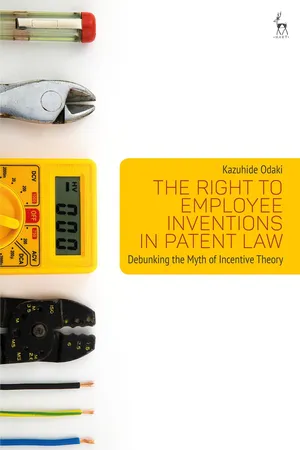
eBook - ePub
The Right to Employee Inventions in Patent Law
Debunking the Myth of Incentive Theory
- 232 pages
- English
- ePUB (mobile friendly)
- Available on iOS & Android
eBook - ePub
About this book
Information
1
Introduction
I.Background and Purpose of this Book
A.Compensation for Employee Inventions: Various Legal Schemes
Most inventions today originate from within organisations. Of the 210,454 patent applications which were made worldwide through the Patent Cooperation Treaty (PCT) route in 2016, 85.5 per cent were filed by businesses, 7.5 per cent by individuals, 5 per cent by universities, and 1.9 per cent by governments or research institutes.1 Although individuals still accounted for a large share of PCT applications in many countries which do not belong to the high income group,2 these data show that nowadays over 90 per cent of inventions patented in the whole world are created by employees working for companies, universities, governments and other organisations.
Employee inventors, who typically work in research and development (R&D) departments of companies, are often expected to contribute to the making of patentable inventions. According to the established principle in labour law that employers should enjoy the fruits of labour of their employees their employees’ labour, there is no reason why employers have to offer compensation for inventions made in the course of employees’ duties in addition to their salaries and benefits. However, patent laws or other related laws in some countries require employers to pay additional compensation for such inventions. For example, according to the German Act on Employees’ Inventions,3 employers based in Germany are required to pay employee inventors ‘reasonable compensation’ in principle if they claim patentable ‘service inventions’.4 Here, ‘service inventions’ refers to those made during the term of employment which either (i) resulted from an employee’s tasks, or (ii) are essentially based upon experience or activities of the company.5 The amount of ‘reasonable compensation’ shall be calculated by considering particularly the commercial applicability of the service invention, the duties and position of the employee in the company, and the company’s contribution to the invention.6 According to the Guidelines for the Remuneration of Employees’ Inventions in Private Employment7 which are issued by the Federal Minister of Labour,8 its amount is ‘value of invention’ multiplied by ‘share factor’.9 According to the ‘licence analogy’, which is most frequently used in practice of the three calculation methods prescribed in the Guidelines,10 the ‘value of invention’, or supposed licence fee, is calculated on the basis of total turnover and the usual royalty rate applied to each industrial sector.11 ‘Share factor’ is a numerical value expressed in the form of percentage which represents the inventor’s share in the supposed benefit from the invention, and is determined in consideration of the assignment and solution of the task and his position in the company.12 Such an elaborate legal scheme for calculating additional compensation to employee inventors is unique to Germany.
Courts in other countries have awarded the additional compensation on a case-by-case basis pursuant to relevant statutory provisions. In Japan, a court decision in 2004 awarded ¥20 billion (then over £10.3 million) to an ex-employee of a company who had invented a blue Light-Emitting Diode during his tenure on the assumption that he had contributed to 50 per cent of company profits (the Blue LED case).13 On appeal, however, both parties reached a court-mediated settlement, in which the company agreed to pay the ex-employee about ¥840 million (a little more than 4 per cent of the amount originally awarded to him).14 In the United Kingdom (UK), the High Court of England and Wales in 2009 awarded £1.5 million to a pair of employee inventors who had synthesised a new compound during their tenure. The amount accounted for 3 per cent of the profits their employer had derived from a patented radioactive imaging agent which incorporated this compound (the Kelly and Chiu case).15 Since 2000, French courts have been willing to award a substantial amount of ‘additional remuneration’ for ‘inventions under mission’, namely those made in the course of employees’ duties.16 Decisions which awarded between €10,000 and €100,000 to employee inventors are not rare, and a few courts have awarded €300,000 or more, with the maximum award being €600,000.17
By contrast, courts in the United States (US) generally allow employers to claim inventions made by employees without paying additional compensation, as long as both parties have made a proper contract in advance.18 Nonetheless, employees of the Federal Government who have assigned the inventor’s rights to the Government are entitled by special legislation to a fixed sum of $2,000 in the first year, and at least 15 per cent of licensing royalties after deducting patent costs thereafter.19
B.Rationale for Inventor Remuneration: The ‘Incentive Theory’?
One question which arises is why statutory laws in many, if not all, countries make the payment of additional compensation to employee inventors mandatory under certain conditions. A simple view may be that these statutory laws are aimed at fair distribution of profits gained from an invention to its inventor(s). However, this view gives no theoretical explanation as to why only inventors should be given special treatment even though these profits would not have arisen without a contribution made by other employees such as those working in manufacturing and marketing departments.
Some may argue instead that such laws are social legislation intended to improve employee inventors’ status as workers. This theory partly explains why the German Act on Employees’ Inventions was introduced.20 However, it does not apply to most countries where only a few employee inventors can receive the additional compensation. According to the Patents Act 1977 in the UK, for example, where ‘having regard among other things to the size and nature of the employer’s undertaking, the invention or the patent for it (or the combination of both) is of outstanding benefit to the employer, and’ ‘it is just that the employee should be awarded compensation’, ‘the court … may award him such compensation’ ‘as will secure for the employee a fair share … of the benefit which the employer has derived’ from the invention or the patent.21 It is hard to say that the Act has generally raised the social status of employee inventors in the UK since according to this provision the additional compensation shall be awarded only in exceptional circumstances at the court’s discretion. Indeed, the Kelly and Chiu case has been the only example so far where the English court actually awarded compensation. Meanwhile, employee inventors may want to establish their right to additional compensation by collective agreements so that they can redress the social inequality between them and their employers. In Sweden, a collective agreement concluded in 2015 guarantees unionised employees a lump sum payment of either kr22,150 or kr44,300 (≒ €2,400 or €4,800, as of 2016) per invention claimed by their employers.22 Yet in France, there are currently few enforceable collective agreements23 despite a statutory provision that the conditions for the payment of the additional compensation shall be determined by collective agreements apart from company agreements and individual employment contracts.24 In the US, employee inventors generally regard themselves as professional individualists, and as such are reluctant to unionise.25 In most countries employee inventors have not sought the payment of the additional compensation by collective agreements which are aimed at improving employees’ social status as a whole.
Traditional theories on the justification of the patent system may give a clue as to the rationale for the additional compensation employee inventors receive. However, the ‘labour theory of property’, which holds that an inventor has the natural property right in the fruits of his labour, is untenable on the grounds that the amount of monopoly profits gained by a patent depends on various social factors in the market, and that his idea itself is also fundamentally a social product based on the ideas of others ahead of him.26 The ‘reward theory’, which holds that an inventor deserves reward for his labour rather than his natural talent or luck, has also attracted little support because a patent may bring him a considerable reward disproportionate to his effort.27 Since the utilitarian argument that a patent offers the best incentive to invent gives a more acceptable explanation for the patent system,28 the most plausible view may be that employee inventors receive additional compensation because this enhances or otherwise contributes to their overall motivation to invent. This ‘incentive theory’ claims that employee inventors need a special inducement to make inventions because, unlike independent inventors, they are on the regular payroll regardless of their job performance. This argument must be clearly distinguished from the ‘reward theory’ mentioned above, according to which the reward is given for inventors’ effort rather than their ‘natural talent and luck’ beyond their control.29 The additional compensation may be justified as an incentive, but not as what is mentioned as ‘reward’ here because its amount is usually linked to the social value of the inventions rather than the inventors’ effort.30 Compensation offered to employee inventors is comparable to cash prizes historically offered to the general public by governments or other organisations to trigger important discoveries or inventions.31 It may boost the creation of inventions by employees, even if only a few who have made fairly valuable inventions can receive it.
C.Does Inventor Remuneration Really Encourage Employees to Invent?
It has been taken for granted in the relevant literature of law and economics that money acts as an incentive for employee inventors to invent.32 Policy makers in many countries may want to boost the creation of valuable inventions that are vital to the industrial development of the country by allowing employee inventors to receive more generous compensation for inventions made in the course of their duties. However, to date there has been no critical examination of whether invention compensation schemes can actually increase the number of inventions made by employees. First of all, employee inventors may not be ...
Table of contents
- Cover
- Title Page
- Acknowledgements
- Table of Contents
- List of Figures
- Table of Cases
- Table of Legislation
- 1. Introduction
- PART I FINANCIAL INCENTIVES AND THE MOTIVATION, PRODUCTIVITY AND CREATIVITY OF EMPLOYEE INVENTORS
- PART II OWNERSHIP OF EMPLOYEE INVENTIONS AND THE VALIDITY OF THE INVENTOR PRINCIPLE
- Bibliography
- Index
- Copyright Page
Trusted by 375,005 students
Access to over 1.5 million titles for a fair monthly price.
Study more efficiently using our study tools.
Frequently asked questions
Yes, you can cancel anytime from the Subscription tab in your account settings on the Perlego website. Your subscription will stay active until the end of your current billing period. Learn how to cancel your subscription
No, books cannot be downloaded as external files, such as PDFs, for use outside of Perlego. However, you can download books within the Perlego app for offline reading on mobile or tablet. Learn how to download books offline
Perlego offers two plans: Essential and Complete
- Essential is ideal for learners and professionals who enjoy exploring a wide range of subjects. Access the Essential Library with 800,000+ trusted titles and best-sellers across business, personal growth, and the humanities. Includes unlimited reading time and Standard Read Aloud voice.
- Complete: Perfect for advanced learners and researchers needing full, unrestricted access. Unlock 1.5M+ books across hundreds of subjects, including academic and specialized titles. The Complete Plan also includes advanced features like Premium Read Aloud and Research Assistant.
We are an online textbook subscription service, where you can get access to an entire online library for less than the price of a single book per month. With over 1.5 million books across 990+ topics, we’ve got you covered! Learn about our mission
Look out for the read-aloud symbol on your next book to see if you can listen to it. The read-aloud tool reads text aloud for you, highlighting the text as it is being read. You can pause it, speed it up and slow it down. Learn more about Read Aloud
Yes! You can use the Perlego app on both iOS and Android devices to read anytime, anywhere — even offline. Perfect for commutes or when you’re on the go.
Please note we cannot support devices running on iOS 13 and Android 7 or earlier. Learn more about using the app
Please note we cannot support devices running on iOS 13 and Android 7 or earlier. Learn more about using the app
Yes, you can access The Right to Employee Inventions in Patent Law by Kazuhide Odaki in PDF and/or ePUB format, as well as other popular books in Law & Comparative Law. We have over 1.5 million books available in our catalogue for you to explore.