A fresh set of concerns face the twenty-first century British novelist. In this study of the four key novelists Zadie Smith, Nadeem Aslam, Hari Kunzru and David Mitchell, the the changes in narrative approaches and critical directions of a new post-1989 fiction are explored.
Close readings of the writers are informed by a range of contemporary theorists, critics and commentators to reveal the emphases of twenty-first century fiction. Terror, fear, consumerism, multinationalism, and corporatism: the terms circulating in culture and social networks are evident in Smith's faith in ethical living, Aslam's consideration of multiculturalism, the novels Kunzru builds around the politics of identity and in the importance Mitchell places on the interconnectedness of human life. By putting the emergence of a new British literary dynamic in the context of ethical as well as global contexts, this study analyzes the transformed fictional perceptions of a world no longer defined by the stand off of super powers.
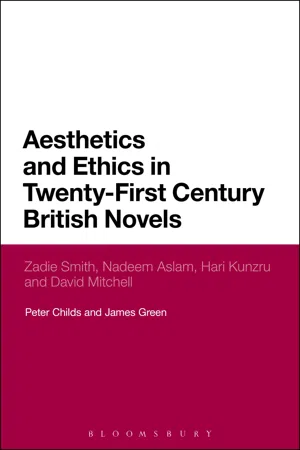
eBook - ePub
Aesthetics and Ethics in Twenty-First Century British Novels
Zadie Smith, Nadeem Aslam, Hari Kunzru and David Mitchell
- 192 pages
- English
- ePUB (mobile friendly)
- Available on iOS & Android
eBook - ePub
Aesthetics and Ethics in Twenty-First Century British Novels
Zadie Smith, Nadeem Aslam, Hari Kunzru and David Mitchell
About this book
Information
1
Zadie Smith
The most well-known of the four writers discussed in this study, Zadie Smith, more than any other British novelist of her generation, is an author whose fiction has grown up in the glare of critical opinion. Her first novel, White Teeth (2000), was greeted as that of a prodigy, her voice that of the spokesperson for a new vanguard of writers who would plot the coordinates of cosmopolitan urban living. Time described it as ‘the first novel ever written that truly feels at home in our borderless, globalized, intermarried, post-colonial age’.1 Her two subsequent novels, The Autograph Man (2002) and On Beauty (2005), put her narratives in a transatlantic context, with American as well as British settings, and showed more overtly how her literary heritage influences aspects of the writing and plotting. After a seven-year gap in which she proved herself to be an accomplished literary and cultural critic, Smith returned with the more modernistic NW (2012) to rework the ethnically diverse north London picture created in her first novel and its snapshot of the state of the nation in the capital at the turn of the century.
There is a danger of the literature of the nation supporting hierarchical divisions between, for example, migrant and national. As Spivak points out, this is the aggressive attitudinal thrust of Rushdie’s The Satanic Verses (1988). Conversely, there can be dangers in eliding the association of the cosmopolitan imagination, if narrowly defined, with particular class positions, cultural privileges and educational opportunities, such that some writers see cosmopolitanism as a mask for first-world nationalism and a synonym for the culture of Westernized consumerism, rather than as an ‘unconditional hospitality’, in Derrida’s phrase, or Timothy Brennan’s delineation of a quasi existential apprehension of being ‘not-quite at-home’ in the world.2
Hence the attack on a writer like Smith (e.g. see Schoene) because a book such as White Teeth (2000) seems to position itself far from the forces of globalization and chiefly gestures towards cosmopolitanism through slang and style. Thus, in the words of one chapter title, the Chalfen family are taken to be ‘more English than the English’ because of their liberal middle-class values. However, they are third-generation Poles, originally Chalfenovskys – not more English than the English, but as English as anyone else. Smith rings this theme of hybridity and cross-fertilization through numerous parallels, drawn from horticulture, eugenics and meteorology. One of the dominant extended metaphors belongs to Joyce Chalfen’s 1976 book, entitled The New Flower Power:
Where once gardeners swore by the reliability of the self-pollinating plant in which pollen is transferred from the stamen to the stigma of the same flower (autogamy), now we are more adventurous, positively singing the praises of cross-pollination where pollen is transferred from one flower to another on the same plant (geitonogamy), or to a flower of another plant of the same species (xenogamy) . . . Yes, self-pollination is the simpler and more certain of the two fertilization processes, especially for many species that colonize by copiously repeating the same parental strain. But a species cloning such uniform offspring runs the risk of having its entire population wiped out by a single evolutionary event. In the garden, as in the social and political arena, change should be the only constant. Our parents and our parents’ petunias have learnt this lesson the hard way. The March of History is unsentimental, tramping over a generation and its annuals with ruthless determination.3
As the title of Joyce Chalfen’s book suggests, being English for the Chalfens is rooted in a set of 1960s images, such that they emerge as ‘an ageing hippy couple both dressed in pseudo-Indian garb’ (131). Joyce expresses the idea that miscegenation is valuable in itself, and her marriage to Marcus Chalfen is an expression of their shared belief in ‘good genes’ rather than ‘pure blood’. Consequently, Smith has been accused of advocating in the novel little more than the rhetoric of the multicultural ‘greenandpleasantlibertarianlandofthefree’ she satirizes (465).
Making a contrasting point, Padmaja Chatterjee concludes on the approach used in many books, including White Teeth, that ‘cosmopolitan political subjectivity as represented in contemporary fiction is conservative because it is fundamentally spectatorial’.4 This is exploited in Nirpal Singh’s 2006 debut, Tourism – a novel that attempts a kind of reverse colonization in its depiction of the consumer lifestyle of a young Asian man living in London.5 In Singh’s novel, the capital and the English countryside are, as his title suggests, as susceptible to packaged commodification as Mumbai or Bangkok.
A canonical example in British fiction that seems to justify Chatterjee’s accusation of spectatorial conservatism is Ian McEwan’s Saturday (2005), which takes place on the day of the February 2003 protest march in London against the second Gulf War. This was the largest protest march that has ever been staged in the British Isles, yet McEwan’s interest appears to be in the course of a family’s private life that runs in parallel, but not in sympathy, with the protestors’ spirit of global concern watched from behind expensive facades by the protagonist, Henry Perowne.
However, there are alternative examples conducive to a planetary understanding in the work of other contemporary writers. Thus, for instance, there is a contrast to McEwan’s use of an anti-war march as backdrop to illustrate the threat to the western bourgeois home in Robert Newman’s The Fountain at the Centre of the World (2006). This is another novel that begins in London, but its narrative snakes across the world, describing the lives of different communities affected by the flows of labour and capital. It concludes in a long final section detailing the excessive repression of the anti-World Trade Organization protestors in Seattle in 1999, and draws in numerous mythological allusions in its story of the fight for the centrality of water or oil supplies in global negotiations.
Very different again, a work that evokes the cosmopolitan non-hierarchically is Geoff Ryman’s 253 from 1998.6 Ryman describes the inner and outer life of passengers on a London tube journey. 252 passengers are described, randomly arranged on all the seats in seven cars. Again intimating the unique quality of the novel form to render the familiar strange and the different same, the book scans the appearance of each person in each compartment, as though the reader is also a passenger seeing the apparition of these faces in the crowd, but it also describes their inner life, making plain the human as well as multinational heterogeneity within shared urban living. Most interestingly, Ryman’s novel uses the train compartment as contact zone in which the world travels through London, almost as though to dramatize the contention that London is one of the most cosmopolitan cities in the world.
A book that does something similar by absence and omission is John Lanchester’s Mr Phillips (2000). It is an unusual novel – because so utterly banal and entertaining at the same time – which has drawn comparisons even with Ulysses. This is in no way because of its style or complexity, but because it charts a day in the life of a pointedly unexceptional man who wanders around the capital in a way that seems reminiscent of Bloom in Dublin. Mr Phillips is a newly unemployed 50-year-old accountant who feels redundant in almost every sense. The entire book, with its world of Neighbourhood Watch Associations, commuter belts and Pre-Raphaelite paintings, has a sense of suburban faux gentility attaching to it. Mr Phillips himself conforms to an archetype of the reserved, undemonstrative, insular, repressed white Englishman. The original book cover shows an improbably clean white unoccupied bench in a green and pleasant spot.
Mr Phillips is a book that self-consciously marginalizes issues of community and ethnicity to unexplored side lines, implying them almost exclusively through their conspicuous absence. The book glosses Mr Phillips with the sheen of Ulysses, but his odyssey is one that contains no informal intimacy, no narrative high points, and nothing but quiet amusement as its protagonist walks through London’s emblematic spaces of Britishness. These places, ranging from Battersea Park to the Tate Gallery via the sex-cinemas of Soho, are actually quite unfamiliar to the novel’s protagonist; and when Mr Phillips travels on the bus through what he calls the ‘glamorous parts of London’, he feels an outsider again. Pointing up Mr Phillips’ sense of unbelonging, Lanchester’s choice of epigraph is a quotation from the French philosopher Simone Weil’s book entitled The Need for Roots (L’Enracinement (1949)) – ‘A man left alone in the universe would have no rights whatsoever, but he would have obligations’.
With a deracinated man at its centre, Lanchester’s novel is a highly conscious exercise in nostalgia, filtering received images of behaviour through the mind of a man who feels he has lived his life, if not his national identity, vicariously, and now takes a day to explore the capital, where he feels he is an outsider. Mr Phillips is an individual who is in almost every sense in the middle of life, but who Lanchester appears to have made step out of the Britain of 1945, the year Mr Phillips was in fact born. Mr Phillips’s embodiment of traditional, formal Anglicized Britishness is expressed in the narrator’s refusal to address him by his forename from first page to last. Even Mr Phillips, whose ironic first name is Victor, thinks of himself as ‘Mr Phillips’.
Edward Said argued in Culture and Imperialism that the imposition of national identity is implicit in the domestic novel in its boundaries, exclusions and silences – the Imperial interstices of society that contrapuntal reading can reveal by turning the narrative inside out, temporarily centralizing its supposed margins. This is what Zadie Smith in White Teeth seems to have done with the archaic version of London in Mr Phillips. White Teeth, by contrast to the satirical consideration of the national stereotype in Mr Phillips, presents a series of metaphors for the mondialized heterogeneity of Britain since the war. And Smith’s title, of course, plays with the idea that everyone is the same under the skin, but the novel charts the variety of molars, canines, incisors, root canals, false teeth, dental work and damage that constitute the history behind different smiles. The commonsensical idea of the uniformity of teeth, which can also be divided into a host of shades from pearly to black, is as much a fiction in Smith’s novel as the template of ‘Britishness’ exposed with tender affection in Mr Phillips.
The negative of Mr Phillips might be Gautam Malkani’s Londonstani (2006), which tells the story of a section of the Asian population of Hounslow, in West London, near Heathrow. This narrative overturns the image of Englishness and the reader’s assumptions by revealing at its close that the Hindu Desi gang hero of the novel, who speaks an urban argot fusing Hindi, cockney and black American hip hop, is in fact white.7 Londonstani is ultimately not about Asian acculturation in Britain, but the chutnification, in Rushdie’s words, of English identity.
But these novels still fail to give a sense of glocal interconnectedness in their cosmopolitan pictures of London. In a Time review, Pico Iyer uses the term ‘planetary novel’ to describe David Mitchell’s Ghostwritten (1999) (Iyer n.p.), which we will consider in the final chapter. The subtitle of Ghostwritten presents it as ‘a Novel in Nine Parts’, its formal arrangement comprising nine discrete first-person narratives that trace an imaginative passage from East to West, encircling the globe’s northern hemisphere. Though the narrative does come to pass through the more familiar ‘centres’ of the global cultural economy, such as London and New York, much of the novel concentrates on places that have been perceived as alien and mysterious by the Western cultural imagination. Japan, Hong Kong, China and Mongolia have all found themselves refracted through a prism of Eurocentric discourse that has world history radiating outwards from its ‘over-developed’ centres. Ghostwritten’s trajectory is not a reversal of this, as in the familiar postcolonial trope of the former empire ‘writing back’ to the centre, but rather seems to be an alternative recognition of planetary con-temporality and dynamic synchronicity, where people and places are inextricably linked, regardless of distance. The novel does not merely show events happening around the world at the same time for purposes of comparison; it animates an entire circuitry of global interaction and interdependence between seemingly unconnected characters and events.
Against readings of globalization that frame it as a process of integration and assimilation homogenizing cultural difference, Mitchell’s novel suggests that the site of the local is crisscrossed by innumerable paths of movement with varying speeds and directions. Mitchell encapsulates this most directly in the dramatization of a literally disembodied spirit in his chapter entitled ‘Mongolia’. The...
Table of contents
- Cover-Page
- Half-Title
- Series
- Title
- Copyright
- Contents
- Introduction
- 1 Zadie Smith
- 2 Hari Kunzru
- 3 Nadeem Aslam
- 4 David Mitchell
- Bibliography
- Index
Trusted by 375,005 students
Access to over 1.5 million titles for a fair monthly price.
Study more efficiently using our study tools.
Frequently asked questions
Yes, you can cancel anytime from the Subscription tab in your account settings on the Perlego website. Your subscription will stay active until the end of your current billing period. Learn how to cancel your subscription
No, books cannot be downloaded as external files, such as PDFs, for use outside of Perlego. However, you can download books within the Perlego app for offline reading on mobile or tablet. Learn how to download books offline
Perlego offers two plans: Essential and Complete
- Essential is ideal for learners and professionals who enjoy exploring a wide range of subjects. Access the Essential Library with 800,000+ trusted titles and best-sellers across business, personal growth, and the humanities. Includes unlimited reading time and Standard Read Aloud voice.
- Complete: Perfect for advanced learners and researchers needing full, unrestricted access. Unlock 1.5M+ books across hundreds of subjects, including academic and specialized titles. The Complete Plan also includes advanced features like Premium Read Aloud and Research Assistant.
We are an online textbook subscription service, where you can get access to an entire online library for less than the price of a single book per month. With over 1.5 million books across 990+ topics, we’ve got you covered! Learn about our mission
Look out for the read-aloud symbol on your next book to see if you can listen to it. The read-aloud tool reads text aloud for you, highlighting the text as it is being read. You can pause it, speed it up and slow it down. Learn more about Read Aloud
Yes! You can use the Perlego app on both iOS and Android devices to read anytime, anywhere — even offline. Perfect for commutes or when you’re on the go.
Please note we cannot support devices running on iOS 13 and Android 7 or earlier. Learn more about using the app
Please note we cannot support devices running on iOS 13 and Android 7 or earlier. Learn more about using the app
Yes, you can access Aesthetics and Ethics in Twenty-First Century British Novels by Peter Childs,James Green in PDF and/or ePUB format, as well as other popular books in Literature & English Literary Criticism. We have over 1.5 million books available in our catalogue for you to explore.