This book is available as open access through the Bloomsbury Open Access programme and is available on www.bloomsburycollections.com.
Winner of the 2015 David Easton Prize, awarded by the American Political Science Association (APSA)
Global forces are eroding the ability of states to exert sovereign control over their populations, territories, and borders. Yet when dominated subjects across the world dream of freedom, they continue to conceive of it in sovereign terms. Sovereign freedom haunts the imagination of oppressed ethnic minorities, popular masses ruled by foreign powers or homegrown tyrants, indigenous peoples, and individuals chafing under customary or governmental restrictions.
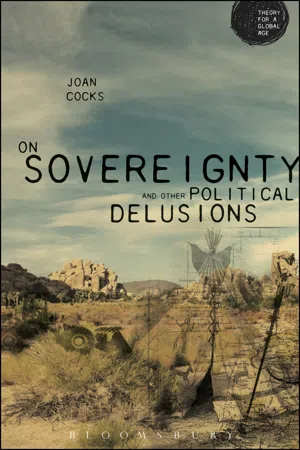
On Sovereignty and Other Political Delusions draws on political theory and on two case studies – the encounter between Anglo-American settlers and Native American tribes, and the search for Jewish sovereignty in Palestine – to probe the allure of the idea of sovereign freedom and its self-defeating logic. It concludes by shifting its sights from political to economic sovereign power and by pursuing intimations of non-sovereign freedom in the contemporary age.
- 208 pages
- English
- ePUB (mobile friendly)
- Available on iOS & Android
eBook - ePub
On Sovereignty and Other Political Delusions
About this book
Information
1
The Sovereignty Concept
Concepts and politics
The terms of political discourse are the words we use to talk about problems and possibilities in the political world, but they also are problems and possibilities in themselves. “Power,” “justice,” “equality,” “tyranny,” and so on are, first of all, intellectual puzzles without definitive solutions, in that any conceptualization of any of these terms will spark its own revision, refinement, extension, or counter-conceptualization when it inevitably is found to be inadequate to its object in some way. In turn, those contrasting concepts will spark new chains of revisions, refinements, and counter-concepts. Magnifying the undecidability of each political keyword is the fact that its conceptualization involves the use of other keywords (sometimes political, but sometimes philosophical, aesthetic, religious, or economic) that are intellectual puzzles without definitive solutions, too.
Take, for example, the classical liberal definition of freedom proposed by J. S. Mill in On Liberty. The individual is free to the extent that he can form his own thought and feeling, opinions and sentiments, tastes, associations, goals for action, and style of life. The only justifiable limits to this “sovereignty of the individual over himself” are that he must not harm other individuals and must share in the “labors and sacrifices incurred for defending the society or its members from injury and molestation.”1 In short, the free individual can pursue his self-regarding interests without interference by others but is obligated to contribute to their collective security and refrain from injuring them. While at first glance Mill’s proposition seems straightforward, it has provoked in many inquiring minds, simply because they are inquiring minds, a host of new questions about freedom and the other key terms on which Mill relies. What constitutes injury to another? Are any interests purely self-regarding? What is a self? Are sovereignty and freedom synonyms?
Every term of political discourse is not just an intellectual but also a political Pandora’s box. People with clashing ideological commitments in the world also will clash over the meaning of the keywords they use to talk about the world and even may go to war because, to stay with our example, they value freedom but disagree in part about what freedom means and who is its proper subject. Thus, in a case in which one society tries to export the requisite institutions and habits of thought and practice to support freedom in some twenty-first-century revision of the Millian sense of that term, and another society denies that the individual self is sovereign, sees freedom’s most significant subject as the collective culture, and defines freedom as national self-determination, not just conceptual debate but also political conflict may ensue. It is a weird and unfortunate fact of political life that if conflict does ensue, the relative material power of the two sides rather than the relative intellectual worth of their competing concepts will determine which idea of freedom is victorious.2
In a classic gem of an essay, W. B. Gallie characterizes aesthetic, religious, and political discourse as pivoting on concepts over which disputes are likely to erupt without the possibility of an “objective” or universally agreed-upon resolution. Concepts are essentially contestable if they are intellectually open ended, in the sense we noted above of being susceptible to further elaborations and revisions; internally complex, containing many ideational aspects; and inherently appraisive, in describing a phenomenon with an intrinsic value that can be over-ridden only by strong reasons pertaining to special circumstances, whether that value is positive (as according to Gallie’s original formulation) or negative (once other scholars had expanded it).3 In The Terms of Political Discourse William E. Connolly explains how essential contests over political concepts occur and why those contests are themselves political.4 Those who use the same political keyword may not agree on an entire list of its internal aspects, although they will agree on enough of those aspects to feel that their disagreements are about the same general idea. They may agree on the list of aspects but rank the importance of each differently. They may clash over the conceptualization of other keywords on which the definition of this one relies. They may place this value on different rungs of a hierarchy of all shared or partly shared positive values. Thus, our Millian individualist and champion of national–cultural self-determination both see freedom as a good and autonomy as a central internal aspect of the concept, while disagreeing about the sanctity of individual self-regarding interests, what a self is (self-authoring and atomistic or indelibly stamped by its membership in a larger social whole), and whether the value of freedom should be ranked higher than, lower than, or on the same level as the values of solidarity and cultural integrity. Because they have an overlapping sense of what “freedom” means and because they are both invested in it as a good, it will be impossible to resolve their conflict by giving the term “freedom” to one party’s concept and coining a new term for the other’s.
What also will be impossible is for scholars of politics to evade or resolve or transcend the essentially contested nature of political keywords in their own analyses of politics. The conceit of positivistic social science to stand outside the world it seeks to explain hinges on its ability to develop a vocabulary that is substantively uncontroversial, normatively neutral, with universally agreeable rules for the construction and application of terms. However, if scholars of politics wish to clarify and illuminate the world of politics, they at some point will have to draw on the everyday language of politics to describe that world, which means that they will have to use essentially contested concepts of politics in specific ways, defining “democracy,” for example, in the liberal democratic instead of right- or left-populist sense when they describe certain political societies as “democratic.” In doing so, whether intentionally or unwittingly, they ally themselves with actors who endorse that definition against others who do not. Hence, in addition to whatever political positions they may have in their capacity as members of the political world that inform or seep into their work, scholars of politics will be pulled by the logic of essentially contested concepts into the world as they analyze it, instead of being able to dissect it from a god’s eye point of view. If those scholars instead try to assume a scientific stance by devising a new language—say, a mathematical one—from which all internally complex, inherently appraisive, and open-ended concepts have been excised, their statements may achieve a veneer of value-neutrality, objectivity, and universalizability, but what they have to say with those statements will clarify little about the world as it is inhabited and understood by political actors and hence be of interest mostly to political scientists as a specialized professional group. I say “veneer,” because the superiority of value-neutrality for gaining insight into human affairs is itself a value position, pitted against, for example, a recognition of the inevitability of having a stake in those affairs and the superiority of having a stake that is self-conscious and self-reflective.
Political keywords are problems and possibilities in themselves not only because they are intellectually open-ended and politically contested but also because they are historical phenomena. Their internal aspects, associations, and even evaluative thrust undergo metamorphoses over time, both in response to and in anticipation of changes in practical circumstances. This is the point to which Raymond Williams is attuned in Marxism and Literature when he tracks the changes in the English word “culture” from its early connotation of the cultivation of crops to its later connotation of self-cultivation and learning, along with its competing connotation of a whole way of life. Magnifying this historical flexibility is the fact that the terms from which “culture” is distinguished change over time as well, although not always at the same pace or for the same reasons. Thus, as Williams recounts, “society” conjured up the idea of shared fellowship when “culture” conjured up crop cultivation but later came to signify that which is abstract, mechanical, industrial, and economic, over against which culture came to signify literature, the arts, meaning, values, and inner, subjective experience.5
Past inflections of keywords often remain sedimented in the present connotations of those same words. That the past leaves its traces on categories in the present means that the words we use in political life may, by evoking elements of a world that is disappearing or already has largely disappeared, prevent us from identifying and grasping the new lineaments of our own world. The capacity of everyday terms to attach the imagination to ossified forms of thought tied to evaporating forms of practice was one of Antonio Gramsci’s worries about the effect of inherited ideas on a peasantry subordinated to landowning elites and the Catholic Church as Italy moved towards an industrial capitalist future. Although with a different political agenda, Michel Foucault flags the same antiquated potentiality of language when he declares that a preoccupation with “sovereignty” on the part of scholars of politics is a hangover from the age of monarchical rule that blinds them to new micro-modalities of modern power.
As Williams notes, however, residues of the past in our current terminology also can provide us with tools for identifying, criticizing, and staunching the human losses that those new lineaments entail. To cite a current example, the English keyword “the commons” once connoted forests, meadows, and fields available for use by everyone until that land was enclosed by rural aristocrats, gentry, and other improving farmers for private profit-making. Today, because of its residual references, “the commons” has become an evocative keyword for critics of the neo-liberal project of privatizing or “enclosing” all public or collective goods.6
Then again, as Williams also is right to note, the triumph in the present of some historical meaning of a term over other, partially discrepant meanings it had had in the past can blind us to possibilities of practice conjured up by those defeated meanings. Quentin Skinner, who agrees with Williams here, praises the intellectual historian for acting “as a kind of archaeologist, bringing buried intellectual treasure back to the surface, dusting it down and enabling us to reconsider what we think of it.”7 Skinner cites, as an example, the contemporary hegemony of the classical liberal notion of liberty as a sphere of action not blocked by external impediments. The notion of liberty as non-interference, which conceivably could be secured for the individual by autocratic political rule, conflicts with and helps obscure an older, neo-roman notion of liberty as non-dependence on the will, even the goodwill, of a superior power. The actualization of this idea of liberty invites a quest for the self-governance of citizens as the necessary condition of non-dependence. It is a contention of this book that once-experienced features of “self-rule” (in the not necessarily individualistic sense of “self”) were obscured once the idea of self-rule was swept under the sovereignty rubric.
The missed opportunities of defeated meanings aside, the historicity of political keywords gives our imagination, speech, and action a density of meaning of which any individual speaker and actor may or may not be aware, as the participants in the general assemblies of Occupy Wall Street benefited but may or may not have recognized the descent of their thought and practice from the French Revolution and the political theory of Jean-Jacques Rousseau. What happens to this enriching historical density of language in the event of drastic breaks in historical continuity? In the mid-twentieth century, Hannah Arendt believed that the rise of totalitarianism reduced all inherited Western political concepts to shards and fragments, forcing its survivors to dig through the rubble for conceptual insights that might be salvaged for use in a radically new but not thereby improved world. Today, many intellectuals wonder whether globalization represents another kind of concept-shattering historical break.
To see just how shattering this break might be, we need to make one last point about political concepts: they are formed not just in time but also in space. At least until now, political concepts always have emerged in and have responded to life in particular places, even if they sometimes purport to pertain to all places. The local derivation and reference of political ideas hardly means that they remain rooted in one spot. They can travel spontaneously, as Edward Said put it, from one place to another on the wings of speech and the written word, their connotations mutating as they go. Alternatively, these terms can be imposed by a stronger society in one location on a weaker one in another, as an ideal template to which the social reality of that place is commanded to conform. Moreover, political keywords are geographical in that they can seem fitting and/or benign as long as one keeps one’s sights focused within the limits of the place in which they were first created but unfitting and/or malignant once one expands one’s vision to include the spaces outside those parochial borders. Those foreign spaces may prove simply to lie outside the purview of the concept in question, quite innocently ignored by it, as the space of, say, the North Pole was outside and ignored by the French concept of fraternity. Or, they may lie outside the concept in appearance but in truth be a creature of that concept, as Said claimed that the space of the Orient was a creature of the Western concept of the Occident. Finally, they may lie outside the purview of the concept but become a casualty of actions animated by it, as Indian Country lay outside the geographical limits of the space within which the concept of government by the people, for the people was applied at the birth of the United States, but was gradually vanquished by the expansion of U.S. sovereign power across the continent.
Are global communication technologies subverting the geographical specificity of political language today? Given how quickly concepts travel as a result of the instantaneous electronic message, not to speak of how frequently people physically move, taking ideas with them, from place to place, the distinction between the inside and the outside, or the parochial and the foreign, seems on the way to becoming archaic. More implacably than the world-straddling but region-differentiating power of Western imperialism that preceded and paved the way for it, globalization is knitting the world tightly together. The conceptual effects of that knitting-together process are as of yet unclear. On the one hand, the shards and fragments of inherited ideas from all the world’s peoples might become available to all, invigorating, in unpredictable and heterogeneous new mixtures, diverse efforts to come to terms with emergent realities. On the other hand, a global political vocabulary may subject everyone in the world to the same pre-determined range of possible thoughts and conceivable actions. But whether our future is multi- or univocal, “sovereignty” will not emerge unscathed. What will be—and should be—the fate of this concept, which long before the age of globalization had acquired the status of a nearly universal truth of exclusive political rule within a bounded territory, but which now is under universal strain?
The concept of sovereign power
After years of use as a relatively untroubled term of political discourse, “sovereignty” has come to agitate scholars of politics. In 1991 Nicholas Onuf explained the revitalized interest in this prominent but often taken-for-granted idea with respect to the international relations field.8 In a spin on the notion that the owl of Minerva flies at dusk, he suggested that the concept becomes fully graspable only after it comes to actualization in the universalized form of the developed modern state—which is the very moment before the state form starts to buckle under the pressure of new conditions and political requirements. What once had seemed a permanent and self-evident background feature of political life becomes, in the age of sub- and supra-national competitors to the nation-state’s agency and authority, a temporally limited and contingent question mark. As the sovereign state begins to lose even the semblance of the mastery over its affairs that impermeable boundaries around its territory once had been said to guarantee, political thinkers are provoked to inquire: When did sovereign power first emerge, what possibilities of thought and action are encouraged and inhibited by it, what should or will replace it, and, by the way, what exactly does “sovereignty” mean?
But other obstacles blocked a critical or even bemused attitude toward the concept in much of the twentieth century besides the fact that the modern state had not yet been hit over the head with challenges to its power and sufficiency. As a reflection of institutional realities in the West crystallizing in the sixteenth and seventeenth centuries, when overlapping authorities over land and populations gave way to exclusive political authority inside a delineated space, the discipline of political science posited sovereign power as a central premise of modern ideal and empirical political life. Regions of the world that had not achieved sovereign control over their internal affairs or were not recognized as sovereign by other states either were considered by mainstream political scientists to be weak, dependent, and/or backward or were barely considered at all. Especially international relations realists took sovereignty for granted by commission, using sovereign states as their basic unit of analysis; especially normative political theorists took sovereignty for granted by omission, tacitly accepting sovereign states as setting the limits for the polities to which their principles of justice, citizenship, and community applied.9 In short, what was to become a strange puzzle to scholars of politics by the turn of the twenty-first century was assumed before then to be an already- or still-to-be achieved telos of political organization. Exceptions to this rule do not undermine it. For example, those international relations specialists in the 1960s who looked forward to the eclipse of conflict among Western sovereign states as a result of European integration could not and perhaps did not mean to foreclose the inference that national sovereign power would be ratcheted up and reconstituted at the higher, regional level. To take a very different example from the political theory field, Hannah Arendt, who unlike other normative theorists insisted on tackling not only abstract political ideals but also actual historical upheavals, identified, in her 1951 The Origins of Totalitarianism, the crisis for the moder...
Table of contents
- FC
- Half title
- Theory For A Global Age
- Title
- Contents
- Series Editor’s Foreword
- Acknowledgments
- Introduction
- 1 The Sovereignty Concept
- 2 Foundational Violence and the Politics of Erasure
- 3 The Search for Sovereign Freedom
- Conclusions and Extrapolations
- Notes
- Bibliography
- Index
- Copyright
Trusted by 375,005 students
Access to over 1.5 million titles for a fair monthly price.
Study more efficiently using our study tools.
Frequently asked questions
Yes, you can cancel anytime from the Subscription tab in your account settings on the Perlego website. Your subscription will stay active until the end of your current billing period. Learn how to cancel your subscription
No, books cannot be downloaded as external files, such as PDFs, for use outside of Perlego. However, you can download books within the Perlego app for offline reading on mobile or tablet. Learn how to download books offline
Perlego offers two plans: Essential and Complete
- Essential is ideal for learners and professionals who enjoy exploring a wide range of subjects. Access the Essential Library with 800,000+ trusted titles and best-sellers across business, personal growth, and the humanities. Includes unlimited reading time and Standard Read Aloud voice.
- Complete: Perfect for advanced learners and researchers needing full, unrestricted access. Unlock 1.5M+ books across hundreds of subjects, including academic and specialized titles. The Complete Plan also includes advanced features like Premium Read Aloud and Research Assistant.
We are an online textbook subscription service, where you can get access to an entire online library for less than the price of a single book per month. With over 1.5 million books across 990+ topics, we’ve got you covered! Learn about our mission
Look out for the read-aloud symbol on your next book to see if you can listen to it. The read-aloud tool reads text aloud for you, highlighting the text as it is being read. You can pause it, speed it up and slow it down. Learn more about Read Aloud
Yes! You can use the Perlego app on both iOS and Android devices to read anytime, anywhere — even offline. Perfect for commutes or when you’re on the go.
Please note we cannot support devices running on iOS 13 and Android 7 or earlier. Learn more about using the app
Please note we cannot support devices running on iOS 13 and Android 7 or earlier. Learn more about using the app
Yes, you can access On Sovereignty and Other Political Delusions by Joan Cocks in PDF and/or ePUB format, as well as other popular books in Politics & International Relations & Political History & Theory. We have over 1.5 million books available in our catalogue for you to explore.