eBook - ePub
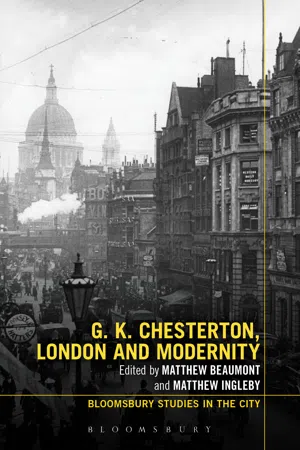
G.K. Chesterton, London and Modernity
- 224 pages
- English
- ePUB (mobile friendly)
- Available on iOS & Android
eBook - ePub
G.K. Chesterton, London and Modernity
About this book
G. K. Chesterton, London and Modernity is the first book to explore the persistent theme of the city in Chesterton's writing. Situating him in relation to both Victorian and Modernist literary paradigms, the book explores a range of theoretical and methodological approaches to address the way his imaginative investments and political interventions conceive urban modernity and the central figure of London. While Chesterton's work has often been valued for its wit and whimsy, this book argues that he is also a distinctive urban commentator, whose sophistication has been underappreciated in comparison to more canonical contemporaries. With chapters written by leading scholars in the field of 20th-century literature, the book also provides fresh readings and suggests new contexts for central texts such as The Man Who Was Thursday, The Napoleon of Notting Hill and the Father Brown stories. It also discusses lesser-known works, such as Manalive and The Club of Queer Trades, drawing out their significance for scholars interested in urban representation and practice in the first three decades of the 20th century.
Information
1
Why Chesterton Loved London
Michael D. Hurley
It is curious that one of England’s greatest poets of the countryside, the laureate of the Lake District, William Wordsworth, should write one of his greatest poems in praise of London. ‘Composed upon Westminster Bridge, September 3, 1802’ opens with arresting stridency, at once establishing a tone of self-witnessing authority: ‘Earth has not anything to show more fair’. Both grammatically (as a discrete declarative phrase) and also prosodically (in the confident fit of the sense-unit with the lineation) this first line neither invites nor allows for contradiction. And if the fact that it is sealed off by a colon rather than a full-stop entertains the possibility of subsequent qualification, then that possibility is only opened up just far enough to be slammed shut again. In the lines that immediately follow, the claim is not contextualized, it is universalized: ‘Dull would he be of soul who could pass by / A sight so touching in its majesty.’ Grammatical and prosodic features once again collude to press the argument and provoke the reader. Rhetorically and rhythmically, the accent falls on ‘Dull’. To object to the sentiment would be to concede that adjective not merely to one’s dissenting aesthetic sensibility, but to one’s very ‘soul’. Can Wordsworth really believe this? Here is the poem in full:
Earth has not anything to show more fair:
Dull would he be of soul who could pass by
A sight so touching in its majesty;
This City now doth, like a garment, wear
The beauty of the morning; silent, bare,
Ships, towers, domes, theatres, and temples lie
Open unto the fields, and to the sky;
All bright and glittering in the smokeless air.
Never did sun more beautifully steep
In his first splendor, valley, rock, or hill;
Ne’er saw I, never felt, a calm so deep!
The river glideth at his own sweet will:
Dear God! the very houses seem asleep;
And all that mighty heart is lying still!1
There is, we may notice, an irony that ripens through this poetical panegyric.2 Not in the crude sense that Wordsworth reveals himself to be sarcastically insincere, but in the more subtle sense that, it becomes apparent, London’s beauty affects him with special poignancy because of his awareness of its fragile ephemerality. For the city’s lovely vista is indirectly figured in terms of the ugliness of human activity temporarily suspended. The air is not ‘fresh’ but ‘smokeless’, and once stripped of the early morning’s ‘garment’, of nature’s borrowed splendour not its own, the scars of industrial pollution will return: the air will become smoke-filled, the river will be not run by its ‘own sweet will’, but by boat-traffic; and all will cease to be ‘touching’ and to evoke ‘calm’. The poem’s punning conclusion, that the city’s mighty heart is lying still, finally and brilliantly clarifies Wordsworth’s double perspective: London is a geographical place, but it is also a human event.
While Wordsworth registers distaste here for the human industry threatening to pollute the city at slumber, he elsewhere articulates a symmetrical anxiety, about the way the city threatens its inhabitants. He worries that dull souls might miss the beauty of London – but also that London itself might dull souls. As a child, he warmed to the idea of bustling streets, processions and theatres: ‘Marvellous things / My fancy had shaped forth, of sights and shows’. His dreams of it were ‘hardly less intense’, he says, than those that inspired Dick Whittington. One thought above all, however, left him ‘Baffled’: ‘how men lived / Even next-door neighbours, as we say, yet still / Strangers, and knowing not each other’s names’. Anonymity tips into alienation:
How often in the overflowing streets
Have I gone forwards with the crowd, and said
Unto myself. The face of everyone
That passes by me is a mystery!
Thus have I look’d, nor ceas’d to look, oppress’d
By thoughts of what and whither, when and how,
Until the shapes before my eyes became
A second-sight procession such as glides
Over still mountains, or appears in dreams,
And all the ballast of familiar life –
The present and the past, hope, fear, all stays,
All laws, of acting, thinking, speaking man –
Went from me, neither knowing me, nor known.3
Those delightful fancies that once excited his boyhood are thus, in his mature imaginings, converted into something that ‘oppress’d’. The sentiment is characteristic of its time. There are, as Raymond Williams observes, ‘hundreds of cases, from James Thomson to George Gissing and beyond, of the relatively simple transition of earlier forms of isolation and alienation to their specific location in the city.’4 Conspicuously, though, G. K. Chesterton may not be counted in that company. Although he shares Wordsworth’s double vision of the city as a place and as a human event (as he also understood the way they mutually influence one another), he rejects Wordsworth’s governing assumptions. For a start, he rejects the notion that environment shapes the person as a determinate force. ‘The idea that surroundings will mould a man is’, he avers in What’s Wrong with the World (1910), ‘always mixed up with the totally different idea that they will mould him in a particular way’:
To take the broadest case, landscape no doubt affects the soul; but how it affects it is quite another matter. To be born among pine-trees might mean loving pine-trees. It might mean loathing pine-trees. It might quite seriously mean never having seen a pine-tree. Or it might mean any mixture of these or any degree of any of them . . . It may be that the Highlanders are poetical because they inhabit mountains; but are the Swiss prosaic because they inhabit mountains? It may be the Swiss have fought for freedom because they had hills; did the Dutch fight for freedom because they hadn’t? Personally I should think it quite likely. Environment might work negatively as well as positively. The Swiss may be sensible, not in spite of their wild skyline, but because of their wild skyline. The Flemings may be fantastic artists, not in spite of their dull skyline, but because of it.5
What determines one’s way of living is not therefore the environment as such, it is one’s response to that environment. The suggestion is implicitly illustrated by his own often-expressed fondness for London, in which his reaction to the city differs from Wordsworth and others not about the facts of its conditions, but in his interpretation of those facts. This is the second sense in which he rejects Wordsworth’s assumptions: he does not see the fair beauty and physical splendour of London as defiled but as defined by the thrum of its human activity. Even when the city is ‘asleep’, he admires it as active with the human agency that brought its material landscape into being.
What distinguishes Chesterton’s counter-cultural love for London is partly a matter of scale. He does not see an endless brick and concrete sprawl, he notices its historically demarcated districts (that ‘London was already too large and loose a thing to be a city in the sense of a citadel’ is the anxious observation that inspires The Napoleon of Notting Hill (1904), his comic fantasy of reasserting the primacy of these districts).6 For Chesterton, the city expresses its humanity even in the tiniest elements of its construction: ‘Every brick has as human a hieroglyph as if it were a graven brick of Babylon.’7 This is a bold entreaty self-consciously set against the Romantic habit of handwringing over urban engorgement, in which (as Shelley describes it) ‘Hell is a city much like London’.8 Blake’s London poem is perhaps the most anthologized of all English verses on how – in both senses – the city ‘appals’. And yet Chesterton invites us to notice in his biography of Blake that the poet himself never succumbs to this iniquitous influence: his imagination allows him not only to observe acutely but also to transcend, to reconfigure, what he sees. ‘Blake had more positive joy on his death-bed than any other of the sons of Adam’, Chesterton claims; and the reason for that seems to be directly explained by an earlier proposition of equal extremity: namely, that ‘Blake was about as little affected by environment as any man that ever lived in this world’.9 Chesterton’s own transcendence from, and reconfiguration of, the city relies less on retreating into an ethereal spiritual realm and more on seeing the realm of the city itself as spiritual in its very physical fabric. Blake ruefully observes ‘Marks of weakness, marks of woe’ in every face, and ‘mind-forg’d manacles’ in every cry that rings out from London’s streets.10 Chesterton, by contrast, thrills to the idea of human creativity as marked within the streets themselves, for testifying that the city might express as well as oppress the ‘soul’.
This realization of the poetry of London is not a small thing. A city is, properly speaking, more poetic even than a countryside, for while Nature is a chaos of unconscious forces, a city is a chaos of conscious ones. The crest of the flower or the pattern of the lichen may or may not be significant symbols. But there is no stone in the street and no brick in the wall that is not actually a deliberate symbol – a message from some man, as much as if it were a telegram or a post-card. The narrowest street possesses, in every crook and twist of its intention, the soul of the man who built it . . .11
It is one thing to read a metropolis for the poetry of its human agency as inscribed with the ‘deliberate symbol’ and ‘intention’ of its architecture (his most sustained and impressive interpretation of this sort is to be found in The Resurrection of Rome [1930]); i...
Table of contents
- Cover
- Half-title
- Introduction Matthew Ingleby
- 1 Why Chesterton Loved London Michael D. Hurley
- 2 The Chestertonian City: A Singularly Plural Approach Lynne Hapgood
- 3 Signs Taken for Wonders: Adverts and Sacraments in Chesterton’s London Mark Knight
- 4 Chesterton, Machen and the Invisible City Nick Freeman
- 5 The Knight Errant in the Street: Chesterton, Childe Roland and the City Matthew Beaumont
- 6 Queer Clubs and Queer Trades: G. K. Chesterton, Homosociality and the City Merrick Burrow
- 7 Chesterton and the Romance of Burglary Matthew Ingleby
- 8 A Playground for Adults: Urban Recreation in Chesterton’s Detective Fiction Michael Shallcross
- 9 Estranging the Everyday: G. K. Chesterton’s Urban Modernism Colin Cavendish-Jones
- 10 Distributism and the City Matthew Taunton
- Afterword: The Unremarkable Chesterton Julian Wolfreys
- Index
Trusted by 375,005 students
Access to over 1.5 million titles for a fair monthly price.
Study more efficiently using our study tools.
Frequently asked questions
Yes, you can cancel anytime from the Subscription tab in your account settings on the Perlego website. Your subscription will stay active until the end of your current billing period. Learn how to cancel your subscription
No, books cannot be downloaded as external files, such as PDFs, for use outside of Perlego. However, you can download books within the Perlego app for offline reading on mobile or tablet. Learn how to download books offline
Perlego offers two plans: Essential and Complete
- Essential is ideal for learners and professionals who enjoy exploring a wide range of subjects. Access the Essential Library with 800,000+ trusted titles and best-sellers across business, personal growth, and the humanities. Includes unlimited reading time and Standard Read Aloud voice.
- Complete: Perfect for advanced learners and researchers needing full, unrestricted access. Unlock 1.5M+ books across hundreds of subjects, including academic and specialized titles. The Complete Plan also includes advanced features like Premium Read Aloud and Research Assistant.
We are an online textbook subscription service, where you can get access to an entire online library for less than the price of a single book per month. With over 1.5 million books across 990+ topics, we’ve got you covered! Learn about our mission
Look out for the read-aloud symbol on your next book to see if you can listen to it. The read-aloud tool reads text aloud for you, highlighting the text as it is being read. You can pause it, speed it up and slow it down. Learn more about Read Aloud
Yes! You can use the Perlego app on both iOS and Android devices to read anytime, anywhere — even offline. Perfect for commutes or when you’re on the go.
Please note we cannot support devices running on iOS 13 and Android 7 or earlier. Learn more about using the app
Please note we cannot support devices running on iOS 13 and Android 7 or earlier. Learn more about using the app
Yes, you can access G.K. Chesterton, London and Modernity by Matthew Beaumont, Matthew Ingleby, Matthew Beaumont,Matthew Ingleby in PDF and/or ePUB format, as well as other popular books in Literature & English Literary Criticism. We have over 1.5 million books available in our catalogue for you to explore.