Subjectivity and Identity is a philosophical and interdisciplinary study that critically evaluates critically the most important philosophical, sociological, psychological and literary debates on subjectivity and the subject. Starting from a history of the concept of the subject from modernity to postmodernity - from Descartes and Kant to Adorno and Lyotard - Peter V. Zima distinguishes between individual, collective, mythical and other subjects.
Most texts on subjectivity and the subject present the topic from the point of view of a single discipline: philosophy, sociology, psychology or theory of literature. In Subjectivity and Identity Zima links philosophical approaches to those of sociology, psychology and literary criticism. The link between philosophy and sociology is social philosophy (e.g. Althusser, Marcuse, Habermas), the link between philosophy and literary criticism is aesthetics (e.g. Adorno, Lyotard, Vattimo). Philosophy and psychology can be related thanks to the psychological implications of several philosophical concepts of subjectivity (Hobbes, Stirner, Sartre).
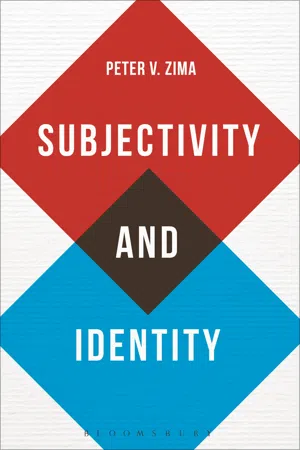
- 288 pages
- English
- ePUB (mobile friendly)
- Available on iOS & Android
eBook - ePub
About this book
Information
II
Subjectivity Between Metaphysics and Modernism: The Subject as a Fundamental, Subjugated and Disintegrating Instance
This chapter is a return to the beginning of the first in the sense that the nexus between the subject as a basic given and the subject as a subjugated or disintegrating instance will now be reconsidered in a diachronic perspective. The word ‘nexus’ evokes the kind of dialectic relationship inherent in the great metaphysical systems of modernity – in the philosophies of Descartes, Kant, Fichte and Hegel – in which the idea of the subject as a fundamental instance is tacitly linked to its subjugation by an external or internal power. Time and again, the autonomy of the individual subject is bought by concessions to heteronomy and submission.
It is one of the merits of modernism, defined here as a late modern self-criticism of modernity, to have recognized and explored this dialectic between autonomy and submission. Auch Einer (1879), an almost forgotten novel by the Young Hegelian philosopher Friedrich Theodor Vischer, initiates this self-criticism by revealing to what extent Hegel’s subject depends on chance and the contingency of the objective world. Vischer’s method is a paradoxical, self-reflexive ‘thinking against one’s self’,1 which he applies whenever he turns the satire of his novel against his own Hegelian premises.
His Young Hegelian critique is intensified and radicalized by Stirner, Kierkegaard and Nietzsche, who reveal the other side of the Hegelian coin: the particularity and contingency of all subjective projects – along with chance and dream, the body and nature as irreconcilable but indispensable companions of Spirit. Following the Young Hegelians and some Romantics,2 Nietzsche in particular emphasizes the role of contingency and casts doubts upon the idea of historical necessity underlying Hegel’s system. To him, as to Hegel’s rebellious disciples, this system appears as a contingent construct: as the particular project of a contingent individual.
This late modern rejection of Cartesian, Kantian and Hegelian aspirations towards universally valid knowledge is inherent in Kierkegaard’s and Sartre’s thought in which, as Kierkegaard himself points out in conjunction with Hegel’s reading of Socrates, ‘the person of Socrates is essential’.3 This tendency towards particularization also characterizes Sartre’s approach which is marked by the refusal of the subjective alibi underlying the metaphysical systems (Descartes’, Hegel’s) and by the focus on the individual subject’s political, epistemological and ethical responsibility. To the existentialist philosopher this subject appears as fundamental and subjugated at the same time: ‘Whenever freedom is at stake, Sartre’s thought is constantly aware of submission, of a possible or real experience of over-determination, of violence. The possibility of submission and concrete violence thus appears as the permanent reverse of Sartrian freedom.’4
In view of this dialectic between freedom and subjugation, Sartre insists on the autonomy and self-determination of individual subjects. Having rejected Cartesian and Hegelian systems, all of which tend to suppress individual responsibility, he pleads in favour of an autonomous individual subject and condemns all experiments with the unconscious, chance and dream. He believes that such experiments call into question subjectivity as conscious action. This is why he criticizes André Breton’s surrealism, whose experiments with the unconscious and ‘automatic writing’ he considers as a threat to autonomous and rational action. It will become clear that the drawback of Sartrian autonomy is a repressive attitude towards nature and sexuality which makes itself felt in Sartre’s first novel, La Nausée (1938). Subjective autonomy is preserved at the cost of the subject’s nature: a fatal sacrifice anticipated by Descartes and Kant.
In this perspective, Adorno’s and Horkheimer’s Critical Theory may be considered as an attempt to mediate between subjectivity as reason and subjectivity as nature. In many ways, this theory is a return to the Young Hegelian problematic mapped out by Vischer in his critique of Hegel, some of which is an attempt to reconcile nature and mind (Spirit): ‘Man’s domination over himself, which grounds his selfhood, is almost always the destruction of the subject in whose service it is undertaken.’5 This maxim is completed by a more concise remark in Adorno’s Aesthetic Theory: ‘Ratio without mimesis is self-negating.’6 However, the attempt to mediate between reason and artistic mimesis turns out to be as aporetic as Sartre’s attempt to break out of the contradiction between subjective freedom and over-determination. For Adorno’s conception of a non-theoretical theory geared towards the mimesis of art contradicts the very idea of theory and of a theoretical subject who cannot afford to replace theoretical argument by essayistic or paratactic writing.7
Adorno’s essayistic style, sprinkled with paradoxes, comes close to that of some modernist writers like Robert Musil, Italo Svevo and Hermann Broch, who reacted to the ambivalences, aporias and crises of their times with attempts to save the individual subject. Like Adorno, these writers tried to turn the symptoms of crisis – ambivalence, doubt, irony – into instruments of criticism and put these at the disposal of a new, invigorated individual subject. The idea that their attempts could be of some relevance to the postmodern problematic, because they avoid metaphysical illusions as well as ideological dogmas, will be made plausible in what follows.
Together with Adorno’s philosophy and Freud’s psychoanalysis, modernist novels announce a postmodern problematic in which the notion of subject is frequently considered as an illusion: as a euphemism for subjugation. What Freud has to say about the subject in mass society sounds like an answer to Adorno’s remark in Minima Moralia that ‘to think that the individual is being liquidated without trace is over-optimistic’:8 ‘His emotions become extraordinarily intensified, while his intellectual ability becomes markedly reduced, both processes being evidently in the direction of an approximation to the other individuals in the group.’9 Hermann Broch chooses a similar vocabulary when describing the ‘dozing’ mass individual who follows unconscious impulses without reflection: ‘He loses his individual human physiognomy; whenever doziness [das Dahindämmern] overcomes him, man turns into mass.’10
It is not the empirical basis of such diagnostics that matters he...
Table of contents
- Cover
- Dedication
- By the same author
- Title Page
- Contents
- Preface
- I Theories of the Subject: Definitions of the Term and the State of the Debate
- II Subjectivity Between Metaphysics and Modernism: The Subject as a Fundamental, Subjugated and Disintegrating Instance
- III Disintegration and Submission of the Individual Subject in Postmodernity: Philosophy and Psychology
- IV The Dialectics of Individual Subjectivity from a Sociological Viewpoint
- V Theory of the Subject: Towards a Dialogical Subjectivity
- Bibliography
- Index
- Index 2
- Copyright
Trusted by 375,005 students
Access to over 1.5 million titles for a fair monthly price.
Study more efficiently using our study tools.
Frequently asked questions
Yes, you can cancel anytime from the Subscription tab in your account settings on the Perlego website. Your subscription will stay active until the end of your current billing period. Learn how to cancel your subscription
No, books cannot be downloaded as external files, such as PDFs, for use outside of Perlego. However, you can download books within the Perlego app for offline reading on mobile or tablet. Learn how to download books offline
Perlego offers two plans: Essential and Complete
- Essential is ideal for learners and professionals who enjoy exploring a wide range of subjects. Access the Essential Library with 800,000+ trusted titles and best-sellers across business, personal growth, and the humanities. Includes unlimited reading time and Standard Read Aloud voice.
- Complete: Perfect for advanced learners and researchers needing full, unrestricted access. Unlock 1.5M+ books across hundreds of subjects, including academic and specialized titles. The Complete Plan also includes advanced features like Premium Read Aloud and Research Assistant.
We are an online textbook subscription service, where you can get access to an entire online library for less than the price of a single book per month. With over 1.5 million books across 990+ topics, we’ve got you covered! Learn about our mission
Look out for the read-aloud symbol on your next book to see if you can listen to it. The read-aloud tool reads text aloud for you, highlighting the text as it is being read. You can pause it, speed it up and slow it down. Learn more about Read Aloud
Yes! You can use the Perlego app on both iOS and Android devices to read anytime, anywhere — even offline. Perfect for commutes or when you’re on the go.
Please note we cannot support devices running on iOS 13 and Android 7 or earlier. Learn more about using the app
Please note we cannot support devices running on iOS 13 and Android 7 or earlier. Learn more about using the app
Yes, you can access Subjectivity and Identity by Peter V. Zima in PDF and/or ePUB format, as well as other popular books in Filosofía & Crítica filosófica. We have over 1.5 million books available in our catalogue for you to explore.