- 304 pages
- English
- ePUB (mobile friendly)
- Available on iOS & Android
eBook - ePub
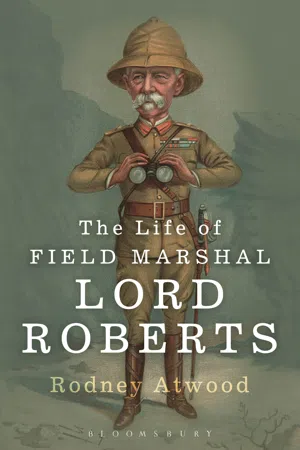
The Life of Field Marshal Lord Roberts
About this book
This biography of Field Marshal Lord Roberts charts a remarkable life that spanned the apogee of the British Empire. During a diverse career, Roberts won the Victoria Cross, planned the strategic defence of India, turned the tide of war in South Africa, introduced army reform and campaigned for National Service before 1914. Rodney Atwood explores his military career, in particular his role as a tactician and strategist in Afghanistan, Burma, the North-West frontier, South Africa and Europe, but also looks at Roberts as a symbol of Empire and explores his celebration in British culture.
Information
CHAPTER ONE
A visit to Lord Roberts
In late years I saw much of [Lord Roberts]. It was a high privilege to know so single-minded a man and so noble-hearted a soldier. His love of his country was a passion. His constant thoughts were directed to the welfare of England and the security of the Empire …
REGINALD, 2ND VISCOUNT ESHER
In my opinion Gen[era]l Roberts is in all public matters the most dangerous & unscrupulous man I have ever known.
COLONEL HENRY HANNA
You are not going, I hope, to leave the destiny of the British Empire to prigs and pedants.
BENJAMIN DISRAELI TO THE HOUSE OF COMMONS, 5 FEBRUARY 1863
It is 1908. Edward VII is on the throne. He is also Emperor of India and head of a global empire. The Liberal Prime Minister Sir Henry Campbell-Bannerman is soon to make way for Mr Herbert Asquith. The Secretary of the Board of Trade, Mr Winston Churchill, will shortly wed Miss Clementine Hozier at St Margaret’s, Westminster. A new law will introduce old-age pensions on 1 January, 1909. The fledgling Automobile Association will put up the first road signs. Wilbur and Orville Wright are to demonstrate their new heavier-than-air machines in Europe.
For men and women who have travelled the British Empire, it is but a short rail journey from London to Ascot, home of the well-known racecourse and of the famous imperial hero, Field Marshal Earl Roberts of Waterford, Kandahar and Pretoria. Fifty years earlier, in 1858, Roberts returned from India as a young Indian Mutiny hero and Victoria Cross winner. Now in his seventies, he is renowned as ‘Bobs Bahadur’, ‘Bobs the hero’ of the Second Afghan War, author of the best-selling autobiography Forty-One Years in India, friend of Rudyard Kipling, commander-in-chief successively in India, Ireland, South Africa and England, the only man to hold the Victoria Cross, the Order of Merit and the Garter.
His house ‘Englemere’ was purchased and refurbished with the £100,000 which Lord Salisbury’s Unionist government awarded him after he had turned the tide of war in South Africa in a few short months in 1900. ‘Englemere’ takes its name from a large pond lying on the boundary of the ancient manor of Winfield. The surrounding wild, sandy heath and forest had been converted from the time of Queen Anne for hunting and then racing. The discovery of mineral water in a chalybeate spring added to Ascot’s attraction. When Englemere was first built after 1817, the races were drawing the rich to the area. From 1875 it was the home of Sir Robert Henry Meade, groom in waiting to the Prince of Wales and from 1892 Under Secretary of State for the Colonies. Sir Robert died without heirs in 1897. In 1903 Lord Roberts with his wife and two unmarried daughters moved in, for two years as tenants and then as owners.
The London and South Western Railway runs partly through the grounds. A footpath runs from Ascot station beside the railway and thence to the house.1 Approaching the classical white walls, standing above the trimmed lawns, and then entering the house, visitors could see that the field marshal had, in the words of a local newspaper, entirely ‘re-built Englemere with the exception of the billiard room’.2 The welcome from the field marshal and his family is warm, and for those who have eyes and ears there is much of interest. When John Morley, the Liberal Secretary of State for India visits, he finds the house ‘all full of Afghan things, weapons, pictures, flags, etc. – and we talked Afghanistan all day long. He made me feel much at home on the frontier with his good soldierly way of talking’. This is generous as Morley has been an opponent of imperial adventures and regards ‘the Jingo’ as ‘the devil incarnate’.3
In the grounds is ‘the camp’, a replica of a Boer War laager with tents, guns and other weaponry. It resembles the encampment of Piet Cronje, which Roberts captured with 4,000 fighting Boers in February, 1900.
Roberts and his wife Nora, Countess Roberts, are devout Christians. Every morning the staff, including five cooks, assemble, and the field marshal reads family prayers ‘in the simple old fashion’. One frequent visitor, the politician and journalist Leo Amery, is impressed by the old soldier’s simple faith and kindness to swallows in his outbuildings.4
Nora Roberts has seconded her husband’s career for many years. By 1908, she no longer enjoys robust health. Their elder daughter Aileen is often seen at her father’s side at public events and social engagements, while the younger Edwina answers her parents’ many letters. Roberts receives more each day than he can read, let alone answer.5 The old soldier is, however, alert and active. Despite his small stature, five-feet-four-inches, he is ramrod straight whether in the saddle or out of it, his back erect, his gait purposeful.6 His face is reddened by years in the Indian sun, contrasting with his white whiskers. His expressive blue eyes twinkle with humour. One is sightless, although this is not well known.7
Inside, the entrance hall opens onto fine public rooms and a ballroom, with offices and service rooms beyond. In the hall is a dramatic painting of the attack on the Peiwar Kotal in Afghanistan in November 1878, showing the dawn charge of the 5th Gurkhas supported by the 92nd Highlanders.8 The wide, curved staircase leads up to the library and Roberts’s study. One frequent visitor was Reginald Brett, 2nd Viscount Esher, courtier and War Office reformer. Esher first met Roberts in November 1880 when he returned from victories in Afghanistan. Esher finds him looking active and neat in his country clothes: ‘in mind [he] is as young as he was at 30’.9 In his study Roberts has two portraits, one of his idol when a young officer, the hero of Delhi, John Nicholson; the other of his son Freddie, fatally wounded at Colenso in South Africa trying to rescue guns under Boer fire. The death of Freddie, beloved only son, was a terrible blow to a close-knit family.10
There are visitors from India as well as England. When a Maharajah arrived – most likely Pertab Singh of Jodhpur – he brought two elephants who lumbered up the drive and were laagered at ‘the camp’.11 Another old friend from Roberts’s India days is William MacNabb. MacNabbs have been in the Bengal Medical Service since 1778. He and his daughter Dorothy drove over from Binfield to join a lunch party which included Sir Hugh and Lady Gough. Sir Hugh was a comrade of Roberts in the 1857 Mutiny. It is forty-nine years to the day since Roberts and Gough were in a running fight outside Cawnpore. No wonder Sir Hugh proposes a toast to that memory. The lunch gathering is good-natured, Aileen Roberts being ‘chaffed’ by her father, and she and her sister Edwina teasing their mother. The girls show Dorothy MacNabb mementoes including a casket presented to the Field Marshal, signatures at a press dinner, among them Rudyard Kipling’s, and the flag which Piet Cronje flew over his laager, ‘just a piece torn off a shirt hemmed at one edge, but white enough to be used for the surrender of Paardeberg. Also a silk flag made for him [Roberts] by Lady R. which he flew over recaptured Kimberley, Bloemfontein & Pretoria’.12
Roberts’s life is intensely busy. Visits to public occasions, debates in the House of Lords, inspections of bodies of soldiers, campaigning for universal military service as President of the National Service League, gathering evidence on Britain’s vulnerability to invasion, writing to The Times – he is constantly in the public eye. In December 1911 The Strand Magazine asked: ‘Who are the Ten Greatest Men Now Alive?’ and placed the inventor Edison first, the writer Kipling second and Roberts seventh.13 This owes something to his reputation as one of the Empire’s two leading soldiers, but much to his skill with the pen, warmth of personality and showmanship. He is astute at exploiting his press and personal contacts, but his memory for names endeared him to soldiers of all ranks. In his memoirs Major-General Sir George Younghusband remembered their first meeting forty years before at Kabul in the bitterly cold winter of 1879–80. Roberts and his men withstood siege and assault by Afghan forces. The 800-strong elite Corps of Guides paraded to receive gallantry awards. Behind the rearmost line stood Younghusband, newest joined subaltern. Roberts strode along the regiment’s front rank, glanced over it and then spotted the newcomer.
‘Who is that new officer?’ he asked the colonel.
‘That’s Younghusband, just joined from the 17th Foot.’
‘Call him up, I should like to make his acquaintance.’
So Younghusband was hustled forth by the adjutant, and stood before the great man.
‘How do you do? Glad to meet you. You are a lucky young fellow to have joined such a splendid regiment. Goodbye, good luck.’
Years afterward, shortly before the 1914 war, the younger man was gazing at the opulent things in Asprey’s window in Bond Street when a gentleman in a top hat passed him. Younghusband did not look round, but in a moment there was a tap on his shoulder.
‘Hullo! Younghusband. How are you?’
It was Lord Roberts. He had not seen him for seven years.
‘How are the old Guides? Going strong as ever? By the way, did you win the regimental [polo] tournament? I saw you got through the semi-finals.’
Lord Roberts recognised him after seven years, knew his regiment, and even that it had been playing in a polo tournament. Such was the secret of his appeal to so many.14 To those closer to him such as his military secretary for many years, Colonel Neville Chamberlain, the tie of affection was stronger: ‘we on the Chief’s staff just loved him, and we would have done anything for him’.15 To those who know him less well, an admiring and patriotic public, Roberts is a living embodiment of the last half century of Empire, a character from Boy’s Own in action at so many of his country’s battles, the ‘hero of innumerable adventures … lived from the cradle to the grave within the four corners of the King’s, or Queen’s, Regulations … his heart … always full of romance …’16 Born before the accession of Queen Victoria, the son of an East India Company officer and his second wife, an Irish background in common with so many of Britain’s soldiers, Roberts was a small and delicate child. He nearly died from ‘brain fever’ which cost him the sight of an eye. The vigorous, ‘red-faced little man’ of Kipling’s poem, sitting upright in the saddle, was a later development of ambition and determination. He was commissioned into the Bengal Artillery, and was serving in the Punjab when the Sepoy Mutiny broke out at Meerut. He had just met John Nicholson, who was at the forefront of the British counter-offensive against Delhi.17 Roberts served at the siege of Delhi, the relief of Lucknow; the pursuit of rebel forces; he witnessed the bloody revenge exacted for crimes both real and imagined. He won the Victoria Cross in hand-to-hand fighting. On his return to Ireland on sick leave he married Nora Bews, seven years his junior. They were together for fifty-five years.
The advance of his career, after the Mutiny, Roberts owed in large part to his father, who advised that he remain on the staff, at the centre of command, the operational heart of the Indian Army. He also owed it to his own diligence, organisational skills, intelligence and ambition. He served under Lt-General Sir Robert Napier in Abyssinia in 1868. Later, as Indian Army commander-in-chief, Napier appointed him quartermaster general. He was Roberts’s first important patron after his father. His second was Lord Lytton, Disraeli’s new viceroy, who arrived in India the year that Napier left, 1876. Command in the field in the Second Afghan War of 1878–80 was his making. Roberts entered it as an unknown substantive colonel. He emerged as a hero in both India and Britain. His march from Kabul to Kandahar and victory over Ayub Khan’s army restored the reputation of British arms and enabled Lytton’s successor, Lord Ripon, to withdraw British forces from Afghanistan while achieving the strategic goal of making that country a buffer to defend India. His career never looked back.
After a brief South African interlude, Roberts took command of the Madras Army, and for five years initiated measures that he developed further as commander-in-chief, India. His final step in India he owed to his third patron, Lord Randolph Churchill. Roberts’s warning about the probable failure in battle in the Sudan of a smart Indian regiment came true. It confirmed Churchill’s judgement already formed by correspondence and then meeting.18
As Indian Army commander-in-chief, Roberts was hugely influential. He worked well with successive viceroys and with their advisors, the military members of their council; he increased the number of Gurkha regiments and other ‘martial races’ of the ...
Table of contents
- Cover
- Title Page
- Contents
- List of Maps
- List of Illustrations
- Acknowledgements
- Notes on Usage and Note Abbreviations
- 1 A visit to Lord Roberts
- 2 Irish and Indian beginnings
- 3 1857
- 4 Marriage and staff service
- 5 War in Afghanistan
- 6 ‘One equal temper of heroic hearts’
- 7 In command at Madras
- 8 Commander-in-chief, India
- 9 From Bengal to Southampton via Forty-One Years in India
- 10 Turning the tide of war in South Africa – and failing to finish it
- 11 Good work for army and Empire
- 12 Trying to arouse his countrymen
- 13 Epilogue: armageddon
- Notes
- Select Bibliography
- Index
- Copyright
Trusted by 375,005 students
Access to over 1.5 million titles for a fair monthly price.
Study more efficiently using our study tools.
Frequently asked questions
Yes, you can cancel anytime from the Subscription tab in your account settings on the Perlego website. Your subscription will stay active until the end of your current billing period. Learn how to cancel your subscription
No, books cannot be downloaded as external files, such as PDFs, for use outside of Perlego. However, you can download books within the Perlego app for offline reading on mobile or tablet. Learn how to download books offline
Perlego offers two plans: Essential and Complete
- Essential is ideal for learners and professionals who enjoy exploring a wide range of subjects. Access the Essential Library with 800,000+ trusted titles and best-sellers across business, personal growth, and the humanities. Includes unlimited reading time and Standard Read Aloud voice.
- Complete: Perfect for advanced learners and researchers needing full, unrestricted access. Unlock 1.5M+ books across hundreds of subjects, including academic and specialized titles. The Complete Plan also includes advanced features like Premium Read Aloud and Research Assistant.
We are an online textbook subscription service, where you can get access to an entire online library for less than the price of a single book per month. With over 1.5 million books across 990+ topics, we’ve got you covered! Learn about our mission
Look out for the read-aloud symbol on your next book to see if you can listen to it. The read-aloud tool reads text aloud for you, highlighting the text as it is being read. You can pause it, speed it up and slow it down. Learn more about Read Aloud
Yes! You can use the Perlego app on both iOS and Android devices to read anytime, anywhere — even offline. Perfect for commutes or when you’re on the go.
Please note we cannot support devices running on iOS 13 and Android 7 or earlier. Learn more about using the app
Please note we cannot support devices running on iOS 13 and Android 7 or earlier. Learn more about using the app
Yes, you can access The Life of Field Marshal Lord Roberts by Rodney Atwood in PDF and/or ePUB format, as well as other popular books in History & 19th Century History. We have over 1.5 million books available in our catalogue for you to explore.