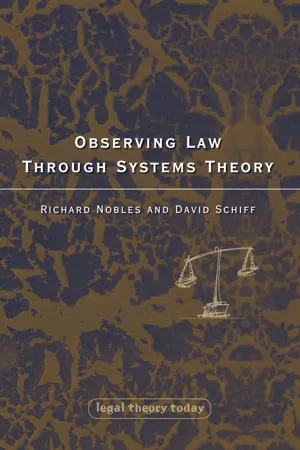
This book uses Niklas Luhmann's systems theory to explore how the legal system operates as one of modern society's subsystems.
The authors demonstrate how this theory alters our understanding of some of the most important and controversial issues within law: the nature of judicial communication and legal argument; the claim that it can be right to disobey law; the character of legal pluralism and globalisation; time and its construction within law; the significance of the rule of law and human rights and the role of appeals to, and within, law.
Systems theory enables the authors to demonstrate how the legal system observes its own operations through its own communications, and how this contrasts with the manner in which law is observed by other systems such as the media and politics.
In this context the authors explore the constraints imposed by systems, in particular the legal system, upon the individuals who participate in them.
- 290 pages
- English
- ePUB (mobile friendly)
- Available on iOS & Android
eBook - ePub
Observing Law through Systems Theory
About this book
Information
1
Is the Legal System a System?
It is not sensible to launch into applications and implications of a theory that operates on the assumption that the legal system is both a system and one that describes and observes itself through its own operations, without giving some attention to what systems theorists mean by a system and, therefore, what makes the legal system a system for these purposes. This does not require us to restate all of the elements of autopoietic systems theory, but will inevitably involve some comparison between this version of systems theory and legal theories that have attempted to describe the legal system as a system, the most notable being that of HLA Hart. Nor is it necessary for us to explore all of the different meanings and approaches to systems, what it means to think and learn in systems1 or in terms of systems.2 Rather, for our purposes, such an introductory analysis of law’s operation as a system addresses some of the most general questions in jurisprudence and, as we will demonstrate, displaces some of the answers provided by conventional legal theories.
What kind of system is the legal system?3 Despite the ubiquitous use of the phrase ‘legal system’ there is no obvious consensus on what it means for law to operate as a system, how its systematic qualities are generated or maintained, or even that law operating as a system has a distinct character that could be distinguished from, or could distinguish itself from, any other part of society. This is so despite the fact that there have been many attempts to present law as a system.4 Perhaps the most famous, that of Hart in The Concept of Law,5 elaborated on law as a system of rules, separated from other social rules by the presence of a pedigree test for which rules count as legal rules, namely the ‘rule of recognition’. Much of the writing in Anglo-American jurisprudence since this seminal work can be seen as a debate about the claim that law exists as a system, with some providing alternative accounts of law’s systematic qualities (for example Dworkin – law as the systematic articulation of justificatory principles; Raz – law as the provision of source-based reasons for action within legal systems which are comprehensive in that they claim ‘authority to regulate any type of behaviour’, supreme, in that they claim ‘authority to regulate the setting up and application of other institutionalized systems by its subject-community’, and open, in giving ‘binding force within the system to norms which do not belong to it’6), or denials or serious questioning of its systematic character (for example Sampford – law as mêlée;7 Van de Kerchove and Ost – law operating between order and disorder;8 much critical legal studies writing which, from a variety of theoretical perspectives, seeks to challenge claims that law is systematic and distinct, especially from politics).
Classical ideas of what a system is go back to the Greeks (Plato, Aristotle and Euclid), who explored ideas of wholeness, or union. The most general idea of system expressed is that of a distinct whole which has internal relationships between its various parts. The wholeness of a system requires it to be separated from its surroundings. There must be a boundary. The notion that the parts of the whole have a relationship with each other, and with the whole of which they form a part, is captured in the following statement by American philosopher John Dewey: ‘It differs from such terms as aggregate, collection and inventory, in expressly conveying the way inherent bonds bind together . . . the parts of the whole [and] it differs from such terms as organism, totality and whole in expressly connoting that the parts are interdependent.’9 The features of wholeness, a whole formed out of the relationship between the parts, points in turn to the concept of structure. The relationship between the parts forms the structure of the whole, and gives it its character as a particular system, distinct from other entities. Thus, with this formulation of what it means to be a system, structure also establishes the border or boundary of the system. By establishing what forms part of the system, the structure necessarily also establishes what does not form part of the system and hence establishes the system’s boundary.
Using these ideas of system, Charles Sampford in The Disorder of Law undertakes a sustained attack on the possibilities of law existing as a system.10 He presents legal positivism, as represented by the works of Hart, Kelsen, Raz and MacCormick, natural law, as represented by Dworkin, and sociological approaches to law, as represented by Parsons, as three unsuccessful attempts to understand law as a system. His presentation of these three approaches, and his reasons for concluding that they fail to explain how law could exist as a system, provides a useful starting point to our own explanation of how law operates as a separate and autonomous social system.
Legal positivism relies on a hierarchical structure, which sets out, in many different versions, to present law as the consequence of relationships of validity stretching between higher and lower norms. To Sampford all such versions fail to account for all of the possibilities of what can become law. Some norms become legal norms that are not selected as such by the highest norms in the system, and there are occasions when the highest norms are themselves altered. The structures identified by positivist legal theories cannot account for all that is commonly accepted to be law and, in particular, they cannot account satisfactorily for the capacity of law to evolve. Dworkin’s attempt to describe law, using a hierarchy of principles and other background values, explains the capacity of law to exist, and evolve, by reference to relationships between levels of justification.11 In particular, justifying the use of coercion involves a combination of consistency and appeal to community values. Community values themselves change, so some earlier justifications lose their persuasive force. Totally ad hoc justification would appear arbitrary, so some part of whatever has been justified in the past (especially the very recent past) must operate as a restraint on the ability to offer wholly new and novel versions of what can be law. But once we abandon the pretence that any human judge could generate a single consistent set of justifications for what counts as law (producing replacement sets as social values alter) then this structure of reasoning does not account for the possibility of what can become law. Sampford feels that it has not established a relationship of the whole to its parts, and therefore it has also failed to establish law’s boundaries, and its existence as a system. Parsons’ version of systems theory sought to establish law as a separate system by reference to his account of functionalism.12 Starting from the premise that society could not continue to exist unless certain functions (which include adaptive functions producing evolution) were carried out, Parsons sought to identify how these functions are achieved.13 He identified particular functions with particular subsystems, one of which was the legal system.14 Within this theory, law has an integrative and legitimating function, by means of the resolution of conflict. The actions of participants within each system are co-ordinated through their taking the form of roles, which are in turn co-ordinated by contributing to the achievement of the subsystem’s function. What contributes to this co-ordinated achievement of function constitutes the values of each system. So, for example, within the legal system, whose function is conflict resolution, the roles of participants such as judges and lawyers are structured by ideas of justice that allow the resolution of disputes to represent something more acceptable, and successful, than the application of naked coercion. This version of law as a system is challenged by empirical experience. Law in many instances not only fails to resolve conflicts but by producing new laws that clash with established expectations it also creates conflicts that would not otherwise arise. And any attempt to claim that the legal system has any set of functions that are sufficiently specific to orientate the roles of its participants falls foul of the fact that other systems can be seen to carry out some of the functions attributed to law, and vice versa. Law is not the only mechanism for resolving conflict, and, with the political system, seems to share the role of setting standards, goals, or other normative expectations.
If one accepts these kinds of arguments one could, or perhaps should conclude, like Sampford, that law is not a system, or is not best understood as operating as a system. And there are alternative formulations of this conclusion, for example, that law is at best a relatively autonomous system.15 But to call law a relatively autonomous system is simply to concede that what you have identified as its structure does not account for the whole of law. Only some of law, albeit that part which might include most of law, or the most important parts of law (depending on the basis of assessment used for such judgements) is accounted for by the structure in question: hierarchy of rules; standards or reasons for action; justificatory principles; actions attributable to a dominant function; etc.16 If one accepts that law is a relatively autonomous system, yet continues to regard law as something that can be described as a whole by reference to a particular set of relationships, one is either being inconsistent, or claiming that a particular attempt to describe law as a system is, despite its inadequacies, superior to other ways of attempting to understand law. To explain how law can be a system, despite the above arguments, we need to re-examine our idea of a system.
A system cannot be a mere collective or aggregate of phenomena. We need to keep the ‘interdependent’ character of the parts, as set out in Dewey’s definition, in mind. Namely, there needs to be a relationship between its parts. Unrelated matter does not amount to a system, even if the future configurations of that matter (such as a cloud of gas molecules17) are quite predictable. We need to move from the Aristotelian idea of a system being a relationship between a whole and its parts, an understanding that leads one to look for fixed and given structures, to an alternative understanding of the nature of a system. The jurisprudential debate over claims that law operates as a system has been a kind of quest for the Holy Grail. What structures are sufficient to determine what can belong to law rather than another social phenomenon? What interrelationship of parts and whole explains law at both the micro-level (what single elements can belong to law) and at the macro-level (how can law be understood as a whole). Instead of this focus on the idea of a whole constructed by, and in turn constructing, its parts through fixed and given structures, can we consider the possibilities for a system to exist without a fixed structure? Can a social system, such as law, exist and evolve with structures that are contingent and open to change? By what processes could this occur? To begin to explore this idea, to move beyond an attempt to identify specific structures that account for the whole and the parts of a legal system, we need to re-examine what it means for something to be a system and focus not on the idea of structure, but that of boundaries.18
Systems exist by distinguishing themselves from their surrounding environment. This does not mean that systems are isolated from their environment, and that nothing enters and nothing leaves. All systems, social, biological, psychical and physical, are open to their environment, in the sense that some things enter and others leave. The key question is how systems determine what can enter and leave. What, within the system, restricts its interaction with its environment? Without any such restriction we do not have a system. We just have a particular part of a more general environment. To think of a system as something with a totally open environment is actually to abandon the idea of a system. And to think of a system as something totally isolated from its environment is, as we have just stated, to hypothesise about an entity that does not exist as such, even though it might be so constructed for the purposes of logical or other forms of thinking or conceptualising.19
Terms such as ‘open’ or ‘closed’ systems have been developed within both the physical20 and social sciences to refer to particular kinds of restrictions on what may enter or leave a system. Rather than repeat and adopt these terminologies here, we prefer to focus on the more general point that systems develop boundaries, not in the sense that nothing passes through those boundaries, but in the sense that the system closes itself to its environment by establishing restrictions on what can enter or leave. Only by doing this can a system differentiate itself from its environment.21 This in turn is the basis of the system’s identity – what separates it from what surrounds it. Statements like ‘the open rests on the closed’,22 which may seem paradoxical or merely playful, are actually quite logical and appropriate. Finding out how a system establishes restrictions on its openness to its environment, its closure, is the basis of its openness to its environment.
From this new starting point, we can begin to describe how law exists as a system. What differentiates law, as a system, from its environment? What is the basis of its closure (which is also the basis of its openness)? In his discussion of Luhmann’s version of functionalism, Sampford, relying on Social Systems,23 did not feel that Luhmann had moved sufficiently far from Parsons’ functional systems theory. Luhmann accepts that subsystems duplicate each others’ performance (for example, law is not the only conflict resolution system) but still insists that law carries out an overall function that is peculiar to itself: ‘establishing and stabilizing normative expectations’.24 This was interpreted by Sampford as a claim that this function generates and maintains law’s existence as a separate system.25 Whilst society needs normative expectations, the idea that this need could structure the behaviour of individuals throughout the legal system, through the creation of roles and the generation of values and commitments likely to fulfil this general function, is implausible.26 However, this is not the kind of functionalism, or system, that we need to consider. The function of law, within Luhmann’s theory, is not something that orientates and separates it off as a separate social system. It is merely something that we can observe. If we consider what law does within society, by contrast with other parts of society (mass media, science, economy, etc.) we might agree that it generates and maintains normative expectations in the face of counterfactual examples.27 Attribution of function is an observation about the contribution which a system makes to the continuation of society.28 One is able to observe systems, sociologically or scientifically, and make assessments of their function.29 The description of law as a system that contributes normative expectations distinguishes it from the economy as the system that manages expectations about the future availability of scarce resources. This does not mean that law never allocates resources or that the economy never generates normative expectations. By contrast, science creates ‘truthful’ knowledge, and the mass media generates information. But the claim that law is the primary supplier of something a society needs in order to function should not be translated into a claim that this need structures the behaviour of all individuals who participate within the legal system.
To understand the existence of law as a system we need to begin, not with how it may function within society, but how it establishes a boundary between itself and the rest of society, and to comprehend how this may be possible without the presence of fixed and given structures. Society, for Luhmann, consists of its communications.30 Inanimate objects are not part of society – they do not communicate. Nor are the biological, chemical or thought processes that operate within human beings – these things may motivate communication, but are not themselves communications. These objects and processes form society’s environment. Law’s existence as a system operates as a subsystem of communication within society, and society consists of the sum total of communications. It is relatively easy to see how society, as the totality of communication, establishes a border with its environment. Society is open to, and influenced by, what occurs in the physical world, and what takes place within the minds and biological processes that constitute human beings. But there is no possibility for communication to become the same as its environment. One can communicate about the physical world, or about the human beings that inhabit it, but those communications remain separate from these objects of communication. The medium generated and carried by communications is meaning.31 Only what is meaningful can form the content of a communication. And this allows human beings, motivated by their thoughts, to make communications that allow them to participate within society. But communication cannot be reduced to thoughts, motivations or attitudes. Thoughts remain thoughts until they are communicated, and once they are communicated they are not just thoughts, but communications.
There is a vast literature on whether or not the possibilities of what can be communicated are established through structures, and what form those structures might take. Fortunately, we do not need to explore this here. If the reader can understand what is meant by the claim that communications remain separate from (closed to) their environment we can move on to the more controversial and relevant question: how can law exist as a separate system within society? We cannot point to an obvious separation such as exists between communications and other phenomena (such as objects in the real world, or processes of cognition). Everything that explains why and how communications are separate from their environment fails to explain this particular separation. Legal communications are not thoughts, or physical matter. Like other communications they have the potentiality to transmit meanings. The vast bulk of legal communication uses language, and the language (English, French, etc) is the same language used within the mass media, science, politics, morals, religion, and the economy. The same structures of syntax and grammar apply, and whilst there may be some unique terms within law, these are insufficient to justify a claim that law is in any significant way separate from the rest of society. Communications are not limited to language (images – including images of silence – communicate meanings as well as speech) but again relatively little of law is communicated through images and symbols that are unique to it (albeit that some of its symbols may be important).
With all the common features of legal and other communications, how can law est...
Table of contents
- Cover
- Title
- Preface
- Acknowledgements
- Contents
- 1: Is the Legal System a System?
- 2: Why Do Judges Talk the Way they Do?
- 3: Can One Have a Right to Disobey a Law?
- 4: Understanding Legal Pluralism
- 5: How Law Constructs Time
- 6: Politics and Law: The Rule of Law, Constitutional Law, and Human Rights
- 7: Control through Law
- 8: Appeals in Law
- Bibliography
- Index
Trusted by 375,005 students
Access to over 1.5 million titles for a fair monthly price.
Study more efficiently using our study tools.
Frequently asked questions
Yes, you can cancel anytime from the Subscription tab in your account settings on the Perlego website. Your subscription will stay active until the end of your current billing period. Learn how to cancel your subscription
No, books cannot be downloaded as external files, such as PDFs, for use outside of Perlego. However, you can download books within the Perlego app for offline reading on mobile or tablet. Learn how to download books offline
Perlego offers two plans: Essential and Complete
- Essential is ideal for learners and professionals who enjoy exploring a wide range of subjects. Access the Essential Library with 800,000+ trusted titles and best-sellers across business, personal growth, and the humanities. Includes unlimited reading time and Standard Read Aloud voice.
- Complete: Perfect for advanced learners and researchers needing full, unrestricted access. Unlock 1.5M+ books across hundreds of subjects, including academic and specialized titles. The Complete Plan also includes advanced features like Premium Read Aloud and Research Assistant.
We are an online textbook subscription service, where you can get access to an entire online library for less than the price of a single book per month. With over 1.5 million books across 990+ topics, we’ve got you covered! Learn about our mission
Look out for the read-aloud symbol on your next book to see if you can listen to it. The read-aloud tool reads text aloud for you, highlighting the text as it is being read. You can pause it, speed it up and slow it down. Learn more about Read Aloud
Yes! You can use the Perlego app on both iOS and Android devices to read anytime, anywhere — even offline. Perfect for commutes or when you’re on the go.
Please note we cannot support devices running on iOS 13 and Android 7 or earlier. Learn more about using the app
Please note we cannot support devices running on iOS 13 and Android 7 or earlier. Learn more about using the app
Yes, you can access Observing Law through Systems Theory by Richard Nobles,David Schiff in PDF and/or ePUB format, as well as other popular books in Droit & Jurisprudence. We have over 1.5 million books available in our catalogue for you to explore.