House of Lords reform is often characterised as unfinished business: a riddle that has been left unanswered since 1911. But rarely can an unanswered riddle have had so many answers offered, even though few have been accepted; indeed, when Viscount Cave was invited in the mid-1920s to lead a Cabinet committee on Lords reform, he complained of finding 'the ground covered by an embarrassing mass of proposals'.That embarrassing mass increased throughout the twentieth century. Much ink has been spilled on what should be done with the upper House of Parliament; much less ink has been expended on why reform has been so difficult to achieve.
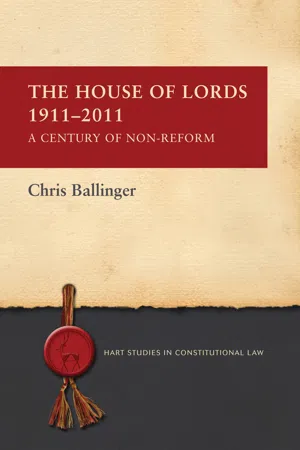
This book analyses in detail the principal attempts to reform the House of Lords. Starting with the Parliament Act of 1911 the book examines the century of non-reform that followed, drawing upon substantial archival sources, many of which have been under-utilised until now. These sources challenge many of the existing understandings of the history of House of Lords reform and the reasons for success or failure of reform attempts. The book begins by arguing against the popular idea that the 1911 Act was intended by its supporters to be a temporary measure.
'No one – peers included – should be allowed to pronounce about the future of the House of Lords without reading Chris Ballinger's authoritative, shrewd and readable account about reform attempts over the past century. He punctures several widely-held myths and claims in the current debate.'
Rt Hon Peter Riddell CBE
Director, Institute for Government and former Hansard Society chair
'This is at once an impeccably researched academic study, and a thoroughly readable account loaded with lessons for today's would-be Lords reformers.'
Lord (David) Lipsey
- 264 pages
- English
- ePUB (mobile friendly)
- Available on iOS & Android
eBook - ePub
About this book
Information
1
Veto Limitation over Reform: The Parliament Act 1911
The House of Lords are expected in every serious political controversy to give way at some point or other to the will of the House of Commons as expressing the deliberate resolve of the nation
AV Dicey, 19021
The C-B Plan at least leaves the Constitution and the hereditary principle intact, though it restricts hereditary power.
Lewis Harcourt MP2
THERE WAS NOTHING in the pre-election policy programme of the victorious Liberal Government in 1906 which was as provocative to the peers as they had found franchise reform, the repeal of the corn laws, or the Irish question, in the late nineteenth century. Social reform was more prominent in Liberal than in Unionist campaigning in 1905–06, but no immediate issue threatened unresolvable conflict between the Commons and the Lords. Indeed, Sir Henry Campbell-Bannerman, as Adonis states, ‘deliberately shelved Home Rule in the run up to the election, and did so not least to avoid an early show-down with the Upper House’.3 In the absence of an anticipation of deadlock, the constitutional issue hardly arose during the 1906 general election campaign.
THE POLITICAL SITUATION, 1906–07
Campbell-Bannerman’s incoming Liberal Government in 1906 was, however, aware of the potential threat posed to its programme by the overwhelming Unionist majority in the House of Lords. The Government had 400 seats in the House of Commons to the Unionists’ 157, and an absolute majority of 130. The landslide Liberal victory had reversed the numbers of Liberal and Unionist members in the House of Commons. However, whereas the previous Unionist Government had enjoyed a substantial majority in both Houses, the incoming Liberal Government commanded the support of only 88 of the 602 peers in the upper House.
The threat to the Government from the House of Lords, at least in the immediate aftermath of the election, was more theoretical than practical: for all the public statements on challenging the Government, Arthur Balfour, the Conservative leader in the Commons, knew that the power of the Lords ought to be used with ‘caution and tact’.4 The House of Lords’ rejection of Home Rule legislation in the 1890s did not provide a blueprint for the Unionist leaders in 1906. The incoming Liberal Government was not a single-issue administration and it was, as a consequence of this, more difficult to attack the whole administration by focusing on one policy area. Moreover, the Unionists were electorally much weaker in 1906 than they had been in 1892: there would be little to be gained by forcing a general election.5
Balfour’s primary concern was not to use the Lords to force an immediate appeal to the electorate, but rather to frustrate the Government and to unite his own party. The Unionists picked their battles carefully. They attacked sectional measures which catered for Liberal Party supporters, such as nonconformist and anti-Church measures; they opposed policies for which the electorate’s support was not wholehearted. Yet the Unionists allowed some legislation to reach the Statute Book (most notably the Trade Disputes Act 1906), which, though they did not instinctively support them, had broader popular appeal or a clear electoral mandate.6 The Unionist majority in the Lords chose its principal battlegrounds to be the 1906 Education Bill, the 1907 land reforms and the 1908 Licensing Bill. In November 1910, the leader of the Unionists in the Lords, Lord Lansdowne, pointed out that the upper House had rejected only six of the 250 Government measures introduced since 1906.7 Peers were selective in exercising their veto, carefully picking their targets from amongst the crowd.
CABINET DISCUSSIONS ON LORDS REFORM, 1907
The position of the House of Lords was broached in the 1907 King’s Speech, which warned that: ‘Serious questions affecting the working of our Parliamentary system have arisen from unfortunate differences between the two Houses. My Ministers have this important subject under consideration with a view to a solution of the difficulty.’8 The peers had already shown obstruction to the Government’s programme, not least by greatly amending the Education Bill during the 1906–07 Session, and the Government had felt forced to abandon that Bill. Campbell-Bannerman would have preferred to seek a new electoral mandate following this obstruction by the Lords, but he knew that there was insufficient support for this amongst the electorate. Unable to appeal to the country, the Cabinet sought House of Commons resolutions on reform of the Lords and established a Cabinet Committee to consider the House of Lords question.9
Following its preliminary discussions on House of Lords reform in February 1907, the Cabinet referred the problem to a committee under the Lord Chancellor, Lord Loreburn. As Weston notes, ‘the Cabinet Committee interpreted their charge as one of dealing with the lords’ veto but not with the reform of the House of Lords’.10 Yet, in effect, it recommended neither veto limitation nor reform. The following month, the Committee produced a practically unanimous report which favoured joint sittings of the two Houses to overcome disputes between Commons and Lords, preferring joint sittings to the limitation of the Lords’ veto as a means of resolving disputes between the two Houses.
The Cabinet Committee’s recommendations, which were accepted by the Cabinet, rejected the reconstruction of the House of Lords on the grounds that any change in the composition of the upper House ‘must tend to strengthen the House of Lords and to increase its power’.11 Further, the report rejected the idea that the Lords could require a referendum before disputed bills could become law, because this would place the Houses on an equal legislative footing. Replacing the House of Lords’ veto with a time-limited delaying power was seriously considered as an option, but was turned down on the grounds that it would, in effect, abolish the House and introduce single-chamber government – proposals which would inspire maximum resistance. Instead, the report recommended joint sittings to resolve inter-cameral disputes: after a year’s delay, a bill would be placed before a joint sitting comprising the entire House of Commons (670 Members) and 100 peers (of whom up to 20 would be government peers). The Cabinet Committee was unsure, however, whether joint sittings would satisfy the wishes of the Liberal Party beyond the Cabinet: restricting the veto had general approbation amongst Liberals. Nevertheless, as Weston observes: ‘If somewhat hesitant about its reception, the Cabinet Committee had no doubt of the intrinsic superiority of their plan to that of the suspensory veto.’12
This plan quickly, though misleadingly, became known as the ‘Ripon Plan’.13 Its genesis, however, as Weston has shown, lay in discussions between Lord Crewe, the Lord President of the Council, and Herbert Asquith, Chancellor of the Exchequer. Crewe had considered four plans – unicameralism, a wholly elected senate, ‘Home Rule all round’14 and a referendum – to be ‘either utterly unacceptable or practically unattainable’. The suspensory veto, the preferred option, was in some respects too similar to the referendum proposal. In other respects, the suspensory veto was too short and, though appealing to the Liberal Party, would require for its enactment extreme measures which could not, in the political circumstances prevailing at the time, be justified. Crewe realised that a small House of Lords would be necessary for joint sittings to have effect, suggesting a House of about 150 peers selected according to experience; Asquith modified the idea, suggesting that the House remain unaltered, but that joint sittings be undertaken by a delegacy. This was the foundation of the plan which the Committee reported to Lord Ripon, whose own involvement in the ‘Ripon Plan’ was negligible.15
The Cabinet had agreed to support the joint sitting proposal of its Committee; however, the Prime Minister thought that the proposals would not satisfy Liberal opinion, not least because it would give carte blanche for the Lords to reject government bills if their delegates could not be out-voted in the joint sitting, thus ensuring a Lords veto over modest Liberal Commons majorities. Weston shows how, during May 1907, Campbell-Bannerman started to throw his weight against the proposals.16 He preferred the drastic solution of replacing the Lords’ veto with a suspensory veto of just one year. As discussions continued, three severe problems with the idea of joint sittings quickly emerged and were highlighted in a Cabinet paper issued by Campbell-Bannerman himself at the end of May 1907.17 First, it would be difficult to justify the joint sitting as a ‘joint’ vote when the whole of one body and only a fraction of the other was involved (100 peers, 20 from the Government and 80 others, was ‘a very liberal estimate of the number of working Peers’). Second, 770 people – the House of Commons and 100 peers – was deemed too large an organisation for a genuinely deliberative conference on the differences between the two Houses. Third, the joint sittings would, in effect, allow the House of Lords to block the legislation of a Government which had a majority of 70 or less in the Commons.18 By early June 1907, it had become clear that the Prime Minister’s reservations were well-founded: the proposals would not please rank-and-file Liberals. The Prime Minister therefore suggested that the Lords’ veto be restricted to being a suspensory veto over three Sessions, in addition to conferences between the Houses to resolve disagreements. The Cabinet, after some deliberation,19 reached a compromise, which rejected the idea of joint sittings but supported the suspensory veto and combined it with the suggestion of Lord Crewe (who had not been enthusiastic about the suspensory veto) that the parliamentary term be shortened from seven years to five.20 By reversing Cabinet policy and changing support for the Ripon Plan into support for the suspensory veto, Campbell-Bannerman had ‘carried out virtually by himself a sweeping reversal of a Cabinet policy that had been adopted by the leading members of his Government after a process of discussion and due deliberation’.21
The decision of the Cabinet to support Campbell-Bannerman’s veto limitation plan framed the Government’s response to the House of Lords question for the next four years. The ‘C-B Plan’, as it became known, had in its favour effectiveness and simplicity. Reform – which to the Liberal Cabinets of 1906–11 meant proposals that sought to alter both the powers and the composition of the chamber in ways that were hoped to be a lasting constitutional settlement, as opposed to proposals which purported to modify only the powers of the House of Lords – raised too many points of contention which would cloud the central question of the prerogative of the lower House and which might divide opinion in the Party and the country. Moreover, reform might entrench a strong, conservative-inclined element in Parliament. Whereas some in the Cabinet had instincts towards reform over limiting the veto alone, in the parliamentary Liberal Party, the divide was between veto-limiters and abolitionists: a three-day debate in the House of Commons, on 24–26 June 1907, ended with 20 Liberals joining Irish members in voting for a Labour amendment calling for the abolition of the House of Lords. However, at the same time, the House of Commons supported by 432–147 the Prime Minister’s motion:
That, in order to give effect to the will of the people as expressed by their elected representatives, it is necessary that the power of the other House to alter or reject Bills passed by this House should be so restricted by Law as to secure that within the limits of a single Parliament the final decision of the Commons shall prevail.22
The ‘C-B Plan’ for the suspensory veto became, from this point in June 1907, the common ground across the Cabinet and the parliamentary Party, ‘notwithstanding the reluctance of Asquith’ and others.23 It was publicly supported not only by those who saw it as optimal, but also by those who favoured a more extreme solution. Over time, Liberals came to regard the 1907 Cabinet compromise as stated party policy on second chamber reform, and by 1910 most of the parliamentary party was united behind veto-limitation and against wider reform.
The House of Lords responded to the Commons’ resolution by establishing a Select Committee under Lord Rosebery. The Committee reported in 1908 with proposals that would still leave the House of Lords as a Conservative-dominated body, but which would nonetheless engender a complete overhaul of the House’s composition, with a severe reduction in the hereditary element. This change in composition would have made the Lords much easier to defend in the event of a disagreement between the Houses. ‘Yet’, as Blewett observes, ‘there was no follow up. The report was not even debated.’24 Earlier, in 1907, Lord Newton, who wished to strengthen the House of Lords through changing its composition rather than weakening it by diminishing its powers, had introduced a Bill for the House to be composed of a mixture of hereditary and life peers.25 The Bill was not without significance – not least because its proposals for drastically cutting back the hereditary element of the Lords gained a deal of support on the Conservative side – but Newton’s Bill of 1907 had as little effect on the House of Lords question as Rosebery’s report had a year later.26
Despite this flurry of activity in 1907, there was no mention of the ‘C-B Plan’ in the King’s Speech of 1908. Roy Jenkins argues convincingly that: ‘It is difficult to accept any conclusion other than that the Prime Minister intended to give the peers another year’s trial before attempting to proceed any further.’27 Certainly, with markers laid down by the House of Commons, there was no further need to forewarn the Lords in the King’s Speech. But there is a further, and crucial, reason why a bill for the limitation of the Lords’ veto power could not be introduced straight away. Campbell-Bannerman saw that his party could not remain in office if a veto limitation bill was rejected by the peers – as he knew it was certain to be – and yet it was too risky to go to the country on this issue alone. He therefore realised that the Government needed a trigger on...
Table of contents
- Cover
- Title
- Copyright
- Acknowledgements
- Contents
- Tables
- Introduction: Reform and Non-reform
- 1 Veto Limitation over Reform: The Parliament Act 1911
- 2 ‘The Battle is Over’: House of Lords Reform, 1917–45
- 3 A Pre-emptive Strike: The Parliament Act 1949
- 4 Diluting the Hereditary Principle?: The Life Peerages Act 1958
- 5 ‘The Wedgwood Benn Enabling Bill’: The Peerage Act 1963
- 6 Adding to Wilson’s Strife: The Inter-Party Conference and the Parliament (No 2) Bill [1968–69]
- 7 Stage One of Two?: The House of Lords Act 1999
- 8 The Long Stage Two: The Wakeham Commission and Beyond
- 9 Reasons for Reform and Non-reform
- Further Reading
- Bibliography
- Index
Trusted by 375,005 students
Access to over 1.5 million titles for a fair monthly price.
Study more efficiently using our study tools.
Frequently asked questions
Yes, you can cancel anytime from the Subscription tab in your account settings on the Perlego website. Your subscription will stay active until the end of your current billing period. Learn how to cancel your subscription
No, books cannot be downloaded as external files, such as PDFs, for use outside of Perlego. However, you can download books within the Perlego app for offline reading on mobile or tablet. Learn how to download books offline
Perlego offers two plans: Essential and Complete
- Essential is ideal for learners and professionals who enjoy exploring a wide range of subjects. Access the Essential Library with 800,000+ trusted titles and best-sellers across business, personal growth, and the humanities. Includes unlimited reading time and Standard Read Aloud voice.
- Complete: Perfect for advanced learners and researchers needing full, unrestricted access. Unlock 1.5M+ books across hundreds of subjects, including academic and specialized titles. The Complete Plan also includes advanced features like Premium Read Aloud and Research Assistant.
We are an online textbook subscription service, where you can get access to an entire online library for less than the price of a single book per month. With over 1.5 million books across 990+ topics, we’ve got you covered! Learn about our mission
Look out for the read-aloud symbol on your next book to see if you can listen to it. The read-aloud tool reads text aloud for you, highlighting the text as it is being read. You can pause it, speed it up and slow it down. Learn more about Read Aloud
Yes! You can use the Perlego app on both iOS and Android devices to read anytime, anywhere — even offline. Perfect for commutes or when you’re on the go.
Please note we cannot support devices running on iOS 13 and Android 7 or earlier. Learn more about using the app
Please note we cannot support devices running on iOS 13 and Android 7 or earlier. Learn more about using the app
Yes, you can access The House of Lords 1911-2011 by Chris Ballinger in PDF and/or ePUB format, as well as other popular books in Law & Public Law. We have over 1.5 million books available in our catalogue for you to explore.