eBook - ePub
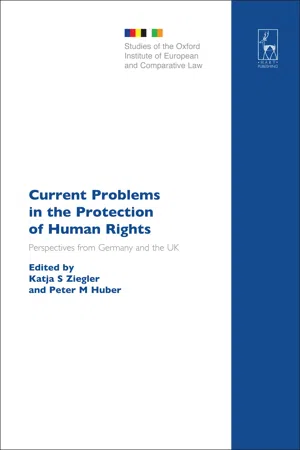
Current Problems in the Protection of Human Rights
Perspectives from Germany and the UK
- 276 pages
- English
- ePUB (mobile friendly)
- Available on iOS & Android
eBook - ePub
Current Problems in the Protection of Human Rights
Perspectives from Germany and the UK
About this book
While the legal systems of the United Kingdom and Germany differ in essential respects, the current process of 'constitutionalisation' is well recognised on both sides of the Channel. 'Constitutionalisation' manifests itself in the evolution of a constitution and the influence of existing constitutional principles on the ordinary law. Human rights law provides one of the best examples of this process, and the aim of this book is to provide a comparative UK-German perspective on recent developments. First, it addresses human rights questions which arise in both jurisdictions in a similar way such as the tension between liberty and security, absolute rights such as human dignity and the prohibition of torture, and the question how conflicts between human rights are to be resolved and conceptualised. A second theme considers the impact of human rights on different areas of law, in particular administrative law, criminal law, labour law and private law generally. Finally, a third theme focuses on the intersection of national, supra- and international human rights law, in particular after the entry into force of the EU Charter on Fundamental Rights. The book thus reveals convergent and divergent answers to similar problems, examines differences in the impact of human rights on the legal systems under consideration, and traces parallel and distinct debates over and sensitivities about, human rights as well as sensitivities that arise in multi-layer situations in the UK and Germany.
Information
1
Introduction: Current Problems in the Protection of Human Rights
Perspectives from Germany and the UK
This collection of essays comprises the revised papers presented at a joint conference of the Law Faculty of the Ludwig-Maximilians-Universität in Munich and the Institute of European and Comparative Law at the University of Oxford held in 2009. The conference was the first in a series of conferences on challenges of constitutional law in the United Kingdom and Germany from a comparative perspective, generously funded by the Excellence Programme of the German Government.
While the legal systems in the United Kingdom and Germany differ in essential aspects, the current process of constitutionalisation is well recognised on both sides of the Channel. Among the variety of notions attributed to this term, in the present context ‘constitutionalisation’ refers to the evolution of a constitution on the one hand and the influence of existing constitutional principles on ordinary law on the other hand. Presumably, the best example for this process is the area of human rights. Recent developments include the incorporation of the European Convention on Human Rights (ECHR) into UK law by the Human Rights Act 1998 (HRA) and the impact of the Charter of Fundamental Rights of the European Union, which was given binding effect on 1 December 2009 (Art 6(1) TEU). Protocol No 30 purports to limit the Charter’s justiciability in Poland and the UK, but the consequences of this limitation remain doubtful.
This collection includes chapters from three different perspectives. First, the authors contribute perspectives from different jurisdictions on the same sort of human rights questions. Second, the effect of human rights is examined in different areas of law. Third, the law under consideration is not only national but also supra- and international. Such a reflection of different layers and perspectives is increasingly a distinguishing factor of modern legal research. In the light of this overall approach, each of the collection’s four parts has a particular focus.
Part One approaches the complex process of constitutionalisation by examining the significance of human rights protection in different areas of law, the first being criminal law and criminal procedure. Against the backdrop of a common assumption about the positive reinforcement of criminal law and criminal justice through human rights and limits imposed by human rights on the criminal law and criminal justice system, Frank Zimmermann examines the ambivalent relationship between human rights protection and the substantive criminal law in more general terms. While accepting that human rights may require protection by the criminal law and analysing and comparing the relevant case law of the German Constitutional Court and the European Court of Human Rights (‘constitutional minimum’), he also demonstrates and emphasises the ‘liberalising’ effect of human rights on substantive criminal law. Human rights may limit the application of criminal law, for example by excluding certain forms of punishment or by requiring a balancing act according to the principle of proportionality where other interests protected by human rights are at stake, such as the freedom of speech and the right to privacy (‘constitutional maximum’). He concludes that both the proportionality principle and the principle of foreseeability of criminal punishment rooted in the rule of law ought to be activated to further ‘constitutionalise’ the criminal law, in particular also at the level of the EU.
Andrew Ashworth considers the influence of human rights on the criminal justice system against the background of the structure of the ECHR, taking a critical view on the potentially erosive effect of certain interpretations of human rights on the protection afforded by the criminal justice process. This may be considered to be the result of an already advanced interaction between human rights and the criminal law and criminal justice system as a particularly rights-sensitive subject matter. He critically examines recent trends, pointing to a watering down of the protection traditionally afforded by absolute human rights in the criminal justice system, such as Articles 3 and 5 ECHR. He argues that the European Court of Human Rights still strictly upholds the absolute prohibition of torture in the context of Article 3 ECHR when affirming that a trial that has been vitiated by torture, for example in the way evidence was collected, cannot be considered fair. This approach to torture must be contrasted with case law in regard to the prohibition of ‘mere’ inhuman and degrading treatment, and, even more so, with regard to violations of the right to private life or the home (Article 8 ECHR) where the structure of the Convention already provides for balancing of interests. He argues that the European Court of Human Rights has not been consistent and is potentially eroding the protections of the Convention by introducing balancing of public interests and proportionality considerations into its examination, which may too easily outweigh the rights protected by Articles 3, 5, 6 or 8 ECHR.
Four chapters then address the process of constitutionalisation in the area of private law from different perspectives. Anne Davies deals with the possibilities and problems of constitutionalisation in the area of labour law. In contrast to criminal law, human rights arguments are considered to be a relatively novel feature in UK labour law. Davies discusses in particular the tension between the individual and the traditional collective dimensions of UK labour law. For example, an individual common law ‘right to work’ may conflict with collective labour law rights of closed shop agreements and other expressions of collective bargaining. She argues that concerns that the individual rights dimension may be prioritised over the collective dimension of labour law because of the constitutionalising influence of human rights are currently unwarranted. However, she also points to the limited practical influence of increased use of human rights arguments in the UK and Strasbourg. She identifies a strong policy orientation of the executive and legislature towards employers’ interests as one of the reasons. This policy focus influences the approach of the courts, which grant a high degree of deference to other branches of government when it comes to balancing employers’ interests and individual (or collective) human rights in labour law. Human rights arguments are made, but only come in as one factor amongst many in the equation, not as an overarching constitutional value. In other words, while the use of human rights arguments reflects the formal constitutionalisation of labour law, this process does not (yet) translate substantively into outcomes or the creation of substantive constitutional values.
The next three chapters deal with the constitutionalisation of private law through human rights and EU law more generally: Alison Young considers the impact of the HRA on the horizontal application of human rights in private relationships; Carsten Herresthal analyses the impact of human rights on the freedom to contract and autonomy of contracts; and Peter Huber considers the evolution and influence of the provisions on non-discrimination in German constitutional and EU law on German law, and in particular private law.
Young examines the meaning and different forms of constitutionalisation of private law through human rights and the HRA 1998, distinguishing between influences on ‘manner’ and ‘content’ of private law, the former comprising procedure, procedural rights and institutions as well as the process of adjudication itself. She then reflects on the different forms of horizontal application of human rights and the HRA in particular, concluding that horizontal application of rights is both narrower and wider than the label of constitutionalisation. In analysing the tension and evolution of the relationship between the right to freedom of expression and the right to privacy in English law after the entry into force of the HRA, she demonstrates how the HRA has added legitimacy to the growing process of constitutionalisation not only of English public law but also of English private law. Although the HRA does not give the ECHR direct effect in the UK legal order, she emphasises that the indirect effect and a rather indeterminate and flexible approach taken by the courts may amount to a more effective protection of rights and hence may have to be considered a strength rather than a weakness of the UK’s approach to the ECHR.
Herresthal critically reflects on the lack of constitutionalisation of the principle of autonomy in contract law [Privatautonomie] as a leading principle of private law, in particular at EU level. He argues that thus far autonomy in contractual relationships has not been reflected and fleshed out sufficiently to make it operable and to give it appropriate weight in balancing it with conflicting interests (such as social standards or consumer protection). He argues that this age-old principle should be strengthened against new challenges posed by human rights and the absence of a clear public–private divide in EU law, for example, by including it explicitly in the EU Charter on Fundamental Rights.
Peter Huber then focuses on the right not to be discriminated against in the light of recent legislative action of the EU. He enquires in his contribution whether anti-discrimination law leads to a shift of paradigm in the protection of human rights more widely. He considers that positive and modernising impulses emanated from the EU in regard to sex discrimination and quotas to promote women where the provisions or interpretations of the Grundgesetz [Basic Law] were less forward looking. However, he expresses concern about the influence of EU non-discrimination legislation and case law in regard to age discrimination.
The final chapter of Part One turns to the wide-ranging impulses of the HRA for public law. Anthony Bradley examines the impact of the HRA in more detail with regard to administrative law, revealing its strong constitutionalist force in the absence of a single constitutional text in the UK. He distinguishes two aspects of how the HRA influences administrative law: ‘internally’, concerning the content of administrative law; and ‘externally’, concerning the delimitation of the jurisdiction of the administrative judge. In regard to the latter, using the example of the right to be heard, he demonstrates how the ECHR (through the HRA) has enabled UK courts to protect this fundamental right where they would not have had jurisdiction under common law. With regard to the internal perspective, he discusses how the addition of human rights as a substantive ground for judicial review by the HRA has been crucial to enable judicial review in immigration cases. However, not all limitations of the common law have been overridden. For example, claims for damages in tort for unlawful administrative decisions (which breach human rights) will not necessarily be successful because the HRA did not create a new tort in English law; hence it would be wrong to conclude that a ‘wholesale reform of the common law’ has taken place. Nevertheless, as Bradley critically observes, the use of jurisprudence of the European Court of Human Rights by UK courts, in particular in deportation and terrorism cases, has triggered a debate about whether the courts go beyond their constitutional role and whether the HRA should be repealed.
Part Two turns away from subject area analyses to the cross-cutting question of how courts technically apply human rights, and more specifically, how they deal with, and have capacity to deal with, balancing between individual rights or rights and other interests. Sophie-Charlotte Lenski and Paul Yowell reflect on the criteria by which courts determine breaches of human rights from a conceptual and theoretical perspective in the context of balancing rights. While Lenski looks more closely at how conflicting rights are balanced in the light of recent case law of the Federal Constitutional Court, Yowell examines the practical application of the proportionality principle and the capacity of courts to deal with factual and empirical information when applying it.
Lenski contrasts a new analytical perspective of multipolar fundamental rights situations which can be found in several recent cases of the Bundesverfassungsgericht [Federal Constitutional Court] with the more traditional notion of indirect effect of human rights (as expressions of a system of values) in private law. She argues that the concept of multipolar legal relationships facilitates the resolution of conflicts between fundamental rights without having to refer to the objective dimension of fundamental rights. This is so because balancing between conflicting rights through the multipolar approach can take place at the same level as the rights in question, rather than using one right as a starting point, which possibly biases the outcome. While she argues that the concept of multipolar legal relationships is capable of generalisation beyond the specific cases discussed, it remains to be seen whether the Federal Constitutional Court will take this route.
Yowell discusses the relationship between human rights and institutional competence/capacity when engaging in complex fact-finding and risk assessment. He demonstrates how the proportionality principle requires judges to collect and assess empirical evidence by reference to historic and recent case law in the US and Canadian Supreme Courts as well as the Bundesverfassungsgericht. In particular he analyses how these courts have considered and used empirical evidence in three high-profile cases: restriction of speech by the prohibition of violent video games (USA), the possible interference with the right to life by the prohibition of private health insurance (Canada), and business and property rights affected by a smoking ban in pubs (Germany). He critically exposes the often haphazard nature of gaining factual information from – at least in this context – doubtful sources (such as Wikipedia) and the lack of scientific training of judges when it comes to interpreting empirical and statistical data. He argues that courts which have the power to decide on the validity of legislation should have access to research services at least similar to those of parliaments.
Part Three considers a specific issue: absolute rights. Whereas the previous parts enquire into the trajectory of constitutionalism at large and the technique of balancing, Part Three focuses on one expression of constitutionalism, that of normative hierarchies and on the accommodation of diversity where national and European constitutionalism conflict. The right to human dignity serves as an example for the divergence and convergence of human rights protection in the United Kingdom and Germany.
Based on Article 1 of both the Grundgesetz and the Charter of Fundamental Rights of the European Union, Sebastian Unger describes the inviolability of human dignity as a constitutional taboo. After sketching out the interpretation of the meaning of human dignity by the Bundesverfassungsgericht, he critically analyses the consequences of an assumption of an absolute legal value. He argues that an inflation of the meaning of human dignity has taken place and that the concept has been applied where reference to ordinary fundamental rights would have been sufficient. Human dignity, therefore, should be reserved for a narrow category of cases.
Jan Kalbheim examines the status of national identity in the EU treaties and case law and considers the impact of EU law on the right to human dignity. He looks at how, in a situation where different layers of law apply (namely EU and national law), a balance is achieved where concerns for a national identity are raised. He uses the Omega decision of the European Court of Justice as an example to show how national identity may be protected under EU law when conflicting with a market freedom. By allowing a Member State to legitimately restrict a market freedom on the basis of a specific aspect of its national identity, national identity may be accorded priority, at least in a situation where concepts of dignity diverge vastly between Member States.
Part Four is dedicated to the ambivalent relationship between human rights and security, in particular the restriction of human rights through anti-terrorism measures. Foroud Shirvani describes the evolution of anti-terrorist legislation in Germany from the 1970s, when the terrorist activities of the ‘Red Army Faction’ peaked, to recent days. He then focuses on the anti-terrorist legislation following the 9/11 attack. He discusses the expansion of the possibilities and competences of the authorities in charge of public security to collect and process data in order to combat terrorism. He demonstrates how in two key decisions the Bundesverfassungsgericht has taken a restrictive approach towards preventive collection and use of information and police action. He concludes that the ‘preventive state’ has to accept limits if it intends to retain its self-image as a guarantor of both security and freedom, the suitable constitutional concept being primarily the task of the legislature and only secondarily the task of the courts.
Patrick Birkinshaw’s contribution provides a counterpart analysis from a UK perspective. He examines critically the recent legislation and case law concerning various restrictions on access to information in the UK in relation to suspects of terrorist offences, such as secret evidence and the Special Advocates in the Special Immigration Appeals Commission (SIAC), control orders and their successors (civil preventative measures) as well as public interest immunity in criminal cases. He highlights the widespread resort to deference to the executive by UK courts where an actual or perceived security interest of the state is at stake, but also critically points out how the features of secrecy have spilled over into other contexts. He points out that problems of secrecy are likely to continue in the light of the Government’s Green Paper on Justice and Security published in the autumn of 2011. Nevertheless he stresses the improvement of human rights protection by...
Table of contents
- Cover
- Title
- Copyright
- Contents
- List of Contributors
- 1. Introduction: Current Problems in the Protection of Human Rights – Perspectives from Germany and the UK
- Part One Constitutionalisation by Human Rights in Specific Areas of Law
- Part Two Balancing Human Rights
- Part Three Absolute Rights: The Example of Human Dignity
- Part Four Human Rights and Anti-terrorism Measures
- Index
Trusted by 375,005 students
Access to over 1.5 million titles for a fair monthly price.
Study more efficiently using our study tools.
Frequently asked questions
Yes, you can cancel anytime from the Subscription tab in your account settings on the Perlego website. Your subscription will stay active until the end of your current billing period. Learn how to cancel your subscription
No, books cannot be downloaded as external files, such as PDFs, for use outside of Perlego. However, you can download books within the Perlego app for offline reading on mobile or tablet. Learn how to download books offline
Perlego offers two plans: Essential and Complete
- Essential is ideal for learners and professionals who enjoy exploring a wide range of subjects. Access the Essential Library with 800,000+ trusted titles and best-sellers across business, personal growth, and the humanities. Includes unlimited reading time and Standard Read Aloud voice.
- Complete: Perfect for advanced learners and researchers needing full, unrestricted access. Unlock 1.5M+ books across hundreds of subjects, including academic and specialized titles. The Complete Plan also includes advanced features like Premium Read Aloud and Research Assistant.
We are an online textbook subscription service, where you can get access to an entire online library for less than the price of a single book per month. With over 1.5 million books across 990+ topics, we’ve got you covered! Learn about our mission
Look out for the read-aloud symbol on your next book to see if you can listen to it. The read-aloud tool reads text aloud for you, highlighting the text as it is being read. You can pause it, speed it up and slow it down. Learn more about Read Aloud
Yes! You can use the Perlego app on both iOS and Android devices to read anytime, anywhere — even offline. Perfect for commutes or when you’re on the go.
Please note we cannot support devices running on iOS 13 and Android 7 or earlier. Learn more about using the app
Please note we cannot support devices running on iOS 13 and Android 7 or earlier. Learn more about using the app
Yes, you can access Current Problems in the Protection of Human Rights by Katja S Ziegler, Peter M Huber, Katja S Ziegler,Peter M Huber in PDF and/or ePUB format, as well as other popular books in Law & Civil Rights in Law. We have over 1.5 million books available in our catalogue for you to explore.