This book analyses the emerging practice in the post-Cold War era of the creation of a democratic political system along with the creation of new states. The existing literature either tends to conflate self-determination and democracy or dismisses the legal relevance of the emerging practice on the basis that democracy is not a statehood criterion. Such arguments are simplistic. The statehood criteria in contemporary international law are largely irrelevant and do not automatically or self-evidently determine whether or not an entity has emerged as a new state. The question to be asked, therefore, is not whether democracy has become a statehood criterion. The emergence of new states is rather a law-governed political process in which certain requirements regarding the type of a government may be imposed internationally. And in this process the introduction of a democratic political system is equally as relevant or irrelevant as the statehood criteria. The book demonstrates that via the right of self-determination the law of statehood requires state creation to be a democratic process, but that this requirement should not be interpreted too broadly. The democratic process in this context governs independence referenda and does not interfere with the choice of a political system.
This book has been awarded Joint Second Prize for the 2014 Society of Legal Scholars Peter Birks Prize for Outstanding Legal Scholarship.
eBook - ePub
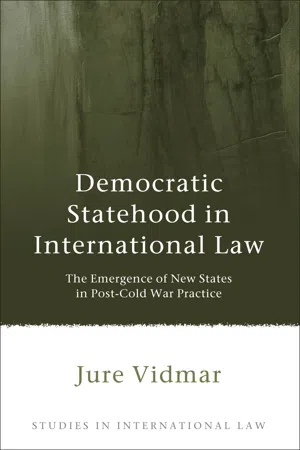
Democratic Statehood in International Law
The Emergence of New States in Post-Cold War Practice
- 302 pages
- English
- ePUB (mobile friendly)
- Available on iOS & Android
eBook - ePub
Democratic Statehood in International Law
The Emergence of New States in Post-Cold War Practice
About this book
Information
1
Democracy and Statehood in International Law
1 INTRODUCTION
1.1 Background
AT THE END of the Cold War, two multiethnic socialist federations were dissolved: the Union of Soviet Socialist Republics (the Soviet Union) and the Socialist Federal Republic of Yugoslavia (SFRY).1 This period thus marked not only the end of the communist/socialist social, political and economic order but also the emergence of a number of new states.2 The entanglement of post-Cold War political developments and the emergence of new states led to the idea that democracy should be brought into international law as a normative framework in relation to both existing and emerging states. This was at a time when some international legal scholars argued that democracy had become a normative entitlement of all individuals3 and when the European Community (EC) Member States adopted documents which explicitly expressed the willingness to (collectively) grant recognition only to those new states which had constituted themselves on a democratic basis.4
The dissolutions of the Soviet Union and of the SFRY were followed by the dissolution of a third (then already formerly) socialist federation – Czechoslovakia.5 Shortly afterwards, Eritrea successfully seceded from Ethiopia.6 In due course, East Timor7 and Montenegro also became independent states.8 In 2008, Kosovo declared independence.9 Kosovo has attracted a significant number of recognitions, but its legal status remains ambiguous. Most recently, South Sudan emerged as an independent state.10
In the language of international law, these new states emerged as a result of consensual and non-consensual dissolutions of federations; as a result of consensual secessions from their parent states, and in one case perhaps even as a result of a successful unilateral secession (Kosovo). Some of these states satisfied the statehood criteria upon their emergence and others had problems in this respect. Most new states were recognised promptly, but some were not and were nevertheless considered to be states. The new states may have emerged upon the exercise of the right of self-determination and some of them possibly even under the doctrine of remedial secession. With regard to self-determination, most states emerged with the overwhelming support of the will of the people, expressed at independence referenda. And many of the post-Cold War state creations were marked by international involvement, which included the creation of democratic institutions.11
The question now arises whether the language being used in the discourse of state creation is still that of international law. Concepts such as statehood criteria, recognition, secession and dissolution are traditional concepts in the law of statehood. As we move through self-determination towards democracy, it becomes unclear whether one is still on the terrain of the law of statehood or is rather dealing with issues of policy. Yet even policy, if followed universally, could be reflective of state practice and opinio juris.
In essence, the post-1990 developments were marked by an entanglement of the processes of democratisation and state creation; however, what is the legal significance of such an entanglement?
The place of democracy in the international law of statehood remains unclear. It is commonly argued that if democracy were accepted as a statehood criterion, ‘a territorial entity which did not come about in a democratic procedure and which does not seek to establish democratic government structures would not qualify as a state’.12 This argument carefully avoids pronouncing democracy a statehood criterion and holds that democracy in the law of statehood is concerned with two basic concepts: (i) a ‘democratic procedure’ required by international law in the process of state creation (altering the legal status of a territory in accordance with the will of the people); and (ii) a requirement for ‘democratic government structures’ in a new state (creating new states that adhere to a particular political system).
Doctrinal writings have not established a proper distinction between these two concepts subsumed under democracy in the international law of statehood. Scholarship in this area of international law has also remained too narrowly focused on the statehood criteria and has not analysed state creation as an internationalised process, to some extent influenced by the statehood criteria but also by other factors – democracy being a prominent example of one.
1.2 Context and Existing Literature
In 1992, Thomas Franck authored ‘The Emerging Right to Democratic Governance’, an article which adopts an election-centric definition of democracy, deriving the putative new right from a selection of civil and political rights.13 A related idea stems from the writings of Fernando Teson14 and Anne-Marie Slaughter,15 who suggest the reconceptualisation of international law as law among democratic states.
The ideas of both normative democratic entitlement and international law as law among democratic states have attracted strong criticism. Susan Marks argues that these endeavours are overtly ideological and points out the inadequacy of an election-centric definition of democracy.16 José Alvarez questions the idea of legal prescriptions being based on the election-centric democratic self-image of some states and argues that the democratic enterprise in international law proposes to disrupt the United Nations (UN) Charter system.17 Brad Roth cautions that even from the perspective of the election-centric definition of democracy, a democratic bias in reading universal human rights standards cannot be assumed.18 Steven Wheatley notes that although there is ‘a commitment of the international community to democracy as the only legitimate form of government . . . [t]here is . . . no “hard” international law norm that all governments should be democratic’.19
These discussions on the idea that international law supports only one particular type of government relate predominantly to the governments of existing states and deal with the origins of their legitimacy. In contrast, this book explores the legal significance of democratic procedures, institutions and even postulates of substantive democracy for new state creations.
The concept of the state and its emergence has been subject to notable controversy in international legal scholarship. In one view, states emerge as ‘a matter of fact’, upon meeting the Montevideo statehood criteria.20 However, as Hersch Lauterpacht argued, in order to accept this explanation, one needs to accept the rather awkward idea that ‘a State exists in international law as soon as it exists’.21 The emergence of a new state may thus rather depend on international acceptance of the existence of a new state rather than on a presumption that its existence is a self-evident fact.22 Lauterpacht explained international acceptance in the context of constitutive recognition,23 but this view is problematic in light of the general perception in contemporary international law of recognition being a declaratory act. However, existing practice on new state creations in contemporary international law may well suggest that Lauterpacht was right in arguing that states do not emerge automatically upon meeting the Montevideo statehood criteria. As Marc Weller argues, the emergence of a new state may instead depend on ‘a grant of legal authority’.24
The existing literature has not adequately explored the legal nature of international acceptance of the existence of a new state in the absence of a presumption that recognition is constitutive. If the emergence of a new state is not a matter of meeting the statehood criteria, and the practice shows that this is the case, it is questionable on which other requirements a state creation depends and how these requirements are grounded in contemporary international law.
Based on the practice of states and UN organs, James Crawford argues that the traditional statehood criteria have been supplemented by additional ones, and an entity which does not meet them is not a state.25 John Dugard bases his arguments on the general principle of law ex injuria jus non oritur and in the concept of jus cogens, and argues that the creation of an entity in breach of jus cogens is illegal and cannot produce legal rights to the wrongdoer; in other words, such an entity cannot become a state.26
While the concept of the additional statehood criteria can explain why certain illegally created effective entities did not become states (eg, Southern Rhodesia),27 it cannot explain why some other effective entities cannot become states even in the absence of territorial illegality (eg Somaliland).28 Statehood criteria (traditional and additional) are not the only parameters in the equation that explains whether and why an entity is a state. This book thus considers the emergence of new states in the broader context of an internationalised process which also prescribes certain democratic procedures.
Prior to 1990, it was generally not maintained that judging the type of government based on electoral practices could be determinative of a successful state creation.29 After the end of the Cold War, this perception changed to some degree. Part of the EC’s response to the events in the territories of the SFRY and the Soviet Union was to issue a set of guidelines for recognition of new states emerging in these two territories. In the case of the SFRY, the EC also established a mechanism for recognition.30
The legal significance of international involvement – most notably of the EC – in the dissolution of the SFRY has been examined by writers in international law and international relations. David Raič argues that the requirement for states to constitute themselves on a democratic basis, expressed in the EC Guidelines on recognition, should, as suggested by the title of this document, be regarded as a recognition requirement and not a statehood criterion.31 However, as Richard Caplan argues, although the EC termed its involvement as that of recognition of new states, this was rather an exercise in collective state creation.32
This book demonstrates that the act of recognition was not crucial for the emergence of new states in the territory of the federation. It was rather that the international involvement led to an internationalised extinguishing of the SFRY’s personality, which made its claim to territorial integrity inapplicable . . . Considerations for democracy by the international community were thus not necessarily applied only in the process of granting recognition, but rather in the process of international acceptance of the dissolution of the SFRY. What implications does this practice have for the contemporary law of statehood?
Existing analyses of the dissolution of the SFRY do not thoroughly deal with the substance of the EC’s requirement for new states to adhere to democratic practices. It has been insufficiently explored how these requirements were implemented and what their significance was under international law. Although it is acknowledged that international involvement in the process of dissolution of the SFRY may well have had constitutive effects, little attention has been paid to the phenomenon of international (attempts at) imposition of democratic institutions in a new state being dependent on the mode of a certain state creation. As Jean d’Aspremont notes, there exists significant practice of an entanglement of the processes of internationalised transitions to both statehood and democracy.33
To date, this entanglement has not been analysed from the perspective of international law. In other words, scholarship has not explained the legal nature of the interplay between the mode of state creation and the international imposition of democratic institutions; neither has it divorced the issue of imposition of democratic institutions in the new state from the democratic principles operating in the law of statehood via the right of self-determination.34
The principle of self-determination and democratic political theory have been expressly wedded in the ideas of the American and French Revolutions and in the writings and speeches of the US President Woodrow Wilson.35 Yet self-determination also featured prominently in Lenin’s writings and thus in the socialist interpretation of law an...
Table of contents
- Cover
- Title
- Copyright
- Acknowledgements
- Table of Contens
- Tables of Cases
- Table of Materials
- Chapter 1 Democracy and Statehood in International Law
- Chapter 2 The Practice of Post-Cold War State Creations: The Statehood Criteria, Democracy and Human Rights
- Chapter 3 Democratic Aspects of the Right of Self-Determination
- Chapter 4 Delimitation of New States and Limitations on the Will of the People
- Chapter 5 Democratic Statehood: Conclusions
- Bibliography
- Index
Trusted by 375,005 students
Access to over 1.5 million titles for a fair monthly price.
Study more efficiently using our study tools.
Frequently asked questions
Yes, you can cancel anytime from the Subscription tab in your account settings on the Perlego website. Your subscription will stay active until the end of your current billing period. Learn how to cancel your subscription
No, books cannot be downloaded as external files, such as PDFs, for use outside of Perlego. However, you can download books within the Perlego app for offline reading on mobile or tablet. Learn how to download books offline
Perlego offers two plans: Essential and Complete
- Essential is ideal for learners and professionals who enjoy exploring a wide range of subjects. Access the Essential Library with 800,000+ trusted titles and best-sellers across business, personal growth, and the humanities. Includes unlimited reading time and Standard Read Aloud voice.
- Complete: Perfect for advanced learners and researchers needing full, unrestricted access. Unlock 1.5M+ books across hundreds of subjects, including academic and specialized titles. The Complete Plan also includes advanced features like Premium Read Aloud and Research Assistant.
We are an online textbook subscription service, where you can get access to an entire online library for less than the price of a single book per month. With over 1.5 million books across 990+ topics, we’ve got you covered! Learn about our mission
Look out for the read-aloud symbol on your next book to see if you can listen to it. The read-aloud tool reads text aloud for you, highlighting the text as it is being read. You can pause it, speed it up and slow it down. Learn more about Read Aloud
Yes! You can use the Perlego app on both iOS and Android devices to read anytime, anywhere — even offline. Perfect for commutes or when you’re on the go.
Please note we cannot support devices running on iOS 13 and Android 7 or earlier. Learn more about using the app
Please note we cannot support devices running on iOS 13 and Android 7 or earlier. Learn more about using the app
Yes, you can access Democratic Statehood in International Law by Jure Vidmar in PDF and/or ePUB format, as well as other popular books in Derecho & Derecho internacional. We have over 1.5 million books available in our catalogue for you to explore.