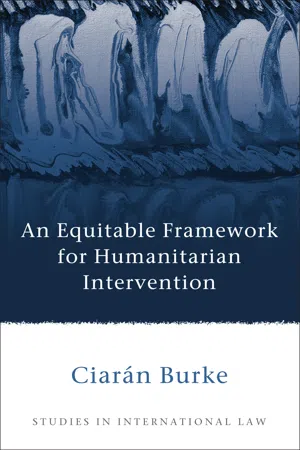
This book aims to resolve the dilemma regarding whether armed intervention as a response to gross human rights violations is ever legally justified without Security Council authorisation. Thus far, international lawyers have been caught between giving a negative answer on the basis of the UN Charter's rules ('positivists'), and a 'turn to ethics', declaring intervention legitimate on moral grounds, while eschewing legal analysis ('moralists'). In this volume, a third solution is proposed. The idea is presented that many equitable principles may qualify as 'general principles of law recognised by civilised nations' - one of the three principal sources of international law (though a category that is often overlooked) - a conclusion based upon detailed research of both national legal systems and international law. These principles, having normative force in international law, are then used to craft an equitable framework for humanitarian intervention. It is argued that the dynamics of their operation allow them to interact with the Charter and customary law in order to fill gaps in the existing legal structure and soften the rigours of strict law in certain circumstances. It is posited that many of the moralists' arguments are justified, albeit based upon firm legal principles rather than ethical theory. The equitable framework proposed is designed to provide an answer to the question of how humanitarian intervention may be integrated into the legal realm. Certainly, this will not mean an end to controversies regarding concrete cases of humanitarian intervention. However, it will enable the framing of such controversies in legal terms, rather than as a choice between the law and morality.
'...has potential to become one of the most important books in public international law of the decade, or in a generation'.
Martin Scheinin, Professor of Public International Law, European University Institute, Florence
- 398 pages
- English
- ePUB (mobile friendly)
- Available on iOS & Android
eBook - ePub
An Equitable Framework for Humanitarian Intervention
About this book
Information
Table of contents
- Cover
- Title
- Copyright
- Acknowledgements
- Contents
- Table of Cases
- Table of Legislation
- Introduction
- 1: The Humanitarian Intervention Discourse: A Debate on the Edges of the Law
- 2: The Third Source of International Law
- 3: Equity as ‘General Principles’ in the Legal Systems of ‘Civilised Nations’
- 4: Equity in International Legal Practice
- 5: A Framework for Equitable Humanitarian Intervention
- Conclusion
- Bibliography
- Index
Trusted by 375,005 students
Access to over 1.5 million titles for a fair monthly price.
Study more efficiently using our study tools.
Frequently asked questions
Yes, you can cancel anytime from the Subscription tab in your account settings on the Perlego website. Your subscription will stay active until the end of your current billing period. Learn how to cancel your subscription
No, books cannot be downloaded as external files, such as PDFs, for use outside of Perlego. However, you can download books within the Perlego app for offline reading on mobile or tablet. Learn how to download books offline
Perlego offers two plans: Essential and Complete
- Essential is ideal for learners and professionals who enjoy exploring a wide range of subjects. Access the Essential Library with 800,000+ trusted titles and best-sellers across business, personal growth, and the humanities. Includes unlimited reading time and Standard Read Aloud voice.
- Complete: Perfect for advanced learners and researchers needing full, unrestricted access. Unlock 1.5M+ books across hundreds of subjects, including academic and specialized titles. The Complete Plan also includes advanced features like Premium Read Aloud and Research Assistant.
We are an online textbook subscription service, where you can get access to an entire online library for less than the price of a single book per month. With over 1.5 million books across 990+ topics, we’ve got you covered! Learn about our mission
Look out for the read-aloud symbol on your next book to see if you can listen to it. The read-aloud tool reads text aloud for you, highlighting the text as it is being read. You can pause it, speed it up and slow it down. Learn more about Read Aloud
Yes! You can use the Perlego app on both iOS and Android devices to read anytime, anywhere — even offline. Perfect for commutes or when you’re on the go.
Please note we cannot support devices running on iOS 13 and Android 7 or earlier. Learn more about using the app
Please note we cannot support devices running on iOS 13 and Android 7 or earlier. Learn more about using the app
Yes, you can access An Equitable Framework for Humanitarian Intervention by Ciarán Burke in PDF and/or ePUB format, as well as other popular books in Diritto & Diritto internazionale. We have over 1.5 million books available in our catalogue for you to explore.