- 304 pages
- English
- ePUB (mobile friendly)
- Available on iOS & Android
eBook - ePub
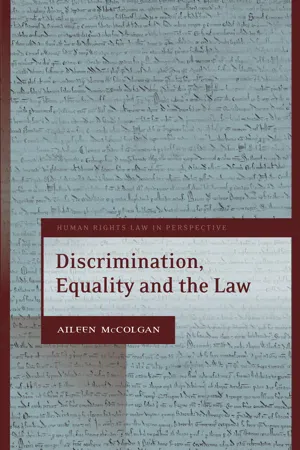
Discrimination, Equality and the Law
About this book
This monograph explores some of the conceptual questions which underpin the legal disputes which arise in relation to equality and discrimination. Among these are questions about the meaning of 'equality' as a legal concept and its relationship to the principle of non-discrimination; symmetrical and asymmetrical approaches to equality/non-discrimination; the role of comparators in discrimination/equality analysis; the selection of protected characteristics and the proper sphere of statutory and constitutional protections, and the scope for and regulation of potential conflicts between protected grounds. The author engages with domestic, EU and ECtHR case law as well as with wider international approaches.
Information
1
‘Equality’, ‘Discrimination’ and the
Law: an Introduction
Law: an Introduction
The Last Decade or so has seen extraordinary changes in the landscape of equality/discrimination law in the UK. Not only have the grounds to which statutory protection applies extended beyond race, sex and disability to include sexual orientation, religion and belief, and age, but the patchwork of legislative provisions has been transformed into a relatively coherent legal framework (in Great Britain) by the Equality Act 2010. The implementation of the Human Rights Act 1998, in October 2000, opened the door to equality/discrimination challenges beyond the boundaries of the sometimes rigid framework of anti-discrimination statutes. And perhaps most radical of all, the enactment of what have come to be known as the ‘public sector equality duties’ has begun to transform the landscape by including equality considerations as mandatory factors which must be taken into account by public authorities in all their decisions.1
This book is directed towards a largely UK readership, though I hope it will also be of interest to others. It is a book primarily for lawyers, whether academics, practitioners or students. It is not a textbook or a practitioners’ manual and does not set out to detail domestic statutory provisions, or those of a more international flavour. It seeks, rather, to address deeper questions concerning the proper shape and development of equality/discrimination law.
The questions that I attempt to address in this book are those which have come to interest me during the course of a quarter century’s involvement in the area. My first exposure was as an undergraduate law student. The House of Lords’ decision in Hayward v Cammell Laird (No 2),2 in which a canteen cook won the right to equal pay with her male comparators – male painters, thermal insulation engineers and joiners – was one of the cases, much dreaded by students, decided in the period immediately preceding my final exams. What I remember about that particular decision, however, was that my delight in their Lordships’ requirement for equality in relation to each contractual term relating to pay, rather than ‘in the round’, outweighed my irritation in having (yet) another case to memorise.
During my LLM studies in Edinburgh, the formal aspect of which seemed to consist largely in gazing in bewilderment at the equations in Joseph Raz’s Authority of Law, I fell into a women’s reading group run by Beverley Brown as a result of which I replaced my sex-and-shopping reading material with Mary Daly and Germaine Greer. There followed a job writing about labour law where I was allowed to pursue an increasing interest in sex discrimination/equal pay which in turn led me to academia. Finding myself teaching criminal law, my first real ventures into academic writing concerned the legal treatment of women who killed abusive men, and of women who complained of sexual assault.3 Criminal law gave way to labour law and I began to write about equal pay and sex discrimination law, then about (broadly) employment-related discrimination more generally.
My interest in these areas as aspects of labour law was balanced by broader concerns about equality in the context of public and human rights litigation. The latter began in a theoretical way with the writing of a sceptical book about the likely impact of the Human Rights Act 1998 on women and gender equality.4 Shortly after this book was completed I began to practise as a barrister, as a result of which my macro-level scepticism about both the common law and the Human Rights Act became tempered, at least at the micro level, by the recognition that there were aspects of both that were useful additions to the lawyer’s tool kit.5 With the amendment of the discrimination statutes expressly to regulate discrimination by public authorities,6 and the implementation of the public sector equality duties, the statutory regime (now consolidated, if not radically simplified), common law and human rights arguments have begun to come together in a much more coherent way than was previously the case.
Now seems the time to attempt to engage with some of the difficult questions thrown up by the competing demands of those with different interests in the outcomes of arguments about equality/discrimination. What groups or individuals, for example, are the proper subject of our concern when we talk about ‘equality’ or ‘discrimination’?. Ought we to be striving for a society which is blind to differences of race, gender or sexual orientation? Whatever the answer to the previous questions, do they similarly apply to disability? to age? to religious or other beliefs, or to their absence? to appearance? to gluttony? to wealth? to cleverness? to the ability or inclination to keep one’s nose to the grindstone?
If the answer is not that society should be blind to these, or some of these, or to other, differences, to what extent can such differences be respected without running the danger of reifying and/or perpetuating that which might otherwise be minor and/or transient? What balance is to be struck between avoiding the demand for assimilation and driving people into bunkers which reflect, if at all, only limited aspects of their multifaceted individuality? When is difference good? When is it bad? When is it to be respected and when merely tolerated? When, by recognising difference, do we make it real? Do we ever have to accommodate difference where, in so doing, we allow the disadvantaged to be further disadvantaged in the pursuit of some other kind of equality? Do we have to allow those who insist on their difference to subject others to disadvantage in pursuit of that difference? And does the answer to this question and the previous one depend on whether the person or group whose difference is being insisted on is him/her/itself disadvantaged?
What do we mean by ‘disadvantage’? What factors, by reference to which people may be identified, should be excluded from consideration when it comes to the distribution of advantages in the context of work, for example, night clubbing or flat sharing? Ought these factors always to be ignored? Or should we be striving to treat equally on the basis of these or other characteristics? If so, what does treating equally mean? Are the answers to each of these questions the same for each of these factors? And are they the same as the factors which should be disallowed from consideration, or otherwise subjected to ‘equal’ treatment, in the context of education, access to healthcare or the policing function of the state?
These and other questions are the subject of the chapters that follow. Some can be regarded as legal questions in the sense that legal analysis will generate answers to them, whether firm or tentative, within particular legal systems. Some of those answers will be considered over the course of this book, the legal systems to which reference will be made being those currently applicable in Britain as well as, to greater or lesser extents, Canada, the US and South Africa. But many of these questions are most interestingly addressed in the realm of the ‘ought’ rather than the ‘is’, because their answers may most fruitfully be determined by matters other than the particular choice of words legislators or adjudicators have selected or compromised on, often when considering issues of more immediate concern to the decision makers.
STRUCTURE OF THE BOOK
The ‘ought’, then, is what I am primarily interested in, and it is the ‘ought’ which drives the selection of the comparative material discussed in the book, which is organised as follows. In this chapter I make a very brief sketch of the legal framework which operates in Britain. This sketch serves to anchor what follows but does not purport to do more than nod towards some of the complex legal issues which arise in connection with that framework. As above, this is not the book to read to discover the detail of British discrimination law. The main purpose of this chapter is to introduce some of the recent debates about the underpinning purpose of anti-discrimination law and the scope and target of equality-related concerns.
In Chapter 2 I outline the role of ‘grounds’ or ‘protected characteristics’ in the current legal approach to discrimination, and begin to consider which such grounds/characteristics ought to be protected from discrimination. In doing this I discuss the various approaches taken to grounds in the US, Canada and the jurisprudence of the European Court of Human Rights. Part of the purpose of this chapter is to challenge the general tendency which those with a concern for equality might have to favour expansion of the list of protected characteristics. There are, in my view, strong reasons of principle, as well as pragmatism, to confine fairly narrowly those characteristics which are provided with relatively comprehensive protection from discrimination and to focus on the correlation between identification with those grounds and disadvantage across multiple spheres of life. In discussing these reasons, I introduce what is a core theme of this book: the tensions which result from treating religion and belief, in particular, as synonymous with characteristics such as ethnicity or sexual orientation, for example, in the legal regulation of discrimination.
In Chapter 3 I explore what I call ‘symmetrical’ and ‘asymmetrical’ approaches to discrimination, that is, conceptualisations of discrimination which are, respectively, generally compatible with and hostile to ‘positive’ discrimination. Domestic law has historically been suspicious of any approach which takes race, sex or other protected characteristic into account, preferring an ideal of justice blindfolded. While there are obvious attractions in a refusal to take into account characteristics which are generally irrelevant to ‘merit’, the demand for sy...
Table of contents
- Cover
- Title Page
- Contents
- 1 ‘Equality’, ‘Discrimination’ and the Law: an Introduction
- 2 Defining the Protected Characteristics
- 3 ‘Equality’ and ‘(A)symmetry’
- 4 The Evolution of Equality Law
- 5 Competing Equalities
- 6 Multiculturalism and Equality
- 7 Conclusion
- Bibliography
- Acknowledgements
- eCopyright
Trusted by 375,005 students
Access to over 1.5 million titles for a fair monthly price.
Study more efficiently using our study tools.
Frequently asked questions
Yes, you can cancel anytime from the Subscription tab in your account settings on the Perlego website. Your subscription will stay active until the end of your current billing period. Learn how to cancel your subscription
No, books cannot be downloaded as external files, such as PDFs, for use outside of Perlego. However, you can download books within the Perlego app for offline reading on mobile or tablet. Learn how to download books offline
Perlego offers two plans: Essential and Complete
- Essential is ideal for learners and professionals who enjoy exploring a wide range of subjects. Access the Essential Library with 800,000+ trusted titles and best-sellers across business, personal growth, and the humanities. Includes unlimited reading time and Standard Read Aloud voice.
- Complete: Perfect for advanced learners and researchers needing full, unrestricted access. Unlock 1.5M+ books across hundreds of subjects, including academic and specialized titles. The Complete Plan also includes advanced features like Premium Read Aloud and Research Assistant.
We are an online textbook subscription service, where you can get access to an entire online library for less than the price of a single book per month. With over 1.5 million books across 990+ topics, we’ve got you covered! Learn about our mission
Look out for the read-aloud symbol on your next book to see if you can listen to it. The read-aloud tool reads text aloud for you, highlighting the text as it is being read. You can pause it, speed it up and slow it down. Learn more about Read Aloud
Yes! You can use the Perlego app on both iOS and Android devices to read anytime, anywhere — even offline. Perfect for commutes or when you’re on the go.
Please note we cannot support devices running on iOS 13 and Android 7 or earlier. Learn more about using the app
Please note we cannot support devices running on iOS 13 and Android 7 or earlier. Learn more about using the app
Yes, you can access Discrimination, Equality and the Law by Aileen McColgan KC in PDF and/or ePUB format, as well as other popular books in Law & Labour & Employment Law. We have over 1.5 million books available in our catalogue for you to explore.