- 272 pages
- English
- ePUB (mobile friendly)
- Available on iOS & Android
eBook - ePub
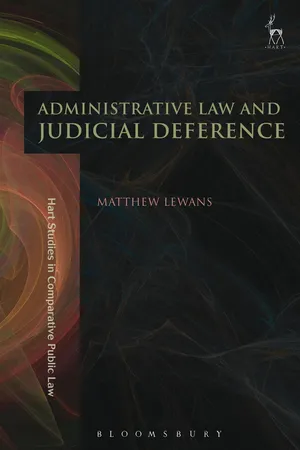
Administrative Law and Judicial Deference
About this book
In recent years, the question whether judges should defer to administrative decisions has attracted considerable interest amongst public lawyers throughout the common law world. This book examines how the common law of judicial review has responded to the development of the administrative state in three different common law jurisdictions – the United Kingdom, the United States of America and Canada – over the past 100 years. This comparison demonstrates that the idea of judicial deference is a valuable feature of modern administrative law, because it gives lawyers and judges practical guidance on how to negotiate the constitutional tension between the democratic legitimacy of the administrative state and the judicial role in maintaining the rule of law.
Information
1
A Question about Administrative Law
ONE OF THE most puzzling questions in public law concerns the status of administrative law: do administrative officials have legitimate authority to interpret the law? Surprisingly, common law jurists have only addressed this issue indirectly when responding to a different question concerning the legitimacy of judicial review: when are judges entitled to quash an administrative decision? Over the last century, much ink has been spilt discussing the legitimacy of judicial review without much regard for the legitimacy of administrative law.
Nevertheless, there is broad consensus that the administrative state plays a vital role in contemporary society. Scholars agree that administrative institutions have pervasive legal influence,1 but only modest attempts have been made to explore the normative foundations of these institutional arrangements and how other legal officials, including judges, should respond to administrative decisions. At best, the question regarding the administrative law has been relegated to a sidebar in persistent debates regarding the proper ambit of judicial review.2 Hence, public law scholarship tends to focus on legislative intent or the parameters of administrative ‘jurisdiction’, which are determined by legislatures or courts, rather than articulating why administrative decisions are worthy of respect in a democracy committed to the rule of law. This preoccupation generates a hollow conception of administrative law, because it is portrayed merely as a species of political power that emerges when the law runs out.3
In this book, I will argue that administrative law should be approached from a different direction, one which aims to explain its constitutional legitimacy from the ground up rather than attempting to identify the point at which judicial review is triggered. Thus, instead of focusing our attention on jurisdictional parameters, we should ask more directly whether administrative officials have legitimate authority to interpret the law, what the normative basis of that legitimacy is, and how it ought to be incorporated into a constitutional framework unified by the rule of law.
The contrast between these different approaches underscores a conspicuous doctrinal schism within the common law world. The schism divides administrative lawyers in the United Kingdom and other Commonwealth countries from their counterparts in the United States of America and Canada. Much of this book examines the history behind this schism, but the basic differences can be gleaned from a brief overview of three landmark cases.
I. JURISDICTIONAL ERROR
Anisminic Ltd was a British corporation which owned a manganese mine located in the Sinai Peninsula. Prior to the Suez-Sinai war, Anisminic estimated the value of its mine to be £4.5 million, but Israeli forces damaged approximately £500,000 worth of property during the war and the Egyptian government expropriated the remaining assets after the Israeli army withdrew. Anisminic subsequently mounted a public relations campaign to dissuade its former clients from purchasing manganese from the Egyptian authority which took over the mine. In order to placate Anisminic, the Egyptian government agreed to purchase all of the remaining assets for £500,000, but the agreement stated that the settlement did not prejudice Anisminic’s ability to seek compensation from any other state.
Almost two years later, the United Arab Republic paid £27.5 million to the United Kingdom as compensation for property damage incurred by its citizens during the war. This fund was to be distributed by the Foreign Compensation Commission, pursuant to the Foreign Compensation Act 1950 and its related regulations.4 Among other things, the Act declared that any ‘determination by the commission of any application made to them … shall not be called into question in any court of law’.5 Anisminic applied for compensation, but after a four-day hearing the Commission rejected the bulk of its claim on the basis that Anisminic had failed to prove that the Egyptian economic authority was not its ‘successor in title’ within the meaning of the regulations.6 Anisminic then brought an application for judicial review to overturn the Commission’s decision.
The House of Lords held that the Commission had exceeded its jurisdiction by misconstruing the ‘successor in title’ provision.7 However, the majority opinions in Anisminic advanced two very different conceptions of ‘jurisdictional’ error. In the lead judgment for the Court, Lord Reid drew a distinction between jurisdiction in its ‘narrow and original’ sense and jurisdiction in its ‘wider’ sense. The narrow sense of jurisdiction referred to whether the legislature had empowered an administrative decision-maker to ‘enter on the inquiry in question’.8 In this sense, the Commission was authorised to decide whether Anisminic was entitled to compensation, because it had been expressly empowered by an Act of Parliament to decide that question. If further support for this conclusion was needed, it could be drawn from the privative clause in the statute, which stated that the Commission’s decisions could not be challenged in court.
Nevertheless, Lord Reid concluded that the Commission’s authority was subject to additional legal constraints, which he associated with administrative jurisdiction in its ‘wider’ sense.9 He stated that:10
there are many cases where, although the tribunal had jurisdiction to enter on the inquiry, it has done or failed to do something in the course of the inquiry which is of such a nature that its decision is a nullity. It may have given its decision in bad faith. It may have made a decision which it had no power to make. It may have failed in the course of the inquiry to comply with the requirements of natural justice. It may in perfect good faith have misconstrued the provisions giving it power to act so that it failed to deal with the question remitted to it and decided some question which was not remitted to it. It may have refused to take into account something which it was required to take into account … If it is entitled to enter on the inquiry and does not do any of those things which I have mentioned in the course of the proceedings, then its decision is equally valid whether it is right or wrong subject only to the power of the court in certain circumstances to correct an error of law.
Even though he thought the Commission had jurisdiction in the narrow sense, Lord Reid held that the Commission had exceeded its jurisdiction in the wider sense because it had deviated from what he considered to be the ‘true construction’ of the regulation. The result is that, even though Lord Reid recognised that there were two different conceptions of jurisdiction in play, he asserted that both sets of parameters had been established by Parliament. Thus, Lord Reid and the other judges who sided with the majority claimed that they were not, in fact, disregarding parliamentary intent by quashing the decision, despite the privative clause which signalled Parliament’s desire to insulate the Commission’s decision from judicial interference.11
Lord Reid’s opinion in Anisminic highlights three chronic problems with the doctrine of jurisdictional error. The first concerns a point I made earlier: that administrative law is perceived primarily in terms of its outer limits. Lord Reid’s opinion focuses exclusively upon the parameters of the Commission’s jurisdiction, which he assumes are established by either Parliament or via judicial interpretation of Parliament’s will. As a result, Lord Reid’s approach involves a hollow conception of administrative law that does not adequately explain the legitimate authority of administrative officials.
The second problem is that this framework for judicial review is incoherent. This incoherence is rooted in the fact that the term ‘jurisdiction’ trades upon conflicting conceptions of law. Lord Reid’s ‘narrow’ conception identifies the parameters of administrative jurisdiction by reference only to positive law established by Parliament, whereas his ‘wider’ conception asserts additional legal parameters established through judicial interpretation of what the law (understood more broadly than legislative commands) requires. So in addition to being hollow, the doctrine of jurisdictional error in Anisminic is radically unstable because it incorporates conflicting ideas regarding the nature of jurisdictional parameters.
This confusion is particularly acute when judges attempt to grapple with the interpretive problem posed by privative clauses. If judges disagree with an administrative decision, they can circumvent the privative clause by assuming that Parliament intended for courts to enforce unwritten limits associated with jurisdiction in the ‘wider’ sense; conversely, they can justify judicial quiescence by adopting the ‘narrow’ sense of jurisdiction and interpreting the enabling legislation and privative clause strictly.
The third problem concerns the constitutional legitimacy of judicial review. If the doctrine of jurisdictional error were only hollow and incoherent, it might be possible to defend it as a rhetorical veneer which enables judges to achieve outcomes that are consistent with their own sense of equity or justice. But that argument is usually regarded as a poor one. Generally speaking, we expect that judges will respect the law instead of manipulating legal analysis to secure outcomes they personally prefer, especially when judicial interpretation of the law conflicts with decisions made by other legal officials who have been authorised through the democratic process to decide a particular question on behalf of the community. This belief is shared by judges who, like Lord Reid, attempt to justify their decisions by invoking express or implied notions of parliamentary intent instead of mounting the bolder claim that judges are entitled to prioritise their own assessments regarding the substantive merits of an administrative decision.
If we accept the idea that administrative officials have legitimate authority to interpret the law and that judges should not interfere with an administrative decision merely because they disagree with its substance, then we have good reasons for exploring an alternative theory of administrative law to guide the practice of judicial review. More particularly, we have good reasons to consider whether the doctrine of judicial deference, which prevails in Canada and the United States, provides a sounder account of the constitutional relationship between the judiciary and the administrative state.
II. JUDICIAL DEFERENCE
In 1977, the Canadian Union of Public Employees (CUPE) commenced a legal labour strike directed against the New Brunswick Liquor Corporation. During the strike, the Corporation began using management personnel to operate its retail stores. This tactic provoked the union to picket stores owned by the company throughout the province. The union also lodged a complaint with the Public Service Labour Relations Board, alleging that the Corporation had violated section 102(3)(a) of the Public Service Labour Relations Act, which stated that ‘the employer shall not replace the striking employees or fill their position with any other employee’.12 The Board agreed, and ordered the Liquor Corporation to stop using managers as replacement employees. The Corporation challenged the Board’s decision by applying for judicial review, even though section 101 of the Act stated that ‘every order, award, direction, decision, declaration, or ruling of the Board … is final and shall not be questioned or reviewed in any court’.13
The Canadian Supreme Court unanimously upheld the Board’s decision. However, Dickson J did not rely upon the jurisdictional rationale set out in Anisminic.14 Instead, he began by observing that the provincial legislature had not determined the meaning of section 102(3)(a). Although an interpretation of the provision was a question of law, he declined to characterise it as a ‘jurisdictional’ issue, saying that ‘courts, in my view, should not be alert to brand as jurisdictional, and therefore subject to broader curial review, that which may be doubtfully so’.15 Because the dispute fell within the Board’s statutory mandate and the legislation stated that judges should not interfere with the Board’s decision, Dickson J held that it was inappropriate for the Court to intervene, saying:16
Section 101 constitutes a clear statutory direction on the part of the Legislature that public sector labour matters be promptly and finally decided by the Board. Privative clauses of this type are typically found in labour relations legislation. The rationale for protection of a labour board’s decisions within jurisdiction is straightforward and compelling. The labour board is a specialized tribunal which administers a comprehensive statute regulating labour relations. In the administration of that regime, a board is called upon not only to find facts and decide questions of law, but also to exercise its understanding of the body of jurisprudence that has developed around the collective bargaining system, as understood in Canada, and its labour relations sense acquired from accumulated experience in the area.
The usual reasons for judicial restraint upon review of labour board decisions are only reinforced in a case such as the one at bar. Not only has the Legislature confided certain decisions to an administrative board, but to a separate and distinct Public Service Labour Relations Board. That Board is given broad powers—broader than those typically vested in a labour board—to supervise and administer the novel system of collective bargaining created by the Public Service Labour Relations Act. The Act calls for a delicate balance between the need to maintain public services, and the need to maintain collective bargaining. Considerable sensitivity and unique expertise on the part of Board members is all the more required if the twin purposes of the legislation are to be met. Nowhere is the application of those skills more evident than in the supervision of a lawful strike by public service employees under the Act.
Accordingly, Dickson J held that the Court could not intervene merely because it disagreed with the Board’s interpretati...
Table of contents
- Cover
- Dedication
- Title Page
- Acknowledgements
- Table of Contents
- Table of Cases
- Table of Legislation
- 1. A Question About Administrative Law
- 2. Rethinking the Diceyan Dialectic
- 3. The Legacy of the Diceyan Dialectic
- 4. Constitutionalism, Judicial Restraint, and Administrative Law
- 5. From Formalism to Reasonable Justification: The Transformation of Canadian Administrative Law
- 6. Authority, Legitimacy, and Legality in Administrative Law
- Bibliography
- Index
- Copyright Page
Trusted by 375,005 students
Access to over 1.5 million titles for a fair monthly price.
Study more efficiently using our study tools.
Frequently asked questions
Yes, you can cancel anytime from the Subscription tab in your account settings on the Perlego website. Your subscription will stay active until the end of your current billing period. Learn how to cancel your subscription
No, books cannot be downloaded as external files, such as PDFs, for use outside of Perlego. However, you can download books within the Perlego app for offline reading on mobile or tablet. Learn how to download books offline
Perlego offers two plans: Essential and Complete
- Essential is ideal for learners and professionals who enjoy exploring a wide range of subjects. Access the Essential Library with 800,000+ trusted titles and best-sellers across business, personal growth, and the humanities. Includes unlimited reading time and Standard Read Aloud voice.
- Complete: Perfect for advanced learners and researchers needing full, unrestricted access. Unlock 1.5M+ books across hundreds of subjects, including academic and specialized titles. The Complete Plan also includes advanced features like Premium Read Aloud and Research Assistant.
We are an online textbook subscription service, where you can get access to an entire online library for less than the price of a single book per month. With over 1.5 million books across 990+ topics, we’ve got you covered! Learn about our mission
Look out for the read-aloud symbol on your next book to see if you can listen to it. The read-aloud tool reads text aloud for you, highlighting the text as it is being read. You can pause it, speed it up and slow it down. Learn more about Read Aloud
Yes! You can use the Perlego app on both iOS and Android devices to read anytime, anywhere — even offline. Perfect for commutes or when you’re on the go.
Please note we cannot support devices running on iOS 13 and Android 7 or earlier. Learn more about using the app
Please note we cannot support devices running on iOS 13 and Android 7 or earlier. Learn more about using the app
Yes, you can access Administrative Law and Judicial Deference by Matthew Lewans in PDF and/or ePUB format, as well as other popular books in Jura & Verwaltungsrecht. We have over 1.5 million books available in our catalogue for you to explore.