- 224 pages
- English
- ePUB (mobile friendly)
- Available on iOS & Android
eBook - ePub
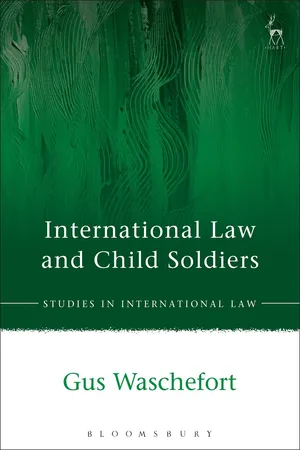
International Law and Child Soldiers
About this book
This book commences with an analysis of the current state of child soldiering internationally. Thereafter the proscriptive content of contemporary norms on the prohibition of the use and recruitment of child soldiers is evaluated, so as to determine whether these norms are capable of better enforcement. An 'issues-based' approach is adopted, in terms of which no specific regime of law, such as international humanitarian law (IHL), is deemed dominant. Instead, universal and regional human rights law, international criminal law and IHL are assessed cumulatively, so as to create a mutually reinforcing web of protection. Ultimately, it is argued that the effective implementation of child soldier prohibitive norms does not require major changes to any entity or functionary engaged in such prevention; rather, it requires the constant reassessment and refinement of all such entities and functionaries, and here, some changes are suggested. International judicial, quasi-judicial and non-judicial entities and functionaries most relevant to child soldier prevention are critically assessed. Ultimately the conclusions reached are assessed in light of a case study on the use and recruitment of child soldiers in the Democratic Republic of the Congo.
Information
1
Situating the Debate
I. A BRIEF CHRONOLOGY OF THE PREVENTION OF CHILD SOLDIERING
FOR MOST OF human history, children’s participation in armed conflict was not a matter of concern. Indeed, there are many accounts in history, theology and mythology of children’s heroism in battle, notably the boy David defeating Goliath, the giant Philistine warrior. The origin of the word ‘infantry’ is said to be derived from the Latin word infans, meaning ‘a very young child or baby’.1 The infantry were those soldiers in the Roman legions who were too young, or of too low rank, to form part of the cavalry.2 Many small towns in the United States have monuments and statues in honour of children who fought in the American Civil War: for example, the grave of Avery Brown is a landmark in Elkhard, Indiana.3 Brown enlisted in Abraham Lincoln’s Union Army during the Civil War, aged 8 years, 11 months and 13 days.4 More recently, significant numbers of children participated in hostilities during the Second World War; yet the Geneva Conventions of 1949 did not prohibit the recruitment and participation of children in armed conflict.5
By 1977, a shift in the mores of the international community had occurred and the first instruments directly prohibiting child soldiering had been adopted in the form of the Two Additional Protocols to the Geneva Conventions.6 For more than a decade after the adoption of the Additional Protocols there were no further developments. During 1989, the UN Convention on the Rights of the Child (CRC) was adopted which (inter alia) prohibited child soldiering and mandated the creation of the Committee on the Rights of the Child (CRC Committee).7 Two vital decisions were taken at the Commitee’s third session, during 1993. It was decided to submit a request to the Secretary-General of the UN to appoint an expert to launch an in-depth investigation into the protection of children during armed conflict.8 It was also decided to entrust a member of the Committee with drafting a first preliminary text of a Protocol to the CRC on the involvement of children in armed conflict (CIAC Protocol).9
Graça Machel was duly appointed in terms of a General Assembly resolution to investigate and report on the situation of children during armed conflict.10 Although her mandate included the plight of all children during armed conflict, it was her ground-breaking report, released during 1996, that drew the international community’s attention to the problem of child soldiering.11 In her report, Machel states:
The flagrant abuse and exploitation of children during armed conflict can and must be eliminated. For too long, we have given ground to spurious claims that the involvement of children in armed conflict is regrettable but inevitable. It is not. Children are regularly caught up in warfare as a result of conscious and deliberate decisions made by adults. We must challenge each of these decisions and we must refute the flawed political and military reasoning, the protests of impotence, and the cynical attempts to disguise child soldiers as merely the youngest ‘volunteers’.12
This sentiment resonated across the divide between civil society and state actors. If ever the participation of children in armed conflict was wholly accepted, the turning point had been reached by the time this study was released. This is evident today in that not a single state, not even those most responsible for the use and recruitment of child soldiers, argues that such use or recruitment is lawful.
As recommended in the Machel report, the Office of the Special Representative to the Secretary-General on Children and Armed Conflict (SRSG) was created during 1998, and Olara Otunnu was appointed as the first SRSG.13 The SRSG has a multifaceted mandate that, in relation to children in armed conflict, includes: tracking progress, raising awareness, promoting information gathering, working closely with other role players, fostering international cooperation to ensure respect for children’s rights and finally contributing to the coordination of efforts by governments and relevant UN bodies.14
Child Soldiers International is a non-government organisation (NGO) that was originally founded as The Coalition to Stop the Use of Child Soldiers (CSUCS), collaboratively formed by Amnesty International, Human Rights Watch, the International Save the Children Alliance, the Jesuit Refugee Service, the Quaker United Nations Office, and Terre des Hommes International Federation during 1998 as an NGO coalition. By this time, Rädda Barnen (Save the Children Sweden), Quaker United Nations Office, the International Committee of the Red Cross and others had already made significant contributions to the prohibition of child soldiering on both an advocacy and a research basis. Behind the driving force of the CSUCS, civil society spearheaded the campaign for the draf ing and adoption of a protocol to the CRC on the involvement of children in armed conflict, originally the brainchild of the CRC Committee. The campaign called for a protocol that would lif the minimum use and recruitment age to a so-called ‘straight-eighteen’ threshold. Accordingly, the Optional Protocol to the Convention on the Rights of the Child on the Involvement of Children in Armed Conflict (CIAC Protocol) was adopted during 2000.15 However, in my view, the final product is very disappointing. The adopted text presents a compromise on the straight-eighteen threshold that allows states parties to the CIAC Protocol to voluntarily recruit children between sixteen and eighteen, but not allowing them to use children younger than eighteen in direct participation in hostilities.
In another important development in 2000, the Security Council of the United Nations acknowledged that child soldiering ‘may constitute a threat to international peace and security’.16 It thus took a mere four years from when child soldiering was placed firmly on the agenda of the international community by the Machel report, for the organ of the UN with principal responsibility for the maintenance of international peace and security to recognise child soldiering as a problem potentially affecting such peace and security.
By 16 January 2002, the date upon which the Special Court for Sierra Leone was established, there had never been a prosecution for the use and recruitment of child soldiers. To date, that Court has delivered four Trial Chamber judgments on the subject,17 as well as appeal judgments in each of those cases.18 All of these cases relate to the war crime of child soldier enlistment, conscription or use. Furthermore, in the International Criminal Court’s (ICC) first conviction, the Lubanga case (appeal pending), the defendant was charged with the sole war crime of enlisting, conscripting or using children for active participation in hostilities.19 In the Democratic Republic of the Congo (DRC), numerous prosecutions, in national courts have been finalised.20 The first was during 2008.
During 2005, a comprehensive Monitoring and Reporting Mechanism (MRM) on child soldiering was established in terms of a Security Council resolution.21 Otunnu, in his capacity as SRSG, first proposed the creation of such a mechanism to the General Assembly during his 2003 annual report.22 The MRM serves to ‘collect and provide timely, objective, accurate and reliable information’ on those situations affecting children that have been identified by the SRSG as most urgently deserving attention,23 which includes ‘recruiting or using child soldiers’.24
The exact level of effectiveness of these measures is relatively unclear. What is clear, however, is that the recruitment and use of child soldiers internationally persists and no clearly visible inroads have been made as yet. This is not to say that current measures are wholly ineffective, but, as Drumbl suggests, ‘although international interventions have helped reduce specific incidents, the practice of child soldiering still persists. It may shif locally, but it endures globally.’25 Having said this, it is certainly also true that there are far fewer child soldiers today than during
Conceptualising an ‘Era of Application’ 5 the 1990s. What is less clear is whether this reduction has much to owe to the interventions of international law.
At the time of writing there are indeed a number of situations internationally where child soldiering is a real and a large-scale problem. The armed conflicts in Syria and the Central African Republic are key areas of concern, and reports that the Nigerian terrorist group Boko Haram are using child soldiers is equally worrisome. As such, the need for a strong international law response remains as acute as ever.
II. CONCEPTUALISING AN ‘ERA OF APPLICATION’
During 1999, the SRSG at that time, Olara Otunnu, reported to the General Assembly that:
The Special Representative believes that the time has come for the international community to redirect its atention and energies from the juridical task of the development of norms to the political project of ensuring their application and respect on the ground. An ‘era of application’ must be launched. Words on paper cannot save children and women in peril. Such a project can be accomplished if the international community is prepared to employ its considerable collective influence to that end.26
The year prior to recommending this refocus of attention towards an ‘era of application’, Otunnu had already reported that ‘the Special Representative believes that the most important and pressing challenge today is how to translate existing standards and commitments into action that can make a tangible difference to the fate of children exposed to danger on the ground’.27 With reference to the establishment of the child soldier monitoring and reporting mechanism,28 SRSG Otunnu contended that this mechanism ‘marks a turning point in our collective campaign for the “era of application” — for transforming protective standards into compliance, and condemnation into accountability’.29 Almost ten years after first introducing the era of application, on the occasion when Otunnu received the Harvard Law School Association Award and when he was no longer the SRSG on Children in Armed Conflict, he elaborated further on what an era of application entails.30 On this occasion, he placed specific emphasis on the need that an era of application be ‘embedded within formal, structured and binding compliance mechanisms’. This, however, has to be interpreted together with his earlier statement, quoted above, that a shif has to occur from norm creation to ‘the political project of ensuring their [norms] application and respect on the ground’. As such, an era of application is dependent ...
Table of contents
- Cover
- Title Page
- Contents
- 1 Situating the Debate
- 2 Contemporary Child Soldiering: Distribution, Use and Causes
- 3 International Humanitarian Law and the Prevention of Child Soldiering
- 4 International Human Rights Law and International Humanitarian Law: An Integrated International Law Response to the Prevention of Child Soldiering
- 5 International Criminal Responsibility and the Prosecution of Individuals for the Enlistment, Conscription and Use of Child Soldiers
- 6 International Institutional Law and the Prevention of Child Soldiering
- 7 Case Study: The Democratic Republic of the Congo
- 8 Conclusion
- Bibliography
- Acknowledgments
- eCopyright
Trusted by 375,005 students
Access to over 1.5 million titles for a fair monthly price.
Study more efficiently using our study tools.
Frequently asked questions
Yes, you can cancel anytime from the Subscription tab in your account settings on the Perlego website. Your subscription will stay active until the end of your current billing period. Learn how to cancel your subscription
No, books cannot be downloaded as external files, such as PDFs, for use outside of Perlego. However, you can download books within the Perlego app for offline reading on mobile or tablet. Learn how to download books offline
Perlego offers two plans: Essential and Complete
- Essential is ideal for learners and professionals who enjoy exploring a wide range of subjects. Access the Essential Library with 800,000+ trusted titles and best-sellers across business, personal growth, and the humanities. Includes unlimited reading time and Standard Read Aloud voice.
- Complete: Perfect for advanced learners and researchers needing full, unrestricted access. Unlock 1.5M+ books across hundreds of subjects, including academic and specialized titles. The Complete Plan also includes advanced features like Premium Read Aloud and Research Assistant.
We are an online textbook subscription service, where you can get access to an entire online library for less than the price of a single book per month. With over 1.5 million books across 990+ topics, we’ve got you covered! Learn about our mission
Look out for the read-aloud symbol on your next book to see if you can listen to it. The read-aloud tool reads text aloud for you, highlighting the text as it is being read. You can pause it, speed it up and slow it down. Learn more about Read Aloud
Yes! You can use the Perlego app on both iOS and Android devices to read anytime, anywhere — even offline. Perfect for commutes or when you’re on the go.
Please note we cannot support devices running on iOS 13 and Android 7 or earlier. Learn more about using the app
Please note we cannot support devices running on iOS 13 and Android 7 or earlier. Learn more about using the app
Yes, you can access International Law and Child Soldiers by Gus Waschefort in PDF and/or ePUB format, as well as other popular books in Droit & Droit international. We have over 1.5 million books available in our catalogue for you to explore.