In many countries today there is a growing and genuinely-held concern that the institutional arrangements for the protection of human rights suffer from a 'democratic deficit'. Yet at the same time there appears to be a new consensus that human rights require legal protection and that all branches of the state have a shared responsibility for upholding and realising those legally protected rights. This volume of essays tries to understand this paradox by considering how parliaments have sought to discharge their responsibility to protect human rights. Contributors seek to take stock of the extent to which national and sub-national parliaments have developed legislative review for human rights compatibility, and the effect of international initiatives to increase the role of parliaments in relation to human rights. They also consider the relationship between legislative review and judicial review for human rights compatibility, and whether courts could do more to incentivise better democratic deliberation about human rights. Enhancing the role of parliaments in the protection and realisation of human rights emerges as an idea whose time has come, but the volume makes clear that there is a great deal more to do in all parliaments to develop the institutional structures, processes and mechanisms necessary to put human rights at the centre of their function of making law and holding the government to account. The sense of democratic deficit is unlikely to dissipate unless parliaments empower themselves by exercising the considerable powers and responsibilities they already have to interpret and apply human rights law, and courts in turn pay closer attention to that reasoned consideration.
'I believe that this book will be of enormous value to all of those interested in human rights, in modern legislatures, and the relationship between the two. As this is absolutely fundamental to the characterand credibility of democracy, academic insight of this sort is especially welcome. This is an area where I expect there to be an ever expanding community of interest.' From the Foreword by the Rt Hon John Bercow MP, Speaker of the House of Commons
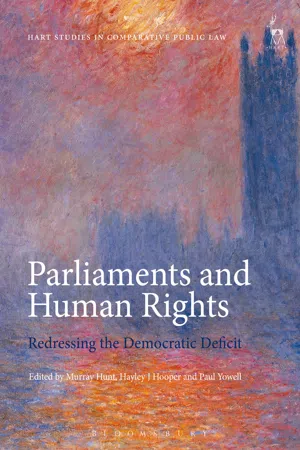
eBook - ePub
Parliaments and Human Rights
Redressing the Democratic Deficit
- 478 pages
- English
- ePUB (mobile friendly)
- Available on iOS & Android
eBook - ePub
Parliaments and Human Rights
Redressing the Democratic Deficit
About this book
Information
Table of contents
- Cover
- Title Page
- Dedication
- Foreword by The Rt Hon John Bercow MP
- Preface and Acknowledgements
- Contents
- List of Contributors
- 1. Introduction
- Part I: Legislative Review for Human Rights Compatibility
- Part II: Legislative Human Rights Review in the UK Parliament
- Part III: Legislative Human Rights Review in the UK’s Devolved Jurisdictions
- Part IV: Legislative Human Rights Review in other National Parliaments
- Part V: International Initiatives to Increase the Role of Parliaments in Relation to Human Rights
- Part VI: The Implications of Legislative Human Rights Review for Courts
- Part VII: A Democratic Culture of Justification
- Appendix—Draft Principles and Guidelines on the Role of Parliaments in the Protection and Realisation of the Rule of Law and Human Rights
- Select Bibliography
- eCopyright
Trusted by 375,005 students
Access to over 1.5 million titles for a fair monthly price.
Study more efficiently using our study tools.
Frequently asked questions
Yes, you can cancel anytime from the Subscription tab in your account settings on the Perlego website. Your subscription will stay active until the end of your current billing period. Learn how to cancel your subscription
No, books cannot be downloaded as external files, such as PDFs, for use outside of Perlego. However, you can download books within the Perlego app for offline reading on mobile or tablet. Learn how to download books offline
Perlego offers two plans: Essential and Complete
- Essential is ideal for learners and professionals who enjoy exploring a wide range of subjects. Access the Essential Library with 800,000+ trusted titles and best-sellers across business, personal growth, and the humanities. Includes unlimited reading time and Standard Read Aloud voice.
- Complete: Perfect for advanced learners and researchers needing full, unrestricted access. Unlock 1.5M+ books across hundreds of subjects, including academic and specialized titles. The Complete Plan also includes advanced features like Premium Read Aloud and Research Assistant.
We are an online textbook subscription service, where you can get access to an entire online library for less than the price of a single book per month. With over 1.5 million books across 990+ topics, we’ve got you covered! Learn about our mission
Look out for the read-aloud symbol on your next book to see if you can listen to it. The read-aloud tool reads text aloud for you, highlighting the text as it is being read. You can pause it, speed it up and slow it down. Learn more about Read Aloud
Yes! You can use the Perlego app on both iOS and Android devices to read anytime, anywhere — even offline. Perfect for commutes or when you’re on the go.
Please note we cannot support devices running on iOS 13 and Android 7 or earlier. Learn more about using the app
Please note we cannot support devices running on iOS 13 and Android 7 or earlier. Learn more about using the app
Yes, you can access Parliaments and Human Rights by Murray Hunt, Hayley J Hooper, Paul Yowell, Murray Hunt,Hayley J Hooper,Paul Yowell, Murray Hunt, Hayley Hooper, Paul Yowell in PDF and/or ePUB format, as well as other popular books in Law & Public Law. We have over 1.5 million books available in our catalogue for you to explore.