eBook - ePub
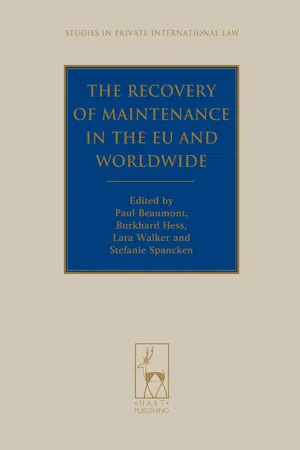
The Recovery of Maintenance in the EU and Worldwide
- 448 pages
- English
- ePUB (mobile friendly)
- Available on iOS & Android
eBook - ePub
The Recovery of Maintenance in the EU and Worldwide
About this book
This book grew out of a major European Union (EU) funded project on the Hague Maintenance Convention of 2007 and on the EU Maintenance Regulation of 2009. The project involved carrying out analytical research on the implementation into national law of the EU Regulation and empirical research on the first year of its operation in practice. The project also engaged international experts in a major conference on recovery of maintenance in the EU and worldwide in Heidelberg in March 2013. The contributions in this book are the revised, refereed and edited versions of the best papers that were given at the conference. The book is divided into four parts: (i) comparative context (ii) international, looking at national and non-European regional practice and how the Hague Convention could change things; (iii) international and the EU, looking at issues covered by both the Hague Convention and the EU Regulation; and (iv) the EU - looking at the Maintenance Regulation. This is the first study to look carefully at both of the new cross-border maintenance regimes globally and in Europe and to begin the examination of the practical operation of the latter regime. The approval of the Hague Convention by the EU on 9 April 2014 is a major step forward for its practical significance in enabling the recovery of child and spousal support, as from 1 August 2014 all of the 28 EU Member States apart from Denmark will be bound by the Convention.
Information
Part One
Comparative Context
1
Cultural Dimensions of Maintenance Law from a Private International Law Perspective
I. Introduction
A. Legal Culture
i. Family Law and Social Security Law
The question of the cultural dimension of law can be interpreted in different ways. First, legal norms and legal institutions are embedded in their legal culture of origin. This legal culture is based primarily on a certain legal tradition. This holds true for the legal system as such, but also for the administration of justice and, in particular, the professional practice. It is clear that the current law of maintenance is embedded in such an environment of customs and habits. In Germany, for example, courts decide on maintenance obligations, while in many other countries, in principle, it is social authorities who decide. This also affects the structure of maintenance law. The New Zealand Child Support Act 1991, section 128 (under the heading ‘Debt due to the Crown’) provides:
Any amount of financial support payable under this Act (including penalty or interest imposed thereon) is a debt due to the Crown.
ii. Maintenance Tables
Different jurisdictions have found different solutions for the demarcation of family law and social security law, that is, private law and public law, including criminal penalties for the failure to pay maintenance. German courts decide on the basis of maintenance tables that show the amount of maintenance due to the exact cent. These tables exist for every higher Regional Courts district. The best known of these is the so-called Düsseldorf Maintenance Table.
Other countries manage their maintenance cases almost completely without such tables; the focus is on the individual case. A maintenance law based on tables aims to foster equality in society. In a law without tables, the focus of attention lies on the individual and his or her needs. These differences again correspond to the sense of justice that prevails in a society. In Germany, the individual only seems to be satisfied if he or she is treated in the same way as all others. In other societies, citizens are convinced of the uniqueness of their cases and demand appropriate justice in each individual case. Apart from that, tables take the pressure off from those in charge to decide on the maintenance claim, be it a judge or a social authority. The structure of the law of maintenance also affects private international and international procedural law. The similarity of the law of maintenance in New Zealand and Australia has led to a bilateral agreement that guarantees the mutual cross-border enforcement of maintenance claims.
iii. History and Science
Moreover, the legal system as such, which has evolved over time, forms part of the legal culture. In this sense, the French Civil Code is part of the country’s cultural heritage, a monument of rationality and precise legal language. Further, legal science is of crucial importance: We may recall, for example, the concept of Anspruch (material claim). Only the German Pandektistik in the nineteenth century separated the Anspruch from the procedural action.
In countries that adopted this distinction, other legal issues related to the recovery of maintenance claims arose. There could be a conflict between a maintenance claim and a party’s legal standing, for example, in cases of child maintenance. Section 1629(3) sentence 1 of the German Civil Code reads:
If the parents of the child are married to each other, then one parent, as long as the parents live apart or a matrimonial matter between them is pending before a court, may assert maintenance claims of the child against the other parent only in his own name.
This situation is called Prozessstandschaft: One parent is entitled to bring the legal action in his or her own name while the holder of the maintenance claim remains the child.
In other jurisdictions, these questions do not arise and therefore these issues do not need to be addressed by the legislature—the material claim and the legal standing coincide; a distinction is not necessary. That is, for example, the case in English law. Under the Children Act 1989, section 1(1), Schedule 1 (which concerns orders for financial relief against parents) the court may, at the request of one parent, require the other parent to make periodical payments for the benefit of the child, either directly to the latter or to the applicant. English law does not distinguish between the claim itself and its procedural enforcement; in other words, substantive claim and procedural action merge in the application.
iv. Language
Language forms an important part of the legal culture, especially as regards the concept of ‘maintenance’. From a comparative law perspective, there is a lack of a uniform, transnational concept. Italian law, for example, distinguishes between mantenimento and alimenti. The latter concerns maintenance obligations towards other people than immediate family members: the recipient of a gift may in certain cases be obliged to maintain the donor. In addition, it follows from Article 438 of the Italian Civil Code that alimenti are only a form of second degree maintenance, while the mantenimento encompasses all forms of maintenance.
v. Religion
The influence of religion also forms part of the legal culture, especially in countries where in family law matters religious law applies to members of a religious group. It is striking that numerous religious laws do not provide for provisions on maintenance. This holds true even for the laws of the various Christian churches. In States with Islamic legal traditions, spousal maintenance in particular is determined by such traditions. A post-marital maintenance obligation does not exist. The Jewish Talmudic law also does not provide for spousal maintenance obligations. In Israel however, spousal maintenance follows from State Regulations (in the area of maintenance law). The States which have been influenced by Islam have created legal institutions intended to substitute the maintenance obligation.
B. Comparative Law
This briefly sketched cultural dimension of law plays a key role in cross-border situations, which are the main topic of this book. In this context, it is necessary first to examine the role of comparative law since only comparative law may provide the basis for an answer to the numerous questions arising out of cross-border situations. Postmodern comparative law focuses on the diversities between national laws rather than on the commonalities. Only as a second step are equivalences to be identified in order to allocate the legal norm in question to a hypernym, here to ‘maintenance’.
An example is provided by an older decision of the Court of Justice of the European Union (CJEU) of 6 March 19801: The question was whether a French ruling that ordered the spouse to make a prestation compensatoire according to Article 270ff of the French Civil Code could be seen as a decision on ‘maintenance’, since the Convention on jurisdiction and the enforcement of judgments in civil and commercial matters did not apply to rights in property arising out of a matrimonial relationship, but to maintenance obligations. The court pointed out that in French law such compensation depends on the needs and resources of the spouses and is therefore to be regarded as ‘maintenance’. However, French law distinguishes clearly between pension alimentaire and prestation compensatoire.2 The maintenance obligation—devoir de secours— ends with the divorce, except in cases of a divorce because of a rupture de la vie commune (an irretrievable breakdown in the relationship, under Article 270 of the French Civil Code). However, this illustrates that in international cases the notion of ‘maintenance’ in conflict of law rules may have a broader meaning than in national law.
Furthermore, by using comparative law, different types of maintenance may be identified. For instance in Germany, Bedarfsunterhalt, that is, maintenance to help provide for the necessities of daily life, such as clothing and housing, may be distinguished from Ausgleichsunterhalt, that is, maintenance which allows the creditor to benefit from the more prosperous financial situation of another family member. The boundaries between maintenance and the family property regime might be blurry in many cases, particularly as regards spousal maintenance.
C. Cultural Differences
i. Extended Family or Nuclear Family
The differences between the legal systems with regard to maintenance based on cultural differences can also be due to different forms of family and home life, and different ideologies in the respective society. This becomes particularly clear when looking at the persons entitled to maintenance. The beneficiaries of maintenance in the different legal systems vary according to whether a society is based on the extended family or the nuclear family. While the legal systems in the European Union limit maintenance obligations to relatives in direct line, spouses and civil partners, Turkish law, for instance, extends maintenance obligations to siblings.
For example, the German Bundesfinanzhof (Federal Fiscal Court) had to rule on a case involving a Turkish national domiciled in Germany.3 The claimant was subject to taxation in Germany and claimed a tax deduction for maintenance paid to relatives living in Turkey as exceptional costs, namely 8.800 DM which he had paid to his father and his step-mother and 17.608 DM paid to his sister and her three children. The Federal Fiscal Court held that the principles of maintenance obligations under German law were decisive. The second sentence of the first official case report reads as follows: ‘Maintenance paid in accordance with foreign law to persons related collaterally who would not have been entitled to maintenance under German law are not tax deductible in Germany, even if the maintenance obligation arising from foreign law is to be complied with in Germany according to private international law’.
This decision has justly been criticised. The tax payer is exposed to a conflict of obligations—on the one hand, he is required to pay maintenance to his relatives living in Turkey under German private international law, while on the other hand he is obliged to pay taxes in Germany for amounts which no longer form part of his disposable income, because his taxable income is determined considering the German principles of maintenance obligations. It should be remembered that judgments given in Turkey may be enforced in Germany. In German doctrine, Wilhelm Wengler stated that avoiding conflicts of obligations was a fundamental goal of private international law. The Turkish tax payer is put in a virtually hopeless situation, stuck between the opposing claims of the German treasury and of his Turkish family.
As can be seen, extended family and nuclear family are culturally diverging concepts, and this has an effect on the law of maintenance.
ii. Non-marital Partnerships
In many legal systems, maintenance obligations are limited to relatives and spouses. However, in some legal systems the non-marital partnership is also of importance. According to Article 1694 of the Brazilian Civil Code, it is not only relatives and spouses who are entitled to maintenance but also partners in non-marital partnerships, known as companheiros. Under Portuguese law, Article 2020 of the Portuguese Civil Code contains a provision addressing the união de facto (the factual union). The surviving partner of a factual union which has lasted for at least two years is entitled to maintenance which is to be paid from the estate of the deceased partner. The attribution of legal effects to the factual union is a characteristic of Lusophonic legal systems. However, the embodiment of the factual union in family law can also be found in the succession States of the former Yugoslavia, for instance, in Serbian law, which imposes maintenance obligations on the partners in a factual union (Article 156 of the Serbian Family Law).
D. Parent Maintenance in Particular
Traditionally, a distinction is made between spousal maintenance and child maintenance, although the two areas may overlap. This is the case if one parent is entitled to claim maintenance (Betreuungsunterhalt) in order to take care of a child that lives with him or her after parents have separated.
More recently however, discussion has focused on parent maintenance (maintenance claims of parents against their children).4 This is particularly true for countries which, due to their demographic development, are facing a declining birth rate and an increasing number of elderly people in need of support. The question which arises is whether parent maintenance is subject to exceptional rules. Section 1611(1) of the German Civil Code reads as follows:
If the person entitled to maintenance has become in need of financial support as a result of his own moral fault, if he has grossly neglected his own obligation to maintain the person who is now liable for maintenance or intentionally committed severe misconduct against the person liable for maintenance or a close relative of the person liable for maintenance, the person liable for maintenance is required to pay only such contribution to maintenance as may be deemed to be equitable. The obligation lapses completely if it would be grossly inequitable for the person liable for maintenance to be held to be so liable.
Section 1611(2) of the German Civil Code reads: ‘The provisions of subsection (1) do not apply to the obligation of parents to maintain their minor unmarried children’.
Thus, it is possibility that the right to parent maintenance may be forfeited by parents, as a result of their own reprehensible behaviour.
Thus, it can be seen that parents are obliged to fulfil their maintenance obligation irrespective of the behaviour of the children, but not vice versa. Parents who have grossly neglected their obligation as parents to maintain their children, may not then claim parent maintenance from the latter. In practice, courts are mostly concerned with the question of if and how far social security authorities may recover social benefit payments for parents in need from the children. In private...
Table of contents
- Cover
- Title Page
- Foreword by William Duncan
- Editors’ Preface
- Contents
- List of Contributors
- PART ONE: COMPARATIVE CONTEXT
- 1. Cultural Dimensions of Maintenance Law from a Private International Law Perspective
- PART TWO: INTERNATIONAL PERSPECTIVE
- 2. Introduction to Part Two (International) and Part Three (International and EU)
- 3. The Modern History, Evolution and Projected Future of Child Support Enforcement in the United States and Globally: 1975 to 2025
- 4. Recognition and Enforcement of Foreign Maintenance Orders in Commonwealth African Countries
- 5. Recovery of Child Maintenance in South America and in Mercosur’s Countries
- 6. Enforcing Foreign Maintenance Decisions in the Hong Kong Special Administrative Region of the People’s Republic of China and the Hague Convention on International Recovery of Child Support and Other Forms of Family Maintenance from an Asian Perspective
- 7. The Potential of the 2007 Child Support Convention: Addressing Global Poverty and Supporting Economic Rights
- 8. Migration, Remittances and Child Support
- 9. International Maintenance Cases: Preliminary Research
- 10. Setting Appropriate Child Support Orders and Addressing Barriers: Research and Policy Implications to Improve Payments and Compliance
- 11. Administrative Establishment and Enforcement of Child Support in Norway
- 12. Child Support in Kazakhstan: Case for Accession to the 2007 Hague Maintenance Convention
- 13. Maintenance Obligations in the Brazilian Legal System
- 14. Argentina’s Regulation of Maintenance Obligations: Implementation of the 2007 Hague Convention
- 15. Recovery of Child Support in Nigeria
- 16. The Interface between Maintenance and Cross-border Surrogacy
- PART THREE: INTERNATIONAL AND EUROPEAN UNION MATTERS
- 17. Developing an Electronic Case Management and Communication System for the 2007 Hague Child Support Convention and 2009 EU Maintenance Regulation: The iSupport Project
- 18. Child Maintenance and Authentic Instruments—A German Perspective
- 19. Innovations of the 2007 Hague Maintenance Protocol
- PART FOUR: EUROPEAN UNION PERSPECTIVE
- 20. Setting the Scene—The EU Maintenance Regulation
- 21. Empirical Study on the Early Operation of the EU Maintenance Regulation
- 22. The Effective Operation of the EU Maintenance Regulation in the Member States
- 23. Love and Money: Problems of Characterisation in Matrimonial Property and Maintenance Matters in the European Union
- 24. Drawing a Demarcating Line between Spousal Maintenance Obligations and Matrimonial Property in the Context of the New Instruments of European Union Private International Law
- 25. Characterisation within Private International Law: Maintenance or Succession?
- 26. Choice of Court in Matters Relating to Maintenance Obligations
- 27. The Enforcement of Maintenance Decisions in the EU: Requiem for Public Policy? Family Relationships and the (Partial) Abolition of Exequatur
- 28. Jurisdiction, Recognition and Enforcement in Cases of Reimbursement Claims by Public Bodies
- eCopyright
Trusted by 375,005 students
Access to over 1.5 million titles for a fair monthly price.
Study more efficiently using our study tools.
Frequently asked questions
Yes, you can cancel anytime from the Subscription tab in your account settings on the Perlego website. Your subscription will stay active until the end of your current billing period. Learn how to cancel your subscription
No, books cannot be downloaded as external files, such as PDFs, for use outside of Perlego. However, you can download books within the Perlego app for offline reading on mobile or tablet. Learn how to download books offline
Perlego offers two plans: Essential and Complete
- Essential is ideal for learners and professionals who enjoy exploring a wide range of subjects. Access the Essential Library with 800,000+ trusted titles and best-sellers across business, personal growth, and the humanities. Includes unlimited reading time and Standard Read Aloud voice.
- Complete: Perfect for advanced learners and researchers needing full, unrestricted access. Unlock 1.5M+ books across hundreds of subjects, including academic and specialized titles. The Complete Plan also includes advanced features like Premium Read Aloud and Research Assistant.
We are an online textbook subscription service, where you can get access to an entire online library for less than the price of a single book per month. With over 1.5 million books across 990+ topics, we’ve got you covered! Learn about our mission
Look out for the read-aloud symbol on your next book to see if you can listen to it. The read-aloud tool reads text aloud for you, highlighting the text as it is being read. You can pause it, speed it up and slow it down. Learn more about Read Aloud
Yes! You can use the Perlego app on both iOS and Android devices to read anytime, anywhere — even offline. Perfect for commutes or when you’re on the go.
Please note we cannot support devices running on iOS 13 and Android 7 or earlier. Learn more about using the app
Please note we cannot support devices running on iOS 13 and Android 7 or earlier. Learn more about using the app
Yes, you can access The Recovery of Maintenance in the EU and Worldwide by Paul Beaumont, Burkhard Hess, Lara Walker, Stefanie Spancken, Paul Beaumont,Burkhard Hess,Lara Walker,Stefanie Spancken in PDF and/or ePUB format, as well as other popular books in Law & Conflict of Laws. We have over 1.5 million books available in our catalogue for you to explore.