This second collection of Brian Coote's previously published writings is for the most part a follow-up to his Contract as Assumption (Hart Publishing, 2010). Part of the theme of that collection was that in a bilateral contract the obligations of the parties, both primary and secondary, are those which at formation they have each assumed, that is, have taken upon themselves. Being exchanged at the point of formation, these assumptions constitute the consideration. The institution of contract provides a facility the purpose of which is to enable the parties thereby to bind themselves to legal (contractual) obligation.
This emphasis on what happens at formation has prompted the inclusion of several of the papers in this collection. These focus on intention, offer and acceptance, the qualification of primary and secondary obligations whether express or implied, agency, and the effect of illegality on pre-existing rights. Falling outside this group are two pieces respectively on chance and the burden of proof and on impecuniosity, in each case in tort as well as in contract.
The collection ends with the author's valedictory lecture, "Contract – an Underview". In this paper, delivered on his retirement from the University of Auckland, he summed up his thinking on Contract. It is now for the first time given general currency.
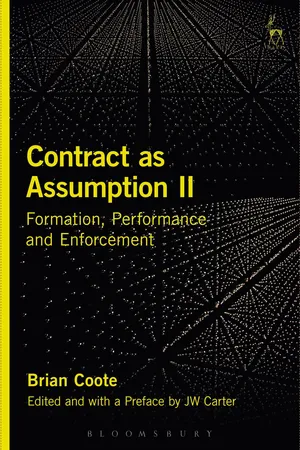
- 272 pages
- English
- ePUB (mobile friendly)
- Available on iOS & Android
eBook - ePub
About this book
Information
1
Introduction
This is the second collection of my shorter pieces to be published by Hart Publishing of Oxford, the helpfulness of whose staff throughout has been very much appreciated. Each collection owes its existence to the generosity of a colleague who volunteered, inter alia, to act as editor and to provide a Preface. For the earlier collection, it was Professor Rick Bigwood, then of Auckland and now at Bond University in Queensland. This time, it is Emeritus Professor John Carter of the University of Sydney. In his case, the relationship goes back to his time at Cambridge reading for a PhD. Being there myself on leave I was invited for a term to act as his temporary supervisor. For that slight service he has repaid me many times over, not least by publishing quite a number of my articles and notes in his Journal of Contract Law.
The title of the first collection, Contract as Assumption1 reflected the fact that all the writings in it were in some way related to a theory of contract, the main aspects of which include:
—Contractual obligations are not imposed by the law ab extra but are those which at formation the parties have assumed, that is, have taken upon themselves. Whether there has been such an assumption falls to be determined objectively.
—Bilateral contracts are formed by an exchange of assumptions at formation, it being the assumptions themselves which constitute the consideration.2 Performance can be consideration only when the contract is unilateral.
—Contractual obligations and liabilities, otherwise known as primary and secondary obligations, are two sides of the one coin. An assumption of the one is an assumption of the other.
—In the institution of contract, the law provides a facility the purpose of which is to enable parties to bind themselves to contractual obligations so far as the law allows. The motives for so providing may, of course, be various.
More extended statements of the theory appear in Chapters 2, 12, and 13 of this present collection. The arguments for it, and its main implications, were set out in ‘The Essence of Contract’ which now forms Chapter 2 of Assumption.3 It emphasises the prime importance of both the formation of the contract and the objectively determined intention of the parties to contract. Predictably, therefore, the first paper in this collection attempts, inter alia, to distinguish an intention to assume from other meanings of the word ascribed by law.
Also concerned with formation is the second paper, on the instantaneous transmission of acceptances. While the paper was written more than 40 years ago, means of instantaneous communication have been available much longer. The suggested conclusions all derive from common law principles and, unless and to the extent that they have been, or are, overtaken by legislation, ought still to remain relevant. It is significant that in the subsequent Brinkibon case,4 Lord Wilberforce summarised the law in terms not so very different from those expressed in the article.
The next piece, on Dunlop v Lambert,5 more closely reflects the assumption theory. Its thesis is that the particular answer to the perceived problem of privity in that case lay not with a very problematic rule of law applied ab extra, but in the obligations assumed by the parties at formation. Similarly, the answer to a perceived ‘black hole’ is found in the notion that obligation and liability are two sides of the one coin, each determining the content of the other.
The article on the sale of goods at auction without reserve turns largely on the distinction between consideration where the contract is bilateral, and consideration if it is unilateral. It is argued, as the assumption theory requires, that performance as such can be the consideration only when the contract is unilateral.
The next three chapters deal with exception clauses, the discussion of which involves direct application of aspects of assumption. Such clauses are seen to function not as taking effect just as defences at adjudication, but as going instead to the definition of the obligations assumed at formation. Another aspect particularly relevant to exception and limitation clauses is its emphasis on the interrelationship of obligation and liability (otherwise the primary and secondary obligations), an exception or limitation that affects the one having a corresponding effect on the other.
Chapter 6, on correspondence with description, was prompted by the flat contradiction in Ashington Piggeries Ltd v Christopher Hill Ltd6 of the earlier case of Arcos Ltd v EA Ronaasen & Son,7 both decisions of the House of Lords. The contradiction was brought about by a failure in the later case to distinguish the description of goods from their identification. The wording of the contract was clear enough but, instead of interpreting those words, their Lordships under the continuing influence of fundamental breach chose to apply, ab extra, criteria inconsistent with the apparent intention of the parties and imposed something quite different.
Chapter 7 was originally a contribution to a festschrift honouring Professor FMB Reynolds.8 One of the best known features of deviation from the contract route in contracts for the carriage of goods by sea is that on such a departure, unless it is justified, the carrier loses the protection not only of any contractual exception or limitation clauses, but of the common law exceptions as well. He becomes liable for any loss or damage to the goods carried unless he can show that it would have been suffered anyway. This might be taken to be evidence that, far from forming part of the definition of the obligations and liabilities assumed by the parties at formation, such clauses have independent existence as mere defences. The chapter shows why that is not the case. It also explains why, notwithstanding the deviation, freight can still be recovered if the goods are delivered safely. Exceptionally, a short passage in this chapter had to be substituted because of a ‘not’, the unsuspected existence of which was drawn to my attention by Professor Carter.9
The two papers reproduced here as Chapter 8 were, in effect, the second and third instalments of a three-stage attack on the then highly regarded and warmly welcomed doctrine of fundamental breach developed by the courts since 1953. ‘Fundamental breaches’ and ‘fundamental terms’ were seen as so fundamental that no exception or limitation clause, however clearly worded, could exclude or limit any aspect of a promisor’s liability in the event of breach. It owed its existence largely to the belief that such clauses function as mere defences to claims based on obligations defined without reference to them, and that they took effect, if at all, only at adjudication.
All this directly contradicted the central premise of my Exception Clauses (1964),10 that such clauses helped define the obligations and liabilities, there called primary and secondary obligations, assumed by the parties at formation. Fundamental breach was the subject of that book’s chapter 8 but, because of its central premise, it might be possible to see the entire book as an attack on the new doctrine!
As it happened, less than two years later, the House of Lords in the Suisse Atlantique case11 had an opportunity to review this new development. For the most part, their Lordships dismissed the notion that ‘fundamental breach’ was a rule of law and were agreed that, at least in general, the effect of such clauses depended on their interpretation. But some of their Lordships, and Lord Reid in particular,12 were inclined to the view that those clauses would automatically cease to have effect on a discharge of the contract for breach. (That was a view derived from Hain v Tate & Lyle13 where the House of Lords appeared to have ascribed the special effects of deviation to an automatic termination of the contract on a discharge for breach unless the breach were waived.) To reduce the impact of their expressed views on fundamental breach, by suggesting that such clauses would cease to have any application upon discharge for breach, was predictably to tempt fate (or at least, Lord Denning MR). As it also happened, in 196614 Lord Justice Diplock, as he then was, was reported as beginning a series of judgments in which he expanded upon the view that the obligation to pay damages for breach (or as he called it the secondary obligation) is consensual and becomes binding at formation. On that reasoning, the restrictive clauses would have the effect of defining liabilities ab initio rather than operating as mere defences.15
It also happened that on the day the result in Suisse Atlantique was reported in the press, Lord Denning was in New Zealand and, at a dinner in Auckland soon afterwards, told the audience that while he had been away their Lordships had been ‘up to no good’. But he assured those present that when he returned to England he would see that things were ‘put right’. Harbutt’s Plasticine16 was his opportunity to do just that, and the means he employed were basically those foreshadowed in the already mentioned dicta of Lord Reid.
Of the two articles reproduced in Chapter 8 the first half of the earlier one was, therefore, devoted to a detailed argument that, on a discharge for breach, termination was not of the contract but of the injured party’s obligation to perform. Any analogy with deviation was false. Reliance was placed on dicta in Heyman v Darwins Ltd.17 The balance of that article and the whole of the second one are given over to a range of other arguments against fundamental breach and in support of the view that the effect of exception and limitation clauses should depend on their interpretation.
The outcome of all this was that, in Photo Production Ltd v Securicor Transport Ltd,18 the House of Lords for a second and, as it has turned out, the last time, affirmed that at common law the effect of exception and limitation clauses depends on their interpretation. Referring to dicta in Heyman v Darwins, their Lordships confirmed that on a discharge for breach, what terminated was not the contract but the injured party’s obligation to perform. The analogy with deviation was false. For his part, Lord Diplock based his concurring judgment mainly on a further, much more extended, exposition of the theme that secondary obligations were consensual and, hence, related back to formation.
The paper on Bowmakers (Chapter 9) analyses a case in which the...
Table of contents
- Cover
- Title Page
- Preface
- Acknowledgements
- Contents
- Abbreviations
- Table of Cases
- Table of Legislation
- 1. Introduction
- 2. Reflections on Intention in the Law of Contract
- 3. The Instantaneous Transmission of Acceptances
- 4. Dunlop v Lambert: The Search for a Rationale
- 5. Sale of Goods at Auction Without Reserve
- 6. Correspondence with Description in the Law of Sale of Goods
- 7. Deviation and the Ordinary Law
- 8. PART I: The Effect of Discharge by Breach on Exception Clauses
- 8. PART II: Discharge for Breach and Exception Clauses Since Harbutt’s ‘Plasticine’
- 9. Another Look at Bowmakers v Barnet Instruments
- 10. Chance and the Burden of Proof in Contract and Tort
- 11. Damages, The Liesbosch, and Impecuniosity
- 12. Contract as Assumption and Remoteness of Damage
- 13. Contract: An Underview
- Index
- Copyright Page
Trusted by 375,005 students
Access to over 1.5 million titles for a fair monthly price.
Study more efficiently using our study tools.
Frequently asked questions
Yes, you can cancel anytime from the Subscription tab in your account settings on the Perlego website. Your subscription will stay active until the end of your current billing period. Learn how to cancel your subscription
No, books cannot be downloaded as external files, such as PDFs, for use outside of Perlego. However, you can download books within the Perlego app for offline reading on mobile or tablet. Learn how to download books offline
Perlego offers two plans: Essential and Complete
- Essential is ideal for learners and professionals who enjoy exploring a wide range of subjects. Access the Essential Library with 800,000+ trusted titles and best-sellers across business, personal growth, and the humanities. Includes unlimited reading time and Standard Read Aloud voice.
- Complete: Perfect for advanced learners and researchers needing full, unrestricted access. Unlock 1.5M+ books across hundreds of subjects, including academic and specialized titles. The Complete Plan also includes advanced features like Premium Read Aloud and Research Assistant.
We are an online textbook subscription service, where you can get access to an entire online library for less than the price of a single book per month. With over 1.5 million books across 990+ topics, we’ve got you covered! Learn about our mission
Look out for the read-aloud symbol on your next book to see if you can listen to it. The read-aloud tool reads text aloud for you, highlighting the text as it is being read. You can pause it, speed it up and slow it down. Learn more about Read Aloud
Yes! You can use the Perlego app on both iOS and Android devices to read anytime, anywhere — even offline. Perfect for commutes or when you’re on the go.
Please note we cannot support devices running on iOS 13 and Android 7 or earlier. Learn more about using the app
Please note we cannot support devices running on iOS 13 and Android 7 or earlier. Learn more about using the app
Yes, you can access Contract as Assumption II by Brian Coote, John Carter in PDF and/or ePUB format, as well as other popular books in Law & Contract Law. We have over 1.5 million books available in our catalogue for you to explore.