- 240 pages
- English
- ePUB (mobile friendly)
- Available on iOS & Android
eBook - ePub
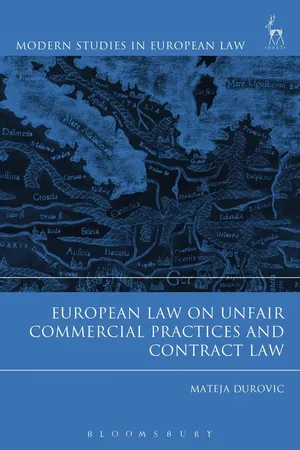
European Law on Unfair Commercial Practices and Contract Law
About this book
The book examines the ambiguous relationship between the European law on unfair commercial practices and contract law. In particular, the manuscript demonstrates that the Directive 2005/29/EC on unfair commercial practices (UCPD) has had a major impact on contract law, despite the declaration concerning the formal independence between the two branches of law established by Article 3(2) UCPD. The insights and conclusions identified in the book contribute to a better understanding of European private law and the general process of Europeanisation of private law in the European Union, and in particular of contract law.
Information
1
Introduction
SETTING THE SCENE
CONSUMERS ARE EXPOSED daily to a number of unfair commercial practices which traders use to attract consumers in order to buy their products or use their services. In order to protect consumers from the widest possible range of unfair commercial practices and establish a common pan-European legal framework of fair trading in business-to-consumer relations, the Directive 2005/29/EC on unfair commercial practices1 (‘UCPD’ or ‘Directive’) was adopted in 2005. More than a decade later, the UCPD still represents the most important and powerful European tool in the field of consumer protection, prohibiting any commercial practice which is unfair. The Directive has founded a hierarchically defined three-step mechanism for the assessment of fairness of a commercial practice that secures an effective protection of consumers from any form of unfair commercial practice. In its rather fruitful case law, the Court of Justice of the European Union (‘Court’ or ‘ECJ’) has confirmed the UCPD’s wide scope of application, with its provisions applying to all types of commercial practices which may hinder the economic interest of consumers.2
The maximum harmonisation character of the Directive further adds to its importance and effect. The principal objective of the UCPD is twofold: firstly, to set up a unified and coherent European legal framework for fair trading, through the abolishment of all obstacles for cross border trade among Member States; secondly, to secure a sufficiently high and common level of consumer protection throughout the European Union.3
After the adoption of the Directive, what has remained ambiguous is the relationship between the law on unfair commercial practices, on the one side, and contract law, on the other side. This includes the existing body of European contract law, ie the areas of contract law that have been subject to the ongoing process of Europeanisation, which is particularly noticeable in the area of consumer contract law, but also the national contract laws of the different Member States. The relationship between the law on unfair commercial practices and contract law has already attracted the attention of legal scholars,4 from the case law of the ECJ5 and from high level officials responsible for consumer policy.6 However, the question has not been squarely addressed to date in a systematic and comprehensive manner. This is the gap that this book seeks to fill in.
Thus, the main purpose of the book is to contribute to the clarification of the relationship between the law on unfair commercial practices and contract law, which has rightly been described as ‘a legally tricky area’.7 Such a study is not only of theoretical significance, but it is also a topic of high practical importance, since in practice the rules of these two areas of law will often apply to the same factual situations, hence the need to reflect on how they are correlated and how they affect each other.
This book eventually shows that the law on unfair commercial practices has had a strong impact on consumer contract law and identifies that the UCPD has been used as a powerful tool aimed at fostering and strengthening the process of Europeanisation of contract law. The Europeanisation of contract law is to be understood as a phenomenon that includes: firstly, the development of common contract rules at the European level; secondly, the penetration of EU common rules into traditional national contract law concepts; and, finally, the very process of harmonisation of the Member States’ national laws.8
STRUCTURE OF THE BOOK
The book is divided into six chapters: an introductory chapter, four main chapters and a concluding chapter, which are all further divided into sections. The six chapters include:
1)Introduction
2)The Average Consumer
3)The Duty to Trade Fairly
4)The Duty of Information
5)Remedies
6)Conclusions
Each of the four main chapters of the book is dedicated to the analysis of one of four fundamental elements of the Directive. These four concepts were chosen since they represent the four cross-over points where the link and correlation between the law of unfair commercial practices and contract law are at their most intense and relevant. They basically cover the entire system of protection of consumers provided by the UCPD. This is why, eventually, the examination of these four major interlinked points between the law on unfair commercial practices and contract law will make it possible to draw conclusions and to clarify, at least to some extent, their complex mutual connection.
The average consumer is, according to the Directive, the main benchmark for the assessment of the fairness of a commercial practice, followed by the standard of vulnerable consumer as a subsidiary benchmark. The average consumer also represents a model of expected behaviour that deserves to be protected by EU Consumer law. Despite the need for adoption of a related standard in relation to information and transparency requirements, such a standard did not exist in consumer contract law. In this chapter of the book, it was shown that there is a noticeable tendency to consider that the standard of average consumer of the UCPD is also applicable in the context of consumer contract law.
The duty to trade fairly has been established by the Directive as a general obligation of all traders while acting in the market, ie, one that applies to all their commercial practices whenever they may hinder consumers’ economic interests. Such a common and general duty, which would always regulate a trader’s behaviour, did not exist in consumer contract law. Due to its universal and broad character and the tight connection between a commercial practice and a contract, the duty to trade fairly now also applies and regulates all phases of any consumer contract.
The duty of information has been, for the first time, established through the provisions on misleading omissions of the Directive as a universal pre-contractual duty of traders in EU consumer law. Duty of information, as the main regulatory instrument of EU consumer law, was previously regulated through a fragmented, partial and incoherent European legislation, dispersed in a dozen directives, characterised by a phenomenon of ‘information overload’. In this chapter of the book, it is identified that the introduction of the universal duty of information by the UCPD, has resolved, to a certain extent, these shortcomings of contract law instruments. Moreover, the Directive has also provided a European meaning to the notion of invitation to purchase, a par excellence contract law concept.
Remedies represents an area for which the UCPD provides very scarce rules, leaving the procedural part of the law of unfair commercial practices to be regulated primarily by the national laws of Member States. Accordingly, an individual consumer, a victim of unfair commercial practice, has to rely on traditional contract law rules. The lack of capacity of the existing contract law concept to provide an adequate response to the breach of the rules of the Directive, has led to their modification or adoption of new contract law remedies. In addition to this, there is a presence of a particularly dynamic relationship with the existing remedies developed by European contract law that may be used in certain cases as a convenient and easy means by an individual consumer for the purpose of remedying the breach of the UCPD. Contrary to this, the provisions of the UCPD provide an additional level of protection to consumer rights established through contract law instruments.
Two Branches of EU Consumer Law
The system of EU consumer law consists of two large subcategories: the law on unfair commercial practices and consumer contract law.9 The law on unfair commercial practices is understood herein exclusively as the set of rules defined by the UCPD that exclusively regulate business-to-consumer relations. Equally, contract law is approached as comprising ‘any laws which govern the relative rights, duties or liabilities of the parties to a consumer contract, whatever the formal classification as a matter of national law’.10 In the book, the relationship between these two areas of law as understood above is examined, so that anything else is beyond its scope.
The UCPD represents the main source of the law on unfair commercial practices; it provides a complete and thorough regulation of fair trading in business-to-consumer relations.11 Accordingly, there is a rather high level of harmonised rules on unfair commercial practices at the European level, contained in one consistent piece of legislation. The UCPD materially affected national laws on unfair commercial practices, having replaced previously existing diverse national regimes with only one set of rules, based on the principle of maximum harmonisation.12 Therefore, the remaining, non-harmonised national provisions on unfair commercial practices, in particular those of substantive character, fall outside the scope of the book.13 Furthermore, it is true that the law on unfair commercial practices is also embodied in other pieces of legislation, but their significance is, in general, minor and therefore irrelevant for this book.14
Contrary to highly harmonised law on unfair commercial practices, only a small part of contract law has been affected, so far, by the process of Europeanisation, with a significantly larger part still contained in the national laws. The area of contract law affected by far the most by the process of Europeanisation is the field of consumer contract law.15 However, despite the increasing pace of Europeanisation, a significant part of consumer contract law is still regulated by the rules defined by the national contract laws of Member States. Furthermore, unlike in the case of the rules on unfair commercial practices, the rules on European...
Table of contents
- Cover
- Title Page
- Table of Contents
- Acknowledgements
- Table of Cases
- Table of EU Legislation
- 1. Introduction
- 2. The Average Consumer
- 3. The Duty to Trade Fairly
- 4. The Duty of Information
- 5. Remedies
- 6. Conclusions
- Bibliography and Sources
- Index
- Copyright Page
Trusted by 375,005 students
Access to over 1.5 million titles for a fair monthly price.
Study more efficiently using our study tools.
Frequently asked questions
Yes, you can cancel anytime from the Subscription tab in your account settings on the Perlego website. Your subscription will stay active until the end of your current billing period. Learn how to cancel your subscription
No, books cannot be downloaded as external files, such as PDFs, for use outside of Perlego. However, you can download books within the Perlego app for offline reading on mobile or tablet. Learn how to download books offline
Perlego offers two plans: Essential and Complete
- Essential is ideal for learners and professionals who enjoy exploring a wide range of subjects. Access the Essential Library with 800,000+ trusted titles and best-sellers across business, personal growth, and the humanities. Includes unlimited reading time and Standard Read Aloud voice.
- Complete: Perfect for advanced learners and researchers needing full, unrestricted access. Unlock 1.5M+ books across hundreds of subjects, including academic and specialized titles. The Complete Plan also includes advanced features like Premium Read Aloud and Research Assistant.
We are an online textbook subscription service, where you can get access to an entire online library for less than the price of a single book per month. With over 1.5 million books across 990+ topics, we’ve got you covered! Learn about our mission
Look out for the read-aloud symbol on your next book to see if you can listen to it. The read-aloud tool reads text aloud for you, highlighting the text as it is being read. You can pause it, speed it up and slow it down. Learn more about Read Aloud
Yes! You can use the Perlego app on both iOS and Android devices to read anytime, anywhere — even offline. Perfect for commutes or when you’re on the go.
Please note we cannot support devices running on iOS 13 and Android 7 or earlier. Learn more about using the app
Please note we cannot support devices running on iOS 13 and Android 7 or earlier. Learn more about using the app
Yes, you can access European Law on Unfair Commercial Practices and Contract Law by Mateja Durovic in PDF and/or ePUB format, as well as other popular books in Law & International Law. We have over 1.5 million books available in our catalogue for you to explore.