eBook - ePub
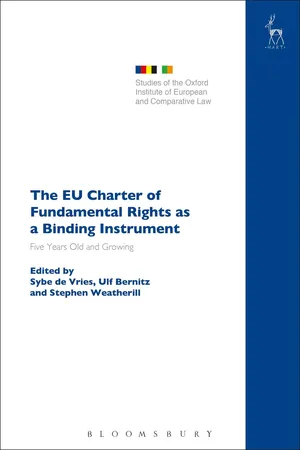
The EU Charter of Fundamental Rights as a Binding Instrument
Five Years Old and Growing
- 416 pages
- English
- ePUB (mobile friendly)
- Available on iOS & Android
eBook - ePub
The EU Charter of Fundamental Rights as a Binding Instrument
Five Years Old and Growing
About this book
The entry into force of the Treaty of Lisbon in 2009 caused the EU's Charter of Fundamental Rights to be granted binding effect. This raised a host of intriguing questions. Would this transform the EU's commitment to fundamental rights? Should it transform that commitment? How, if at all, can we balance competing rights and principles? (The interaction of the social and the economic spheres offers a particular challenge). How deeply does the EU conception of fundamental rights reach into and bind national law and practice? How deeply does it affect private parties? How much flexibility has been left to the Court in making these interpretative choices? What is the likely effect of another of the reforms achieved by the Lisbon Treaty, the commitment of the EU to accede to the ECHR? This book addresses all of these questions in the light of five years of practice under the Charter as a binding instrument.
Information
Part I
The Constitutional Dimension of Fundamental Rights
1
Five Years of Charter Case Law: Some Observations
I.FROM GENERAL PRINCIPLES OF EU LAW TO THE CHARTER
BEGINNING WITH STAUDER, Internationale Handelsgesellschaft and Nold,1 the European Court of Justice (ECJ) relied in its fundamental rights case law on a combination of two types of sources: 1) the ‘general principles of Community law’ as a directly binding source of law; and 2) some secondary sources as ‘guidelines’ or ‘sources of inspiration’. To use the Nold formula, the latter consisted of the constitutional traditions common to the Member States as well as international human rights treaties ‘on which the Member States have collaborated or of which they are signatories’. Gradually, the focus shifted away from the constitutional traditions common to the Member States towards the use of international human rights instruments and, more specifically since Rutili,2 a stronger reliance on the European Convention on Human Rights (ECHR), which was given ‘special relevance’.3
The reasons for this emphasis on the ECHR are not difficult to gather. First of all, it is a European instrument to which, since 1974, all EU Member States were Contracting Parties.4 Second, it is a well-known whilst not too cumbersome instrument, distilling in one single document, as supplemented by the Protocols, most of the human rights considered as essential at least from a European perspective.
On the other hand, the efforts to make the EU itself becoming a Contracting Party to the Convention failed and in 1996 the ECJ held that, as Community law stood at the time, the Community lacked competence to accede.5 At the same time, the EU legal order became increasingly to be seen as a constitutional order, which required its own bill of rights, a set of fundamental rights to be articulated by the EU itself rather than being expressed in an international instrument drawn up in the framework of an international organisation (by the Council of Europe with respect to the ECHR) comprising third states as well.
The constitutional character of the endeavour was further underlined by the composition and name of the body that prepared the draft text for the EU Charter. The Convention that produced the first draft leading to the ‘solemn proclamation’, on 7 December 2000, of the Charter as a formally non-binding instrument6 was composed of representatives of not only the governments of Member States but also the European Parliament, national parliaments and the Commission. This format was also followed with respect to the European Convention which prepared the abortive Treaty establishing a Constitution for Europe.7 While this Treaty, which was signed but never entered into force, incorporated the Charter as its Part II, the amendments to the Treaty on European Union (TEU) brought about by the Lisbon Treaty implied a comparable result as Article 6(1) TEU now refers to the Charter (‘as adapted at Strasbourg, on 12 December 2007’) and declares it to have ‘the same legal value as the Treaties’.8
In view of this background, it should have come as no surprise that the ECJ, confronted with a new constitutional and legal reality (Article 6(1) TEU and the Charter itself, including its drafting history), took the 2007 version of the Charter and the entry into force of the Treaty of Lisbon, quite seriously and began to take the Charter as a starting point when approaching fundamental rights issues raised before it. It is to this general trend that I will now turn. Subsequently, I will make some observations on more specific problem areas which have been addressed in ECJ case law, notably the application of other sources than the Charter in the fundamental rights case law of the Court, the application of the Charter at the national level and the relationship between the Charter and national constitutions.
II.THE CHARTER IN ECJ CASE LAW: GENERAL CONSIDERATIONS
Whilst Article 6 TEU even in its post-Lisbon version continues to refer to the general principles of EU law as a source of fundamental rights (paragraph 3), it is the Charter, as put into effect by the first paragraph of Article 6, that has become the main point of reference in post-Lisbon case law. It is true that first the General Court and the Advocates General of the ECJ and then, since June 2006, the ECJ itself9 began to refer to the Charter as a soft law instrument well before it became a binding part of EU primary law.10 Such references were rather sporadic, however, and in most cases simply served to back up a reasoning which was based primarily on other sources. In the post-Lisbon era, the ECJ has cited the Charter in more than 200 judgments or orders.11 This estimation does not include the case law of the General Court or that of the EU Civil Service Tribunal.
That said, the role and importance that the Charter plays in a given case may vary to a great deal. The Charter, or fundamental rights more generally, are often invoked as one of many arguments and this may, in principle, occur across the wholespectrum of EU law. In some cases, fundamental rights become the issue, in some others, an interpretation of a Charter provision is a relevant although perhaps not predominant element in a judgment, while in yet others, a Charter provision is referred to simply to corroborate a reasoning mainly centred elsewhere or even in a purely descriptive manner. As will be developed in a separate subsection below, there is also a string of cases where the Court has held that the Charter is not applicable because of a missing link between it and EU law more generally.
The most striking category of the cases decided so far consists of the cases in which the Court has invalidated an EU legislative act as being in violation of one or more provisions of the Charter. In Schecke, several provisions of EU legislation relating to the financing of the common agricultural policy were invalidated as being contrary to Articles 7 (respect for private and family life) and 8 (protection of personal data) of the Charter to the extent that they imposed an obligation to publish personal data relating to beneficiaries without drawing a distinction between relevant criteria concerning the nature of aid received.12 In Test-Achats, the Court struck down a provision of a Directive relating to the principle of equal treatment between men and women as being incompatible with Articles 21 (non-discrimination) and 23 (equality between women and men).13 The provision which was held to be invalid enabled Member States to maintain without temporal limitation an exemption from the rule of unisex insurance premiums and benefits provided for by the same Directive. And, most importantly, in Digital Rights Ireland, the entirety of Directive 2006/24 on data retention relating to the fight against serious crime was found to be invalid in light of Articles 7, 8 and 52(1) (the latter concerning limitations on the exercise of rights).14
III.THE USE OF SOURCES OTHER THAN THE CHARTER
As the Charter has become the main focus of proceedings and judgments, the use of other human rights or fundamental rights sources has become less frequent, at least from a relative perspective.15 However, the ECHR still enjoys ‘special relevance’. Whilst the ECHR ‘does not constitute, as long as the European Union has not acceded to it, a legal instrument which has been formally incorporated into [EU] law’,16 Article 52(3) of the Charter establishes a close link between the ECHR and the Charter in providing that Charter rights which ‘correspond to’ rights guaranteed by the Convention should be given the same meaning and scope as the relevant Convention rights. The Explanations relating to the Charter, which according to Article 6(1) TEU shall be taken into account (‘with due regard’) in the interpretation of the Charter,17 tell us that the meaning and scope of the relevant ECHR rights are to be determined not only by the text of the Convention but also by the case law of the European Court of Human Rights and by the Court of Justice of the European Union.18 The ECHR is also mentioned in the Preamble to the Charter and in Article 6(3) TEU, which in reaffirming the relevance of the general principles of EU law for EU fundamental rights refers to the constitutional traditions common to the Member States as well as the ECHR.
The case law of the ECJ thus continues to cite both provisions of the ECHR and Strasbourg case law.19 It may be that at least in a relative sense, this happens less frequently than was the case before the entry into force of the post-Lisbon Charter. It is my impression that the way in which the case is argued before the Court plays an important role in this regard: if the parties are invoking the Charter only and there are no particular grounds for considering that an envisaged interpretation of a Charter right would fall short of the minimum arguably required by the ECHR, the Court’s decision will probably be based on the Charter alone. On the other hand, in some cases, the relationship between the Charter and the ECHR has become an issue and some judgments have also made explicit reference to Article 52(3).20 Many judgments cite ECHR provisions, usually combined with references to Strasbourg case law as well, without specifically mentioning Article 52(3) of the Charter.21
Before the entry into force of the post-Lisbon Charter, the ECJ, whilst giving pride of place to the ECHR, referred now and then to international human rights instruments other than the ECHR and sometimes also to the constitutional traditions common to the Member States in support of reliance on a fundamental right as a general principle of Community law.22 After 2009, such references have become quite rare.23 A certain exception is provided for by the Geneva Convention relating to the Status of Refugees of 1951, which has been cited more often, no doubt due to the fact that the need to respect this Convention is brought out in Article 78(1) of the Treaty on the Functioning of the European Union (TFEU), Article 18 of the Charter and in the EU legislation concerning asylum seekers and refugees.24
IV.WHICH RIGHTS HAVE BEEN AT ISSUE?
Some words should be said about the main tendencies to which parts of the Charter have been at the forefront of during the close to five years of post-Lisbon Charter case law. In this respect, it is evident that most of this case law concerns what is often referred to as civil and political rights rather than the provisions of the Charter relating to so-called economic, social and cultural rights. However, it should be added that the distinction between these categories of rights is far from neat, as illustrated by the principle of equality, the prohibition of discrimination and the principle of cultural, religious and linguistic diversity (see Articles 20–23 of the Charter).25 It is perhaps more pertinent to compare the six substantive Titles of the Charter.26 In that respect, Title VI on Justice, and its Article 47 on the right to an effective remedy and to a fair trial in particular, stand out as the most frequently cited substantive part of the Charter.27 Rights of an economic and social nature appear ...
Table of contents
- Cover
- Title Page
- Preface
- Table of Contents
- List of Contributors
- Table of Cases
- Table of Legislation
- Introduction: Five Years Old and Growing: The EU Charter of Fundamental Rights as a Binding Instrument
- Part I: The Constitutional Dimension of Fundamental Rights
- Part II: The Scope of Fundamental Rights in EU Law
- Part III: Safeguarding Fundamental Rights in Europe’s Internal Market
- Index
- Copyright Page
Trusted by 375,005 students
Access to over 1.5 million titles for a fair monthly price.
Study more efficiently using our study tools.
Frequently asked questions
Yes, you can cancel anytime from the Subscription tab in your account settings on the Perlego website. Your subscription will stay active until the end of your current billing period. Learn how to cancel your subscription
No, books cannot be downloaded as external files, such as PDFs, for use outside of Perlego. However, you can download books within the Perlego app for offline reading on mobile or tablet. Learn how to download books offline
Perlego offers two plans: Essential and Complete
- Essential is ideal for learners and professionals who enjoy exploring a wide range of subjects. Access the Essential Library with 800,000+ trusted titles and best-sellers across business, personal growth, and the humanities. Includes unlimited reading time and Standard Read Aloud voice.
- Complete: Perfect for advanced learners and researchers needing full, unrestricted access. Unlock 1.5M+ books across hundreds of subjects, including academic and specialized titles. The Complete Plan also includes advanced features like Premium Read Aloud and Research Assistant.
We are an online textbook subscription service, where you can get access to an entire online library for less than the price of a single book per month. With over 1.5 million books across 990+ topics, we’ve got you covered! Learn about our mission
Look out for the read-aloud symbol on your next book to see if you can listen to it. The read-aloud tool reads text aloud for you, highlighting the text as it is being read. You can pause it, speed it up and slow it down. Learn more about Read Aloud
Yes! You can use the Perlego app on both iOS and Android devices to read anytime, anywhere — even offline. Perfect for commutes or when you’re on the go.
Please note we cannot support devices running on iOS 13 and Android 7 or earlier. Learn more about using the app
Please note we cannot support devices running on iOS 13 and Android 7 or earlier. Learn more about using the app
Yes, you can access The EU Charter of Fundamental Rights as a Binding Instrument by Sybe de Vries, Ulf Bernitz, Stephen Weatherill, Sybe de Vries,Ulf Bernitz,Stephen Weatherill in PDF and/or ePUB format, as well as other popular books in Law & International Law. We have over 1.5 million books available in our catalogue for you to explore.