- 254 pages
- English
- ePUB (mobile friendly)
- Available on iOS & Android
eBook - ePub
Justice and Authority in Immigration Law
About this book
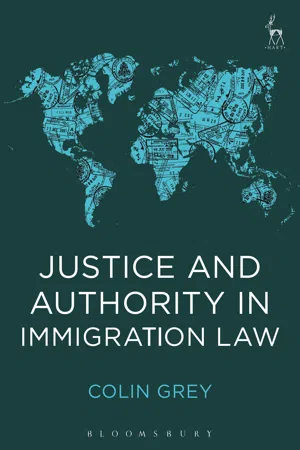
This book provides a new and powerful account of the demands of justice on immigration law and policy. Drawing principally on the work of Adam Smith, Immanuel Kant, and John Rawls, it argues that justice requires states to give priority of admission to the most disadvantaged migrants, and to grant some form of citizenship or non-oppressive status to those migrants who become integrated. It also argues that states must avoid policies of admission and exclusion that can only be implemented through unjust means. It therefore refutes the common misconception that justice places no limits on the discretion of states to control immigration.
Information
Part I
Preliminaries
1
Justice, Authority, and Immigration
I. Introduction
IN THIS ESSAY I seek to refute the plausibility of absolutism, the view that justice does not constrain immigration governance, and to develop a principled alternative. To get underway, sufficiently clear definitions of justice and authority are needed. These are provided in Section Two. But no starting point is entirely neutral. At the outset, we run up against a first, foundational absolutist claim that the inquiry into justice in immigration governance is unintelligible because social justice is a special, not a universal, relationship. No doubt unsurprisingly, I deny this claim. While what is required by justice may vary with context, its scope is limited only by the human capacity to injure one another. These points emerge in Section Three through an exposition of Adam Smith’s account of our judgements of justice. Finally, Section Four broadly frames the inquiry into justice in immigration and explains the distinctive challenges of theorizing justice and authority in immigration governance.
II. Justice and Authority
1. Justice
My focus is on the evaluation of immigration regimes from the standpoint of social justice and, importantly, injustice. Social justice, as I will understand it here, is an ideal that aims at the elimination of oppression, where this term refers to unjustified damage to human purposiveness, responsibility for which is traceable to impersonal human agency. Purposiveness, the capacity to set and act on purposes, is a central aspect of what it means to be human. When purposiveness coalesces, individually or in community with others, into a more or less structured conception of how one’s life should be lived, we can call this structured conception a conception of the good.1 A conception of social justice can be theorized through the specification of principles and rules that achieve an appropriate distribution of rights, duties, benefits, and burdens by major social institutions or practices; that is, to introduce a Rawlsian term, through the basic structure. A condition of social injustice can always be described, or redescribed, in terms of an inappropriate distribution of these things. Such redescriptions may seem artificial or trivial in some cases, for example, cases of torture.2 That does not mean they are unavailable.
Much in the above paragraph will be unpacked and developed as we go. Most important, to start, is that this way of thinking about justice combines two strands in the literature. According to the first, justice is primarily occupied with the distribution of rights, liberties, powers, and benefits as well as of duties, burdens, restraints, and pains.3 A theory of justice provides principles for the apportionment of these goods and ills. According to the second strand, justice aims foremost at the elimination of oppression.4 This second strand, at least recently, has generally been offered up in explicit or implicit criticism of the first. But, as I will use them here, rather than being in tension, these two strands of thought merely come at the problem of justice in different but related ways. Injustice leads to a distinct form of complaint, to which principles of justice respond. Smith states this relationship succinctly: ‘The end of justice is to secure from injury’.5
A further point is that the focus of inquiry is on social justice. However, the definition provided does not support a strong distinction between ‘social’ justice or injustice and ‘personal’ justice or injustice. I have taken the idea of injustice as unjustified injury through human agency pretty much wholesale from Smith, and I will expand on Smith’s account below in Section Three. On this understanding, the distinction between social and personal justice or injustice lies in the human agency that has brought it about, and the kinds of justification appropriate given such agency. Personal injustice results from wrongdoing by identifiable perpetrators. Social injustice, or oppression, is characterized by injuries brought about by impersonal human agency, such as through institutional or social rules, practices, or dynamics. Thus personal and social injustice occupy opposing ends of a spectrum characterizing injuries in accordance with the way we assign responsibility for injury.
To illustrate, on my usage when someone is the victim of a mugging, she has been subject to personal injustice. When someone lives under conditions rendering it more likely she will be mugged, perhaps because she belongs to a marginalized group or lives in a poor neighbourhood, she may be the victim of social injustice. Oppression can be distinguished in part by the special helplessness we feel when injustice begins to approach a state of being. It is brought about not by an identifiable individual or set of individuals, not by a thug or two, but by an ideology, culture, or set of institutions that empowers or enables thuggery. As this example shows, social and personal injustice may be, and often are, experienced together. The search for the causes of oppression can mark the refusal to accept that the explanation of one’s victimization stops with the bad intentions of a few men or women. Where social injustice has occurred, its converse can rarely be restored solely through the punishment of a few wrongdoers. Potentially an entire society may be implicated. Reform, not punishment, may be the appropriate remedy.
2. Authority
There is a tight connection between problems of social justice and problems of political authority. Oppression raises problems of political authority because political power will often lie behind the injury complained of and also, of course, because political power will often be the only realistic means of addressing such complaints. These two facts are related. The very fact that political power might be deployed to eliminate injuries may be grounds for concluding that the political system is complicit by omission.
Political authority, I will say, is a term that aims to capture a relationship of governance in which a person or entity is capable of exercising power over a collection of subjects. A descriptive theory of authority tells us how to identify when a person or entity in fact has authority. A normative theory of authority tells us when it is right and proper that a person or entity has authority. Such a normative theory may have two parts. First is a theory of the legitimacy, meaning the moral justification, of the exercise of power. Second is a theory of political obligation, meaning the vindication or not of the governing entity’s claims to be owed political obligations, in particular an obligation of obedience to its commands.6 If political obligation is owed to a legitimate political authority, I will call it a complete political authority. A complete political authority possesses wide-ranging normative power over its subjects.7 By this, I mean that a person or entity with authority may command, legislate, grant permissions, give authoritative advice, adjudicate, and so on and that, when it acts in these ways, it may change the normative situation of its subjects.8
Legitimacy and obligation need not run together. For instance, it is sometimes said that Lockean consent theory provides independent theories of legitimacy (a legitimate state is one that could have been consented to in an ideal history) and political obligation (political obligation can only come from express or tacit consent).9 This conceptual separation of legitimacy and obligation is disputed by some, who see the two ideas as mutually entailed.10 I think the claim of mutual entailment is wrong. It seems possible to have a legitimate political authority that is not owed obedience, such as within a prisoner of war camp or in a justly occupied territory.11 From the other direction, however, it is hard to conceive of an illegitimate government able to command political obligations. Accordingly, legitimacy may be a necessary condition of obligation, but this does not amount to logical correlation. The perhaps slight conceptual space between legitimacy and obligation means that by arguing for legitimacy, one will not necessarily have established the authority of a regime. On the other hand, an argument that a regime can give rise to political obligations on the part of its subjects will usually also establish its legitimacy, hence its complete political authority. The argument in Chapter Five for the authority of immigration regimes asks how immigration regimes can give rise to political obligations. It is therefore an argument of the second kind, aiming at political obligation but in the process establishing legitimacy.
The demand for the justification of the social and institutional arrangements that govern our lives is central to justice and both aspects of authority, yet each ideal responds to this demand in different ways. A claim of social justice seeks to justify a social arrangement by showing that no one under it is oppressed; that the arrangement results in no unjustified injuries of human provenance. The need for such justification arises when there are disagreements between persons over how to live their lives that cannot be resolved by appeal to some higher-level shared conception of the good. In contrast, a claim that a social arrangement has political authority seeks to justify the arrangement by showing that it ought to be accepted and obeyed. We lean on justifications of authority as the prospect for resolution of disputes over justice recedes.
It might be said that where justice pertains to an area of non-ideal theory relative to conceptions of the good, authority defines an area of non-ideal theory relative to justice.12 We fall back on justice when moderate scarcity and conflicts of interests, combined with ordinary human failings, lead to circumstances in which the potential for injury arises but where we cannot rely on a common conception of the good to resolve it. These are the circumstances of justice.13 We fall back on authority when a shared conception of justice cannot be achieved and disagreements over what is right threaten to take on the same heat as disagreements over what is good. These are what Jeremy Waldron has called the circumstances of politics.14 Disputes at this level can ultimately become more heated, since the initial sense of aggrievement may be compounded by the sense that a set of higher-order impartial standards has been violated. It may not simply be our way of life that is insulted, but an attempt to accommodate other ways of life, including those of the offending parties, at some cost to ourselves.
Theories of authority are to be worked out against background disagreements about justice. One of the reasons it is appropriate to talk about ‘political’ authority where above I invoked only ‘social’ justice is that at this level of compromise, it seems unlikely social arrangements can continue in a stable manner without some centralized, governing power; in the standard contemporary case, a state. After all, what is being asked of subjects is to dampen their resentment or indignation, to revise their feelings of being oppressed, while working within official channels to arrive at mutually acceptable arrangements. Political authority in this sense demands a radical reconstitution of the individual self; radical because it involves a revision of their sense of what their own dignity demands. It is hard to imagine how such demands can be consistently effective without political power, at least initially.
Political authority connects to legal authority in a contingent manner. This point is important because in immigration governance the challenge of t...
Table of contents
- Cover
- Title Page
- Dedication
- Contents
- Introduction
- Part I: Preliminaries
- Part II: The Authority of Immigration Regimes
- Part III: Justice in Immigration Governance
- Conclusion
- Bibliography
- Acknowledgements
- eCopyright
Trusted by 375,005 students
Access to over 1.5 million titles for a fair monthly price.
Study more efficiently using our study tools.
Frequently asked questions
Yes, you can cancel anytime from the Subscription tab in your account settings on the Perlego website. Your subscription will stay active until the end of your current billing period. Learn how to cancel your subscription
No, books cannot be downloaded as external files, such as PDFs, for use outside of Perlego. However, you can download books within the Perlego app for offline reading on mobile or tablet. Learn how to download books offline
Perlego offers two plans: Essential and Complete
- Essential is ideal for learners and professionals who enjoy exploring a wide range of subjects. Access the Essential Library with 800,000+ trusted titles and best-sellers across business, personal growth, and the humanities. Includes unlimited reading time and Standard Read Aloud voice.
- Complete: Perfect for advanced learners and researchers needing full, unrestricted access. Unlock 1.5M+ books across hundreds of subjects, including academic and specialized titles. The Complete Plan also includes advanced features like Premium Read Aloud and Research Assistant.
We are an online textbook subscription service, where you can get access to an entire online library for less than the price of a single book per month. With over 1.5 million books across 990+ topics, we’ve got you covered! Learn about our mission
Look out for the read-aloud symbol on your next book to see if you can listen to it. The read-aloud tool reads text aloud for you, highlighting the text as it is being read. You can pause it, speed it up and slow it down. Learn more about Read Aloud
Yes! You can use the Perlego app on both iOS and Android devices to read anytime, anywhere — even offline. Perfect for commutes or when you’re on the go.
Please note we cannot support devices running on iOS 13 and Android 7 or earlier. Learn more about using the app
Please note we cannot support devices running on iOS 13 and Android 7 or earlier. Learn more about using the app
Yes, you can access Justice and Authority in Immigration Law by Colin Grey in PDF and/or ePUB format, as well as other popular books in Diritto & Diritto pubblico. We have over 1.5 million books available in our catalogue for you to explore.