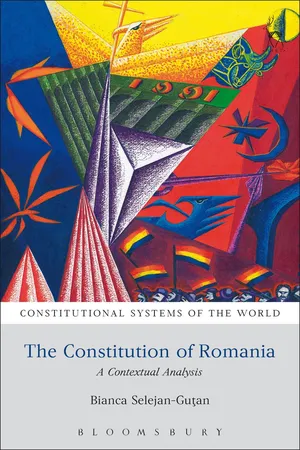
In December 1989, Romania became the last Eastern European communist country to break with its communist dictatorship, the most powerful in the region at the time. It has struggled ever since to overcome the transition to democracy and to become a 'full-time' member of the Western democratic community of states. This book provides a contextual analysis of the Romanian constitutional system, with references to the country's troubled constitutional history and to the way in which legal transplantation has been used. The Constitution's grey areas, as well as the gap between the written constitution and the living one, will also be explained through the prism of recent events that cast a negative shadow upon the democratic nature of the Romanian constitutional system.
The first chapters present a brief historical overview and an introduction to Romanian constitutional culture, as well as to the principles and general features of the 1991 Constitution. The chapters which follow explain the functioning of the institutions and their interrelations-Parliament, the President, the Government and the courts. The Constitutional Court has a special place in the book, as do local government and the protection of fundamental rights. The last chapter refers to the mechanisms and challenges of constitutional change and development.
- 296 pages
- English
- ePUB (mobile friendly)
- Available on iOS & Android
eBook - ePub
About this book
Information
1
Constitution, Nation and State

Constitutional Sources – Sovereignty – Referendums – Citizenship – The National State
I. CONSTITUTION AND CONSTITUTIONAL LAW
THE CONSTITUTION OF Romania (CR) is the supreme law of the land and lies at the centre of the Romanian legal system. As in most Romano-Germanic legal systems, the constitutional system itself is a very formal one, based almost entirely on written norms and with little legal weight given to custom and judge-made law. The origins of this formalism, as has been shown in the historic introduction to this book, can be traced back to the first ‘modern’ constitutional acts, especially starting with 1864 and then with the first Romanian Constitution of 1866. The hierarchical structure (with the Constitution as the supreme law) was not obvious from the beginning, as the constitutional review of legislation was not expressly provided for by the 1866 Constitution but introduced by the courts in 1912 and then formally by the 1923 Constitution. This chapter will provide introductory ideas on the sources of the constitutional system, as well as on its main foundational concepts and principles: nation, people and sovereignty. The main features of the state will be examined (nation state, democracy, rule of law) and, in the last section, a brief overview of the institutional architecture will be provided.
A.The Constitution: Formal and Substantive
The hierarchical structure of the constitutional system does not exclude recognition of a French-inspired distinction between the formal and substantive Constitution. Thus whereas the ‘formal’ Constitution means the actual document, adopted by a special organ, using a special procedure and with a superior binding force, the ‘substantive’ one represents the ensemble of rules relating to the existence and exercise of state power: constitutional norms, electoral laws, international human rights rules, constitutional case law. This formal–substantive distinction also covers the matter of the constitutional source system. The formal hierarchy of sources, entrenched and praised by Hans Kelsen in his general legal theory, is not only reflected in the system, but also expressly provided for in the constitutional text: ‘the observance of the Constitution, of its supremacy and of the laws is compulsory’ (Article 1 §5). The term ‘supremacy’ introduces the idea of a hierarchy, which also results from other constitutional and legal rules.
B.Organic and Ordinary Laws
Laws are understood as the acts of Parliament, situated at the second level of legal binding force below the Constitution. However, several constitutional texts refer to ‘organic laws’ as a special category. They are considered to be laws of greater importance, regulating broader or essential fields, designed to complement the Constitution by regulating in detail the regime of the most important institutions. The nature of this category is neither explained nor defined, but is to some extent inspired by French law. The organic laws are simply mentioned in Article 73 §1 CR, which states that ‘Parliament enacts constitutional, organic and ordinary laws’. The similarity with French organic laws ends here, as there are neither detailed procedural requirements for introducing such laws, nor any compulsory a priori constitutional review.
The Romanian Constitution does not set a general ordinary law domain/domaine de la loi. This means that the Parliament is not limited in its legislative competence. The Constitution only establishes the fields of organic laws in the third paragraph of Article 73. The list is quite heterogeneous, covering: essential fields on the political stage, such as the electoral system and the political parties, the regime applicable to states of siege, war and emergency; and general fields like property, education and ‘the organisation of local public administration’, but also more particular issues like administrative litigation and labour relations. In one field no organic law has yet been enacted (the status of national minorities). The list is open-ended, as it acknowledges that there are other fields which may be regulated by organic law, as referred to in the Constitution (such as the Romanian citizenship, the Constitutional Court, the Ombudsman etc).
The special nature of organic laws also results from their adoption procedure. The majority required for their adoption by Parliament is higher than in the case of ordinary laws, being the majority of the total number of the members of the two chambers of Parliament (whereas only a standard majority is required to pass ordinary legislation, ie 50 per cent plus one of the Members of Parliament (MPs) present in session).
Organic laws are supposed to be more stable and therefore less subject to political whims, but they are still in need of evolution and updating. The most recent important organic laws are the new codes (Civil Code, Criminal Code, Code of Civil Procedure and Code of Criminal Procedure), which entered into force in a very short period of time (around two to three years, after a long period of drafting) and replaced the old codes (amongst which were the Civil Code, enacted in 1864, and the Criminal Code from 1965).
C.Government Ordinances (Ordonante de Guvern)
Delegated legislation is considered a ‘necessary evil’ in contemporary democracies. Romania is no exception, and the Constitution provides for two types of delegated legislation: Government Ordinances (GOs) and Emergency Government Ordinances (EGOs). Both types are acts adopted by the Government based on direct or indirect delegation from Parliament. As a result, the ordinances have the legally binding force of laws. Government Ordinances are adopted by virtue of an enabling law, enacted by Parliament and expressly giving the Government this competence. Emergency Government Ordinances do not need an enabling law; they are adopted by the Government by virtue of a constitutionally granted power, but theoretically only ‘in exceptional cases, the regulation of which cannot be postponed, and [the Government has] the obligation to give the reasons for the emergency status within their contents’ (Article 115 §4 CR). In practice, the emergency requirement has frequently been disregarded by the Government, and EGOs have been used simply to circumvent Parliament. As both types of ordinances are submitted to parliamentary approval, this ‘vice’ of many EGOs has merely been covered by a subsequent parliamentary vote.1 The use and abuse of ordinances was criticised on various occasions by the European Commission in its CVM reports,2 as well as by the Venice Commission in its opinions. For instance, the adoption of over 140 ordinances in only one year (2011) was considered by the Venice Commission to demonstrate a clear ‘abuse of this instrument’.3
D.International Treaties: A Monist Incorporation
Romania chose the monist method of incorporating international law: by the automatic effect of the law of ratification, any international treaty becomes a part of domestic law (Article 11 §2 CR). The Constitution maintains its primacy, and no international treaty may be ratified if contrary to its provisions, unless the Constitution itself is amended. This once again proves the monist vision, as ratification is subject to the domestic legal hierarchy. Ratified human rights treaties have a privileged position: besides being a part of domestic law, they have priority over infra-constitutional legislation. Moreover, constitutional provisions on fundamental rights and freedoms must be interpreted and applied according to the international treaties on human rights ratified by Romania. It is common in most post-communist countries’ constitutions to give precedence to international human rights law, with a special emphasis on the European Convention on Human Rights (ECHR). Post-communist Romania followed this trend, inspired by the French (but not entirely, as France gives priority to all ratified international treaties) and Spanish models.4 The priority of international law of human rights is subject to the principle of subsidiarity (ie is applicable with the exception of more favourable provisions of internal law). Such treaties are considered to have a supra-legislative binding force but an infra-constitutional one.5
E.Complementary Sources: Case Law of the Constitutional Court and the European Court of Human Rights
Two sources complementary to the constitutional law system have gained importance over recent years. Although they do not formally have normative binding force, they have managed to become a part of the interpretative source system. These are: the decisions of the Constitutional Court,6 due to their general binding effect (erga omnes); and the decisions of the European Court of Human Rights (ECtHR), due to the ECHR’s priority in domestic law and to the importance of the Strasbourg Court’s case law in defining Convention terms. The status of these complementary sources is now so high that, in the current process of constitutional change, they have, along with the opinions of the Venice Commission, been the sources most frequently cited to underpin the necessity for changing constitutional texts. However, this started to happen only after 2003, when the Constitution was amended to expressly provide for its own direct applicability (Article 1 §5) and the mandatory erga omnes effects of the Constitutional Court’s decisions on unconstitutionality. The judges were also initially quite reluctant to apply the case law of the ECtHR. It can be said that, although the Constitution is monist as regards international law, Romanian judges are dualist, even in implementing the national Constitution.7
F.Marginal Sources: Ordinary Case Law, Doctrine, Travaux Préparatoires
Judicial decisions of ordinary courts (ordinary case law) do not have the force of precedent in the Romanian legal system. For a long time, judicial decisions (jurisprudence) were applied inter partes litigantes, having no binding force apart from in the cases in which they were pronounced, even as regards the same court. Only in the last few years, under pressure following a few judgments from Strasbourg, has judicial consistency been considered by Romanian courts, as well as judicial precedent, but even then only as having persuasive force. The only decisions having a compulsory effect on all ordinary courts in the system are two types of High Court decision: preliminary rulings on ‘solving a matter of law’ (newly introduced by the new Codes of Civil and Criminal Procedure), at the request of lower courts, on the interpretation of certain legal matters; and decisions on ‘appeals on points of law’ (recurs in interesul legii).8 The effect of such decisions is, therefore, to unify divergent jurisprudence on a specific point of law, as the solution to the specific legal problem found in such decisions must be followed in all courts.9
Legal doctrine and the travaux préparatoires are still very marginal sources of legal interpretation. Law specialists are often called to form committees for drafting legislation, or to advise parliamentary committees, but actual legal doctrine is rarely used in constitution- and law-making, or in decision-making by the courts. The same is true as regards travaux préparatoires, which are mostly used by scholars and are rarely cited by the Constitutional Court in its reasonings.
G.EU Law in the Source System
Starting in 1993, as a result of the Association Agreement with the EU, Romania was trying to adopt the acquis communautaire and to ‘Europeanise’ its national law from an integration perspective. After joining the EU in 2007, Europeanisation became an obligation. The supremacy of EU law over national laws is provided for in Article 148 §2 CR, which states that, ‘[a]s a result of the accession, the provisions of the constituent treaties of the European Union … shall take precedence over the [contrary] provisions of the national laws’. However, the text is not sufficiently clear on the status of EU law vis-à-vis the Constitution. In Europe, other strong constitutional courts decided this matter in favour of the national constitutions,10 despite the view of the European Court of Justice that EU law should take precedence. The Romanian Constitutional Court (RCC), when confronted with the issue of the supremacy of EU law over national law, adopted the view taken by other member states’ constitutional courts, invoking an ‘authority argument’, not analysing the opportunity for such a solution in the Romanian case: ‘the RCC judges assumed the Solange-type solution, but not the Solange mentality’.11 This means that the Constitutional Court has not actually been concerned with the problem of Romanian constitutional identity, but only to find a technical solution to placing EU law within the legal system. Thus, EU law has, indeed, an infra-constitutional position, but a supra-legislative one.
Ever since its accession to the EU, Romania has been subject to a monitoring process—the CVM12—which aims to help the new member state to tackle its existing shortcomings and to achieve its most important aims in consolidating the democracy: independence of justice system and the fight against corruption. One of the ma...
Table of contents
- Cover
- Title Page
- Acknowledgements
- Contents
- List of Abbreviations
- Table of Cases
- Table of Legislation
- Introduction and Historical Overview
- 1. Constitution, Nation and State
- 2. The Romanian Parliament
- 3. The Dual Executive and the Avatars of Romanian Semi-Presidentialism
- 4. Local Government
- 5. The Constitutional Court. Constitutional Aspects of the Judicial System
- 6. Constitutional Protection of Fundamental Rights
- 7. The Process of Constitutional Change: Mechanisms, Limits and Future Developments
- Index
- Copyright Page
Trusted by 375,005 students
Access to over 1.5 million titles for a fair monthly price.
Study more efficiently using our study tools.
Frequently asked questions
Yes, you can cancel anytime from the Subscription tab in your account settings on the Perlego website. Your subscription will stay active until the end of your current billing period. Learn how to cancel your subscription
No, books cannot be downloaded as external files, such as PDFs, for use outside of Perlego. However, you can download books within the Perlego app for offline reading on mobile or tablet. Learn how to download books offline
Perlego offers two plans: Essential and Complete
- Essential is ideal for learners and professionals who enjoy exploring a wide range of subjects. Access the Essential Library with 800,000+ trusted titles and best-sellers across business, personal growth, and the humanities. Includes unlimited reading time and Standard Read Aloud voice.
- Complete: Perfect for advanced learners and researchers needing full, unrestricted access. Unlock 1.5M+ books across hundreds of subjects, including academic and specialized titles. The Complete Plan also includes advanced features like Premium Read Aloud and Research Assistant.
We are an online textbook subscription service, where you can get access to an entire online library for less than the price of a single book per month. With over 1.5 million books across 990+ topics, we’ve got you covered! Learn about our mission
Look out for the read-aloud symbol on your next book to see if you can listen to it. The read-aloud tool reads text aloud for you, highlighting the text as it is being read. You can pause it, speed it up and slow it down. Learn more about Read Aloud
Yes! You can use the Perlego app on both iOS and Android devices to read anytime, anywhere — even offline. Perfect for commutes or when you’re on the go.
Please note we cannot support devices running on iOS 13 and Android 7 or earlier. Learn more about using the app
Please note we cannot support devices running on iOS 13 and Android 7 or earlier. Learn more about using the app
Yes, you can access The Constitution of Romania by Bianca Selejan-Gutan in PDF and/or ePUB format, as well as other popular books in Law & Public Law. We have over 1.5 million books available in our catalogue for you to explore.