- 464 pages
- English
- ePUB (mobile friendly)
- Available on iOS & Android
eBook - ePub
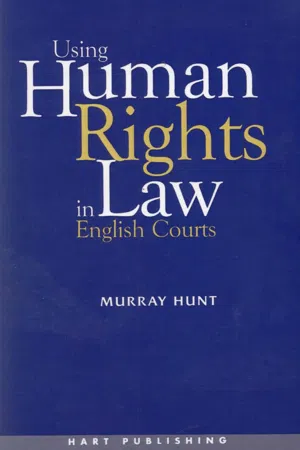
Using Human Rights Law in English Courts
About this book
The primary purpose of this book is to demonstrate the scope that already exists for using international human rights law in English courts, regardless of its status as 'incorporated' or 'unincorporated'. Murray Hunt addresses directly what are commonly supposed to be the theoretical obstacles to using human rights law in English courts and aims to raise awareness of the extent to which these have now fallen away in light of recent developments in English judicial practice. The book was first published in hardback in March 1997.
Information
1
The Changing Domestic Status of International Legal Norms
1. INTRODUCTION
In the course of the last twenty-five to thirty years, a great variety of factors has combined to undermine both the explanatory and the justificatory power of the traditional account of the United Kingdom’s constitutional arrangements.1 Those years have witnessed a number of developments of great constitutional significance, including a dramatic increase in the powers of the regulatory state, the declining effectiveness of traditional mechanisms of governmental accountability and, more recently, the shrinking of the “public” domain as a result of privatisation, deregulation and the contractualisation of government. Each of these has, in different ways, contributed to a growing awareness of an ever-widening chasm between what constitutional actors do in practice and the roles which traditional theory purports both to describe and to justify.
Arguably, however, no single factor has been more significant in exposing this gap between theory and practice than the international dimension which, during the same short period, domestic constitutional practice has been forced to accommodate. Not only has the UK been an active participant in the formulation of the considerable number of international human rights treaties adopted over this period, and ratified most of them, but, in two instances in particular, it has gone a significant step further. First, it has accepted the right of individual petition to the European Commission of Human Rights in Strasbourg and recognised as compulsory the jurisdiction of the European Court of Human Rights2 under the European Convention on Human Rights (“the ECHR”).3 Second, and probably even more importantly from a constitutional point of view, it has become a member of the European Community.
In 1974, when these last two events of constitutional significance were still relatively recent, Sir Leslie Scarman, with characteristic foresight, delivered his Hamlyn Lectures in which he heralded the arrival of a “new dimension” to English law.4 The new dimension consisted largely, though not exclusively, of the challenge from the human rights movement and the “Common Market”, as it was still then known. Lord Scarman believed that the common law system had the principles and flexibility necessary to meet the challenges, but he predicted that, if it was to do so successfully, it would need to engraft a new, constitutional dimension onto the common law by legislatively entrenching a bill of rights.5 Today, more than two decades on, the type of legislatively introduced constitutional reform hoped for by Lord Scarman has not been forthcoming, but fundamental constitutional change has nevertheless taken place, as English courts have been forced to accommodate momentous developments in the legal system of the European Community, as well as the increasing normative force of the European Convention on Human Rights and other international human rights instruments.6
The aim of this book is to draw together these profound influences on the domestic constitution and, by studying in detail the judicial response to them, to demonstrate the inability of the traditional account to provide a satisfactory foundation for the domestic status of international human rights law. By placing the contemporary debate about the status of such norms in the context of wider constitutional themes, and in particular the internationalisation and Europeanisation of constitutional practice, it seeks to demonstrate that much of that debate is conducted on a problematic premise derived from a theory of parliamentary sovereignty that, in practice, has already passed into history. Until it is overtly acknowledged that the theoretical framework has shifted, it will be argued, the place of international human rights norms in domestic law will remain vulnerable to the resurrection of theoretical anachronisms. This theoretical adjustment, it will be suggested, is of significance for much more than the domestic status of international human rights. In particular, it has implications for the courts’ conception of the nature of their function in public law in modern conditions. Even a statutorily incorporated ECHR, or other legislatively approved domestic bill of rights, purporting to be entrenched against future repeal, will fail to provide effective protection so long as the courts called on to apply its provisions remain wedded to an unthinkingly sovereigntist constitutional framework.
What has been referred to above as the “traditional account” of the UK’s constitutional arrangements, and will be referred to variously throughout as the classical, received or orthodox account, is the familiar Diceyan version, which is too well known to bear recounting in detail here.7 Suffice it to say for present purposes that, for Dicey, the British constitution rested on twin foundations: the absolute and continuing legal sovereignty of Parliament and a judicial commitment to a rule of law ideal which, subject only to Parliament’s sovereign will, guaranteed the protection of an individual’s private rights of property and analogous freedoms from state interference. Each of these foundations has been challenged by international and, in particular, European influences with which they are in fundamental tension. The traditional civil and political rights protected by the Diceyan rule of law have begun to look dated, as the substantive values protected in both the international human rights instruments and the positive law of the European Community have gone far beyond the narrow catalogue of property and analogous civil rights traditionally protected by the English common law. Today, international instruments and Community law embrace a much wider lexicon of aspirations, including so-called second and third generation rights which are more often “positive” in the sense that they require state action for their protection or realisation.8 However, it is the modern inadequacy of Dicey’s other foundation, the sovereignty of Parliament, that provides this book’s principal focus, for it is that particular aspect of the Diceyan account which has proved the main theoretical stumbling block to the successful constitutional accommodation of the international dimension generally, and of international human rights in particular.
The inadequacy of the very concept of “sovereignty” in making sense of reality in today’s interdependent world is now a well documented phenomenon.9 In a series of recent essays, for example, MacCormick has persuasively argued that sovereignty has undergone a metamorphosis, which requires a more subtle understanding of its meaning and locus.10 As MacCormick points out, “sovereignty” is a property conventionally ascribed to states, or to their governing authorities, and “sovereign power”, whether legal or political, is ultimate power, power which admits of no superior power or higher authority.11 The concepts of the sovereign law-maker within the domestic legal system and the sovereign nation-state as the basic unit of the international legal system have both been increasingly transcended by legal and political developments, with inevitable consequences for the particular conception of law which those concepts have traditionally underpinned.
Take first the developments on the international plane which have combined to undermine the concept of the sovereign nation-state.12 The post-War period has seen a paradigm shift, away from the traditional position whereby only sovereign states could be the proper subjects of international law, towards the general recognition of individual citizens as the bearers of international rights and obligations.13 There have emerged entirely novel international, transnational and supranational legal orders, supplanting the traditional framework in which sovereign states formerly conducted their affairs with one another, and conferring rights on citizens enforceable against their states through international or supranational mechanisms.14 Not only has there been a notable proliferation of multilateral agreements between states, regulating an ever-increasing range of activities which were previously the exclusive preserve of the sovereign nation-state, but the nature of such agreements has changed, away from the traditional paradigm of treaties concerning the relationship of one state to another, towards a new model of treaties concerned with the relationship of states with their own citizens.15 Above all, the rapid progress towards European integration that has been made since the Treaty of Rome, especially in the last decade since the signing of the Single European Act, together with the maturation of the European Convention system for the protection of human rights, have increasingly restricted the national sovereignty of European nation states.
In short, although “globalisation” and “interdependence” may seem fashionable epithets, they reflect the undeniable present reality that, in today’s world of political and economic transnationalism, nation states can no longer consider themselves masters of their own destiny. The modern state no longer finds itself a free actor in the international sphere, nor even unconstrained domestically. Instead, its freedom of action is limited by a vast array of international legal commitments which operate as very real constraints on the policy choices open to a national government. As McCrudden and Chambers observe,16
“a strong current has been carrying Britain in the direction of an increasing acceptance of supra-national, and for the most part European, laws and institutions which may in practice limit domestic freedom of action and circumscribe national sovereignty.”
The fact that since November 1993 citizens of the UK are also citizens of Europe is perhaps the most potent symbol of this transition from the old international order of sovereign nation states to the relatively untested new world of overlapping domestic and international legal orders.17 It is developments such as these which have led some writers to go so far as to talk of the demise of sovereignty in its classical sense and the dwindling of the nation state.18
The accommodation, at the national level, of these developments in the international sphere has inevitably placed enormous strain on a traditional constitutional account which presupposes the existence of a single sovereign law-maker within a sovereign nation-state.19 It would have been surprising indeed had the metamorphosis of national sovereignty on the international plane not begun to influence the traditional presupposition of parliamentary sovereignty on the domestic plane.20 It is not simply that the domestic Parliament’s freedom to legislate as it chooses is now circumscribed by international obligations, some of which are enforceable through international mechanisms created for that very purpose. The rather less direct, but equally significant, effect of these developments is that international law in the emerging new paradigm is dependent on the domestic legal order of the nation-states to give practical effect to its norms. So the developments outlined above do not amount to the progressive subordination of national legal systems to a superior international order, but rather herald the arrival of a new interdependence of national and international legal orders, in which each presupposes the independent validity of the other. This “mutuality of recognition”, as MacCormick has described it, necessitates the use of a quite different vocabulary from that in which legal discourse about the domestic status of international norms has traditionally been conducted. In place of language reflecting the traditional notion of a nation-state “internalising” norms from an “external” source, the language of “interpenetration” and “interdependence” better reflect the partially overlapping and interacting nature of today’s national and international legal orders.21
The many and varied responses of English courts to this challenge are considered in detail in chapters 2 to 7 below. It will be seen that whilst in practice English courts have gone some considerable way towards accommodating the new international dimension to the UK constitution, at least in the context of European Community law and occasionally, though more sporadically, in the context of international human rights law, they have largely contrived to do so by maintaining at the theoretical level the fiction that such accommodation requires little, if any, modification of their sovereigntist premise, on the preservation of which the legitimacy of the judicial function is perceived to depend. As a result, even in the face of all these challenges from Europe and beyond, the sovereigntist account has proved remarkably durable even as it has become increasingly untenable.
One of the aims of this book is to suggest, as just one aspect of the much broader re-conceptualisation of constitutional thinking now widely called for,22 a more appropriate judicial response to the challenge presented by these momentous changes, yet a response which, it will be argued, remains consistent with the judiciary’s legitimate constitutional role in a representative democracy. The purpose of this introductory chapter is briefly to demonstrate, against this contemporary background of increasing international interdependence and the declining significance of the sovereign nation state, the way in which the domestic status of international legal norms is already changing in the UK. This book is not the place to consider at length the well-rehearsed debate in international law scholarship about the relationship between international law and domestic law.23 Indeed, one of the claims which will be made is that the old opposition between monism and dualism which has dominated that debate has to a large extent been left behind by modern developments. However, it is necessary briefly to explain the historical and theoretical relationship between the orthodox account of the British constitution and the traditional view of the status of international law in domestic courts. It will be seen that the question of the status of international legal norms in the domestic legal system cannot be dissociated from deeper questions of what counts as “law”, or what norms are legally relevant, in a particular legal system. These are questions which English courts have been conspicuously reluctant to consider overtly, despite the magnitude of the constitutional changes wrought largely by their own practical responses to these international pressures.
2. THE RELATIONSHIP BETWEEN PARLIAMENTARY SOVEREIGNTY AND DUALISM
Like so much else in the UK’s constitutional firmament, the status of international law in the domestic legal system continues to bear the unmistakeable mark of Dicey’s influence. The possibility that international law constituted a limitation on the otherwise absolute authority of Parliament was one of the heresies which Dicey sought to refute in the course of his well-known attempt to prove the existence of Parliamentary sovereignty as a legal “fact”.24 He insisted that an Act of Parliament was never invalid merely because it was opposed to the doctrines of international law and that there was simply no legal basis for the theory that judges may overrule an Act of Parliament on the ground that it went beyond the internationally permissible limits of Parliamentary authority. It was, in Dicey’s view, a simple fact of legal practice that a modern judge would never listen to a barrister who presented such an argument.25 On this view, if domestic legislation clearly conflicts with a treaty obligation which has not been statutorily...
Table of contents
- Cover
- Title
- Dedication
- Copyright
- Alexander Maxwell Law Scholarship Trust
- Foreword
- Preface to the Paperback Edition
- Preface and Acknowledgments
- Contents
- Table of Cases
- Table of Statutes and Treaties
- 1. The Changing Domestic Status of International Legal Norms
- 2. The Implications of European Community Membership for Sovereignty Theory
- 3. The Inadequacy of Sovereignty Theory Exposed
- 4. The Early Domestic Career of International Human Rights Law
- 5. The Emergence of a Common Law Human Rights Jurisdiction
- 6. Human Rights in Administrative Law
- 7. The Reception of International Human Rights Law via European Community Law
- 8. Towards an Interpretive Obligation
- Appendix I: Table of English Cases in which Judicial Reference has been made to Unincorporated International Human Rights Law
- Appendix II: The Bangalore Principles (1988)
- Appendix III: The Universal Declaration of Human Rights (1948)
- Appendix IV: The European Convention on Human Rights (1950), Section I and Relevant Protocols
- Appendix V: The International Covenant on Civil and Political Rights (1966), Parts I—III
- Appendix VI: Home Office Policy DP/2/93
- Index
Trusted by 375,005 students
Access to over 1.5 million titles for a fair monthly price.
Study more efficiently using our study tools.
Frequently asked questions
Yes, you can cancel anytime from the Subscription tab in your account settings on the Perlego website. Your subscription will stay active until the end of your current billing period. Learn how to cancel your subscription
No, books cannot be downloaded as external files, such as PDFs, for use outside of Perlego. However, you can download books within the Perlego app for offline reading on mobile or tablet. Learn how to download books offline
Perlego offers two plans: Essential and Complete
- Essential is ideal for learners and professionals who enjoy exploring a wide range of subjects. Access the Essential Library with 800,000+ trusted titles and best-sellers across business, personal growth, and the humanities. Includes unlimited reading time and Standard Read Aloud voice.
- Complete: Perfect for advanced learners and researchers needing full, unrestricted access. Unlock 1.5M+ books across hundreds of subjects, including academic and specialized titles. The Complete Plan also includes advanced features like Premium Read Aloud and Research Assistant.
We are an online textbook subscription service, where you can get access to an entire online library for less than the price of a single book per month. With over 1.5 million books across 990+ topics, we’ve got you covered! Learn about our mission
Look out for the read-aloud symbol on your next book to see if you can listen to it. The read-aloud tool reads text aloud for you, highlighting the text as it is being read. You can pause it, speed it up and slow it down. Learn more about Read Aloud
Yes! You can use the Perlego app on both iOS and Android devices to read anytime, anywhere — even offline. Perfect for commutes or when you’re on the go.
Please note we cannot support devices running on iOS 13 and Android 7 or earlier. Learn more about using the app
Please note we cannot support devices running on iOS 13 and Android 7 or earlier. Learn more about using the app
Yes, you can access Using Human Rights Law in English Courts by Murray Hunt in PDF and/or ePUB format, as well as other popular books in Law & Civil Rights in Law. We have over 1.5 million books available in our catalogue for you to explore.