On July 27,2000 the House of Lords delivered a decision where, for the first time in English law, it explicitly recognised that damages for civil wrongs can be assessed by reference to a defendant (wrongdoer)'s gain rather than a claimant's loss. The circumstances in which such gain-based damages might be available were left for development incrementally.
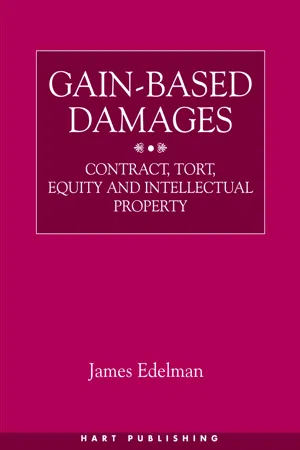
This book considers the nature of gain-based damages and explains when they have historically been available and why, and provides a framework for appreciating the operation of such damages awards. The first part of the book justifies the existence of these damages, which focus upon a defendant wrongdoer's gain made as a result of a civil wrong, explaining the nature and need for such a remedy and the scope of civil wrongs. The core thesis of the book is that two different forms of such gain-based damages exist: the first is concerned with restitution of a defendant's gains wrongfully transferred from a claimant; the second is concerned only with stripping profits from the defendant's hands. Once these two gain-based damages awards are separated they can be shown to be based upon different rationales and the basis for their availability can be easily understood.
The second part of the book considers and applies this approach, demonstrating its operation throughout the cases of civil wrongs. The operation of the two forms of gain-based damages is demonstrated in cases in the area of tort (chapter 4), contract (chapter 5), equitable wrongs (chapter 6) and intellectual property wrongs (chapter 7). It is shown that these gain-based damages awards have long been available in these areas and their operation has conformed to clear principle. The difficulty that has obscured the principle is the nomenclature which has hidden the true gain-based nature of many of these damages awards.
- 320 pages
- English
- ePUB (mobile friendly)
- Available on iOS & Android
eBook - ePub
About this book
Information
1
The Nature of “Damages”
INTRODUCTION
In the vast majority of cases at common law in which damages are claimed, they are sought in order to redress loss which has been suffered. By redressing loss these awards aim to compensate the claimant and are often termed “compensatory damages”. So common are compensatory damages at common law that compensation seems to some to be the sole purpose of common law damages awards. The supporters of this view argue that “where no loss has been suffered no substantial damages of any kind can be recovered”.1 In German law, it is the case that damages awards for wrongs do operate exclusively to compensate for loss.2 However, this first chapter is devoted to demonstrating the falsity of this view in English common law and breaking the link between damages and compensation. Although common law damages are often concerned with compensating a claimant, they can (and do) have different goals. This chapter will show that “damages” means nothing more specific than a monetary award given for a wrong.3
Although this book is concerned with damages awards based upon gain, this chapter will defer discussion of these gain-based awards and, in order to demonstrate that damages awards can be based on principles other than compensating for loss, the focus will be upon a simpler, less contested and better known example. This is the remedy of exemplary damages: an award of damages which, it is universally acknowledged, is expressly not concerned with loss to a claimant. The primary purposes of exemplary damages are to punish a defendant and to create an example to deter the defendant and other potential defendants from similar conduct.
A discussion of exemplary damages might seem to be an odd starting point for a defence of gain-based awards for wrongs. But the reason for beginning in this way is that the single greatest obstacle to the acceptance of gain-based damages is the intuitively attractive, but false, notion that damages must be tied to compensation. Exemplary damages have the following in common with gain-based damages: they are calculated other than by reference to the claimant’s loss. For nearly 40 years English law has been attracted by, and has nearly succumbed to, the notion that exemplary damages are anomalous and should be eliminated for this very reason. A recent study by the Law Commission and a very recent decision of the House of Lords has restrained, perhaps even reversed, the English flirtation with this view. The rehabilitation of exemplary damages is the essential foundation for the recognition of the legitimacy and utility of other kinds of non-compensatory damages.
This chapter is divided into three sections. Section A, examines the arguments that damages should be equated with compensation for loss. Section B examines the specific application of these views in the context of exemplary damages. Section C demonstrates that the conclusion that exemplary damages are a legitimate form of non-compensatory damages necessitates recognition of other forms of non-compensatory damages.
A Damages as compensation
1) Arguments that damages must be compensatory
One frequently encounters the view that awards of damages are only made to compensate a claimant for loss suffered. There are two classic judicial statements, which are often referred to in discussions concerning damages for torts and breach of contract. The first is Lord Blackburn’s statement in the tort case of Livingstone v. Rawyards Coal Company:4
“It is a general rule that, where any injury is to be compensated by damages, in settling the sum of money to be given for reparation of damages you should as nearly as possible get at that sum of money which will put the party who has been injured, or who has suffered, in the same position as he would have been in if he had not sustained the wrong for which he is now getting his compensation or reparation.”
The second is Baron Parke’s statement in the breach of contract case, Robinson v. Harman:5
“The rule of the common law is, that where a party sustains a loss by reason of a breach of contract, he is, so far as money can do it, to be placed in the same situation, with respect to damages, as if the contract had been performed.”
These statements have been referred to again and again, sometimes just as “general principle”6 but, on other occasions, as a “fundamental principle”7 or even as an absolute rule, a “principle that is absolutely firm, and which must control all else.”8
2) Counter-arguments
If it were correct, as an absolute proposition, that damages are only concerned with compensating for loss, exemplary damages or nominal damages could not exist. Neither are concerned to compensate a claimant for loss. The Law Commission, in its Consultation Paper on Aggravated, Exemplary and Restitutionary Damages,9 observed that, at least empirically, claims that tort law is exclusively concerned with compensation are “simply false”. The existence of exemplary damages especially, anomalous or not, in different forms for thousands of years10 shows the express concern of the civil law with matters beyond compensation. Despite this, Dr McGregor begins his seminal treatise on damages with the statement that “[d]amages are pecuniary compensation”.11
(a) Nominal Damages
Despite his opening statement, Dr McGregor does, in fact, devote a section of his book to “damages not based strictly on compensation”,12 in which he discusses exemplary and nominal damages. He begins by acknowledging the non-compensatory nature of nominal damages which have been described in the following manner:13
“A technical phrase which means that you have negatived anything like real damage, but that you are affirming by your nominal damages that there is an infraction of a legal right which, though it gives you no right to any real damages at all, yet gives you the right to the verdict or judgment because your legal right has been infringed.”
Dr McGregor sought to resolve this apparent contradiction in an essay in which he argues that “nominal damages . . . are not really damages” and are unnecessary.14 He argues that they are no longer needed as a “peg on which to hang costs” as costs are now in the court’s discretion. A court can now give costs to a party that is not entitled to damages. He also argues that nominal damages are not needed by a court to assert that a right has been infringed since a court can make such an assertion by a declaration. However, whether needed or not, it is an empirical fact that nominal damages remain to serve these non-compensatory functions.
(b) Exemplary damages
Exemplary damages cannot be dismissed as perfunctorily. Even Dr McGregor accepts that exemplary damages are “damages”. He argues, however, that they are an anomaly and rarely available. It will be seen below that Dr McGregor is not alone and that this debate as to the legitimacy of exemplary damages has occupied English courts in much detail. Other jurisdictions can be equally forceful. In Fay v. Parker,15 for example, the Supreme Court of New Hampshire, setting aside part of a judgment that related to exemplary damages, described exemplary damages in the following manner:
“a monstrous heresy . . . an unhealthy excrescence, deforming the symmetry of the body of the law . . . out of place, irregular, anomalous, exceptional, unjust, unscientific, not to say absurd and ridiculous when classed among civil remedies.”
(c) The “rule” in the Livingstone case
A third counter-example illustrating the existence of non-compensatory damages is ironically the case of Livingstone v. Rawyards Coal Company16 itself, a case which is usually understood or cited as fundamental to the “rule” that damages are compensatory. In fact, obiter dicta in all the speeches in the House of Lords in the Livingstone case support the existence of damages based on principles other than compensation for loss.
The Livingstone case was an appeal brought to the House of Lords from the First Division in Scotland. Both the appellant and respondent assumed that the coal under the appellant’s property was reserved to the respondent. Acting upon this assumption the respondent mined under the appellant’s land for coal. The appellant later realised that he had been mistaken and sued to recover the value of the profits that the respondent had reaped from his coal.
The claim was framed as one for compensatory damages for loss. The appellant argued that the loss suffered was the value of the coal and should be measured by the net profit from the sale of the coal by the respondents. The House of Lords held that the appellant could not have worked the land himself and that the only loss to the appellant was the lost ability to offer the right to mine the coal for a price and an element for damage done to the land.17
Although only compensatory damages were sought, all members of the House of Lords indicated that further damages might have been awarded in different circumstances. Each speech acknowledged that if there had been evidence of “bad faith or sinister intention”18 the appellant could have recovered the market value of the coal, without even a deduction for the respondent’s cost of working the coal. But due to the innocence of the respondent only a compensatory award was allowed. Compensatory damages were therefore awarded but it was recognised that they were not the only damages potentially available. The award of the market value of the coal, less the cost of removing the coal, is explained later in this book as an example of the non-compensatory award of disgorgement damages. It focuses upon the profit made by the defendant as a result of the wrong.19 But the refusal to allow a deduction for the cost of working the coal adds to the award a punitive element. Lord Diplock has acknowledged that this is recognition of exemplary damages.20 Even the Livingstone case confirms that damages awards need not be compensatory.
The House of Lords has also recently recognised, by a majority, in Attorney General v. Blake,21 that the statement concerning compensation in the Livingstone case is only a “general principle”. Lord Nicholls, in the leading speech22 stated that “the common law, pragmatic as ever, has long recognised that there are many commonplace situations where a strict application of this [compensatory] principle would not do justice between the parties.” At common law the award of exemplary damages has been the most prominent of these situations. The following section now considers exemplary damages, and argues that these damages awards are legitimate and that their existence demonstrates the fact that damages are not exclusively concerned with compensation for loss.
B Legitimacy of exemplary damages
1) Their purpose
Historically the award of exemplary damages was accompanied by numerous epithets. Courts have used words such as “wilful, wanton, high-handed, oppressive, malicious, outrageous”23 to describe the fact that these dam...
Table of contents
- Cover
- Title
- Copyright
- Preface
- Contents
- Index of Authorities
- Table of Abbreviations
- Introduction
- 1 The Nature of “damages”
- 2 The Category of Civil Wrongs
- 3 Two Measures of Gain-Based Damages
- 4 Torts
- 5 Breach of Contract
- 6 Equitable Wrongs
- 7 Intellectual Property Wrongs
- 8 Conclusions
- Bibliography
- Index
Trusted by 375,005 students
Access to over 1.5 million titles for a fair monthly price.
Study more efficiently using our study tools.
Frequently asked questions
Yes, you can cancel anytime from the Subscription tab in your account settings on the Perlego website. Your subscription will stay active until the end of your current billing period. Learn how to cancel your subscription
No, books cannot be downloaded as external files, such as PDFs, for use outside of Perlego. However, you can download books within the Perlego app for offline reading on mobile or tablet. Learn how to download books offline
Perlego offers two plans: Essential and Complete
- Essential is ideal for learners and professionals who enjoy exploring a wide range of subjects. Access the Essential Library with 800,000+ trusted titles and best-sellers across business, personal growth, and the humanities. Includes unlimited reading time and Standard Read Aloud voice.
- Complete: Perfect for advanced learners and researchers needing full, unrestricted access. Unlock 1.5M+ books across hundreds of subjects, including academic and specialized titles. The Complete Plan also includes advanced features like Premium Read Aloud and Research Assistant.
We are an online textbook subscription service, where you can get access to an entire online library for less than the price of a single book per month. With over 1.5 million books across 990+ topics, we’ve got you covered! Learn about our mission
Look out for the read-aloud symbol on your next book to see if you can listen to it. The read-aloud tool reads text aloud for you, highlighting the text as it is being read. You can pause it, speed it up and slow it down. Learn more about Read Aloud
Yes! You can use the Perlego app on both iOS and Android devices to read anytime, anywhere — even offline. Perfect for commutes or when you’re on the go.
Please note we cannot support devices running on iOS 13 and Android 7 or earlier. Learn more about using the app
Please note we cannot support devices running on iOS 13 and Android 7 or earlier. Learn more about using the app
Yes, you can access Gain-Based Damages by James Edelman in PDF and/or ePUB format, as well as other popular books in Diritto & Diritto contrattuale. We have over 1.5 million books available in our catalogue for you to explore.