eBook - ePub
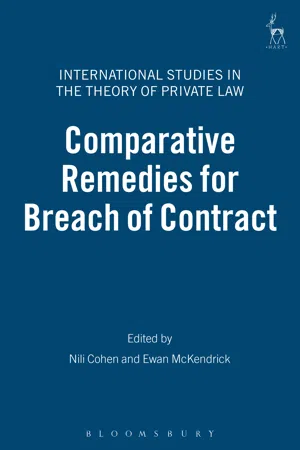
Comparative Remedies for Breach of Contract
- 368 pages
- English
- ePUB (mobile friendly)
- Available on iOS & Android
eBook - ePub
Comparative Remedies for Breach of Contract
About this book
The book provides a comparative analysis of the law relating to remedies for breach of contract. It examines different remedies such as specific performance and damages,doing so from the viewpoint of different legal systems, principally the English, American, German, French and Israeli. Each essay is written by a recognised specialist in his or her own field. Topics covered include the relationship between substantive rights and contract remedies, the recent reforms of the law relating to breach of contract in Germany, the remedies in the context of a third party beneficiary and the extent to which a claimant can choose the remedy which he or she deems to be the most appropriate. The book also makes use of a range of techniques, particularly economic analysis, when examining the legal rules. The book contains an introductory essay written by the editors and an essay by Professor Friedman, which deals with the relationship between substantive rights and contract remedies.
Information
Part One
Concepts, Coherence and Choice
1
Rights and Remedies
I INTRODUCTION
THE RELATIONS OF rights and remedies are subtle and complex and raise a number of issues. These include the questions: Can there be a legal right that is unprotected by a remedy?1 Is the nature of the legal right reflected in the type of remedy offered for its protection, or is it vice versa, namely is it the type of remedy available that sheds light upon the nature of the right involved? Another important issue, that received relatively little attention, relates to the role of discretionary remedies. Courts usually enjoy a broad discretion with regard to the type of remedy to be granted. This means that similar or even identical rights may, in certain circumstances, be accorded one type of remedy for their protection, while in other, sometimes quite similar circumstances, a different type of remedy would be offered. How does this discretion, or rather inconsistency, in the field of remedies affect our understanding of the nature of the legal right involved and the right-remedy relations?
There are four models that can explain the rights-remedies relations:
1) The primacy of the remedy model
2) The primacy of the right model
3) The unity of the right-remedy model
4) The ‘acoustic separation’ model.
II THE PRIMACY OF THE REMEDY MODEL
Under this model it is the potency of remedy and its availability which determines the nature of the legal right and, indeed, its very existence. The right derives from the remedy and as a matter of sequence the remedy precedes the right. Consequently the absence of a remedy points to the non-existence of a legal right. This model is in line with the traditional approach of the common law under which ‘where there is a remedy there is a right’ (ubi remedium ibi ius), and the granting of a remedy via an action in court remains to date a major vehicle for the development of new legal entitlements and the expansion of established legal rights.2
This model, in its extreme form, was adopted by Holmes in whose view ‘[t]he primary rights and duties with which jurisprudence busies itself ... are nothing but prophesies.’ A legal right (and a legal duty) ‘is nothing but a prediction that if a man does or omits certain things he will be made to suffer in this or that way by judgment ot the court’.3 This view was followed by the ‘bad man’ approach to the law. The ‘bad man’ does not worry about rights. He is concerned only with legal consequences, namely sanctions and remedies. Hence the absence of a remedy means freedom of action. In fact, freedom of action is maintained even if a remedy is available but that remedy falls short of actually preventing the specific course of action. In this type of situation it is open to the obligated party to weigh the advantages of breaching the other party’s right against the ‘cost’ of the remedy and to decide accordingly. The famous example is that of breach of contract, which Holmes assumes entails mere liability in damages. The denial of specific enforcement leads him to the conclusion that a party to a contract may (or perhaps we should say: is entitled) to breach the contract subject to his liability to pay damages.4
The difficulty with this approach lies in its assumption that the remedy provides a perfect substitute5 for the right. It is a kind of indulgence that the wrongdoer is entitled to purchase. The fact that the remedy is designed to vindicate the right, not to replace it, is disregarded.6 Similarly disregarded is the distinction between price on the one hand and remedies and sanctions on the other.7 A sign that provides: ‘Parking Prohibited, Penalty $10’ is viewed as identical to a sign: ‘Parking Allowed. Price $10’.
No doubt, there are rare situations in which a party is unilaterally entitled to ‘encroach and pay’ or in other words to ‘purchase’ the right to infringe upon another’s entitlement. The decision in Vincent v Lake Erie Transportation Co provides a conspicuous example.8 In that case the defendant’s ship unloaded cargo at the plaintiff’s dock. When unloading was complete a violent storm developed and it became highly dangerous for the vessel to leave the dock. The master decided to leave the vessel moored and the wind and waves threw it against the dock. The court recognised the defence of necessity, but held the defendant liable for the damage caused to the dock on the ground that ‘where the defendant prudently ... avails itself of the plaintiffs’ property for the purpose of preserving his own more valuable property ...the plaintiffs are entitled to compensation for the injury done’.9
This decision provided the cornerstone for the incomplete privilege theory developed by Bohlen, under which
an act may be so far privileged as to deprive the person whose interest is invaded ... of the privilege ... to terminate or prevent the invasion ... but not so far as to relieve [the actor] from liability to pay for any material damage he does thereby.10
This approach has been adopted by the Restatement (Second) of Torts11 and the Restatement of Restitution.12 The question whether liability in this type of situation is in torts or in restitution has long been debated,13 but need not concern us here. For our purposes it suffices to point out the distinction between impermissible trespass or encroachment of another’s protected interest on the one hand and the use or appropriation of another’s entitlement within the ambit of the incomplete privilege doctrine on the other hand. This distinction has some practical implications. Thus, in the case of impermissible trespass the owner may use self-help to resist or expel the intruder. But where the intruder’s act is permissible under the incomplete privilege doctrine, the owner is required to tolerate the intrusion. In such a case an attempt by the owner to expel or resist the intruder is wrongful and constitutes a tort vis-à-vis the intruder.14 Such practical implications may seem marginal,15 but the basic distinction between a wrong and a permissible act remains important. In the one case the actor committed a transgression. His act was legally as well as morally wrong, and the function of the remedy is not only to compensate the victim but also to deter such conduct. In the other case the remedy is more like a price. It is a payment which the actor is required to make for having lawfully appropriated or damaged that which belongs to another.16
The famous article by Fuller and Perdue ‘The Reliance Interest in Contract Damages’17 appeared some 50 years after the publication of Holmes’ theory. It shares Holmes’ fascination with remedies, places the emphasis upon the remedy of damages and almost completely disregards the possibility of specific performance. Holmes’ theory as well as Fuller and Perdue’s article represent the centrality of the remedy approach and reflect an attempt to view the contractual right through the looking glass of the damages awarded for its breach.18
The well-known article by Calabresi and Melamed ‘Property Rules, Liability Rules and Inalienability: One View from the Cathedral’19 deviates in one aspect from the strict dominance of the remedy model. It assumes that decisions as to entitlements, namely allocation of legal rights, must precede the determination as to their protection via the law of remedies. But in other respects it follows Holmes’ approach and emphasises the centrality of the remedy to the understanding of the nature of the legal right and its implication for the actor’s freedom of action. Calabresi and Melamed assume that an entitlement can be protected either by a property rule or a liability rule (in addition it might be inalienable). When an entitlement is protected by a liability rule it means that ‘someone (a ‘bad man’?) may destroy the initial entitlement if he is willing to pay an objectively determined value for it’. A number of examples are offered to demonstrate the application of a liability rule. These include eminent domain and cases of nuisance for which no injunction is granted so that the plaintiff’s remedy is limited to damages. Also included in this category are accidents on the ground that potential victims have no right to stop the activity that might injure them.
If we were to give victims a property entitlement not to be accidentally injured we would have to require all who engage in activities that may injure individuals to negotiate with them before the accident, and to buy the right to knock off an arm or a leg.20
It is thus conspicuous that no distinction is drawn between permissible conduct and wrongful misconduct, and there is similar failure to distinguish between the price of acquisition and damages imposed for the consequences of a wrong. Eminent domain, accidents and some nuisances are all included in the same category of ‘liability rules’. In the case of eminent domain, which is a permissible appropriation of property against payment, the payment to the owner is simply the price, which the public authority is required to pay for the lawful (albeit forced) taking. In the case of accidents and nuisance the payment, which the wrongdoer is liable to make, constitutes damages for the wrong. However, the tacit assumption, in line with Holmes’ approach, is that this distinction makes no difference. Since mere monetary payment is involved in all these situations, they can all be included in the same category of liability rules, within which a person is allowed to appropriate or damage another’s protected interest subject to the payment of money, and the question whether such payment is to be regarded as damages or price is of no moment.
At this stage I would also point out that Calabresi and Melamed disregard certain situations which do not fit neatly in their division of the subject, eg the case in which an employee, in breach of his contract, seeks to work for another employer. The former employer may sometimes get an injunction but not specific performance.21 More problematic is the very common situation in which the court has a discretion with regard to the remedy. It may grant specific performance or an injunction, but it may deny these remedies and hold that the award of damages is the only appropriate remedy. How is the plaintiff’s interest to be classified beforehand or is it capable of being classified only after the court rendered its decision? The significance of discretion for the proper understanding of the rights — remedies connection is further examined below.22
III THE PRIMACY OF THE RIGHT MODEL
This model seems to follow naturally from any attempt systematically to organise the law. It is typical of the continental legal systems and is likely to be adopted in any systematic codification. Every comprehensive legislation in the field of private law is likely to begin by defining legal rights and duties. This approach which is often termed ‘from rights to remedies’ or ‘where there is a right there must be remedy’ assumes that the legal right precedes the remedy both in time and in importance. Remedies are merely derivative and follow from the legal rights. Under such an approach legal rights have an independent existence and it is possible to conceive of legal rights unsupported by legal remedies.
As a matter of interpretation a question sometimes arises: what is the position where the law defines a right without referring to the remedy to be granted in case of its breach? Is it to be assumed that a remedy must be available on the ground that ‘where there is a right there must be a remedy’,23 and if so what kind of remedy, or should it be assumed that the whole array of remedies recognised by the legal system is to be applied? The following examples illustrate the issue:
1) Section 9 of the Israeli Land Law 1969 deals with ‘conflicting transactions’. It provides in essence that where a person undertakes to effect a transaction in land and, before this transaction is completed, he undertakes towards another person to effect a conflicting transaction ‘the party to the first transaction shall prevail’. This rule does not apply if the party to the second transaction ‘has acted in good faith and for consideration’ and title was transferred to him ‘while he is still in good faith’.
The section thus provides an order of priority between conflicting transactions. It reflects an idea similar to the Anglo-American concept of ‘equitable ownership’, under which the purchaser’s contractual right is stronger than a mere personal right and comes close to a real (property) right.24 But the section says little about the remedial implications in case of a breach, except that ‘the party to the first transaction shall prevail’. This obviously means that if claims for specific performance are brought against the seller both by the party to the first and the party to the second transaction, the claim of the former will be allowed while the claim of the latter will be denied (but the party to the second transaction will presumably be entitled to damages for breach of contract). It is also clear that the party to the first transaction can direct his claim for specific performance not only against the seller but also against the party to the second transaction, if the latter acquired title without consideration or without being in good faith. But what about other potential remedies? Can the party to the first transaction claim damages from the party to the second transaction, if the latter acquired title without consideration or without being in good faith, on the ground that such acquisition of title infringes the right of the party to the first transaction? And if the party to the second transaction sold the property, can the party to the first transaction claim the proceeds of the sale in restitution? The answer to these questions depends on our understanding of the nature of the right of the party to the first transaction and our assumption regarding the type of remedies available for its protection.25
The section thus provides an order of priority between conflicting transactions. It reflects an idea similar to the Anglo-American concept of ‘equitable ownership’, under which the purchaser’s contractual right is stronger than a mere personal right and comes close to a real (property) right.24 But the section says little about the remedial implications in case of a breach, except that ‘the party to the first transaction shall prevail’. This obviously means that if claims for specific performance are brought against the seller both by the party to the first and the party to the second transaction, the claim of the former will be allowed while the claim of the latter will be denied (but the party to the second transaction will presumably be entitled to damages for breach of contract). It is also clear that the party to the first transaction can direct his claim for specific performance not only against the seller but also against the party to the second transaction, if the latter acquired title without consideration or without being in good faith. But what about other potential remedies? Can the party to the first transaction claim damages from the party to the second transaction, if the latter acquired title without consideration or without being in good faith, on the ground that such acquisition of title infringes the right of the party to the first transaction? And if the party to the second transaction sold the property, can the party to the first transaction claim the proceeds of the sale in restitution? The answer to these questions depends on our understanding of the nature of the right of the party to the first transaction and our assumption regarding the type of remedies available for its protection.25
2) A somewhat similar issue arises with regard to remedies for breach of contract. All modern legal systems offer a set of remedies for breach of contract, notably specific performance, damages and termination. A question does however arise whether the traditional remedies are exhaustive or is the injured party also entitled to restitution of the profits gained by the other party as a result of the breach? A detailed discussion of this issue will not be attempted here.26 For our purposes it suffices to point out the approach under which the issue is to be determined in accordance with our understanding of the nature of the contractual right and the type of entitlement that it confers upon the parties to the agreement. If the contractual right is conceived as a kind of property,27 a right that confers upon its owner an entitlement to the other party’s performance,28 then it may be concluded that the innocent party can recover the profits gained by the other party in consequence of the breach. It should however be noted that there is a great diversity among contractual rights. They differ in their content, ambit and the nature of the entitlement that they confer. It is thus clearly conceivable that some remedies, such as enforcement or restitution of gains will be available for certain contractual rights but not for others.
Another issue relates to classification. It is clear that the different remedies are available to protect different rights. In fact the twofold division of property rules versus liability rules, reflects an oversimplification, since there is a whole gamut of pos...
Table of contents
- Cover
- Title
- Copyright
- List of Contributors
- Contents
- Table of Cases
- Table of Legislation
- Introduction
- Part One: Concepts, Coherence and Choice
- Part Two: Comparisons
- Part Three: Specific Performance and Damages
- Index
Trusted by 375,005 students
Access to over 1.5 million titles for a fair monthly price.
Study more efficiently using our study tools.
Frequently asked questions
Yes, you can cancel anytime from the Subscription tab in your account settings on the Perlego website. Your subscription will stay active until the end of your current billing period. Learn how to cancel your subscription
No, books cannot be downloaded as external files, such as PDFs, for use outside of Perlego. However, you can download books within the Perlego app for offline reading on mobile or tablet. Learn how to download books offline
Perlego offers two plans: Essential and Complete
- Essential is ideal for learners and professionals who enjoy exploring a wide range of subjects. Access the Essential Library with 800,000+ trusted titles and best-sellers across business, personal growth, and the humanities. Includes unlimited reading time and Standard Read Aloud voice.
- Complete: Perfect for advanced learners and researchers needing full, unrestricted access. Unlock 1.5M+ books across hundreds of subjects, including academic and specialized titles. The Complete Plan also includes advanced features like Premium Read Aloud and Research Assistant.
We are an online textbook subscription service, where you can get access to an entire online library for less than the price of a single book per month. With over 1.5 million books across 990+ topics, we’ve got you covered! Learn about our mission
Look out for the read-aloud symbol on your next book to see if you can listen to it. The read-aloud tool reads text aloud for you, highlighting the text as it is being read. You can pause it, speed it up and slow it down. Learn more about Read Aloud
Yes! You can use the Perlego app on both iOS and Android devices to read anytime, anywhere — even offline. Perfect for commutes or when you’re on the go.
Please note we cannot support devices running on iOS 13 and Android 7 or earlier. Learn more about using the app
Please note we cannot support devices running on iOS 13 and Android 7 or earlier. Learn more about using the app
Yes, you can access Comparative Remedies for Breach of Contract by Nili Cohen, Ewan McKendrick, Nili Cohen,Ewan McKendrick in PDF and/or ePUB format, as well as other popular books in Law & Contract Law. We have over 1.5 million books available in our catalogue for you to explore.