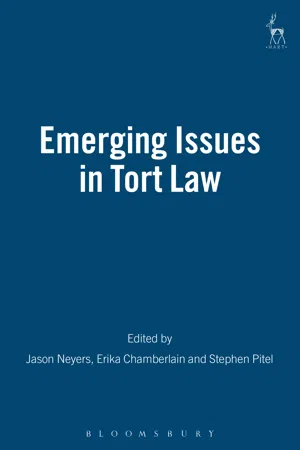
In this book, articles by leading tort scholars from Australia, Canada, Hong Kong, Israel, New Zealand, the United Kingdom and the United States deal with important theoretical and practical issues that are emerging in the law of torts. The articles analyse recent leading developments in areas such as economic negligence, causation, vicarious liability, non-delegable duty, breach of statutory duty, intentional torts, damages, and tort law in the family. They provide a foretaste of the issues that will face tort law in the near future and offer critical viewpoints that should not go unheeded. With its rich breadth of contributors and topics, Emerging Issues in Tort Law will be highly useful to lawyers, judges and academics across the common law world.
Contributors: Elizabeth Adjin-Tettey, Kumaralingam Amirthalingam, Peter Benson, Vaughan Black, Peter Cane, Erika Chamberlain, Israel Gilead, Paula Giliker, Rick Glofcheski, Lewis N Klar QC, Michael A Jones, Richard Lewis, John Murphy, Jason W Neyers, Ken Oliphant, David F Partlett, Stephen GA Pitel, Denise Reaume, Robert H Stevens, Andrew Tettenborn, Stephen Todd, Shauna van Praagh, Stephen Waddams, David R Wingfield, Richard W Wright.
- 610 pages
- English
- ePUB (mobile friendly)
- Available on iOS & Android
eBook - ePub
Emerging Issues in Tort Law
About this book
Information
1
General and Special Tort Law: Uses (and Abuses) of Theory
I. THE GENERAL/SPECIAL DISTINCTION
THE YEAR 1953 saw the publication of a major work by Glanville Williams entitled Criminal Law: The General Part.1 The book’s title alluded to a distinction—which Williams attributed to civil law systems—between the general and special parts of the criminal law. The author’s declared motivation in adopting this distinction was practical: in the case of many crimes, the statutory provisions creating them have not, he observed, been the subject of judicial consideration. But there are certain general principles that apply to all crimes, an understanding of which would be useful to the practitioner confronted with a statutory provision as yet devoid of judicial interpretation. The topics covered in the book included mental states, attempts, the ‘principle of legality’, corporations, burden of proof, and so on. Various theorists of the criminal law have subsequently developed sophisticated ‘philosophical’ accounts of the general/special distinction. In recent years it has attracted more and more attention, to the point where it has recently been the subject of two substantial volumes of essays by leading scholars, one on the general part2 and another on the special part.3
Another area in which the general/special distinction has made some impact is contract law. Here, the standard (student) texts tend to focus on general principles, detailed separate treatment of specific contracts such as bailment, construction, sale and so on being left to works written primarily for practitioners, such as Chitty on Contracts.4 But whereas civil law systems (following Roman law) tend to be structured primarily in terms of specific types of contract, common law systems start from general principles, developed through the action of assumpsit, and create categories of contracts by the implication of terms tailored to specific types of transaction.5 Unlike criminal law theorists, contract law theorists have shown little interest in developing philosophical accounts of the general/special distinction. For this reason, and because contract law is outside my comfort zone, I will consider it no further in this chapter.
What about tort law? That, loosely put, is the question addressed in this chapter. At the outset, it is important to distinguish this from a different question, much discussed by writers on tort law in the late 19th and early 20th centuries when tort law was being created as a distinct legal category. This chapter is not concerned with the question of whether tort law (or some part of it, such as negligence law) is underpinned by a single liability-generating ‘principle’ such as ‘the fault principle’ or whether, on the contrary, tort law consists of various, more specific ‘rules’ of liability.6 The concern, in other words, is not whether tort law can be described as what I have elsewhere called a ‘loose federation of causes of action’7 into one or another of which claimants must fit their case or whether, by contrast, it is for the defendant to give some good reason why a claim that falls within a broad principle of liability should, nevertheless, not succeed.8 As we will see in more detail later, on no account of the general/special distinction in criminal law does the general part consist of one or more principles that generate the grounds of liability (‘crimes’) contained in the special part. Rather the general part deals with principles (or ‘elements’ or ‘conditions’) of liability that apply to offences contained in the special part. So, for instance, as commonly understood, the general part of the criminal law deals with culpability concepts such as intention and recklessness, and with the concept of attempting a crime, while the special part tells us what sorts of conduct—what acts and omissions—are ‘criminal’: murder, theft, rape and so on.
The distinction between these two different questions can be framed in another way. Tort lawyers sometimes debate whether we have a law of tort or a law of torts. At one level, the answer seems obvious—we have a law of torts: trespass, nuisance, defamation, negligence, conspiracy and so on. In the same way (although the issue is undebated) we have a law of crimes—murder, rape, theft and so on—not a law of crime. But that conclusion tells us nothing about whether tort law has two parts—general and special—or whether we would do well to think about tort(s) law in this way, just as the fact that there are numerous ‘crimes’ has not prevented criminal law theorists from identifying two parts of the criminal law, and debating their respective nature and contents, and the utility of the distinction between them. So the puzzle is why tort lawyers and theorists have not identified tort law as a two-part affair, and the question is whether there would be any advantage in doing so.
Any attempt to solve the puzzle and answer the question requires us first to pay closer attention to the relevant debates in criminal law and criminal law theory. Having done that, I will briefly explore what tort theorists have made of the general/special distinction. There then follows a section which asks what benefits, if any, might be gained by reconstructing tort law along the lines of a general/special distinction. Finally, I express some concerns about the use of legal theory as illustrated by certain aspects of the debates around the general/special distinction.
II. A TWO-PART CRIMINAL LAW
The best place to start may be with Michael Moore, who has provided the most systematic and detailed account of and justification for the general/special distinction in criminal law.9 According to Moore, citing George Fletcher in support,10 the ‘traditional’ view is that the general part contains ‘doctrines that apply to all crimes’ and the special part ‘doctrines that define particular crimes’.11 Whereas Williams thought that the general/special distinction, thus drawn, had practical use, Moore thinks it useful pedagogically: since time is short, it is better to teach students those parts of the criminal law that have general application than to bother with the details of particular crimes. But he also thinks that the distinction, differently drawn, has theoretical significance. It reflects, he says, two kinds of ‘moral’ ‘judgment’ or ‘theory’: one about when we can say that a person has done something wrong and the other about when we can say that a person is (or ought to be held) responsible for his or her wrongdoing. The general part provides a theory of responsibility while the special part provides an account of wrongful action. Although he thinks that the two ways of drawing the general/special distinction will divide up criminal law doctrine in much the same way, Moore prefers the latter to the former because, in his opinion, the function of the criminal law is to ‘attain retributive justice’. As he observes, ‘Retributive justice demands that those [and only those] who deserve punishment get it.’12 A person deserves punishment if he or she has done wrong culpably. The special part tells us what acts and omissions are wrong, and the general part provides an account of culpability.
For Moore, then, the general/special distinction is a theoretically useful, and incidentally a descriptively accurate, way of thinking about criminal law because the criminal law has a single goal, the attainment of which requires the satisfaction of two separate criteria (wrongdoing and responsibility). By contrast, he says, the general/special distinction is not a theoretically useful way of thinking about property law because (in his view) property law serves three goals, which he calls ‘utility’, ‘fairness’ and ‘distributive justice’, rather than one. It is also not useful because although property law might be said to have a special part—distinguishing between real property, personal property, intellectual property, and so on—in his opinion it lacks general criteria analogous to criteria of responsibility/culpability in criminal law governing the acquisition, use and transfer of the various kinds of property. So far as tort law is concerned, Moore’s view is that the general/special distinction could be theoretically useful on the assumption that tort law can, by way of plausible description/explanation/interpretation, and should, by way of prescription, be understood in terms of (the single function of realising) ‘corrective justice’.
Moore’s ostensible aim is to provide an argument in favour of according the general/special distinction theoretical (‘moral’) significance and not just practical or educational significance. For him, the distinction is a necessary corollary of the proposition that the normative function of the criminal law is and should be the attainment of retributive justice by punishing, and punishing only, culpable wrongdoers. Nicola Lacey challenges Moore’s view that the general/special distinction is in some sense intrinsic to criminal law by pointing out that the contrast between culpability and wrongdoing is relatively modern, and was much less sharply drawn in the 18th and 19th centuries.13 While this criticism may cast doubt on any claim that Moore has discovered timeless or universal truths about criminal law, it does not obviously undermine his account of necessary conditions for a theoretically useful general/special distinction. Lacey also takes Moore to task for his views that (1) responsibility is a matter of fact14 and a theory of responsibility is a metaphysical theory, whereas (2) in order to be ‘interesting and useful’ a theory of wrongdoing must be ‘normative’.15 The idea that the concepts of culpability and wrongdoing are of qualitatively different types strikes me as odd; but once again, this view seems incidental to Moore’s argument about the usefulness of the general/special distinction.
Finally, Lacey questions whether the distinction between culpability and wrongdoing can be consistently drawn—by Moore, at least.16 Her argument here seems to turn on a further distinction between consequentialist and non-consequentialist theories of wrongdoing. The so-called ‘harm principle’ forms the basis of a consequentialist theory of wrongdoing,17 whereas Moore subscribes to what he calls ‘non-exclusionary legal moralism’ according to which the fact that a type of act or omission is (‘morally’) wrong always counts in favour of its criminalisation regardless of consequences—which is not to say, of course, that consequences should never be taken into account. Lacey apparently thinks that a theorist such as Moore, who adopts a non-consequentialist (or, as Moore refers to it, an ‘agent-relative’) theory of wrongdoing cannot tell us when and why ‘killing’, for instance, is wrong without taking account of the killer’s culpability. In other words, in Lacey’s view a non-consequentialist theory of wrongdoing cannot be independent of a theory of culpability, and so no clear distinction can be drawn between the general and special parts of the criminal law. This is a puzzling objection. For instance, a person might think that unjustified killing is wrong, because it shows disrespect for human life in general and the victim in particular, even if the killer does not, for some reason, deserve to be blamed or punished for the killing. Others may disagree, of course, but the view is not logically flawed.
In fact, consequentialist accounts of wrongdoing actually support and, indeed, require some version (akin to Moore’s) of the general/special distinction. Consequentialism about wrongdoing implies that the function of the criminal law is to prevent bad consequences in the future. There is no reason, in principle, to think that punishing a person responsible for some bad consequence in the past will contribute to the prevention of bad consequences of that type in the future, whether caused by that person or anyone else. If consequentialism governed allocation of criminal punishment as well as specification of criminal wrongfulness, the person rightly punished for any particular bad consequence would be the person judged to be in the best position to prevent consequences of that type in the future, whether caused by the person who caused the particular bad consequence or anyone else, and that person might or might not be the person who actually caused the bad consequence in question.
The point is familiar enough in the context of economic analysis of tort law. For instance, causation of harm in the past has no independent significance in the search for Calabresi’s cheapest cost avoider.18 As corrective justice theorists never tire of stressing, economic analysis cannot explain the bilateral structure of tort law: the basic (causal) link it forges between doing and suffering of harm. This was Hart’s point, too, when he distinguished between the general justifying aim of the criminal law and principles for the distribution of punishment.19 Pithily put, consequentialist theories of wrongdoing yield no independent theory of responsibility for past wrongs. In order to explain (and justify) the criminal law (and tort law) we actually have, the consequentialist theorist of wrongdoing needs a separate non-consequentialist theory of responsibility. So even if Lacey is right to say that the non-consequentialist theorist of wrongdoing will have trouble distinguishing clearly between his or her theory of wrongdoing and theory of culpability, the consequentialist theorist must be able to do so in order to produce a theory of the criminal law that has any pretensions at all to descriptive or explanatory validity. A fortiori, if the consequentialist wants to justify the sort of criminal law we actually have.
As I read it, Lacey’s study of the history of criminal law theory20 provides little support for her attack on Moore’s account of the general/special distinction. Moore derives that account from his views (1) that criminal law has a function (is ‘a functional kind’, as he puts it);21 (2) that unlike property law it has a single function that in case of conflict overrides all other functions it might serve; and (3) that its overriding function is to attain retributive justice. Lacey’s account supports the conclusion that 18th and 19th century writers who made much less of the general part, as understood in modern criminal law theory, did not share Moore’s vision of the criminal law. So it is not surprising that they did not adopt his approach to the general/special distinction. The fundamental basis of L...
Table of contents
- Cover
- Title
- Copyright
- Foreword
- Contents
- Contributors
- Introduction
- 1 General and Special Tort Law: Uses (and Abuses) of Theory
- 2 Breach of Statute and Tort Law
- 3 ‘Sois Sage’—Responsibility for Childishness in the Law of Civil Wrongs
- 4 Claims of Involuntary Parenthood: Why the Resistance?
- 5 Liability for Psychiatric Damage: Searching for a Path between Pragmatism and Principle
- 6 Should White v Jones Represent Canadian Law: A Return to First Principles
- 7 Breaches of Contracts and Claims by Third Parties
- 8 Policy Issues in Defective Property Cases
- 9 Defective Structures and Economic Loss in the United States: Law and Policy
- 10 Harm Screening Under Negligence Law
- 11 Acts and Omissions as Positive and Negative Causes
- 12 Decision Causation: Pandora’s Tool-Box
- 13 Non-Delegable Duties and Vicarious Liability
- 14 Juridical Foundations of Common Law Non-Delegable Duties
- 15 Perish Vicarious Liability?
- 16 Comparative Perspectives on Vicarious Liability: Defining the Scope of Employment
- 17 What is a Loss?
- 18 The Changing Face of the Gist of Negligence
- 19 Tort Law in Practice: Appearance and Reality in Reforming Periodical Payments of Damages
- 20 The Structure of the Intentional Torts
- 21 The Role of Intention in the Tort in Wilkinson v Downton
- 22 Where Principle Meets Pragmatism: Tort Law in Post-Colonial Hong Kong
- Epilogue
- Index
Trusted by 375,005 students
Access to over 1.5 million titles for a fair monthly price.
Study more efficiently using our study tools.
Frequently asked questions
Yes, you can cancel anytime from the Subscription tab in your account settings on the Perlego website. Your subscription will stay active until the end of your current billing period. Learn how to cancel your subscription
No, books cannot be downloaded as external files, such as PDFs, for use outside of Perlego. However, you can download books within the Perlego app for offline reading on mobile or tablet. Learn how to download books offline
Perlego offers two plans: Essential and Complete
- Essential is ideal for learners and professionals who enjoy exploring a wide range of subjects. Access the Essential Library with 800,000+ trusted titles and best-sellers across business, personal growth, and the humanities. Includes unlimited reading time and Standard Read Aloud voice.
- Complete: Perfect for advanced learners and researchers needing full, unrestricted access. Unlock 1.5M+ books across hundreds of subjects, including academic and specialized titles. The Complete Plan also includes advanced features like Premium Read Aloud and Research Assistant.
We are an online textbook subscription service, where you can get access to an entire online library for less than the price of a single book per month. With over 1.5 million books across 990+ topics, we’ve got you covered! Learn about our mission
Look out for the read-aloud symbol on your next book to see if you can listen to it. The read-aloud tool reads text aloud for you, highlighting the text as it is being read. You can pause it, speed it up and slow it down. Learn more about Read Aloud
Yes! You can use the Perlego app on both iOS and Android devices to read anytime, anywhere — even offline. Perfect for commutes or when you’re on the go.
Please note we cannot support devices running on iOS 13 and Android 7 or earlier. Learn more about using the app
Please note we cannot support devices running on iOS 13 and Android 7 or earlier. Learn more about using the app
Yes, you can access Emerging Issues in Tort Law by Jason W Neyers,Erika Chamberlain,Stephen G.A. Pitel in PDF and/or ePUB format, as well as other popular books in Law & Contract Law. We have over 1.5 million books available in our catalogue for you to explore.