Privacy today is much debated as an individual's right against real or feared intrusions by the state, as exemplified by proposed identity cards and surveillance measures in the United Kingdom. In contrast, invasions of privacy by private individuals or bodies tend to arouse less concern. This book attempts to fill the gap by looking at the horizontal application of human rights after Douglas v Hello, Campbell v MGN and Caroline von Hannover v Germany. It provides a conceptual and theoretical framework and also considers specific particularly sensitive areas of law relating to privacy protection, such as intellectual property, employment and media law. It provides comparative perspectives by relating Article 8 of the European Convention on Human Rights, which serves as a focal point, to UK, Dutch, German and European Communities law.
Several common threads are revealed running across jurisdictions and different areas of law and aspects of privacy. The most notable is the definition of privacy in terms of the autonomy of the individual, a notion associated with the liberal state in the classic sense but now acquiring more content as a human right also linked to ideas of social justice.
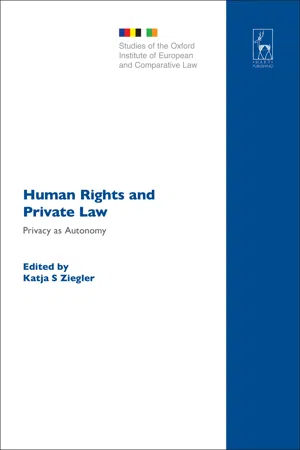
- 242 pages
- English
- ePUB (mobile friendly)
- Available on iOS & Android
eBook - ePub
About this book
Information
1
Introduction: Human Rights and Private Law – Privacy as Autonomy
WHAT IS THE meaning of ‘privacy’? Authors struggle to find a single definition. Privacy is not only a single human right but also a collective term for a multiplicity of rights that have both general and specialist fields of application. This is exemplified by Article 8 of the European Convention on Human Rights: it protects a number of rights that can be brought under the heading of privacy: private life, family life, protection of the home and various freedoms of communication. Here the two somewhat contradictory rationales of privacy appear, giving rise to different strands of interpretation. First, privacy as seclusion or intimacy which is often, as a point of departure, spatially defined; other definitional approaches in this strand might be by the types of action or information that might be considered as private by ‘substance’. Second, privacy as freedom of action, self-determination and autonomy. Privacy, however, is only split in this sense at first sight: the two strands can be united again in perceiving privacy as protecting the free development of one’s personality, that is, self-realisation and autonomy in a wider sense. Both freedom of action and communication in social or public contexts and the ‘right to be let alone’1 and to be able to withdraw to a space of retreat2 are necessary for the development of one’s personality. Indeed, as David Feldman has pointed out, this gets as close as one can to the essence of liberty itself.3
Hans Nieuwenhuis thus sets the scene by inquiring into the meaning of privacy and what different expressions of privacy have in common. Pointing to a transatlantic divide between ‘libertarian’ and ‘dignitarian’ approaches to privacy, as diagnosed by James Q Whitman,4 which reflects underlying (neo)liberal and social democratic theories of human rights, he shows that their alleged antagonism is exaggerated. Stressing different facets of liberty and dignity, he concludes that both include the notion of autonomy. Therefore, at a higher level, he identifies autonomy as the overarching principle and common denominator of various privacy rights. This can be said to reflect the interpretation of Article 8 of the European Convention on Human Rights by the European Court of Human Rights.
Acknowledging the difficulties involved in defining what privacy is, this book neither attempts nor purports to offer one ‘ultimate’ definition. It looks instead at the diversity of the right to privacy. Nor does it limit itself to ‘prototypical’ privacy situations like privacy from public gaze, and the debates over what are private acts and what can justify intrusions on privacy. It covers questions as diverse as the following, from the classical to the less obvious: can we, and how do we, strike an appropriate balance between ‘private’ and ‘public’ where freedom of expression and privacy interests conflict (Nieuwenhuis, Fastrich, Ziegler, Treiger-Bar-Am & Spence)? What claims and actions against private parties can a celebrity derive from privacy when objecting to photographs being taken and published (Barber, Bagshaw, Lindenbergh)? What is the role of privacy in balancing employees’ and employers’ interests in employment relationships (Coester, Freedland)? How do we deal with the intersection of freedom of contract and privacy, both when privacy refers to autonomy and self-determination, and in its very literal meaning of confidentiality of the contents of a contract (Snijders, Coester-Waltjen, Colombi Ciacchi)? How do privacy rights, as distinct from property rights, impact on the protection of moral rights in the context of intellectual property law (Drexl, Treiger-Bar-Am & Spence)?
With regard to the more theoretical aspects of the relationship between human rights and private law, conflicts which superficially appear to be between human rights on the one hand and private law principles on the other hand can be conceived as conflicts between different human rights or even between two claims derived from the same human right, such as privacy. An example of this is, on the one hand, the right to privacy and non-interference with one’s personality and freedom to act and, on the other hand, the freedom to act, including to engage in economic activity, to use one’s property as one likes or to express oneself. Such conflicts can be resolved only by balancing rival interests and rights. Thus concretions of such balancing in the law may have to be context-specific, as will the forms and methods of balancing, whether by the legislature, judiciary or every individual. From a wider angle, all contributions to this book are concerned with this question of balancing. They raise at least three issues:
1. How is balancing achieved on the level of definition (scope of protection) and on the level of justification of restrictions of conflicting human rights? This concerns both domestic and international law.
2. With regard to domestic law: how is balancing achieved in private law, and what are the requirements for balancing via private law? Balancing in this context implies choosing from a spectrum of solutions that may all be compatible with the human rights involved, but with different degrees of ‘optimisation’. Hence the question of ‘who decides’ is raised, which may result in a call for the legislature to act, for example by passing laws on the right to nondiscrimination or providing a general private law remedy for interferences with privacy, such as a specific action in tort. The availability of a remedy in itself may be seen as a decision about the balance of conflicting rights. Balancing can also be a more general, non-channelled duty to consider human rights when applying private law rules by way of direct or indirect horizontal application of human rights, which may be incumbent on public authorities, especially courts, but also possibly on private individuals.
3. A third question concerns the adequacy of balancing decisions at the domestic level. This takes in the actual and appropriate role and impact of the European Court of Human Rights on domestic law.
The broad approach towards privacy taken by this book is reflected in the diversity of themes running through it as common threads. First, the obvious diversity is that of specific issue areas which reflect particular balancing of different privacy interests and interests that conflict with privacy. The relevance of privacy in selected areas of law – contract, employment, intellectual property and media law – are the subject of Part Two of this collection of essays, to which we shall return.
The second diversity is that of the ‘addressee’ of a right to privacy. Privacy in vertical relationships, that is against the state, is topical in general public debate. The debates about introducing identity cards in the United Kingdom or surveillance measures in Germany are symptomatic of this. Privacy is far from being ‘old hat’ even in its state-oriented dimension, as is shown by cases like the electronic eavesdropping case in the German Bundesverfassungsgericht and increased obligations from the European level on telecommunication companies regarding the retention of data in the fight against terrorism.5 But the book does not deal with this aspect of privacy. Instead, it focuses on restraints on privacy by private actors: not on the Orwellian ‘Big Brother is watching you’, but more on ‘playing (with) Big Brother’. It looks at human rights concerns typically arising in private law – horizontal – relationships. This aspect of privacy seems to be of less general concern, at least on an empirical or phenomenological level, as shown by the widespread use of store cards and data held by private companies. Maybe – rightly or wrongly – it is because of the feeling of being in control that these more hidden or dispersed privacy invasions are not perceived with equal sensitivity. Some exceptions may have to be made regarding privacy intrusions by the media and employment situations. This is in spite of the practical reality that power is not only concentrated in the state but increasingly often in non-state actors, and also in spite of the additional conceptual difficulties that arise from the need to balance conflicting claims in private relationships. Naturally, all contributions raise the underlying issue of the horizontal application of human rights from a practical or critical perspective.
Part One of the book focuses on the horizontal application of human rights generally and of the human right to privacy in particular. Fastrich, Young and Colombi Ciacchi look at the interaction of the body of human rights law and private law in horizontal, or – if including the state’s duty to protect – triangular relationships from a broader and theoretical perspective (section B). Lorenz Fastrich discusses the functions of fundamental rights under the German Constitution (negative, protective and positive) and raises the dilemma that maximising human rights on one side of the scale may lead to restrictions on human rights on the other side. He demonstrates, discussing its Suretyship decision, how at least in situations of unequal bargaining power (when the market fails to provide a corrective), special inferiority and unusual risk, the German Constitutional Court applies human rights horizontally in private law and thereby corrects the private law outcome. Thus it shifts from a formal to a substantive concept of freedom.
Alison Young establishes a direct link between the emergence of a tort of privacy and the horizontal effect of human rights generally in English law, following the adoption of the Human Rights Act 1998. Noting the reluctance of the courts to address the question of horizontality directly, she reveals a plethora of different approaches that can be grouped into models of direct or indirect horizontality of varying degrees of strength. She concludes by affirming the need to protect Convention rights via indirect horizontal effect. The Convention’s relationship with the Common Law is depicted as supportive. Although the Convention tends merely to support the results reached by the Common Law, they both underpin its values and principles and provide an easier and more structured way of achieving these results. In this context one might point to the European-influenced change in the use of the principle of proportionality in English courts.6
Aurelia Colombi Ciacchi reflects on the wider picture and the importance of the horizontal application of human rights via courts in the context of constitutionalisation of the European Communities and from a macro-comparative perspective. From an outcome-based perspective, she concludes that the horizontal effect of privacy is closely related to social justice because ‘the right to be let alone’ can be used to balance against influences resulting from agglomerations of power of any kind. International legal sources, most notably the European Convention on Human Rights, provide a basis for harmonisation of the laws at least to a European minimum standard of human rights.
Section C is dedicated to one example of horizontal application: the insertion of a right to privacy into tort law, discussed by Barber, Bagshaw and Lindenbergh. One aspect of the horizontal application of human rights – in this case to privacy – concerns the availability of a remedy or action. This theme reflects the debate in the United Kingdom after the Douglas v Hello! Ltd saga and Campbell v MGN, which was reinforced by the Caroline von Hannover v Germany decision of the European Court of Human Rights. A less recent but parallel development can be made out in the evolution of a claim for compensation based on tort for interferences with privacy derived directly from the constitutional rights, that is, human dignity and personality rights in Articles 1(1) and 2(1) of the German Constitution since the 1950s.7 This amounted to law-making by judges even contra legem, who set aside the Civil Code’s restriction on damages for non-pecuniary loss.8
Against this backdrop, NW Barber starts out by providing an overview of recent cases in the United Kingdom developing a general right (and tort) of privacy. Looking at the ethical, moral and social aspects of privacy, he criticises the trend towards juridification of the concept and questions the need for such legal protection. Where specific aspects of privacy need protection, it should be a matter for the legislature to regulate these specific issue areas and not for the judges to make these decisions.
Roderick Bagshaw considers the practical application of a privacy tort and stresses the difficulties in framing it, which in turn leads to a lack of foreseeability and legal certainty for individuals. These concerns are closely linked to the definitional problems with privacy and those of horizontal application of rights generally. The complicated balancing of conflicting liberty and security interests of the parties to a litigation would be too open-textured and hence should not be undertaken by judges. Also, the horizontal application of privacy is problematic because it will always burden a private individual ‘to comply with’ a human right, whereas in its original application as a negative right against the state, the burden (also of evidence) of justifying restrictions of privacy rests on the state. Privacy rights, therefore, cannot be transplanted lightly into private party relationships by a tort action where it is unclear where the boundaries lie between rights and duties.
Finally, Siewert Lindenbergh focuses on damages for privacy infringements in the system of tort law, particularly in Dutch and German law, and the special problems arising from compensation for non-pecuniary loss with its inherent problem of quantifying damages. As a certain loss will always remain in relation to a wrong, and compensation, therefore, is always the second-best option, he shifts the focus towards the preventive function of tort law: the threat of significant damages may be the only way to protect privacy effectively, especially where a profit can be gained by violations of privacy.
The third element of diversity in this book is the comparative approach, which is attempted within each paper. The aim is to provide national perspectives on common problems and on other jurisdictions rather than merely to describe national law (eg Colombi Ciacchi, Lindenbergh, Coester-Waltjen, Drexl, Freedland, Ziegler). This is facilitated through the unifying bracket of Article 8 of the European Convention on Human Rights and to some degree also EU human rights and secondary legislation, which provide ‘natural’ comparators and focal points for debate – as the von Hannover decision demonstrated.
Fourth, the wider approach is reflected in what may be carefully described as ‘not-only-legal’ debates, be they theoretical or moral. This is demonstrated in a critical approach to the horizontal application of human rights generally which stresses how problematic balancing processes are between individuals with regard to legal certainty and which questions in particular whether a general tort of privacy is a suitable remedy (Barber, Bagshaw). It is also reflected in the focus on the outcome of the horizontal application of human rights as a tool to achieve social justice (Colombi Ciacchi, Coester-Waltjen, Nieuwenhuis).
To return to the first diversity, that of issue areas: Part Two addresses specific problems of privacy arising in selected subject areas of the law: contract law (Snijders, Coester-Waltjen) employment law (Coester, Freedland), intellectual property law (Drexl, Spence, Treiger-Bar-Am) and media law (Ziegler).
Section A deals with contract law and human rights and a specific attempt at balancing the principle of non-discrimination with the freedom of contract. Against the backdrop of the two dimensions of privacy (intimacy and autonomy) Henricus Snijders identifies two correlating aspects of privacy in contract law. Intimacy refers to confidentiality of contract, for example, keeping the terms of a contract secret. Autonomy (rather than the alternative right to property) relates to the freedom to contract, both in the sense of the ‘if’ (conclusion) and the ‘how’ (content) of a contract. He also puts the conclusion of a contract which is a form of communication into the context of freedom of expression. He concludes that both the freedom of contract and its limitations derive from human rights.
Dagmar Coester-Waltjen then looks at a specific example of a re...
Table of contents
- Cover
- Title
- Copyright
- Series Editor’s Foreword
- Preface
- Contents
- List of Contributors
- Table of Cases
- Table of International and European Instruments
- Table of National Instruments
- 1 Introduction: Human Rights and Private Law – Privacy as Autonomy Katja S Ziegler
- Part I: Cross-Sectional Issues: Human Rights and Private Law
- Part II: Restraints on Privacy by Private Parties: Specific Issue Areas
- Index
Trusted by 375,005 students
Access to over 1.5 million titles for a fair monthly price.
Study more efficiently using our study tools.
Frequently asked questions
Yes, you can cancel anytime from the Subscription tab in your account settings on the Perlego website. Your subscription will stay active until the end of your current billing period. Learn how to cancel your subscription
No, books cannot be downloaded as external files, such as PDFs, for use outside of Perlego. However, you can download books within the Perlego app for offline reading on mobile or tablet. Learn how to download books offline
Perlego offers two plans: Essential and Complete
- Essential is ideal for learners and professionals who enjoy exploring a wide range of subjects. Access the Essential Library with 800,000+ trusted titles and best-sellers across business, personal growth, and the humanities. Includes unlimited reading time and Standard Read Aloud voice.
- Complete: Perfect for advanced learners and researchers needing full, unrestricted access. Unlock 1.5M+ books across hundreds of subjects, including academic and specialized titles. The Complete Plan also includes advanced features like Premium Read Aloud and Research Assistant.
We are an online textbook subscription service, where you can get access to an entire online library for less than the price of a single book per month. With over 1.5 million books across 990+ topics, we’ve got you covered! Learn about our mission
Look out for the read-aloud symbol on your next book to see if you can listen to it. The read-aloud tool reads text aloud for you, highlighting the text as it is being read. You can pause it, speed it up and slow it down. Learn more about Read Aloud
Yes! You can use the Perlego app on both iOS and Android devices to read anytime, anywhere — even offline. Perfect for commutes or when you’re on the go.
Please note we cannot support devices running on iOS 13 and Android 7 or earlier. Learn more about using the app
Please note we cannot support devices running on iOS 13 and Android 7 or earlier. Learn more about using the app
Yes, you can access Human Rights and Private Law by Katja S Ziegler in PDF and/or ePUB format, as well as other popular books in Politics & International Relations & Human Rights. We have over 1.5 million books available in our catalogue for you to explore.