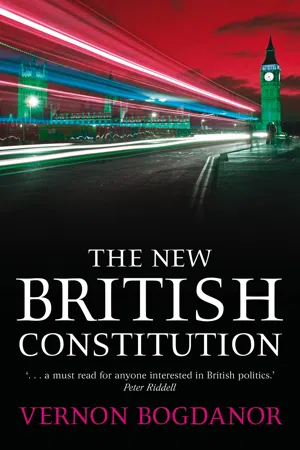
The last decade has seen radical changes in the way we are governed. Reforms such as the Human Rights Act and devolution have led to the replacement of one constitutional order by another. This book is the first to describe and analyse Britain's new constitution, asking why it was that the old system, seemingly hallowed by time, came under challenge, and why it is being replaced.
The Human Rights Act and the devolution legislation have the character of fundamental law. They in practice limit the rights of Westminster as a sovereign parliament, and establish a constitution which is quasi-federal in nature. The old constitution emphasised the sovereignty of Parliament. The new constitution, by contrast, emphasises the separation of powers, both territorially and at the centre of government.
The aim of constitutional reformers has been to improve the quality of government. But the main weakness of the new constitution is that it does little to secure more popular involvement in politics. We are in the process of becoming a constitutional state, but not a popular constitutional state. The next phase of constitutional reform, therefore, is likely to involve the creation of new forms of democratic engagement, so that our constitutional forms come to be more congruent with the social and political forces of the age. The end-point of this piecemeal process might well be a fully codified or written constitution which declares that power stems not from the Queen-in Parliament, but, instead, as in so many constitutions, from `We, the People'.
The old British constitution was analysed by Bagehot and Dicey. In this book Vernon Bogdanor charts the significance of what is coming to replace it.
The expenses scandal shows up grave defects in the British constitution. Vernon Bogdanor shows how the constitution can be reformed and the political system opened up in`The New British Constitution'.
- 334 pages
- English
- ePUB (mobile friendly)
- Available on iOS & Android
eBook - ePub
The New British Constitution
About this book
Information
The Old Constitution
1
A Peculiar Constitution
I
We englishmen’, declares Mr Podsnap in Charles Dickens’s novel, Our Mutual Friend, ‘are Very Proud of our Constitution . . . It was Bestowed Upon Us by providence. No other Country is so Favoured as this Country’.
What Dickens intended as satire seemed to many, until the second half of the twentieth century, no more than sober realism. Mr Podsnap’s view was to be echoed not only in Britain but also by observers in other countries, who studied the British constitution to discover the secret of successful government, the secret of how to combine freedom with stability.
At the beginning of the twentieth century, in 1908, an American scholar, A Lawrence Lowell, professor of government at Harvard University, published a two-volume work entitled The Government of England (sic). In the preface, he declared that:
‘The typical Englishman believes that his government is incomparably the best in the world. It is the thing above all others that he is proud of. He does not, of course, always agree with the course of policy pursued but he is certain that the general form of government is well-nigh perfect.’1
Forty-five years later, in 1953, a visiting American academic, attending a dinner party at a British university, was surprised to hear ‘an eminent man of the left to say—in utter seriousness—that the British Constitution was “as nearly perfect as any human institution could be” ’. He was rather more surprised that ‘No one even thought it amusing’.2 In 1965, another professor from Harvard University, Samuel Beer, concluded his book, Modern British Politics, with the following words:
‘Happy the country in which consensus and conflict are ordered in a dialectic that makes of the political arena at once a market of interests and a forum for debate of fundamental moral concerns’.3
These American professors were Anglophiles. Yet, in April 1960, a similar tribute was paid by someone who had never been accused of being an Anglophile, the French president Charles de Gaulle, speaking in Westminster,
‘Your outstanding role in the midst of the storm is owed not only to your profound national qualities, but also to the value of your institutions. At the worst of moments, who among you challenged the legitimacy and authority of the State . . . With self-assurance, almost without being aware of it, you operate in freedom a secure, stable political system. So strong are your traditions and loyalties in the political field that your government is quite naturally endowed with cohesion and permanence; that your parliament has, throughout each term of office, an assured majority; that this government and this majority are permanently in harmony; in short, that your executive and legislative powers are balanced and work together by definition as it were . . . Thus, lacking meticulously worked out constitutional texts, but by virtue of an unchallengeable general consent, you find the means, on each occasion, to ensure the efficient functioning of democracy without incurring the excessive criticism of the ambitious; or the punctilious blame of purists. Well! I can tell you that this England, which keeps itself in order while practising respect for the liberties of all, inspires trust in France’.4
Yet, during the 1960s, Mr Podsnap began to go out of favour. Britain’s seemingly insoluble economic difficulties were giving rise to a debate about the adequacy of her institutions and even about her much-admired constitution. That debate was to increase in intensity during the following decades, and was not stilled even when the country moved into calmer economic waters in the 1990s. Indeed the great period of constitutional reform in Britain occurred after the election of Tony Blair’s Labour government in 1997, at a time when the economy was buoyant. But the wide-ranging reforms of the Blair era would hardly have been introduced had the British people been as satisfied with their institutions as they seem to have been in Mr Podsnap’s time. One of the central themes of British history during the second half of the twentieth century seems to be a striking loss of national self-confidence; and this was reflected in a loss of confidence in our institutions and in our constitutional arrangements. ‘If you are always altering your house,’ Bagehot points out, ‘it is a sign either that you have a bad house, or that you have an excessively restless disposition—there is something wrong somewhere’.5
The alterations to the house have certainly been extensive. The years since 1997 have been marked by an unprecedented and, almost certainly, uncompleted series of constitutional changes. It is worth listing the main reforms.
- The independence of the Bank of England from government in monetary policy.
- Referendums, under the Referendum (Scotland and Wales) Act, 1997, on devolution to Scotland and Wales.
- The Scotland Act, 1998, providing for a directly elected Scottish Parliament, and with a Scottish Executive responsible to it on devolved matters.
- The Government of Wales Act, 1998, providing for a directly elected National Assembly in Wales.
- The Northern Ireland Act, 1998, providing for a referendum on a partnership form of government and devolution in Northern Ireland.
- The establishment, under the Northern Ireland Act, 1998, following the successful outcome of the referendum, of a directly elected Assembly in Northern Ireland.
- A referendum, under the Greater London Authority (Referendum) Act, 1998, on a directly elected mayor and assembly for London.
- The introduction of proportional representation for the elections to the devolved bodies in Scotland, Wales, Northern Ireland and the London assembly.
- The European Parliamentary Elections Act, 1998, providing for the introduction of proportional representation for elections to the European Parliament.
- The Local Government Act, 2000, requiring local authorities to abandon the committee system and providing for the possibility of directly elected mayors, following referendums.
- The Human Rights Act, 1998, requiring government and all other public bodies to comply with the provisions of the European Convention on Human Rights.
- The House of Lords Act, 1999, providing for the removal of all but 92 of the hereditary peers from the House of Lords, intended as the first phase of a wider reform of the Lords.
- The Freedom of Information Act, 2000, providing for a statutory right of access to government information.
- The Political Parties, Elections and Referendums Act, 2000, requiring the registration of political parties, controlling donations to political parties and national campaign expenditure and providing for the establishment of an Electoral Commission to oversee elections and to advise on improvements in electoral procedure.
- The Constitutional Reform Act, 2005, providing for the Lord Chief Justice, rather than the Lord Chancellor, to become head of the judiciary, depriving the Lord Chancellor of his role as presiding officer of the House of Lords, and establishing a new Supreme Court, whose members, unlike the law lords, will not be members of the House of Lords.
This is a formidable list. It is scarcely an exaggeration to suggest that a new constitution is in the process of being created before our eyes. But, because the reforms have been introduced in a piecemeal, unplanned and pragmatic way, rather than in one fell swoop, we have hardly noticed the extent of the change. It is much easier to notice change in the United States, or indeed in any country with a codified constitution than it is in Britain, with its peculiar, uncodified constitution. In a country with a codified constitution, the framework must be visibly and noticeably altered either by an amendment to the constitution or through a decision by judges which in effect re-interprets the constitution. In Britain, by contrast, the framework can be gradually adapted to create a wholly different constitution almost without anyone noticing.
We are as a nation notoriously uninterested in our constitution. The debate since the 1970s has been conducted primarily amongst the elite—politicians, academics, lawyers, judges and journalists. The people have, on the whole, been little interested, and perhaps even unaware of the wide-ranging nature of the constitutional changes that have been introduced, except of course in Northern Ireland, which remains the great exception to most generalizations about British government.
When, during the 1997 election campaign, the British people were asked, by the opinion research organisation, MORI, to rate the priority of various issues, they put constitutional issues 14th out of 14. Little had changed by the time of the 2001 general election despite the plethora of constitutional reforms in Blair’s first term. Just 5% thought that the constitution was an important issue in determining their vote, as compared with, for example, 61% who thought that health care was the most important issue, 53% education and 24% asylum-seekers. Even in Scotland, where there had been some clamour for devolution, only 8% thought that either the constitution or devolution would ‘be very important . . . in helping . . . decide which party to vote for’.6 The Scots who favoured devolution did so for instrumental reasons—that it was likely to make Scotland richer, improve public services, etc.—rather than because they favoured self-government. They saw constitutional reform as a means rather than an end. In the words of two Scottish social scientists, ‘Most have expectations that it will make a difference to their lives in terms of the services they want it to provide. Those are the grounds on which its effectiveness is likely to be judged, rather than as an affective expression of nationhood’.7 From this point of view, the movement for Scottish devolution should be sharply distinguished from the Irish demand for Home Rule in the nineteenth century, or for the movement for colonial independence in the twentieth, for these were demands for self-government regardless of the economic cost. The people of India or of Kenya would not have been deterred from demanding independence by being told that it would make them poorer.
Turnout figures for the various referendums confirmed that, with the exception of Northern Ireland, devolution did not arouse massive enthusiasm. The turnout figures were:
| Scottish devolution referendum 1997: | 60.2% |
| Welsh devolution referendum 1997: | 50.1% |
| Referendum on the Belfast Agreement 1998: | 80.0% |
| Referendum on a directly elected London mayor and Authority 1998: | 34.0% |
In Wales, only half of those eligible could be bothered to vote. In London, despite apparently widespread criticism that the capital had been left without proper representation since 1986, when the Greater London Council had been abolished, just over one-third of those eligible voted.
The British people remain obstinately concerned with the substance of politics, not its procedures. That may perhaps be a sign of political maturity. What cannot be doubted is that constitutional issues do not lie very high on most people’s list of priorities.
Many of the constitutional reforms have been validated by referendum. That is remarkable, for, until 1975, when Britain held her first, and so far her only, national referendum, this instrument was widely held to be unconstitutional. In 1964, a standard work on British government remarked, ‘It has occasionally been proposed that a referendum might be held on a particular issue, but the proposals do not ever appear to have been taken seriously’.8 Yet, there can be little doubt that the referendum has now become an accepted part of the constitution.
A second, hardly noticed but momentous feature of the reforms, is that it has now come to be accepted that elections to any body other than the House of Commons or a local authority should be by proportional representation. It was generally agreed that the devolved bodies in Scotland, Wales and Northern Ireland, and also regional bodies in England, if created, should be elected by proportional representation. This is a quite unexpected development. Until the 1970s, it was generally assumed that the plurality or ‘first-past-the-post’ electoral system was the natural one for Britain to use. Opposition to this system was confined almost wholly to the Liberal Party whose arguments could easily be dismissed as special pleading. But, by 2009, there were no fewer than four electoral systems in operation in Britain in addition to the first-past-the-post system. These systems are:
- The single transferable vote method of proportional representation used for all elections in Northern Ireland, except elections to the House of Commons, and for elections to local authorities in Scotland.
- A system of proportional representation based on the German method of voting, sometimes called the ‘additional member’ system, used for elections to the Scottish Parliament, the National Assembly of Wales and the Greater London Assembly.
- The regional list method of proportional representation used for elections to the European Parliament.
- The supplementary vote used in elections for all directly elected mayors, including the mayor of London.9
At the beginning of the twentieth century Britain enjoyed a uniform electoral system, the plurality or the first-past-the-post system, but a diversified franchise, there being no less than seven different ways in which a man could qualify for the vote.10 By the end of the twentieth century, by contrast, the qualification for the franchise was uniform, but there were a wide variety of electoral systems. An elector in London would use four different electoral systems. In voting for a Member of Parliament she would use first-past-the-post; in voting for a mayor of London she would use the supplementary vote; in voting for the Greater London Assembly she would use a variant of the German system of proportional representation; and in voting for the European Parliament she would use regional list proportional representation.
II
We have, then, since 1997, been engaged in a process, by no means yet complete, of constitutional reform. But how, it may be asked, can we reform our constitution when, notoriously, we have no constitution? For the first feature that strikes even the most casual observer of British government is that Britain has no constitution. What can ‘constitutional reform’ mean in a country without a constitution?
To answer this conundrum we need to distinguish between two different meanings of the term ‘constitution’. The first and most obvious meaning of the term refers to a selection of the most important legal rules regulating the government and embodied in a document promulgated at a particular moment of time, such as the American constitution of 1787 or the French Fifth Republic constitution of 1958. In this sense, of course, Britain has no constitution, and is one of just three democracies not to have such a constitution, the other two being New Zealand and Israel. Someone who wishes to discover the basic rules of the American system of government can easily obtain a copy of a document outlining these rules—the American constitution—and can, within less than half an hour, gain a reasonable idea of the basic principles of American government, and the rights which individuals living under its jurisdiction enjoy. The American constitution forms an excellent starting-point for civics lessons in the United States, and no doubt encourages Americans to think about their politics from a constitutional perspective. Americans, it is often suggested, think more about their rights and duties, and understand more about how their government works than we in Britain precisely because they have a codified constitution. In Britain, by contrast, we have no such document, and therefore no obvious framework within which to discuss the rules of government and the rights of the individual.
There is, however, a second sense of the term ‘constitution’. In this second sense of the term, we in Britain, together with anyone living in an organised society, most certainly possess a constitution. A society is distinguished from a mere conglomeration of individuals in that it comprises a group of people bound together by rules; and a constitution is nothing more than a collection of the most important rules prescribing the distribution of power between the institutions of government—legislature, executive and judiciary—and between the individual and the state. There is no inherent reason why these rules should be written down and brought together in one single document as they are in most modern democracies. But there must, in every society, by definition, be a constitution in this second sense of the term, whether that constitution is written down or not. When Mr Podsnap declared that our constitution was bestowed upon us by providence, it was this second sense of the term that he had in mind.
Britain is peculiar, then, not in lacking a constitution—for there is a sense in which every organised society has a constitution—but in lacking a written constitution. But that perhaps is a misleading way of putting the point. It is not as if in Britain the rules describing the distribution of governmental powers and the rights of the individual are passed down from generation to generation by word of mouth. Many, if not most, of our rules about the working of government are most certainly written down, in the form either of statutes, or judicial decisions. The Parliament Acts of ...
Table of contents
- Cover
- Title
- Copyright
- Contents
- Acknowledgments
- Introduction
- PART I: THE OLD CONSTITUTION
- PART II: THE NEW CONSTITUTION
- PART III: BEYOND THE NEW CONSTITUTION
- Index
Trusted by 375,005 students
Access to over 1.5 million titles for a fair monthly price.
Study more efficiently using our study tools.
Frequently asked questions
Yes, you can cancel anytime from the Subscription tab in your account settings on the Perlego website. Your subscription will stay active until the end of your current billing period. Learn how to cancel your subscription
No, books cannot be downloaded as external files, such as PDFs, for use outside of Perlego. However, you can download books within the Perlego app for offline reading on mobile or tablet. Learn how to download books offline
We are an online textbook subscription service, where you can get access to an entire online library for less than the price of a single book per month. With over 1.5 million books across 990+ topics, we’ve got you covered! Learn about our mission
Look out for the read-aloud symbol on your next book to see if you can listen to it. The read-aloud tool reads text aloud for you, highlighting the text as it is being read. You can pause it, speed it up and slow it down. Learn more about Read Aloud
Yes! You can use the Perlego app on both iOS and Android devices to read anytime, anywhere — even offline. Perfect for commutes or when you’re on the go.
Please note we cannot support devices running on iOS 13 and Android 7 or earlier. Learn more about using the app
Please note we cannot support devices running on iOS 13 and Android 7 or earlier. Learn more about using the app
Yes, you can access The New British Constitution by Vernon Bogdanor in PDF and/or ePUB format, as well as other popular books in Law & Public Law. We have over 1.5 million books available in our catalogue for you to explore.