- 342 pages
- English
- ePUB (mobile friendly)
- Available on iOS & Android
eBook - ePub
About this book
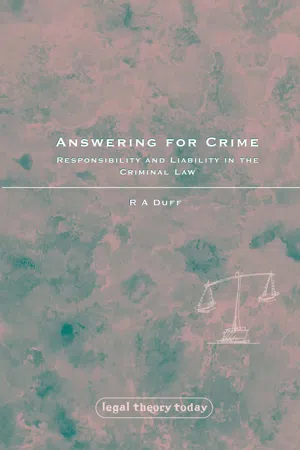
In this long-awaited book, Antony Duff offers a new perspective on the structures of criminal law and criminal liability. His starting point is a distinction between responsibility (understood as answerability) and liability, and a conception of responsibility as relational and practice-based. This focus on responsibility, as a matter of being answerable to those who have the standing to call one to account, throws new light on a range of questions in criminal law theory: on the question of criminalisation, which can now be cast as the question of what we should have to answer for, and to whom, under the threat of criminal conviction and punishment; on questions about the criminal trial, as a process through which defendants are called to answer, and about the conditions (bars to trial) given which a trial would be illegitimate; on questions about the structure of offences, the distinction between offences and defences, and the phenomena of strict liability and strict responsibility; and on questions about the structures of criminal defences. The net result is not a theory of criminal law; but it is an account of the structure of criminal law as an institution through which a liberal polity defines a realm of public wrongdoing, and calls those who perpetrate (or are accused of perpetrating) such wrongs to account.
Information
1
Responsibility and Liability
In place of Markus Dubber’s ‘single, basic question: who is liable for what?’,1 I suggested that we should begin by asking ‘who is (or should be) criminally responsible for what to whom?’. We should, that is, recognise the priority of responsibility over liability, and the relational dimensions of responsibility; and we should make the question explicitly normative. In this chapter, I explain the relational dimensions of responsibility, why they merit attention, and why it is important to distinguish responsibility from liability. The distinction that I draw here between responsibility and liability is admittedly to some degree stipulative: I do not claim that it precisely matches the standard usage of those terms (which are anyway used in several different ways), or that it captures their only proper meanings. I aim to show, however, that it is a significant distinction, and that by attending to it we can illuminate the logical structure of the criminal law and gain a better understanding of some familiar issues in criminal law theory. That will be the task of subsequent chapters: the task of this chapter is to provide an initial explanation of the distinction, and of the relational conception of responsibility which it involves.
1. Responsibility and Liability
Our concern here is with criminal liability and responsibility, and with their extra-legal moral analogues of responsibility for moral wrongdoing and liability to moral blame or criticism. There are of course other species of liability: as well as being criminally liable to conviction and punishment for the crimes that we commit, we may be liable to pay taxes on our income, to pay damages for harms that we cause, to pay maintenance for our children, and so on. Such other types of liability do not concern me here: my focus is on criminal liability to conviction and punishment, or moral liability to criticism and blame, and on the species of responsibility on which such liabilities depend. My focus is therefore also on responsibility for what was in some way untoward—for the harms or wrongs that I cause or commit. We are responsible too for the good and the right that we do or bring about: but we cannot explore the asymmetries between these two kinds of responsibility here.
The relationship between liability and responsibility can be simply stated: responsibility is a necessary but not a sufficient condition of liability. I am liable to conviction or blame for X only if I am responsible for X; but I can be responsible for X without being thus liable.
The phenomena of ‘absolute’ and ‘vicarious’ liability in criminal law might seem to cast doubt on the necessity of responsibility for liability. I can be convicted of being found drunk on a highway without proof that I could have avoided being there, even if I was carried there by the police;2 an employer can be vicariously criminally liable for an employee’s criminal conduct, even if that conduct was not authorised, expected or reasonably foreseeable by the employer:3 in such cases the defendant seems to be criminally liable for the offence without proof that she was responsible for its commission. But there is equivocation here. Such laws make people criminally liable for something for which they might not be morally responsible. However, first, if they are not morally responsible for the action or state of affairs in question, they cannot be morally liable to blame or criticism for it—since moral liability requires moral responsibility. Secondly, they are criminally liable in such cases only because the law, rightly or wrongly, makes them criminally responsible. The law holds the person found drunk on a highway criminally responsible for being thus found—which implies a prospective criminal responsibility to make sure that one is not thus found;4 it held a licensee whose employee sold drinks outside permitted hours criminally responsible for the employee’s actions, even if the employee acted against her express instructions,5 which implied a prospective responsibility to make sure that no drinks were sold in one’s pub outside permitted hours. We might object that such responsibilities are unreasonably strict: the point here is that they are preconditions of the defendants’ liability. Indeed, as we will see later, in Chapter 10, it might be reasonable to hold licensees criminally responsible for the sale of out-of-hours drinks in their pubs—to require them to answer for the commission of that offence in a criminal court: what is crucial is what kind of answer, if any, they can give that will avert a conviction; but that is a matter of liability rather than of responsibility.
To illustrate this point, suppose that the Licensing Act 1964 included a ‘due diligence’ defence of the kind that the Licensing Act 2003 provides for certain offences: that ‘[the] act was due … to an act or omission by another person … and [the licensee] took all reasonable precautions and exercised all due diligence to avoid committing the offence’.6 Whether or not the law allows such a defence, the licensee is criminally responsible for her employee’s actions; she must answer in court for those actions. If the law allows no such defence, she is also strictly liable; by contrast, if such a defence is allowed, she can admit responsibility, but avert liability by offering the defence.
The distinction between responsibility and liability is simply illustrated by justifications. If I wound an assailant, this being the only way to ward off his unlawful attack on me, I have a justification for what I do—a moral justification that saves me from moral condemnation for injuring him, and a legal justification that should save me from a criminal conviction for wounding.7 In offering this justification, I do not deny responsibility for using violence on V, or for V’s wound. I admit responsibility for that action and its result, as something that I had reason not to do (for we always have reason not to use violence on fellow human beings, and to avoid acting in ways that will injure them). I thus admit that I must answer for my action and its result: I must answer morally to anyone whose business it is, and legally in a criminal court. But, I claim, I have an exculpatory answer: that my action was, in its context, justified as an act of self-defence.
This feature of justifications—that they admit responsibility while denying liability—also holds of excuses. If I commit perjury under the influence of a threat of harm which, while not sufficient to justify the commission of perjury, is sufficient to constitute an excuse, I am not criminally liable for committing perjury.8 But I am criminally responsible for committing that offence: I must answer for it in court, and am liable to conviction and punishment if I cannot offer an exculpatory answer. My plea of duress functions, as does my plea of self-defence, to avert liability by blocking the transition from responsibility to liability.
I am responsible for that for which I must answer, and I must answer for that which there was reason for me not to do: I must answer morally for doing what there was moral reason not to do, and criminally for doing what, according to the criminal law, there was legal reason for me not to do. I have both moral and legal reason not to use violence on others, and not to commit perjury: if I act in those ways, I must answer for so acting (and for the consequences—the injury to my assailant, the mistaken verdict—of those actions). If I can justify or excuse my actions by appealing to the context of the action and the reasons that motivated me to act thus,9 I have an exculpatory answer that blocks the normal, presumptive transition from responsibility to liability. If, however, I can offer no such exculpatory answer, responsibility becomes liability.
If I am accused of wrongdoing, either formally in a criminal court or informally in moral discussion, I thus have two ways of averting conviction or blame. I can deny responsibility, claiming that I do not have to answer (in this forum) for that alleged wrong. In the simplest case, I deny responsibility by denying agency: I was not the person who broke your window. But, as we will see throughout this book, there are many other ways in which, and grounds on which, I can deny responsibility—even for my actions and their anticipated effects. Alternatively, however, I can admit responsibility, but avert liability by offering a defence: I must, I admit, answer for what I have done, but I offer an answer that, I claim, exculpates me.
Theorists often do not distinguish responsibility from liability;10 one aim of this book is to show why the distinction matters. We will gain a clearer understanding (both analytical and critical) of the structure of the criminal law, and of the principles of criminal liability, if we distinguish two sets of questions: one concerns the conditions under which agents can be held criminally responsible, ie be called to answer in a criminal court; the other concerns the further conditions that must be satisfied if they are to be criminally liable for that for which they are criminally responsible. Someone who is summoned to answer a criminal charge can seek in various legitimate ways to avert a conviction, and it might be tempting to count them all as ‘defences’, on the ground that they all serve to defend a person against conviction.11 I will argue, however, that it is important to distinguish conviction-averting pleas which deny responsibility from those which admit responsibility but deny liability—and to distinguish between different kinds of responsibility-denial, depending on whether what is denied is that this person can be held responsible, or that she is responsible before this court, or that she is responsible for this alleged conduct.
Once we distinguish responsibility from liability, we can bring the relational dimensions of responsibility into clearer focus.
2. Responsibility as Relational
It is a commonplace that responsibility involves a dyadic relationship: an agent is responsible for something. The relational conception of responsibility that concerns us here is not merely dyadic, but triadic: I am responsible for X, to S—to a person or body who has the standing to call me to answer for X. I am also responsible for X to S as Φ—in virtue of satisfying some normatively laden description that makes me responsible (prospectively and retrospectively) for X to S. To be responsible is to be answerable; answerability is answerability to a person or body who has the right or standing to call me to account; and I am thus answerable in virtue of some normatively laden description, typically a description of a role, that I satisfy.12
(There are non-relational ideas of responsibility. We talk about responsible agency; we commend responsible parents or teachers. Such ideas can be explained in terms of relational responsibility. Responsible agency is a matter of having the capacities that are necessary if one is to answer for one’s actions: a responsible agent is capable of responding to the reasons that bear on her actions, and of answering for her actions in the light of those reasons.13 A responsible parent takes her responsibilities seriously and discharges them conscientiously: she pays due attention to the matters that concern her, and is therefore well placed to answer for her actions, ie to accept retrospective responsibility in relation to those matters.14)
The ‘for X’ dimension of this triadic relationship is familiar: I can be held responsible for a wide range of ‘objects of responsibility’, including actions, omissions, thoughts, feelings and states of affairs.15 The ‘to S’ and ‘as Φ’ dimensions require a little further explanation, in part to make clear how the objects and directions of responsibility can differ from one context to another: how I can be responsible as Φ for X, but not for Y (though both X and Y lie within my control); or responsible to S for X, but not for Y; or responsible for X to S, but not to T.
To illustrate. We can specify my responsibilities as a university teacher. That will involve an account of my prospective responsibilities:16 it is my responsibility to keep up to date with my subject, plan courses that contribute suitably to the curriculum, prepare and conduct my classes in pedagogically effective ways, mark students’ work, and so on. We might disagree about what falls, or should fall, within my responsibilities as a teacher, but any account will set some limits to them: as a teacher in a secular university, for instance, it is no part of my responsibility to attend church services; as a philosophy teacher it is not my responsibility to play football on Saturday for a local amateur team—though I may have such responsibilities as a member of a church or of that team. To say that these are my responsibilities as a teacher is to say that I may be called, and must be ready, to answer as a teacher for my conduct in relation to these matters—for how I discharge (or fail to discharge) these responsibilities.
A full specification of my responsibilities must also identify the people or bodies to whom I am responsible as a teacher—and thus by implication those to whom I am not responsible as a teacher. I am responsible as a teacher to my students, my colleagues and my employer: they can call me to account for the way in which I discharge my pedagogical responsibilities; they can call me to answer for failing to turn up to class or for giving an ill-prepared lecture. But, first, I am not responsible as a teacher to my aunt, or to a passing stranger, or to my fellow footballers: they have no standing to call me to account for missing the class or for giving a bad lecture; if they challenge me about it, or demand that I answer to them for it, I can reply that it is not their business. Secondly, I am not responsible to my students, my colleagues (qua academic colleagues) or my employer for my conduct as a member of a church or a football team. There will be someone to whom I am responsible, as a member of the church, for my religious practices—perhaps my priest, the other members of my congregation, or only God. There are people to whom I am responsible as a member of a football team—other members, our supporters if we have any: depending on the kind of team it is, I may be responsible to them not merely for how I play (and whether I turn up), but for keeping fit and joining in training. But I am not responsible to my academic colleagues for my footballing performance, any more than I am responsible to my fellow footballers for my performance as a teacher.
The responsibility-laden descriptions (teacher, parent, member of a church or team) that help to structure our lives determine the content and the direction of our responsibilities: what we are responsible for and to whom. Such descriptions extend our responsibilities: as a member of a team I have responsibilities that I would not otherwise have, and am responsible to people to whom I would not otherwise be answerable. They also limit our responsibilities: there are matters within my control and knowledge, even matters that bear on my students’ welfare, for which I may deny that I am responsible as a teacher (it is not my responsibility, I might say, to offer them advice on their sexual relationships); and there is only a limited range of people or bodies to whom I am responsible as a teacher.17 Claims of the form ‘A is responsible for X’ are therefore incomplete: they must be filled out by specifying as what and to whom A is responsible for X. That specification need not be explicit if it is obvious from the context; but it must be available.
John Gardner seems to deny this. Responsibility (‘basic responsibility’) does, he agrees, involve the ability to answer for ourselves, to ‘assert ourselves as responsible beings’, which requires an interlocutor to whom I can offer my account of myself:
But why does it need a particular interlocutor? In respect of the same wrong or mistake, couldn’t I assert my basic responsibility by offering the same account of myself to everyone I come across, from judges in the Old Bailey to friends in the pub to strangers on the bus?18
I could certainly offer my account of how I came to give such a bad lecture to ‘everyone I come across’, although I would probably receive some puzzled responses if I did so: an Old Bailey judge and a stranger on the bus might naturally reply that I do not have to answer to them for my performance as a teacher. More to the point, they have no right to demand that I answer to them for my lecture: if they tried to call me to account for it, I could properly refuse, on the ground that it is not their business.19
Some might argue that whilst such limitations hold for those responsibilities that are tied to particular social or institutional roles, they do not hold for our moral responsibilities—our responsibilities as moral agents. Surely, they might say, as moral agents we are responsible to every other moral agent; to recognise ourselves and others as members of the Kingdom of Ends is to recognise not only that we have duties towards all other members, but also that we must be ready to answer to them for our moral conduct or misconduct. The first response to this claim is that, even if it is true, it does not undercut the relational account of responsibility: we must still ask not merely what we are responsible for, but to whom we are responsible; the claim about universal moral jurisdiction is the claim that in the case of moral wrongdoing the answer to the second question is ‘Every moral agent’. The second response, however, is that the claim is anywa...
Table of contents
- Cover
- Title
- Copyright
- Acknowledgements
- Contents
- Table of Cases
- Table of Legislation
- Introduction
- 1. Responsibility and Liability
- 2. Criminally Responsible as What, to Whom?
- 3. Responsible For What?
- 4. Criminally Responsible For What? (1) Crimes As wrongs
- 5. Criminally Responsible For What? (2) Action and Crime
- 6. Criminally Responsible For what? (3) Harms, Wrongs and Crimes
- 7. Structures of Crime: Attacks and Endangerments
- 8. Answering and Refusing to Answer
- 9. Offences, Defences and the Presumption of Innocence
- 10. Strict Liability and Strict Responsibility
- 11. Understanding Defences
- References
- Index
Trusted by 375,005 students
Access to over 1.5 million titles for a fair monthly price.
Study more efficiently using our study tools.
Frequently asked questions
Yes, you can cancel anytime from the Subscription tab in your account settings on the Perlego website. Your subscription will stay active until the end of your current billing period. Learn how to cancel your subscription
No, books cannot be downloaded as external files, such as PDFs, for use outside of Perlego. However, you can download books within the Perlego app for offline reading on mobile or tablet. Learn how to download books offline
Perlego offers two plans: Essential and Complete
- Essential is ideal for learners and professionals who enjoy exploring a wide range of subjects. Access the Essential Library with 800,000+ trusted titles and best-sellers across business, personal growth, and the humanities. Includes unlimited reading time and Standard Read Aloud voice.
- Complete: Perfect for advanced learners and researchers needing full, unrestricted access. Unlock 1.5M+ books across hundreds of subjects, including academic and specialized titles. The Complete Plan also includes advanced features like Premium Read Aloud and Research Assistant.
We are an online textbook subscription service, where you can get access to an entire online library for less than the price of a single book per month. With over 1.5 million books across 990+ topics, we’ve got you covered! Learn about our mission
Look out for the read-aloud symbol on your next book to see if you can listen to it. The read-aloud tool reads text aloud for you, highlighting the text as it is being read. You can pause it, speed it up and slow it down. Learn more about Read Aloud
Yes! You can use the Perlego app on both iOS and Android devices to read anytime, anywhere — even offline. Perfect for commutes or when you’re on the go.
Please note we cannot support devices running on iOS 13 and Android 7 or earlier. Learn more about using the app
Please note we cannot support devices running on iOS 13 and Android 7 or earlier. Learn more about using the app
Yes, you can access Answering for Crime by R A Duff in PDF and/or ePUB format, as well as other popular books in Law & Criminal Law. We have over 1.5 million books available in our catalogue for you to explore.