eBook - ePub
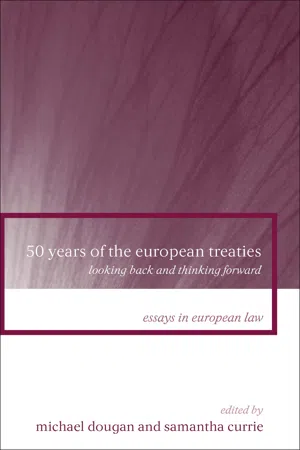
50 Years of the European Treaties
Looking Back and Thinking Forward
- 438 pages
- English
- ePUB (mobile friendly)
- Available on iOS & Android
eBook - ePub
50 Years of the European Treaties
Looking Back and Thinking Forward
About this book
The essays which appear in this work are based on the papers presented at a two-day conference held in Liverpool in July 2007 to celebrate the 50th anniversary of the signing of the Treaty of Rome establishing the EEC. The collection reflects critically upon some of the EU's historic characteristics and speculates imaginatively on some of the diverse challenges facing the Union in the future. Contributions from both established and emerging scholars of EU law and policy are united by two main themes: the paradox of the resilient yet unstable basis of the Union's constitutional fundamentals, and the ever-contested balance between the EU's core economic mission and its broader social values and aspirations. For any student, scholar or practitioner interested in the dynamic nature of the constitutional relationship between the Union and its Member States, and in the complex tensions underpinning the EU's substantive policies, these essays will be essential reading.
Information
1
The Institutional Framework and
the Institutional Balance
ALAN DASHWOOD
… Resolved to substitute for age-old rivalries the merging of their essential interests; to create, by establishing an economic community, the basis for a broader and deeper community among peoples long divided by bloody conflicts; and to lay the foundations for institutions which will give direction to a destiny henceforward shared …
I. INTRODUCTION
THE MOVING WORDS of the final recital of the preamble to the Treaty establishing the European Coal and Steel Community (hereinafter, ‘ECSC Treaty’ or ‘ECSC’) encapsulate the project that was launched in the 1950s to provide a solution to the ‘age-old rivalries’ that had made Europe the cock-pit of the world, arguably since the seventeenth century, but most catastrophically in the twentieth. The aim, eloquently proclaimed by the Schuman Declaration of May 1950,1 was to bind together the nations of Europe politically and economically in such a way as to make it inconceivable that they would ever fight each other again. This was to be achieved step by step, by first establishing an economic community and then going on to broaden and deepen the relationship, a development that would be channelled by a carefully designed set of institutions.
An essential feature of the institutional design that may loosely be identified as the ‘Community model’ has always been the interaction between institutions composed of representatives of the Member States and ‘supranational’ institutions with a duty to act independently of national governments: the role of the former being to involve national political leaders directly in the enterprise of shaping a common European future; that of the latter, to consolidate the gains made (the acquis communautaire) and, if practicable, to carry the integration process forward. Finding and maintaining an appropriate balance between the two groups of institutions has been an essential requirement of the sometimes faltering progress of the EC/EU during the half century since the signing of the Treaty of Rome.
Under the system of the ECSC Treaty, the heavyweight institution was the supranational High Authority. It headed the list of institutions in Article 7 ECSC, with the Special Council of Ministers coming only third, after the Common Assembly and before the Court of Justice. It was the High Authority that was charged explicitly with responsibility for attaining the objectives of the Treaty; and, with a few exceptions, it was also the decision-making body of the Community, empowered to adopt the formal instruments defined by Article 14 ECSC.2 The High Authority was authorised, among other things, to: procure funds3; fix maximum and minimum prices for certain products4; ensure compliance by the Member States with their obligations under the Treaty5; and fine undertakings guilty of infringing the ECSC’s rules on competition.6 The role of the Council was more particularly to harmonise the action of the High Authority with that of the governments of the Member States, acknowledged as being ‘responsible for the general economic policies of their countries’.7 The characteristic involvement of the Council in decisionmaking was by way of a requirement for it to be consulted, or for its assent (avis conforme) to be obtained,8 on actions the High Authority was proposing to take.
In broad terms, therefore, it can be said that the institutional balance of the ECSC was tilted towards the supranational side. Doubtless this can be explained in part by the political context in which the ECSC was created: with World War II still a vivid memory, and the perceived threat posed by the military strength of the Soviet Union and its sponsorship of Communist-led coups in several central and eastern European countries, there was a receptiveness in West European political circles to the grand design set forth in the Schuman Declaration of laying ‘the first concrete foundation for a European Federation’. At the same time, reassurance was provided by the gradualist strategy encapsulated in the recital to the ECSC Treaty recognising ‘that Europe can be built only through practical achievements which will first of all create real solidarity, and through the creation of common bases for economic development’. The scope of the ECSC was limited to the organisation of a common market for coal and steel, the mechanics of which were laid down in considerable detail by the treaty itself.9 The High Authority’s very considerable powers were, therefore, executive in character, the parameters for their exercise having been clearly and firmly set by the primary law of the Community.
The European Economic Community (EEC) was endowed with a similar institutional framework to the ECSC (as also was the European Atomic Energy Community (EURATOM)). There was a council consisting of representatives of the Member States, to which each government was required to delegate one of its members, and a supranational body—the Commission—corresponding to the High Authority. The initially separate Councils and Commissions of the EEC and EURATOM, together with the ECSC’s Special Council of Ministers and High Authority, would be replaced, as from 1 July 1968, by a single Council of the European Communities and a single Commission of the European Communities, acting for the purposes of the different treaties in accordance with the respective powers and procedures laid down therein.10 However, pursuant to a Convention signed at the same time as the Treaties of Rome, the three communities that would exist from 1958 were to be served by a single Assembly and a single Court of Justice.11 The Assembly, soon to re-name itself ‘the European Parliament’,12 was still composed of national parliamentarians, and its powers remained limited. It was not yet a branch of the budgetary authority, and its involvement in the legislative process did not go beyond the right to be consulted on certain Commission proposals.
As compared with the ECSC system, that of the EEC showed a marked adjustment of the institutional balance in favour of the Council, as the main decision-making organ of the Community. The familiar tag, ‘the Commission proposes, the Council disposes’, accurately expresses the interaction between the two institutions that characterised the legislative process originally established by the Rome Treaty: the Commission had a near monopoly of the initiative, the Council a near monopoly of the power of final decision, and it was also the sole budgetary authority. The Council’s role as the organ that must positively approve any development of the body of primary rules contained in the Treaty was highlighted in the reference in Article 145, second indent EEC (now Article 202, second indent EC) to its having ‘power to take decisions’; the Commission was stated to have ‘its own power of decision’, but this was confined in practice to areas, such as the completion of the customs union, where legislative discretion was circumscribed by detailed Treaty provisions.13
The shift in the institutional balance may have been influenced by the failure of the over-ambitious projects for a European Defence Community and a European Political Community, which foundered when the French National Assembly voted against the ratification of the former.14 However, it reflects very real differences between the two Communities. The substantive scope even of the primordial EEC was vastly greater than that of the ECSC—the establishment of a general common market, covering all economic sectors other than those within the purview of the ECSC or EURATOM Treaties, and of a potentially interventionist agricultural policy and a transport policy,15 complemented by a variety of flanking mechanisms, policies and principles.16 Moreover, the Community was much less fully realised by the Treaty itself: in the jargon, the EEC Treaty was a traité cadre, while the ECSC was a traité loi. The bare bones of the Treaty provisions would have to be covered with flesh, through the legislative activity of the institutions.
Many changes have taken place in the institutional framework of the EC/EU over the ensuing 50 years. Practical considerations mean that only the most significant can be noted here, and their selection is necessarily, to some extent, a matter of individual judgment. Leaving aside the immense contribution of the Court of Justice, which is a subject for another paper, I venture to suggest that the main institutional developments have been broadly of two kinds: those designed to overcome reticence on the part of the Member States, and to harness their political will more effectively to the objectives of the EC/EU; and those seeking to introduce an acceptable level of democratic accountability in the legislative process of the Union. I shall indicate, quite briefly, the key changes in each of those categories, as they appear to me, and then attempt, in my conclusion, to assess what effect they may have produced on the institutional balance.
II. OVERCOMING MEMBER STATES’ RETICENCE AND HARNESSING THEIR POLITICAL WILL
It became apparent very early on that adjustments to the Community’s institutional arrangements for this purpose would be necessary, when the Community experienced its worst ever political crisis—that of France’s ‘empty chair’ strategy—which began in the summer of 1965 and culminated in the so-called ‘Luxemburg Compromise’ at the end of January 1966.17 The crisis was precipitated by an activist EEC Commission, under its founding President, Walter Hallstein. The Commission had put forward a proposal in the form of a ‘package deal’, linking the introduction of a system of ‘own resources’ to fund the Community’s budget, with arrangements for the financing of the common agricultural policy (CAP), in which the French Government had a particularly strong interest. Part of the context was that the EEC Treaty provided for the introduction of qualified majority voting in place of unanimity for Council decision-making in a number of policy areas, including the CAP, with effect from 1 January 1966, the end of the second stage of the Community’s transitional period. After that date, it would theoretically be possible for France’s position on CAP financing to be overridden by a Council majority.
Everyone is familiar with the outcome. As part of the Luxembourg Compromise, it was agreed that, on a matter capable of being decided by qualified majority voting (QMV), when ‘very important interests of a Member State are at stake’, the Council must attempt, within a reasonable time, to reach a solution acceptable to all of its Members; the view of the French delegation, that discussion must continue until unanimity was reached, was noted but not accepted by the other delegations. Other elements of the compromise were designed to constrain the behaviour of the Commission in putting forward proposals, especially its tactic of seeking to balance elements liable to be seen as more or less palatable by different Member States, within artificially constructed package deals.
Even though, as we shall see, the Luxembourg Compromise has been formally invoked on very few occasions, the crisis of 1965/66 cast a long shadow. To borrow form Robert Browning, it would never be a ‘glad, confident morning again’ for the Community.18 Nevertheless, the intransigence of De Gaulle’s France may be seen in a positive light, as a salutary reality check. The lesson was learned that Member States could not be compelled to accept constitutional changes through subtle manipulation of the institutional framework; if their ‘very important interests’ were perceived to be at risk, the framework itself was liable to buckle. The survival and further development of the new European constitutional order would depend upon finding ways of ensuring that its component entities—states in the full sense of public international law, and the main focus of their citizens’ collective loyalty—could be comfortably accommodated within it. Three such expedients were: the establishment and expanding role of the European Council; Council practice on QMV; and the ‘pillar structure’ of the European Union created by the Maastricht Treaty. I shall deal with these in turn.
A. The European Council
The habit of holding regular summit meetings of the European Community’s political leaders developed at the end of the 1960s. The meetings, bringing together the heads of state or government of the Member States and the President of the Commission within a ‘European Council’, were set up on an established, although still informal, basis by a decision taken at the Paris Summit in December 1974. The first European Council convened under that designation took place in Dublin in March 1975. There was no such body envisaged in the original EEC Treaty and the earliest mention of the European Council by a treaty was in the rather meagre Article 2 of the Single European Act (SEA), which said nothing about its function. The treaty basis of the E...
Table of contents
- Cover Page
- Title Page
- Copyright
- Contents
- List of Contributors
- Table of Cases
- Table of Legislation
- Editors’ Introduction
- 1. The Institutional Framework and the Institutional Balance
- 2. A Fusing Europe? Insights for EU Governance
- 3. Reflections on the Roles of Mutual Trust in EU Law
- 4. The European Community’s Federal Order of Competences—A Retrospective Analysis
- 5. Community Competence to Regulate the Internal Market
- 6. New EU Governance: The Case of Employment Policy
- 7. Common Foreign and Security Policy: Looking Back, Thinking Forward
- 8. The International Legal Personality of the European Community and the European Union
- 9. The Future of the Area of Freedom, Security and Justice
- 10. From Complainant to ‘Private Attorney General’: The Modernisation of EU Competition Enforcement and Private Anti-Trust Actions Before National Courts
- 11. Energy: Efficiency, Security and the Environment
- 12. New Frontiers in EU Labour Law: From Flexicurity to Flex-Security
- 13. Fifty Years of Avoiding Social Dumping? The EU’s Economic and Not So Economic Constitution
- 14. Federalisation Versus Centralisation: Tensions in Fundamental Rights Discourse in the EU
- 15. The Transformation of Union Citizenship
- 16. Gender, the Acquis and Beyond
- 17. Does the Constitutional Treaty Have a Future?
- Index
Trusted by 375,005 students
Access to over 1.5 million titles for a fair monthly price.
Study more efficiently using our study tools.
Frequently asked questions
Yes, you can cancel anytime from the Subscription tab in your account settings on the Perlego website. Your subscription will stay active until the end of your current billing period. Learn how to cancel your subscription
No, books cannot be downloaded as external files, such as PDFs, for use outside of Perlego. However, you can download books within the Perlego app for offline reading on mobile or tablet. Learn how to download books offline
Perlego offers two plans: Essential and Complete
- Essential is ideal for learners and professionals who enjoy exploring a wide range of subjects. Access the Essential Library with 800,000+ trusted titles and best-sellers across business, personal growth, and the humanities. Includes unlimited reading time and Standard Read Aloud voice.
- Complete: Perfect for advanced learners and researchers needing full, unrestricted access. Unlock 1.5M+ books across hundreds of subjects, including academic and specialized titles. The Complete Plan also includes advanced features like Premium Read Aloud and Research Assistant.
We are an online textbook subscription service, where you can get access to an entire online library for less than the price of a single book per month. With over 1.5 million books across 990+ topics, we’ve got you covered! Learn about our mission
Look out for the read-aloud symbol on your next book to see if you can listen to it. The read-aloud tool reads text aloud for you, highlighting the text as it is being read. You can pause it, speed it up and slow it down. Learn more about Read Aloud
Yes! You can use the Perlego app on both iOS and Android devices to read anytime, anywhere — even offline. Perfect for commutes or when you’re on the go.
Please note we cannot support devices running on iOS 13 and Android 7 or earlier. Learn more about using the app
Please note we cannot support devices running on iOS 13 and Android 7 or earlier. Learn more about using the app
Yes, you can access 50 Years of the European Treaties by Michael Dougan, Samantha Currie, Michael Dougan,Samantha Currie in PDF and/or ePUB format, as well as other popular books in Law & International Law. We have over 1.5 million books available in our catalogue for you to explore.