eBook - ePub
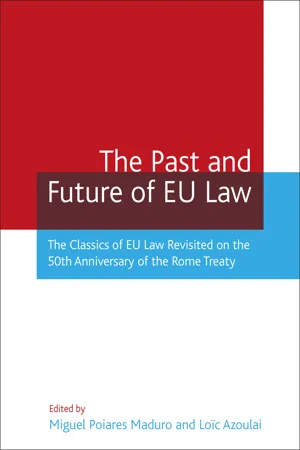
The Past and Future of EU Law
The Classics of EU Law Revisited on the 50th Anniversary of the Rome Treaty
- 526 pages
- English
- ePUB (mobile friendly)
- Available on iOS & Android
eBook - ePub
The Past and Future of EU Law
The Classics of EU Law Revisited on the 50th Anniversary of the Rome Treaty
About this book
This book revisits, in a new light, some of the classic cases which constitute the foundations of the EU legal order and is timed to celebrate the 50th anniversary of the Rome Treaty establishing a European Economic Community. Its broader purpose, however, is to discuss the future of the EU legal order by examining, from a variety of different perspectives, the most important judgments of the ECJ which established the foundations of the EU legal order. The tone is neither necessarily celebratory nor critical, but relies on the viewpoint of the distinguished line-up of contributors - drawn from among former and current members of the Court (the view from within), scholars from other disciplines or lawyers from other legal orders (the view from outside), and two different generations of EU legal scholars (the classics revisit the classics and a view from the future). Each of these groups will provide a different perspective on the same set of selected judgments. In each short essay, questions such as 'what would have EU law been without this judgment of the Court? what factors might have influenced it?; did the judgment create expectations which were not fully fulfilled?' and so on, are posed and answered. The result is a profound, wide-ranging and fresh examination of the 'founding cases' of EU law.
Information
IX
Case C-85/96, María Martínez Sala v Freistaat Bayern and Case C-413/99, Baumbast and R v Secretary of State for the Home Department
1
Martínez Sala and Baumbast revisited
In revisiting these two decisions of the Court of Justice1 I propose to discuss essentially three questions: what has been the added value of these decisions? Is there any specific rationale that could explain this evolution in the case law? And, finally, has this new line of jurisprudence been confirmed and is there still potential for further evolution?
The Added Value of Martínez Sala and Baumbast
Citizenship of the Union, as a new status granted to the nationals of the Member States, was introduced by the Treaty of Maastricht of 1992 with the obvious aim of bringing the Union closer to its citizens. Many commentators at the time expected these new provisions of the EC Treaty, and particularly the articles which are now Articles 17 and 18 EC, to add little to the already existing Community law rights on free movement provided by the EC Treaty and secondary legislation.2 The main message sent by the Court’s decisions in Martínez Sala and Baumbast has been to contradict these expectations. They demonstrate that these provisions do not contain empty phrases and that they can have important legal consequences.
In that respect, both decisions are of course remarkably different. Baumbast has much further reaching consequences than Martínez Sala. The latter decision is still rather classic in its approach—it is daring, however, in the application of that approach. Mrs Sala, a Spanish national lawfully residing in Germany, was refused a child-caring allowance because she was not able to produce a residence permit, a formal condition which did not apply to German nationals wishing to obtain that allowance. The Court approaches the question under the heading of the prohibition of discrimination based on nationality laid down in Article 12 EC. The existence of such discrimination was in itself easily established, but could Mrs Sala benefit from this rule under the Treaty? She could, so the Court said, because as a citizen of the Union, according to Article 17, paragraph 2, she enjoyed the rights conferred by the Treaty. As a citizen of the Union, lawfully residing in a Member State other than that of her origin, she could invoke the principle of non-discrimination under Article 12 EC in view of the fact that the child-caring allowance, ratione materiae, fell within the scope of application of the Treaty. The latter conclusion is perhaps the most daring step in the Court’s reasoning. It justifies this conclusion by referring to the answers already given in the judgment as to the possible applicability of Article 7, paragraph 2 of Regulation 1612/68 and Regulation 1408/71 with regard to the child-caring allowance. This justification has been criticised because the possible application of these regulations does not explain why the allowance would also fall within the scope of application of the Treaty in a situation where neither of these Regulations applies.3
This, indeed, reveals the difficulty of the in itself attractive, because prima facie simple, approach of applying the prohibition of discrimination based on nationality: in each case it must be demonstrated that the substantive issue to which the discrimination relates falls within the scope of the Treaty. Subsequent case law, preceding the Court’s decision in Baumbast, however, has followed a more sophisticated approach in this respect.4 In the cases of Bickel and Franz,5 Grzelczyk6 and D’Hoop,7 the Court accepted the situation of the Union citizen as coming, ratione materiae, within the scope of the Treaty because of the link between the personal situation of the persons concerned and the fact that they had exercised the right of free movement under Article 18 EC.8 In D’Hoop, for instance, a Belgian national was refused the so-called tide-over allowance, an unemployment benefit granted under Belgian legislation to young people having completed their studies and seeking their first employment. The reason for that refusal was that Ms D’Hoop had obtained her secondary school diploma in France and not in Belgium. Consequently, it was because Ms D’Hoop had exercised her right of free movement under Article 18 EC that she was refused the allowance. As the exercise of the right of free movement was involved, her situation was considered to come within the scope of the Treaty, which allowed her to invoke the principle of non-discrimination under Article 12 EC. It is interesting to note that in applying this principle the Court does not pay particular attention to a condition of nationality, but seems to apply a principle of equal treatment according to which Union citizens having exercised their right of free movement must be treated equally in comparison with Union citizens who did not.9 This approach—and that is its advantage—makes a separate analysis of whether the sedes materiae itself, in the case of Ms D’Hoop an allowance such as the tide-over allowance, falls within the scope of the Treaty, superfluous. That such an analysis may be delicate was already demonstrated by the decision in Martínez Sala. Bickel and Franz provides another example. Both persons, respectively an Austrian and a German national, involved in criminal proceedings in the city of Bolzano, invoked the language regime applying in the Province of Bolzano allowing German-speaking citizens to use the German language in court proceedings. Could they have recourse to the principle of non-discrimination under Article 12 EC in order to be able to benefit from this regime? The Court decided that persons in a situation like that of Bickel and Franz should be able to benefit from that principle because, having exercised their right of free movement under Article 18 EC, their situation should be considered as being governed by Community law. This conclusion dispensed the Court from considering the difficult question of whether the language regime in itself, ratione materiae, fell within the scope of the Treaty.
Whereas the decision in Martínez Sala, as further developed by subsequent case law, eased access for the Union citizen by virtue of Article 17 EC to the benefits of the principle of non-discrimination under Article 12 EC, the decision in Baumbast, taken four years later, still goes an important step further in accepting possible legal consequences flowing from the status of Union citizenship.10 Mr Baumbast, a German national living in the United Kingdom but working for German companies in third countries, could not derive a right of residence in the UK from one of the economic freedoms under the EC Treaty, nor could he obtain such a right under the general Directive 90/364 on the right of residence because he did not satisfy the condition of a complete sickness insurance. The Court accepted, however, that he could directly invoke the right to move and reside under Article 18 EC. The Court accepts that right as a directly enforceable Community law right contrary to the position taken by the Member States intervening in the case and the Commission, but following the Opinion of Advocate General Geelhoed and Opinions already earlier expressed by Advocate Generals La Pergola11 and Cosmas.12 The Court rejected the main counter-argument based on the wording of Article 18 EC which makes the exercise of the right of free movement ‘subject to the limitations and conditions laid down in this Treaty and by the measures adopted to give it effect’, by considering that the application of such limitations and conditions is subject to judicial review. Baumbast itself confirms the reality of such judicial review. The Court, first of all, probes the justification of the financial conditions on which the exercise of the right of residence granted by Directive 90/364 is made dependent.13 It implicitly accepts the legitimate interest of Member States, as referred to by the preamble of the Directive, to prevent that beneficiaries of the right of residence become an unreasonable burden on the public finances of the host Member State. However, the important proviso is added that the limitations and conditions referred to by Article 18 EC must be applied in compliance with the limits imposed by Community law and in accordance with the general principles of that law, in particular the principle of proportionality. As to a situation like Mr Baumbast’s, the Court concludes, referring to the specific circumstances of the case, that refusing a right of residence under Article 18 EC would amount to a disproportionate interference with the exercise of that right.
The main innovation achieved by Baumbast is the acceptance of the right of free movement of the Union citizens conferred by Article 18 EC as a directly enforceable Community law right allowing that right to be upheld in Member States’ courts against national measures unduly restricting that right. Subsequent case law has confirmed the possible impact of the right of free movement and the reality of judicial control as to restrictions of this right.
How to Explain this Evolution in the Case Law?
I shall consider this question more particularly with regard to the decision in Baumbast, Martínez Sala being, as I have said, much more traditional in its approach.
Is Baumbast another example of judicial activism for which the European Court of Justice is sometimes criticised? In my view it is not, but I might not be the best placed to answer that question. Let me just mention the following four elements which, I think, should be taken into account when discussing the rationale of this case law:
(1) There is, first of all, the wording itself of Article 18, which is the normal starting point for the interpretation process. Article 18 states unambiguously: ‘Every citizen of the Union shall have the right to move and reside freely within the territory of the member States […]’. Apart from the ‘subject to the limitations and conditions […]’ clause to which I shall return, this text is clear and precise as the Court underlines in para 84 of its decision in Baumbast. It is moreover drafted in the strong terms of a ‘right’ which is being conferred on the citizens of the Union. It is true that Article 18 as amended by the Treaty of Nice, which entered into force after the Court’s decision in Baumbast, now, refers in its second paragraph to the right of free movement conferred by the first paragraph in terms of an ‘objective’. I do not think, however, that any significance should be attached to this change in wording because that same paragraph, subsequently maintains the ‘rights’ terminology.
(2) Secondly, this right is recognised at the level of the Treaty, that is, by primary law. The Court does not mention this, but having such a right which was already recognised by secondary legislation in the three directives previously mentioned, solemnly proclaimed by the EC Treaty itself in a New Part Two of that Treaty, immediately after the First Part on Principles, must carry some weight when considering the scope and status of this right. The Treaty on European Union reinforces this argument where in Article 2 of that Treaty it states as an objective of the Union: ‘to strengthen the protection of the rights and interests of the nationals of its Member States through the introduction of a citizenship of the Union’. This might have been all the more reason for the Court to take the rights defined by Articles 17 and 18 EC seriously.
(3) The main objection to the acceptance of a directly effective Community law right of free movement under Article 18, as put forward in Baumbast by the intervening Member States and the Commission, relates to ‘the limitations and restrictions’ clause to which the right of free movement is being made subject. The Court dismisses that argument by simply stating that the application of that clause is subject to judicial review. For those who are familiar with the Court’s case law on direct effect of Community law, this statement cannot have come as a surprise. As long ago as 1974 the Court ruled in the Van Duyn case that the explicit exception clauses to the fundamental freedoms such as the public policy exception under what is now Article 39, paragraph 3 EC, cannot be invoked as an argument to deny the direct effect of the fundamental Treaty rules on free movement of workers, the application of such an exception being subject to judicial review.14 Numerous examples can be found in the case law demonstrating that vague notions used by a Community law provision, the application of which may entail some margin of appreciation, or even provisions granting discretionary powers by allowing a choice between various options, do not necessarily exclude direct effect to be given to such provisions.15
(4) Fourthly, and finally, there is an element which is often forgotten when wondering why the Court has arrived at a certain interpretation which is considered to be important and innovative. That element is the referral decision of the national court, its motivation and more particularly the content of the preliminary questions themselves. Quite often, a new interpretation given by the Court builds upon the interpretative elements already discussed in the national reference and the arguments submitted by the parties in the main proceedings. It is not rare that it is the question as put forward by the national court and the way in which that question is drafted, which invites the Court to explore new avenues of interpretation and in a way unlocks the door to a new development in the interpretation of Community law. I regard this as one of the more substantive consequences of the dialogue between national courts and the European Court of Justice within the framework of the preliminary procedure. The Baumbast case itself gives a good example. The UK Immigration Appeal Tribunal explicitly raised the question about the direct effect of the right of residence pursuant to Article 18 EC and its decision touched upon the question of whether Article 18 grants any additional right of residence not found anywhere else in the Treaty. More generally, it can be said that all the early preliminary decisions on Union citizenship concerned situations where the persons concerned suffered from disadvantages linked to cross-border movement, difficulties which could not be resolved under the existing secondary legislation on free movement. Apparently, the referring national courts, by raising in most of these cases explicit questions as to the possible impact of Union citizens’ rights, considered that the negative effects of cross-border movement fitted uneasily with the new language o...
Table of contents
- Cover
- Title
- Copyright
- Contents
- List of Contributors
- Introduction
- I Case 26/62, NV Algemene Transport- en Expeditie Onderneming van Gend en Loos v Nederlandse Administratie der Belastingen
- II Case 6/64, Flaminio Costa v ENEL and Case 106/77, Amministrazione delle Finanze dello Stato v Simmenthal SpA
- III Case 11/70, Internationale Handelsgesellschaft mbH v Einfuhr- und Vorratsstelle für Getreide und Futtermittel and Case 4/73, J Nold, Kohlen- und Baustoffgroßhandlung v Commission of the European Communities
- IV Case C-260/89, Elliniki Radiophonia Tiléorassi AE (ERT) and Panellinia Omospondia Syllogon Prossopikou v Dimotiki Etairia Pliroforissis and Sotirios Kouvelas and Nicolaos Avdellas and others, and Case 5/88, Hubert Wachauf v Bundesamt für Ernährung und Forstwirtschaft
- V Case 283/81, Srl CILFIT and Lanificio di Gavardo SpA v Ministry of Health and Case 314/85, Foto-Frost v Hauptzollamt Lübeck-Ost
- VI Case 22/70, Commission of the European Communities v Council of the European Communities (European Agreement on Road Transport, ERTA); Joint Cases C-466/98, Commission v United Kingdom; C-467/98, Commission v Denmark et al (Open Skies Judgments) and Opinion of the Court 2/94 on the Accession by the Community to the European Convention for the Protection of Human Rights and Fundamental Freedoms
- VII Case 43/75, Gabrielle Defrenne v Société Anonyme Belge de Navigation Aérienne Sabena
- VIII Case 294/83, Parti écologiste ‘Les Verts’ v European Parliament
- IX Case C-85/96, María Martínez Sala v Freistaat Bayern and Case C-413/99, Baumbast and R v Secretary of State for the Home Department
- X Joint Cases C-6/90 and C-9/90, Andrea Francovich and Danila Bonifaci and others v Italian Republic
- XI Case 8/74, Procureur du Roi v Benoît and Gustave Dassonville and Case 120/78, Rewe-Zentral AG v Bundesmonopolverwaltung für Branntwein (Cassis de Dijon)
- XII Case C-415/93, Union Royale Belge des Sociétés de Football Association ASBL v Jean-Marc Bosman, Royal Club Liégeois SA v Jean-Marc Bosman and Others and Union des Associations Européennes de Football (UEFA) Jean-Marc Bosman
- Index
Trusted by 375,005 students
Access to over 1.5 million titles for a fair monthly price.
Study more efficiently using our study tools.
Frequently asked questions
Yes, you can cancel anytime from the Subscription tab in your account settings on the Perlego website. Your subscription will stay active until the end of your current billing period. Learn how to cancel your subscription
No, books cannot be downloaded as external files, such as PDFs, for use outside of Perlego. However, you can download books within the Perlego app for offline reading on mobile or tablet. Learn how to download books offline
We are an online textbook subscription service, where you can get access to an entire online library for less than the price of a single book per month. With over 1.5 million books across 990+ topics, we’ve got you covered! Learn about our mission
Look out for the read-aloud symbol on your next book to see if you can listen to it. The read-aloud tool reads text aloud for you, highlighting the text as it is being read. You can pause it, speed it up and slow it down. Learn more about Read Aloud
Yes! You can use the Perlego app on both iOS and Android devices to read anytime, anywhere — even offline. Perfect for commutes or when you’re on the go.
Please note we cannot support devices running on iOS 13 and Android 7 or earlier. Learn more about using the app
Please note we cannot support devices running on iOS 13 and Android 7 or earlier. Learn more about using the app
Yes, you can access The Past and Future of EU Law by Luis Miguel Poiares Pessoa Maduro, Loïc Azoulai, Luis Miguel Poiares Pessoa Maduro,Loïc Azoulai in PDF and/or ePUB format, as well as other popular books in Droit & Droit international. We have over 1.5 million books available in our catalogue for you to explore.