The public image of judges has been stuck in a time warp; they are invariably depicted in the media - and derided in public bars up and down the country - as 'privately educated Oxbridge types', usually 'out-of-touch', and more often than not as 'old men'. These and other stereotypes - the judge as a pervert, the judge as a right-wing monster - have dogged the judiciary long since any of them ceased to have any basis in fact. Indeed the limited research that was permitted in the 1960s and 1970s tended to reinforce several of these stereotypes. Moreover, occasional high profile incidents in the courts, elaborated with the help of satirists such as 'Private Eye' and 'Monty Python', have ensured that the 'old white Tory judge' caricature not only survives but has come to be viewed as incontestable.
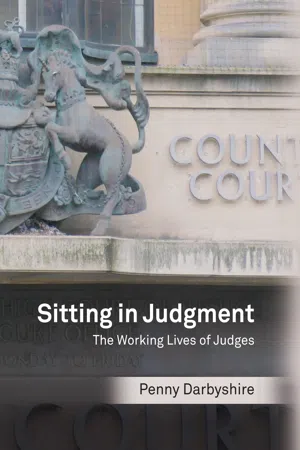
Since the late 1980s the judiciary has changed, largely as a result of the introduction of training and new and more transparent methods of recruitment and appointment. But how much has it changed, and what are the courts like after decades of judicial reform? Given unprecedented access to the whole range of courts - from magistrates' courts to the Supreme Court - Penny Darbyshire spent seven years researching the judges, accompanying them in their daily work, listening to their conversations, observing their handling of cases and the people who come before them, and asking them frank and searching questions about their lives, careers and ambitions. What emerges is without doubt the most revealing and compelling picture of the modern judiciary in England and Wales ever seen. From it we learn that not only do the old stereotypes not hold, but that modern 'baby boomer' judges are more representative of the people they serve and that the reforms are working. But this new book also gives an unvarnished glimpse of the modern courtroom which shows a legal system under stress, lacking resources but facing an ever-increasing caseload. This book will be essential reading for anyone wishing to know about the experience of modern judging, the education, training and professional lives of judges, and the current state of the courts and judiciary in England and Wales.
- 478 pages
- English
- ePUB (mobile friendly)
- Available on iOS & Android
eBook - ePub
About this book
Information
1
Introduction
She’s writing a little anthropology—a study of judges in their habitat
explained one High Court judge to another.
Anyone at any time could undertake observation of judicial behaviour. It is just rarely done.
Professor Dame Hazel Genn, 20081
I WANTED TO find out what judges did, in and out of court, and what they were really like. It seemed to me there was a mismatch between the comedic and media folk-devil: the eccentric, sometimes malign, buffer, out-of-touch with the real world, and the senior judges I had met. They seemed unpretentious, quick-witted, perceptive, and encouragingly kind to my students. Far from clocking-off at four, they worked at weekends and evenings. I had spent time casually work-shadowing and interviewing circuit and district judges for eight years and watched judges since 1971. They seemed like lawyers in general. I resolved to work-shadow every type of judge in different aspects of their work, throughout the six court circuits of England and Wales. After three pilot studies, with district, circuit and High Court judges, I shadowed 40 judges for at least four days each and interviewed them and 37 others. I met hundreds of others.
The public know very little about judges. Most people never appear in court and, while old assize courts like Chester and Lincoln can accommodate hundreds of spectators, modern folk find Judge John Deed more entertaining. Academics have produced a sizeable literature on judges but almost all of it is on judgments, which form only part of judging. Genn, in 2009, said the concentration on appellate decisions reflects academics’ preoccupation with the law, yet everyday judging is a much more reliable indicator of judicial attitudes. Very little research has been conducted in the UK, especially in the lower courts.2 Even in the US, the eminent academic, Judge Richard A Posner, in How Judges Think said ‘I am struck by how unrealistic are the conceptions of the judge held by most people, including practicing lawyers and eminent law professors … and even by some judges’.3 My aim is to paint a portrait of all types of judge and judicial work, including the routine.4 This book gives judges a voice, through extensive interviews and commentary on their working world. As Posner said, judges are not intellectual giants, oracles or calculating machines, they are human workers, responding to the conditions around them.5 No-one had researched judges before by using this method of work-shadowing and no-one had researched such a variety of judges.6
AIMS
These were outlined in the research design and have not changed.
To describe, by observational research, a sample of forty contemporary judges in their working lives …The following will be examined: career backgrounds and aspirations, relationships with other judges and other court actors; day to day work and workload and its effects; the job of judging; adequacy of support and training; opportunities to meet and observe other judges; membership of and attitudes towards judicial organisations; attitudes towards recent and proposed changes in procedure and how this has affected or will affect their lives; attitudes towards proposed changes to the trial structure and the judge’s relationship with the jury.
The details are contained in the successful Nuffield Foundation funding application.7
METHOD
I repeated a method used in studying magistrates’ clerks,8 sitting beside the judge in and out of court, asking them to reflect aloud on their work and those they encountered. The pilot studies, in London, were funded by Kingston University. They were essential in formulating the detailed research design, interview schedules and Nuffield application.
Access and Funding
In 2003, a Court of Appeal judge told me a worrying story. In the 1990s, he had asked the Lord Chief Justice (LCJ) for permission to write a book about the judiciary, whilst on sabbatical leave and funded by a charity. The Judges’ Council refused. It was well known to UK academics9 that judges had generally kept researchers away.10 Malleson, the leading UK writer on judges, noted in her 1999 book11 how little research there was, compared with other jurisdictions, especially the US.12 This was partly caused by judicial hostility, noted by Harlow in 198613 and Abel-Smith and Stevens in 1968.14 Harlow said that, by comparison, jurimetrics—the analysis of judicial decision-making—was well-established in the US by 1966.15 Paterson, in his 1982 classic on the Law Lords,16 noted five UK projects which were aborted because the judiciary or Bar withdrew co-operation. The 1970s story of the Bar’s endeavours to block Baldwin and McConville’s book on plea bargaining is infamous.17 Ashworth’s work on sentencing was terminated in 1981 by Lord Chief Justice Lane, despite its being funded by the Home Office. Judges were apparently offended by questions on membership of local organisations and travel to work. Lord Lane even gave a press conference.18 Malleson listed two more: Hood’s study on race and sentencing was stopped because although individual judges consented, managing judges instructed them to withdraw. Her own doctoral research in 1992–93 was affected. She resorted to interviewing retired judges, as the LCJ refused to allow sitting judges to participate.19
There were exceptional successes. Paterson’s book is rich with frank interview material from the Law Lords, independent of any hostile LCJ. He cited three preceding studies using interviews. Indeed, as can be seen from the UK Supreme Court chapter here, we know everything about the top court. In the UK, there have been some other studies using interviews and/or observation of specific groups of judges, such as Baldwin’s work on small claims,20 Baldwin and McConville’s Jury Trials,21 N Fielding’s Courting Violence,22 research with family judges, interviews with some senior judges by Peay in Tribunals on Trial,23 interviews with trial judges in Zander’s Crown Court Study24 and interviews with appeal judges in Drewry, Blom-Cooper and Blake’s 2007 book, The Court of Appeal.25 Shetreet, in 1976, used interviews,26 for a detailed and penetrating book on the appointment, discipline, removal and politics of judges, though he did not ask judges about themselves. There were studies commissioned by the Lord Chancellor’s Department/Department of Constitutional Affairs that were dependent on judicial co-operation. Nevertheless, this handful of empirical projects27 contrasts strongly with the US where, as Paterson noted, by 1978, there were over 100 studies on appellate judges, using interviews or questionnaires.28
During the times of casually sitting with judges, I noticed they were keen to have a companion and were forthcoming on just about everything. I assumed that I could continue to approach individuals and find enough research subjects but the first proposal to The Nuffield Foundation was referred back, asking me to secure ‘official’ permission, from the Lord Chancellor’s Department. I was reluctant. Rejection would put an end to the plans and, because I considered it a breach of judicial independence that a civil servant could grant or withhold consent, I consulted Professors Baldwin and Ashworth. One of them advised that there was an official procedure and that I should approach the Senior Presiding Judge. I sent the research design and draft questionnaire to Sir Igor Judge, who asked ‘What procedure?’ but after 45 minutes’ cross-examination he offered to do all he could to help. This project owes its success to him and to all the other judges who gave days of their time. It was serendipitous that immediately prior to my commencing this project, I had done some work for Sir Robin Auld, on his Criminal Courts Review 2001. He had given that paper to various senior judges, including Judge LJ. I was in the right place at the right time.
This research also owes its success to the generosity of the Nuffield Foundation and the patient encouragement of Sharon Witherspoon. Past experience had taught me to seek non-governmental funding. In the 1970s, I showed my interview schedule for magistrates’ clerks to a Home Office researcher, engaged in researching magistrates. Her interview schedule had contained some near-identical questions that had been removed by C2 Division of the Home Office and she envied my academic freedom. I also knew about academic research that had been blocked because the funding department or agency did not like the results. Most strikingly, this had just happened to my work.29 During the fieldwork, I was repeatedly grateful to be funded by a charity, when the research judges had to explain to their fellows that I was not a ‘departmental inspector’.
Sample
Observation over decades in different courts had indicated that each had a distinct culture. Clientele, case load and case speed differed according to size, culture, location and management30 so the courts were selected to span as great a variety as possible. Nevertheless, this research found that, thanks to centralised training and management and electronic communications, courts and judges differ much less from each other nowadays.
The problem with previous writing, especially statistical surveys, is that it has concentrated on the senior judiciary and sees judges as homogeneous.31 The core sample of 40 judges were selected to represent as broad a selection of experience, seniority and jurisdiction as possible. They comprised: six county court district judges; three district judges (magistrates’ courts); one High Court district judge,32 16 circuit judges (family, crime and civil), some of whom were managers, eight High Court judges, including one each from the Commercial Court, the Employment Appeal Tribunal, the Chancery and Family Divisions and some from the Administrative Court (some were circuit Presiding Judges, or equivalent), four Lords Justices of Appeal, with backgrounds in family, commercial and administrative law (some were managers), and two Law Lords/Supreme Court Justices.
I drew up a provisional grid of courts. Circuit judges were selected with the help of the Senior Presider and Judge Shaun Lyons, then Secretary of the Council of Circuit Judges, as they had access to background information on judges’ career histories, responsibilities and courts. District Judge Michael Walker, then Secretary of the Association of District Judges,33 helped in selecting the county court district judges. He added courts that were experimenting with new case management software. District judges (magistrates’ courts) were selected with the help of Tim Workman, then Senior District Judge (Magistrates’ Courts), though I included one who had been a court clerk in my PhD research sample 30 years earlier. I included one overtly gay judge, because he had written about this, more women and more solicitor circuit judges than were representative of the judicial population as a whole, and a High Court judge who had been a circuit judge, because I was interested in their experiences. Welsh judges were over-represented in the core sample: I selected one district, one High Court and two circuit judges, three of whom were Welsh speakers. Sometimes I chose judges out of curiosity, such as a High Court judge born two days after me.
Sir Igor Judge drafted a strongly supportive letter to district and circuit judges and he contacted my chosen High Court and Court of Appeal judges. The response rate was overwhelming. All but one district judge accepted. This meant the sample was bigger than intended. For example, I wrote to 16 circuit judges, in the hope of finding 12, but all 16 accepted.
I selected a supplementary sample of 37 interviewees, generally chosen opportunistically but again to provide variety. With district and circuit judges, I often approached the judge in the next room, provided they were sufficiently different from the core sample judge. If I were shadowing a young female, I would approach an experienced male. If I were shadowing the resident circuit judge, I would seek out the most newly appointed. These interviewees were given no notice of the request and did not have the benefit of examining the research design, just a verbal description and the interview schedule. Happily, at courts with only two judges, the second one always consented. Only one district judge and two circuit judges declined. The senior judge interviewees were again selected, with the help of Sir Igor, to provide a span of seniority, experience and jurisdiction and other than that, pin in list. In other words, this senior subsample was randomly selected from a stratified sample. The reason for these ‘knocking on doors’ and ‘pin in list’ methods was so that I could not be accused of allowing my judicial helpers to manipulate this sample.
At two Crown Courts, I was questioned about sampling criteria. At one, they suspected that ‘Igor Judge’ had ‘fixed me up’ with ‘the softie’. They explained that ‘There’s a judge here who makes barristers cry in court’ so I asked him for an interview and he readily consented.34 On two circuits, I rapidly learned from the judges (and my own ex-students at the Bar) who the ‘nutters’ were, and noted that Sir Igor had steered me away from one of them (at a court on my provisional grid). They were indeed so notorious that they did not need me to report on them, as their homilies appeared weekly in the local press. At one London magistrates’ court, the newly appointed core sample district judge said that all the district judges had discussed my work and concluded that had I shadowed one of the old judges with ‘severe judgitis’, I would have ‘got much less out of them’. They suggested I should balance out with an interview with an older woman, so I did.
Why did Judges Want to be Researched?
Baby Boomer judges seem to understand social research and academic freedom and most trust academics not to behave like journalists. Six of the 77 had been academics (ex-academics are far more common on the bench than is generally known); several had spouses who were academics and others had postgraduate degrees (one in criminology). They had grown up with the Peter Cook/Rowan Atkinson/JAG Griffith image of the judiciary35 and were daily bombarded with negative media coverage. They welcomed the opportunity to open up the judiciary to outside scrutiny. I entered their world at a time when judges had just equipped themselves with a press office and a website. Desperate to portray themselves as human and user-friendly, Lord Chief Justice Phillips was photographed holding a baby.36
As for the work-shadowing method, judges I met were familiar with the judicial work-shadowing scheme and before it, barristers accompanying them as marshals. They were used to entertaining work-experience children beside them, or school groups in their courtrooms. Judging is a lonely business. Their enthusiastic replies to my letter, like these from circuit judges, usually came quickly:
Your project sounds interesting and not a little intriguing. As one of those...
Table of contents
- Cover
- Title
- Copyright
- Dedication
- Foreword
- Acknowledgements
- Contents
- 1. Introduction
- 2. Images of Judges
- 3. Where Do English and Welsh Judges Come From?
- 4. The First Step on the Ladder: Becoming a Part-time Judge
- 5. Becoming Her Majesty’s Judge
- 6. Training
- 7. Judges’ Working Personality
- 8. Criminal Business: District Judges in the Magistrates’ Court
- 9. Criminal Business: Circuit Judges in the Crown Court
- 10. Judges and Juries
- 11. Civil Business in the County Court
- 12. Family Judges: The Patience of Job and the Judgment of Solomon
- 13. High Court Business
- 14. The Court of Appeal
- 15. Brenda and the Law Lords Transform into the Supremes
- 16. Judges on Judges
- 17. Tools of the Trade
- 18. The World of Judges from 2011
- Index
Trusted by 375,005 students
Access to over 1.5 million titles for a fair monthly price.
Study more efficiently using our study tools.
Frequently asked questions
Yes, you can cancel anytime from the Subscription tab in your account settings on the Perlego website. Your subscription will stay active until the end of your current billing period. Learn how to cancel your subscription
No, books cannot be downloaded as external files, such as PDFs, for use outside of Perlego. However, you can download books within the Perlego app for offline reading on mobile or tablet. Learn how to download books offline
Perlego offers two plans: Essential and Complete
- Essential is ideal for learners and professionals who enjoy exploring a wide range of subjects. Access the Essential Library with 800,000+ trusted titles and best-sellers across business, personal growth, and the humanities. Includes unlimited reading time and Standard Read Aloud voice.
- Complete: Perfect for advanced learners and researchers needing full, unrestricted access. Unlock 1.5M+ books across hundreds of subjects, including academic and specialized titles. The Complete Plan also includes advanced features like Premium Read Aloud and Research Assistant.
We are an online textbook subscription service, where you can get access to an entire online library for less than the price of a single book per month. With over 1.5 million books across 990+ topics, we’ve got you covered! Learn about our mission
Look out for the read-aloud symbol on your next book to see if you can listen to it. The read-aloud tool reads text aloud for you, highlighting the text as it is being read. You can pause it, speed it up and slow it down. Learn more about Read Aloud
Yes! You can use the Perlego app on both iOS and Android devices to read anytime, anywhere — even offline. Perfect for commutes or when you’re on the go.
Please note we cannot support devices running on iOS 13 and Android 7 or earlier. Learn more about using the app
Please note we cannot support devices running on iOS 13 and Android 7 or earlier. Learn more about using the app
Yes, you can access Sitting in Judgment by Penny Darbyshire in PDF and/or ePUB format, as well as other popular books in Law & Legal Profession. We have over 1.5 million books available in our catalogue for you to explore.