This book consists of interviews with five distinguished international lawyers from the UK, USA, Uruguay and France, conducted by the editor, Antonio Cassese, between 1993 and 1995. Each interview is preceded by a brief 'intellectual portrait' of the interviewee. In his general introduction Cassese stresses that the interviews, all based on the same questionnaire, were intended to bring out not only the main ideas associated with each scholar in the fields of international law and international relations, but also his intellectual and philosophical background, his general outlook and his views of the prospects for the evolution of the international community. In his final essay, Cassese brings together the main threads of the interviews and points to the parallels and divergences appearing from them.
This book offers a unique and important insight into the legal minds and outlook of a select group of prominent scholars of international law and legal institutions during the last years of the twentieth century.
eBook - ePub
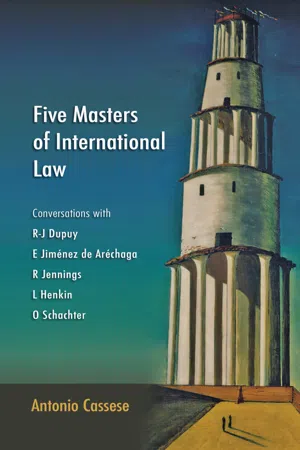
Five Masters of International Law
Conversations with R-J Dupuy, E Jiménez de Aréchaga, R Jennings, L Henkin and O Schachter
- 306 pages
- English
- ePUB (mobile friendly)
- Available on iOS & Android
eBook - ePub
Five Masters of International Law
Conversations with R-J Dupuy, E Jiménez de Aréchaga, R Jennings, L Henkin and O Schachter
About this book
Information
Eduardo Jiménez de Aréchaga
EDUARDO JIMÉNEZ DE Aréchaga, even in his old age, impressed for his handsome face and the elegance of his bearing. Also, his sharp and inquisitive glance and his bushy eyebrows could not go unnoticed. In spite of his numerous professional successes, he remained affable, unassuming, ready to discuss legal matters freely. He was also keen to exchange ideas with colleagues and young persons. He adored his job as an international lawyer. And he was fully immersed in the theory and practice of international law. Even a few weeks before his sudden death, he was active at The Hague pleading before the International Court of Justice.
Eduardo Jiménez de Aréchaga (1918–94), born in Montevideo (Uruguay), took a Doctor of Law degree at the National University (Universidad de la República) in 1942. He was Professor of Public International Law at the same University from 1946 to 1969, and at the Law School of the Catholic University of Uruguay (Universidad Católica del Uruguay). His life was full of accomplishments. He worked in the UN in many capacities: as a staff member (serving for two years (1947–48) as a member of the UN Secretariat dealing with the Security Council), then as a member of the Uruguayan delegation to the General Assembly (1948 and 1950), subsequently as a member of the International Law Commission (from 1960 to 1969, serving as Chairman in 1963), and later as a founder-member and president of the Administrative Tribunal of the World Bank. He also served in his Government: in 1950 he was appointed Under-secretary of State for Foreign Affairs, acted as Secretary of the National Council of the Government from 1951 to 1954, and then was Minister of the Interior for Uruguay in 1968. In addition, he repeatedly acted as an international judge and arbitrator: he was a Judge of the International Court of Justice (ICJ) (1970–79), serving as President from 1976 to 1979, and earlier and later presided over many arbitral tribunals. He was involved in international adjudication too as a legal counsel for governments, acting in many cases as an advocate before the ICJ. He died in a car accident in Punta del Este (Uruguay) on 5 April 1994.
While coming from a developing country, Eduardo Jiménez de Aréchaga never acted as a representative of those States. He did not necessarily share their political and ideological leanings, let alone their most extremist views; neither was he attracted by their legal outlook, oscillating between an inclination towards natural law principles and a political science approach, all leading legal scholars to mix up the inquiry into existing law with proposals for changes in the law. From the outset he was instead a strict positivist and embraced the legal approach typical of Western European scholars. He was nevertheless open to the reasonable demands of the less advanced countries, as well as to the requirement for legal scholars also to promote the development of international rules. For instance, in his well-researched essay on ‘Treaty Stipulations in Favor of Third States’, published in the American Journal in 1956 (hence before the Vienna Diplomatic Conference on the Law of the Treaties), Jiménez de Aréchaga expressed his support for rules allowing treaty stipulations in favour of third parties.1 After explaining the reasons for the need to have such rules,2 he argued that these stipulations found their legal foundation in a ‘general principle of law recognized by civilized nations’.3 He then added:
During the last century the international community has been trying to expand its contractual methods in order to find a way through which it could reach subjects which do not participate in the agreements, and give sanction to rules of law susceptible of general application. The science of international law should assist this evolution and admit the full effects of at least those enlargements of the contractual structure which have been already recognized by the municipal law of civilized nations …4
Jiménez de Aréchaga was not a prolific writer, although he enjoyed writing regularly on major problems of international law. His writings stand out for the acuity of his research and the originality of his contributions. Some themes attracted most of his attention: the handling of disputes by the UN Security Council, with the connected issue of the coordination between the UN and the Organisation of American States in the area of dispute settlement; the law of treaties; and the law of the United Nations. His masterpiece can nevertheless be held to be his Hague Academy General Course.5 These lectures are without doubt among the best ever delivered at the Hague Academy. The author looks at international law from an historical perspective, constantly underlining the progress made by international rules and institutions in the last 30 years (1945–75). Also, the breadth of vision is unique: one feels that the author draws upon his huge experience as a diplomat, a negotiator, a counsel in international litigation and as a judge, and brings all this experience to bear on his insight into the ‘functioning’ of international law. One cannot but admire the fine blend of a positivist approach and sensitivity to the new trends emerging in the world community towards less inequality and greater distributive justice. Although the choice (but not the sequence) of topics treated was classical (sources of law, general principles regulating the conduct of States, international subjects, the laws of the sea and of air and outer space, State responsibility), the discussion of the various issues is original and constantly based on a balanced and thoughtful intertwining of case law, treaty provisions or UN resolutions and the author’s reasoning. The chapters on the interplay between treaties and customary law, as well as those on general principles of international law, State responsibility and the law of the sea, are probably the best ever scholarly contribution to these themes. They have become a ‘must’ for any international scholar.
The interview took place five months before Jiménez de Aréchaga’s sudden and tragic death. There was no time for it to be revised and corrected by him. Jiménez de Aréchaga’s own words have been edited only for clarity.
Interview with Eduardo Jiménez de Aréchaga
November 1993
I. The Role of Legal Scholarship at the Start of Judge de Aréchaga’s Scholarly Activity
Who was the international lawyer who most influenced your thinking at the beginning of your scholarly activity?
You may be a bit disappointed, but the international lawyer who most influenced my thinking was Hans Kelsen.6
Why disappointed? I think he was a great international lawyer.
He was a great international lawyer, but of course that does not mean I am a Kelsenian in any respect. When I was about to finish my law studies, I was appointed to give lectures on international law to the young students who wanted to come into the law school in Montevideo. And I wrote a book, called Introducción al derecho (Introduction to Law),7 which was Kelsenian. At that time I also got in touch with Kelsen. He came to visit South America, Argentina and then he came to Uruguay. He had a great intellectual influence in Mexico, in all of Latin America. He had been invited by an Argentinian philosopher of law, Carlos Cossio,8 who thought he had invented something which went beyond Kelsen; he called it the ‘ecological doctrine of law’ (Teoría Egológica del Derecho). He wrote some books which were interesting, but he went a bit too far. So when Kelsen came to Montevideo, I asked him: ‘What do you think of Cossio’s philosophy of law, of Cossio’s school?’ And Kelsen, who was speaking in French, told me: ‘Ce n’est pas de l’écologie, c’est de l’égolâtrie’.9
I then had contact with him through my first case, when I became a practising lawyer and I had to deal with topics of international law. It is curious, because at that time I was not specialising in international law, but the cases that came to me always had an international law aspect. One of them concerned the Italian Peace Treaty. In that Treaty there was a clause by which Italy renounced claims against States which had broken relations with Italy during the war. My country had declared war on Japan and Germany but not on Italy, but had broken diplomatic relations with the Fascist regime during the war. So Italian shipowners made a claim in our courts against the Uruguayan State for having requisitioned two ships which had been sunk by Axis submarines. I was at that time advising the national authorities who had taken over the ships (they were the respondent). When the Peace Treaty was published in the American Journal of International Law, I said: ‘There is here a stipulation in favour of Uruguay, it’s a third-party stipulation.’ The claimants had obtained the support of a well-known Argentinian international lawyer, Podesta Costa, who was legal adviser to the League of Nations. This was 1948 or 1949. In order to strengthen my position, I asked Kelsen for an opinion on the subject, and he wrote a magnificent opinion on third-party stipulations in favour of sovereign States, saying that the renunciation applied in the case. The case was settled on the basis of that consultation. Kelsen was so modest that when I asked him how much he would charge for his opinion (of 20 pages) he asked for 1,000 dollars. Very little, even at that time. When I told one of my colleagues in the Barcelona Traction case10 this story, he said: ‘Mais ce Monsieur crée des difficultés pour notre gagne-pain.’11
Did Kelsen publish his opinion afterwards?
No, he did not publish it. But it is printed, because I wrote a booklet of 50 pages about that case, and in it I transcribed Kelsen’s opinion fully (he wrote it in English and I translated it into Spanish). Of course when I read his book on the UN Charter12 I became discouraged, because I recalled the comment Hersch Lauterpacht made about it in his review of the book. In Lauterpacht’s view the book was a desperate effort to strike the maximum amount of fault from an admittedly imperfect instrument. You should not interpret the Charter of the United Nations as if it were an insurance contract.13
There was one other famous book review by an Australian, Julius Stone, who was also harshly critical of Kelsen’s formalism. In his view Kelsen had taken a sort of bookish attitude to a political document.
Some people attribute Kelsen’s attitude concerning the drafting of the Charter to the fact that he was not a friend of Pawlowski, who was the State Department’s Legal Advisor in Dumbarton Oaks. Kelsen had not been consulted. You know, he had written a book on the drafting of the League of Nations’ Covenant. It has been said that he was not sufficiently consulted, he was not taken into consideration by Pawlowski, and that is why he was so critical of the drafting of the UN Charter.
You mean just for personal reasons? Was he so sensitive?
No, I don’t think so.
In what respect were you influenced by Kelsen?
I had to explain to the younger students the definition of law, objective law, the subjective rights, and in this area I followed Kelsen’s formulation.
Were you also influenced by him in your own writings on public international law?
At the beginning he was very influential. Then I took a more eclectic position as a result of studying all the courses in the Recueil de Cours by people like Verdross, Scelle and others.
Were you influenced by the great Latin American international lawyers? I am thinking of Álvarez.14 One would think that in Latin America, one would be closer to Latin American international lawyers. Álvarez, as a judge, was famous for his dissenting opinions. There, he tried to develop a new international law.
Many of his opinions, which were de lege ferenda at the time, have become more and more acceptable. He had a very general experience, but he was not a man who influenced my scholarly activity at all. I think the Latin American writer who influenced my studies more at that time was Andrés Bello, from Venezuela. He worked in Chile, he was a great jurist. He wrote the Chilean Civil Code. He wrote a book on international law which was very avant-garde for his time.
Was he translated into French or English?
No. There is a bust of him at the International Court of Justice. He wrote in the early 1800s (1830, 1840). He was the first one to say that Grotius’ theory about fishing being free to all because the natural resources were accessible and could not be exhausted, was wrong, because the resources may become exhaustible. He was a contemporary of Bolívar.15 He died in the 1920s.
Was he part of the cultural and legal scholarly heritage when you started?
He was still very influential not just because he was an international lawyer, but because he was a full jurist. He wrote the Civil Code of Chile, a Code that was then adopted with very few changes in other Latin American countries such as Uruguay and Venezuela. And it is very well written. He was a grammarian also. He was quite a figure in Lat...
Table of contents
- Cover
- Title
- Copyright
- Preface
- Contents
- Basic Questionnaire
- René-Jean Dupuy
- Eduardo Jiménez de Aréchaga
- Sir Robert Jennings
- Louis Henkin
- Oscar Schachter
- Final Remarks
- Index of Names
- Index
Trusted by 375,005 students
Access to over 1.5 million titles for a fair monthly price.
Study more efficiently using our study tools.
Frequently asked questions
Yes, you can cancel anytime from the Subscription tab in your account settings on the Perlego website. Your subscription will stay active until the end of your current billing period. Learn how to cancel your subscription
No, books cannot be downloaded as external files, such as PDFs, for use outside of Perlego. However, you can download books within the Perlego app for offline reading on mobile or tablet. Learn how to download books offline
Perlego offers two plans: Essential and Complete
- Essential is ideal for learners and professionals who enjoy exploring a wide range of subjects. Access the Essential Library with 800,000+ trusted titles and best-sellers across business, personal growth, and the humanities. Includes unlimited reading time and Standard Read Aloud voice.
- Complete: Perfect for advanced learners and researchers needing full, unrestricted access. Unlock 1.5M+ books across hundreds of subjects, including academic and specialized titles. The Complete Plan also includes advanced features like Premium Read Aloud and Research Assistant.
We are an online textbook subscription service, where you can get access to an entire online library for less than the price of a single book per month. With over 1.5 million books across 990+ topics, we’ve got you covered! Learn about our mission
Look out for the read-aloud symbol on your next book to see if you can listen to it. The read-aloud tool reads text aloud for you, highlighting the text as it is being read. You can pause it, speed it up and slow it down. Learn more about Read Aloud
Yes! You can use the Perlego app on both iOS and Android devices to read anytime, anywhere — even offline. Perfect for commutes or when you’re on the go.
Please note we cannot support devices running on iOS 13 and Android 7 or earlier. Learn more about using the app
Please note we cannot support devices running on iOS 13 and Android 7 or earlier. Learn more about using the app
Yes, you can access Five Masters of International Law by Antonio Cassese in PDF and/or ePUB format, as well as other popular books in Law & International Law. We have over 1.5 million books available in our catalogue for you to explore.